Data Workers for data analysts
What Data Workers changes in a data analyst's week: the right table with its definition and trust score, broken dashboards traced upstream with the owner told, access requests dry-run, and assistant answers grounded in governed context.
Data Workers answers the questions that eat a data analyst's week before you have to chase anyone: which table is the right one, what the metric means, whether the number on the dashboard landed on time, and what broke upstream when it is not. You keep the analysis, the answer you give your stakeholders and the dashboards you own, while the agents find, trace, route and record. Every change leaves a receipt, and a named approver signs off wherever the team's autonomy level asks for one.
Data Workers is the agentic data platform. For an analyst it shows up where you already work: Spellbook Data Catalog, the AI assistant your company rolled out, connected over MCP, and the BI tool it reads and never edits.
Key takeaways
- •The right table, with its receipts. Search by business meaning;
explain_tablereturns definition, lineage, documentation and trust score in one answer. - •Broken dashboards arrive diagnosed. When a number goes wrong, Data Workers traces it upstream to the failed run, late source or schema change and tells the pipeline's owner, often before your stakeholder asks.
- •Definitions get written down once. "What counts as churn" is captured with its author and source, and the metric's owner signs it.
- •Access requests come pre-checked. A dry run shows the sensitive columns a grant would reach and the least privilege, and the request goes to the data owner.
- •Your assistant stops guessing. ChatGPT, Claude, Copilot and Gemini answer from governed context over MCP, with sources you can check before you forward.
Your week today
Your job is to answer questions with numbers people can act on. Much of the week goes to proving the number first:
- •"Is this number right?" A director sees weekly churn jump. Before you answer, you need to know whether the data is late, the logic changed or the business moved.
- •The dashboard broke. You notice first, open a ticket for data engineering, and wait.
- •Finding the right table. Three tables called something like
customers, a stale wiki page, and the person who knew has left. - •Definitions. "Active customer" means one thing in finance's deck and another in product's.
- •Access. The table sits behind a ticket, and the approver asks what it contains.
- •The assistant. It writes the query fluently, and you cannot tell which table it used.
In dbt Labs' 2026 State of Analytics Engineering report (third-party; 363 responses, Dec 5, 2025 to Feb 1, 2026), 71% of respondents "are concerned about hallucinated or incorrect data reaching stakeholders." In Stack Overflow's 2025 Developer Survey, the top reason developers would still ask a person is "When I don't trust AI's answers" (75%). Analysts sit where those meet.
The same week with Data Workers
Data Workers works underneath your BI tool and your assistant. Its agents keep a context graph of the estate in Data Context Wizard and do the investigation and routing that used to be your Slack threads.
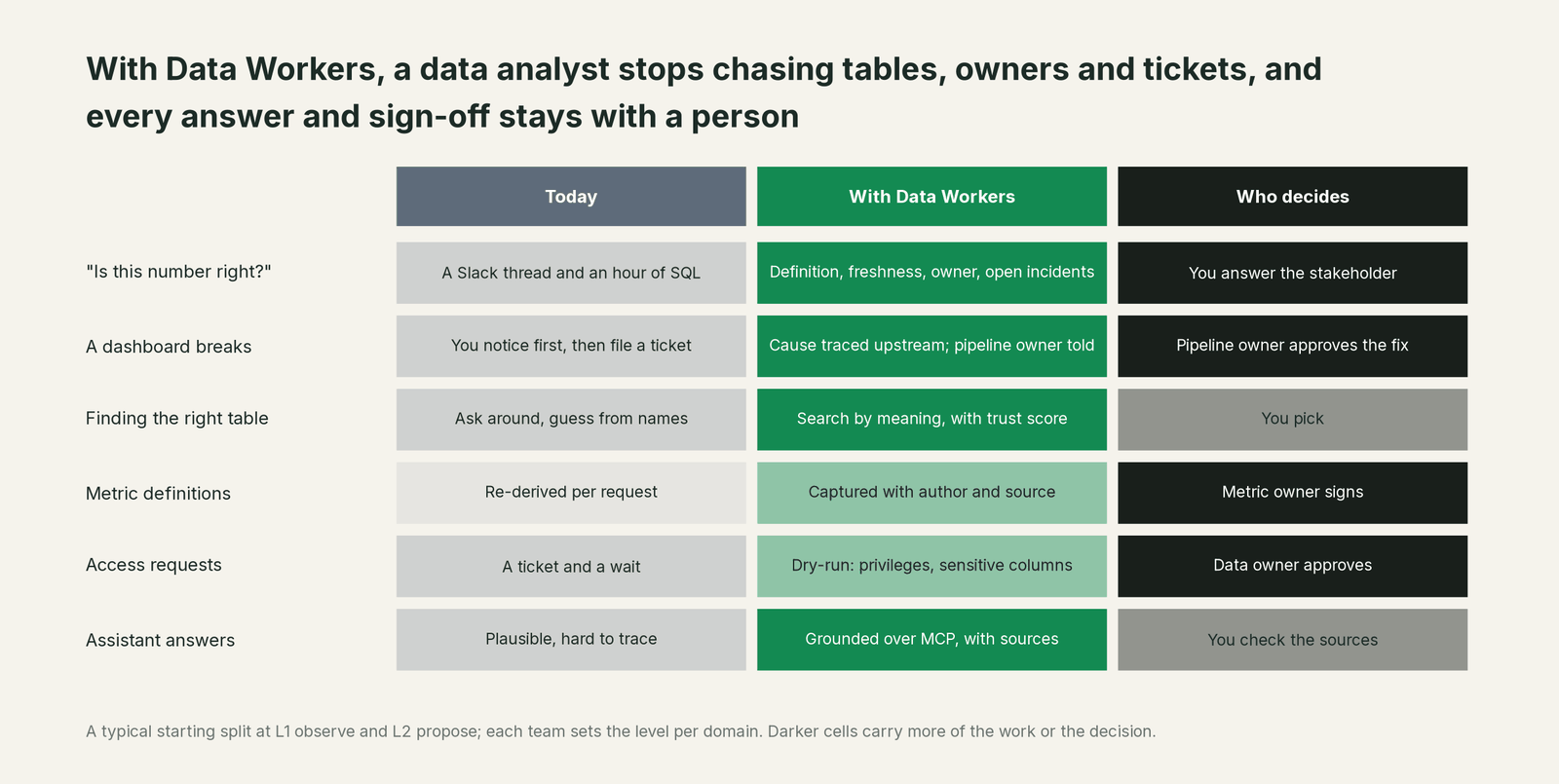
What it takes off your week:
- •Search and lookup.
search_across_platformsfinds tables by business meaning across Snowflake, BigQuery, Databricks and the rest of your estate.explain_tablereturns the definition, lineage, documentation and trust score for the one you pick; the trust score weighs quality, freshness, documentation, usage and ownership.get_quality_scoregives the current quality score andget_incident_historylists the table's incidents. - •Upstream diagnosis.
run_quality_checkandmonitor_metricsbaselines watch the tables your dashboards read. When one fails,diagnose_incidentandget_root_causewalk the lineage upstream to the failed run, late source or schema change behind it, and the pipeline's owner gets the cause and the affected models and dashboards in Slack or Teams. - •Definitions. When you settle what a metric means,
define_business_rulerecords it with its author and source; a conflicting definition goes to the metric's owner, not another meeting. - •Access requests. Data Workers dry-runs a requested grant: effective privileges after role inheritance, the PII, PCI or PHI columns it would reach, policy conflicts, and a least-privilege recommendation with an expiry.
check_policytests it against your rules; on a review verdict,provision_accessgrants nothing andrequest_governance_reviewopens a trackable review for the owner. - •Grounded answers. Your assistant calls the same tools over MCP and names the table, definition and freshness behind its answer.
What you still own and decide:
- •The answer. Data Workers gives you the evidence; you decide what to tell your stakeholder.
- •Your dashboards. BI is read by design. Data Workers reads Tableau and Looker natively and connects to Power BI, Sigma, Hex and ThoughtSpot over their APIs or MCP servers today; workbooks, semantic models, measures and refreshes stay with you and your BI admins.
- •Definitions. The metric's named owner signs a definition with
mark_authoritative. No agent can promote its own work. - •Fixes and access. The team sets the autonomy level per domain: L0 manual, L1 observe, L2 propose, L3 act reversibly, L4 autonomous. At L2, pipeline fixes wait for the pipeline owner; grants always wait for the data owner, and an unanswered request expires and escalates rather than granting itself. Autonomy levels L0 to L4, explained and how approvals work cover both.
How Data Workers fits the tools you already use
Your AI assistant. If your company rolled out ChatGPT Enterprise, Claude, Microsoft 365 Copilot or Gemini Enterprise, your admin connects Data Workers to it as a remote MCP server. Sign-in runs through your own identity provider, such as Okta or Microsoft Entra ID, and Data Workers verifies each token against your provider's published keys before any tool runs. Guides: ChatGPT Enterprise, Claude, Microsoft 365 Copilot, Gemini Enterprise.
Spellbook Data Catalog. Spellbook (in preview) gives each table, dashboard and model a page: what it is, who owns it, what broke and how it was fixed. Its business-analyst mode returns source-linked answers to plain-English questions.
Your BI tools. Tableau, Power BI, Looker, Sigma, Hex and ThoughtSpot stay where people read the numbers. Data Workers maps each dashboard to the tables behind it, so a broken tile traces back to its cause, and after a fix it runs the agreed query on the table the dashboard reads and records the value in the receipt. Data Workers + Tableau, Power BI and Looker and Data Workers + Hex and ThoughtSpot show how.
Your semantic layer. Definitions already in dbt's Semantic Layer, LookML or a glossary come in as context (bring your own context).
Your service desk. Data Workers can open a ServiceNow or Jira Service Management ticket that links its dry run or diagnosis; your service agents move and close it.
The metrics you are judged on
| Metric | How Data Workers moves it | Where you see it |
|---|---|---|
| Turnaround time | "Which table, which definition, is it fresh" answered in one lookup, in Spellbook or your assistant | Requests answered without a Slack thread |
| Accuracy | Trust score, freshness and open incidents checked before a number goes out | Numbers corrected before, not after, a meeting |
| Stakeholder satisfaction | Broken dashboards traced and the owner told before the question arrives | Time from break to stakeholder note |
| Adoption of your dashboards | Definitions signed by a named owner; drifted copies routed | Open definition conflicts and their resolution time |
Take a baseline first: how long "is this right?" questions take and how many breaks you found before anyone else. These are the measures to track, not promised results. How to measure AI data agents sets out the method, and the ROI calculator turns your team's numbers into a range.
A worked example: did churn double last week?
This is an illustration, not a customer case. A Prefect flow loads Zuora subscription events into BigQuery over Zuora's API, dbt builds fct_subscriptions, and finance reads weekly churn on a Power BI dashboard, Subscription health, refreshed daily at 07:00. Data Workers reads Prefect and BigQuery natively; Power BI connects over its API or MCP server today, and the dashboard reaches the blast radius through a context-graph note the team records. The analyst uses Claude, connected to Data Workers over MCP. The subscriptions domain runs at L2 propose.
| Time | System | What happened |
|---|---|---|
| 02:10 | Prefect | The Zuora load fails on an expired API credential |
| 02:25 | Data Workers | The monitor_metrics load baseline flags the raw table as late; diagnose_incident and get_root_cause trace the delay to the failed Prefect run |
| 02:31 | Microsoft Teams | The pipeline owner gets the cause and the downstream list: fct_subscriptions, the churn metric, the Subscription health model |
| 07:00 | Power BI | The scheduled refresh imports a partial weekend; churn reads twice its usual level |
| 08:40 | Teams | Finance asks the analyst: "Did churn double last week?" |
| 08:44 | Claude | The analyst asks whether weekly churn is right |
| 08:45 | Data Workers | explain_table traces the churn table back to the late Zuora load the baseline flagged; get_incident_history links the open incident |
| 08:52 | Analyst | Replies to finance: the load is incomplete, a fix is under way, here is the incident |
| 09:30 | Data engineer | Finds the expired credential in the run log, rotates it and approves the proposed rerun |
| 09:31 | Data Workers | Queues the rerun through Prefect; run_quality_check passes once it lands |
| 10:05 | Power BI | The dataset owner refreshes the model; churn reads 2.1% |
| 10:20 | Data Workers | Records the analyst's note that paused subscriptions are not churn as a proposed definition |
| 14:00 | Finance | The head of FP&A signs it as the authoritative churn definition |
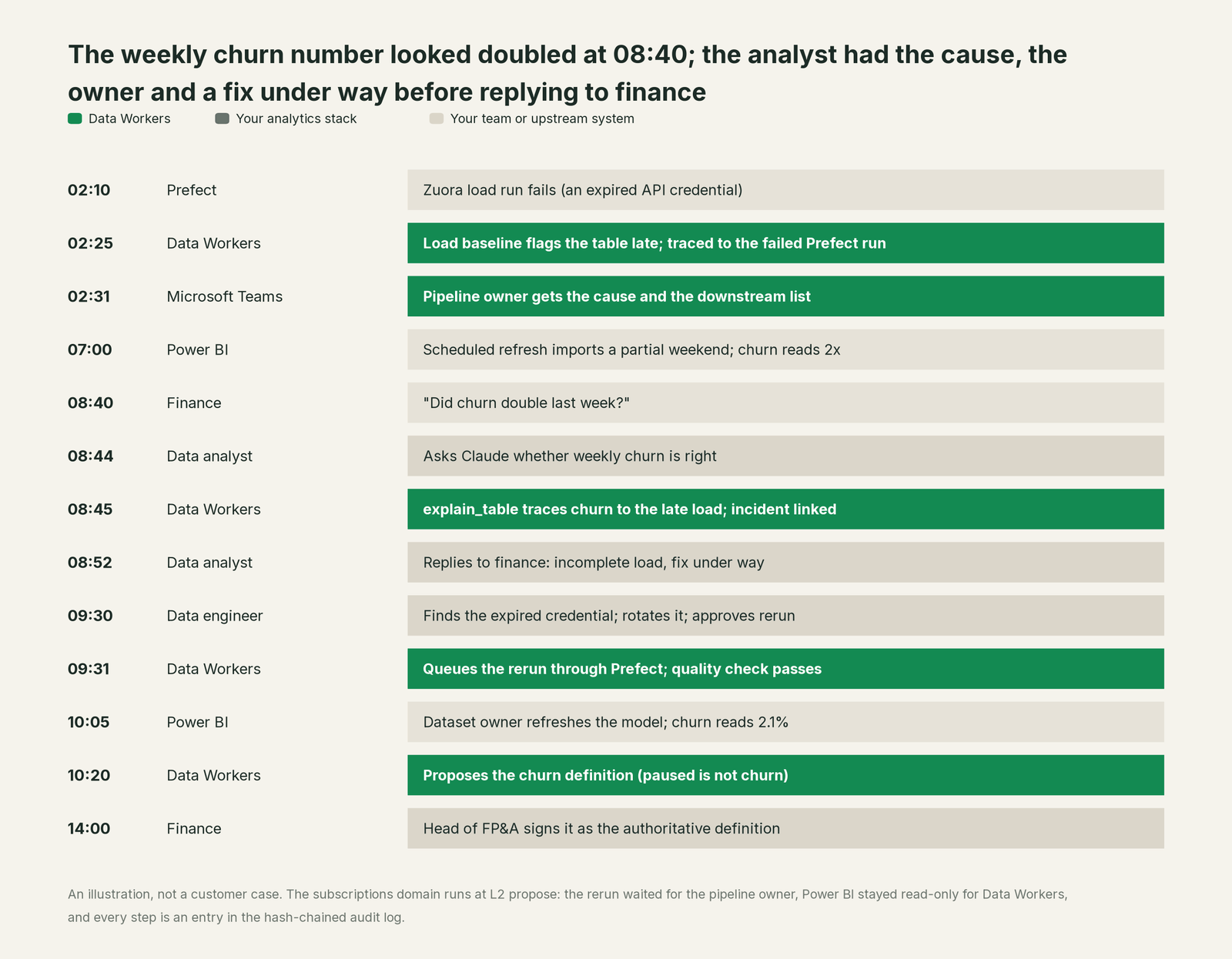
Without Data Workers, the analyst would have spent the morning in SQL. With it, the answer went out before nine and the churn definition is signed. Data Workers never touched Power BI or Zuora: the engineer fixed the credential and the dataset owner ran the refresh.
How to bring it to your team
- •Ask for the assistant connection. Your admin connects Data Workers to the assistant your company already pays for.
- •Pick the dashboards that hurt. Two or three that people question often.
- •Start at L1 observe. For two weeks, Data Workers watches the tables behind those dashboards and logs what it would have flagged and routed. Review that record against what actually happened.
- •Move to L2 propose. Fixes go to the pipeline owner, definitions to the metric owner, grants to the data owner, each with a receipt.
- •Show the record. Breaks caught before a stakeholder asked, questions answered without a thread, definitions settled. How to get your team to trust AI agents has the playbook.
When your manager asks about risk, send is it safe to let AI agents change production data and where your data goes: the agents run in your infrastructure, your data stays in your systems, and the hosted Conductor sees workflow metadata only. Build it ourselves and the ROI of agentic data operations answer the next questions. The next step is a pilot (what a pilot looks like; $7,500 one-time, credited in full against the first year, on /pricing/). Colleagues' pages: analytics engineers, data governance leads; the wider category: AI agents for data analytics.
FAQ
Can I trust an AI answer I can't trace? You should not have to. Answers through Data Workers come from the context graph and name the table, definition and owner behind them; the trust score and open incidents warn you before you forward a number. How Data Workers avoids hallucinations on your data covers the mechanism.
Will Data Workers change my dashboards? No. BI is read by design. It traces a broken tile to its cause, tells the owner, and checks the number behind the tile after the fix; workbooks, measures and refreshes stay with you and your BI admins.
Can it get me access to a table faster? It does the checking an approver needs: effective privileges, the sensitive columns the grant would reach, policy conflicts and the least privilege. The data owner approves, and the grant is recorded with its expiry.
Does it work with the assistant my company already chose? Yes. ChatGPT Enterprise, Claude, Microsoft 365 Copilot and Gemini Enterprise connect to Data Workers as a remote MCP server, signed in through your identity provider, and call the same tools you would use in Spellbook. Your company just rolled out AI assistants has the setup per assistant.
Will it replace analysts? It takes the hunting and chasing, and leaves the questions, the analysis and the story with you. Will Data Workers replace my data team? and who owns the agents answer this directly.
Sources
- •dbt Labs, 2026 State of Analytics Engineering Report (third-party survey; 363 responses, Dec 5, 2025 to Feb 1, 2026): https://www.getdbt.com/resources/state-of-analytics-engineering-2026 (checked Oct 2, 2026)
- •Stack Overflow, 2025 Developer Survey, AI section (published July 2025): https://survey.stackoverflow.co/2025/ai (checked Oct 2, 2026)
- •Data Workers public repository tools (
search_across_platforms,explain_table,get_quality_score,get_incident_history,check_freshness,run_quality_check,diagnose_incident,get_root_cause,define_business_rule,mark_authoritative,check_policy,provision_access,request_governance_review): https://github.com/DataWorkersProject/dataworkers-claw-community (checked Oct 2, 2026) - •Data Workers product repository,
data-workers-agent-swarmmain @ 0c2491e3: agents/dw-governance access dry run (effective privileges, sensitive columns, policy conflicts, least-privilege recommendation; applies nothing); dw-context-catalog trust scorer (quality, freshness, documentation, usage, ownership); dw-incidents root-cause engine (lineage walk to the upstream run or source); Prefect connector (flow and task run states) (checked Oct 2, 2026) - •Data Workers product pages: https://dataworkers.io/product/spellbook-data-catalog/ , https://dataworkers.io/product/data-context-wizard/ , https://dataworkers.io/product/autonomous-data-conductor/ (checked Oct 2, 2026)
- •Data Workers security page: https://dataworkers.io/security/ (checked Oct 2, 2026)
- •Data Workers pricing: https://dataworkers.io/pricing/ (checked Oct 2, 2026)