Inside the Data Migration Agent
The Migration That Took Two Years Was Never About Moving the Data.
Copying the tables was always the easy part. Meet the agent that translates the logic, plans every parity check, and holds the cutover for your sign-off with rollback ready.
The copy was never the hard part
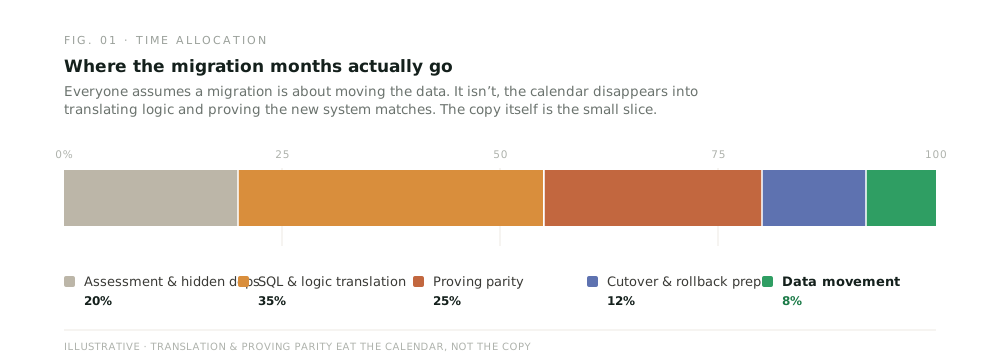
Ask anyone who's migrated off Teradata or Oracle how long it took, and the honest answers come back in quarters - sometimes years. The maddening part is that the data copy, the thing everyone pictures, is the smallest piece. What eats the calendar is translating the logic: the stored procedures that don't exist in the new dialect, the SQL that has to be rewritten function by function, the hidden dependencies nobody documented surfacing one painful job at a time.
And even when the new system is built, there's a worse problem: nobody can prove it's right. Row counts match but values silently differ. So the legacy box stays on just in case for another two years, and you're paying for two systems and trusting neither. It's why a large share of warehouse-modernization projects run over budget or quietly fail - not at the copy, but at the proof.
What our Data Migration Agent actually does
The Data Migration Agent runs the whole migration as one loop - the work that used to mean a roomful of contractors and a year on the calendar.
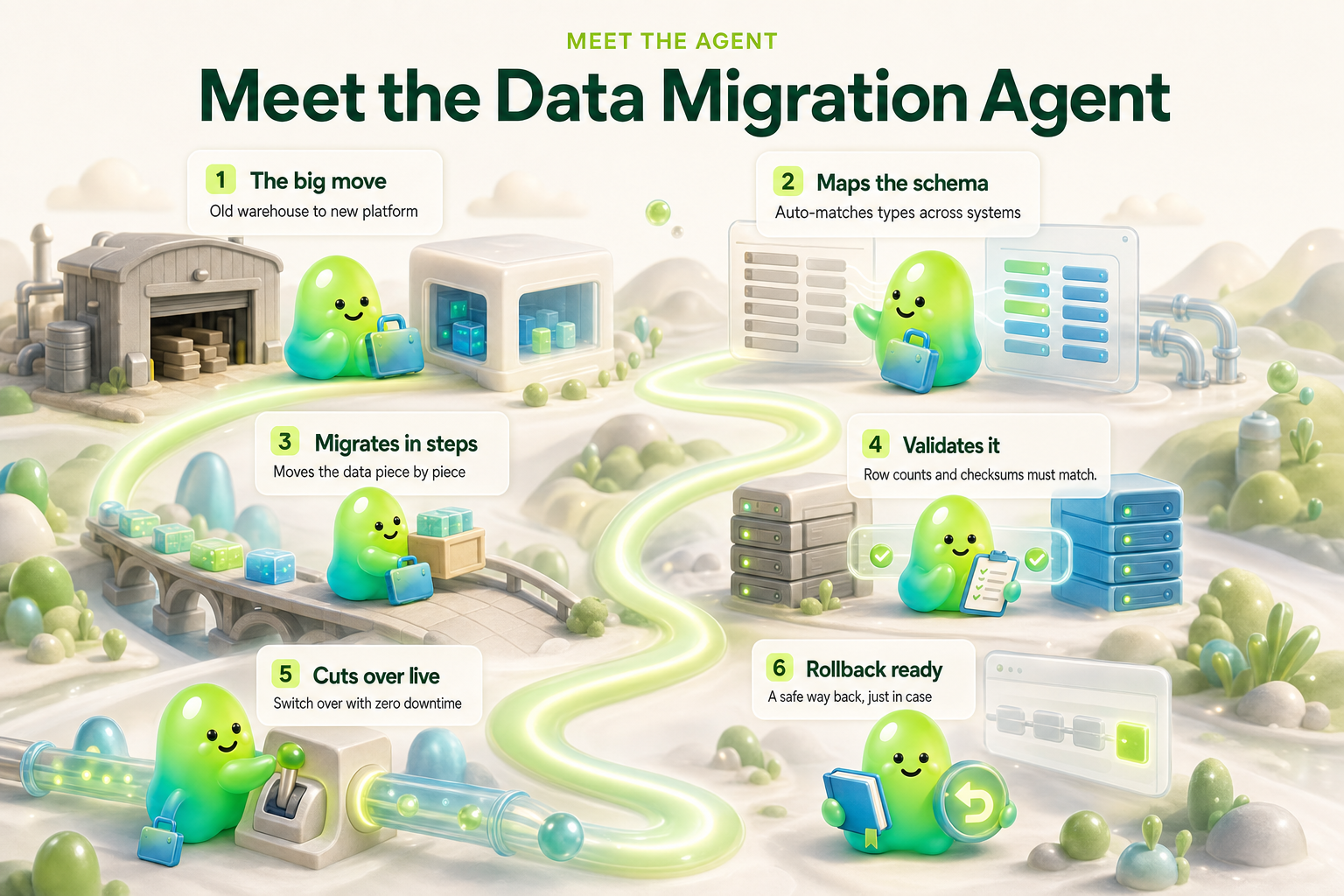
It starts with an honest assessment - complexity, cost, and what's actually in scope - before the timeline can blow up. It uses lineage to sequence the work into safe waves, then translates the legacy SQL and procedural logic from Teradata, Oracle, and others into Snowflake SQL. Crucially, the translation isn't one-and-done: it checks that each translated statement still does what the source intended and re-translates whatever doesn't hold up - instead of dumping a pile of mostly works SQL on your team. It plans each wave with the parity checks a stakeholder will accept - row counts, checksums, statistical profiles, referential integrity - tracks every one, and holds the completion gate until the owner signs off. And it plans the cutover with the lights on: incremental waves, a written runbook, and a rollback procedure ready before anything touches production.
The shape of the win is a migration you can actually finish. What traditionally runs six to twelve months - and slips into years - is built to compress toward four to eight weeks, by automating the translate-and-track-parity loop that eats most of that calendar. The technique isn't hypothetical: background coding agents have merged hundreds of migration changes a month across thousands of pipelines elsewhere in the industry - those are others' numbers, cited as proof the approach works, not ours.
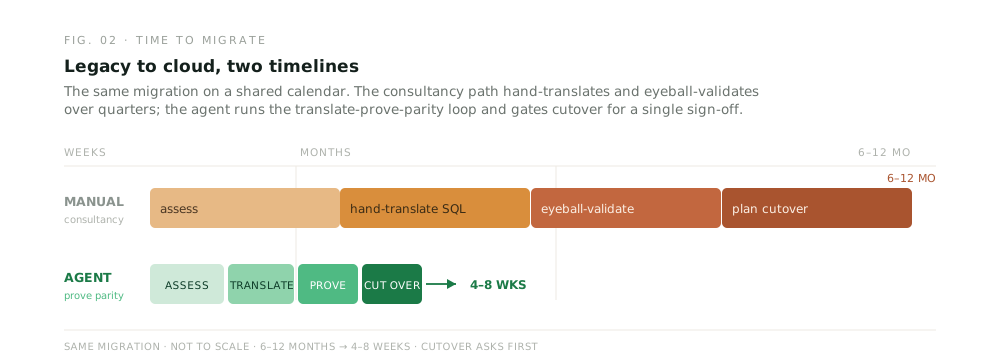
Here's the reframe: a migration isn't a one-time code conversion you finish and forget - it's a parity problem you keep proving true until the legacy system can be switched off. And the agent doesn't run it alone: the catalog agent supplies the lineage that orders the waves, the quality agent gates each migrated object, and the schema agent handles the drift that lands mid-migration. Every object arrives documented and monitored, not dumped.
A few of the agent's capabilities
The Data Migration Agent ships with a deep toolkit. A sampling of what it can do:
| Capability | What it does |
|---|---|
| Migration assessment | Sizes the move up front - complexity, cost, and scope - before the timeline blows up. |
| Schema mapping | Maps source schemas to the target with automatic type conversion across platforms. |
| Lineage-ordered planning | Uses lineage to enumerate downstream consumers and sequence the work in safe waves. |
| SQL & dialect translation | Translates legacy SQL and procedural logic into Snowflake SQL. |
| Self-correcting translation | Re-translates whatever fails validation until the output converges, instead of one-shotting. |
| Parity plan & tracking | Plans row-count, checksum, profile, and referential-integrity checks for every wave and tracks each to sign-off. |
| Intent / scope check | Confirms the translated SQL still does what the source intended, not just that it runs. |
| Zero-downtime cutover plan | Plans incremental waves and a cutover with the legacy system still live until the owner signs off. |
| Runbooks & rollback | Produces a cutover runbook and a rollback procedure for every step. |
| Swarm hand-off | Pulls lineage from the catalog agent and quality gates from the quality agent; objects land documented. |
…and these are just a few of many - the agent carries dozens more autonomy skills, with new ones added continuously.
How this is different from a transpiler or a diff
Plenty of tools own one slice of a migration - and the gap is that nobody runs the whole loop.
Datafold's cross-database diff is the parity gold standard and now fronts its own migration agent - it owns the diff better than anyone, but the loop lives inside its product, not across your stack. Snowflake's SnowConvert is fast and free but converts into Snowflake only - vendor lock-in by design. dbt gives you tests and structure but isn't a translator; SQLMesh brings a genuinely deterministic translation engine with column-level lineage and breaking-change classification, but stops at the plan-and-apply boundary - it tells a human exactly what will break, then a human writes the fix. Fivetran and AWS DMS reliably move the bytes and reconcile schema drift, but they land raw data and stop; they don't translate procedural logic or prove value-level parity. And the lift-and-shift consultancies are the incumbent the timeline is aimed at - expensive, slow, and prone to the scope creep that turns months into years.
The gap none of them close is the full loop: assess, translate, track parity, and gate the cutover - from legacy dialects into Snowflake, as one member of a swarm that already knows your lineage and quality. The others hand you a converted pile or a diff report; this carries it to a cutover you can defend.
The takeaway
Migrations stayed multi-year ordeals because we treated them as a copy job, when the real work was translating the logic and proving the result. Knowing the data moved was never the hard part; trusting that the new system matched the old one was. An agent that translates, re-translates until the intent holds, tracks parity to sign-off, and gates the cutover turns a two-year just in case into a finished switch-off. You should be able to turn the old warehouse off - because you can prove the new one is right.
See it on your own migration
Point the agent at the legacy system you've been meaning to retire - and watch it assess the scope, translate the logic, plan and track every parity check, and plan the cutover with rollback ready. Book a demo to see it on your stack.