Inside the Real-Time Streaming Agent
Nobody Should Need a "Kafka Person".
Building the stream was never the hard part - operating it forever was. Meet the agent that turns a plain-English spec into a reviewed topology design and keeps watch over its health.
The pipeline that never stops
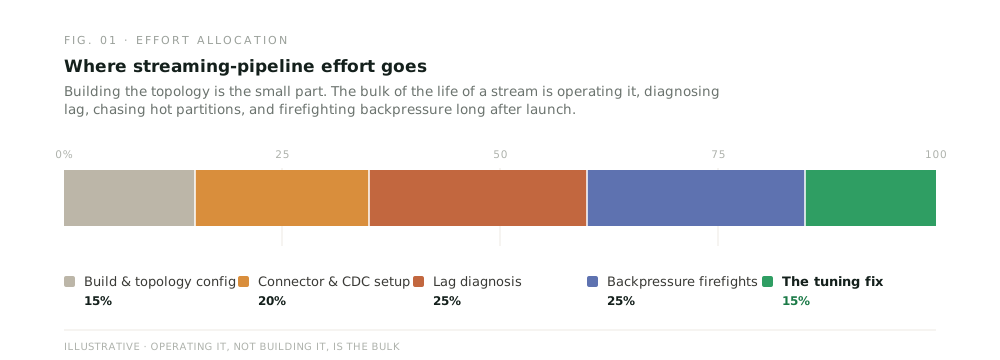
Half the streaming threads on r/dataengineering aren't about how to build a pipeline - they're about whether you even should. Do we actually need Kafka? When someone asks for real-time, the honest follow-up is usually that they didn't need it. But for the teams who genuinely do, the pain is real and specific: streaming is gated on one scarce, expensive skill - someone who deeply understands topics, partitioning, consumer groups, CDC snapshots, watermarks, and backpressure.
And the cost isn't the build - it's the operating. A stream never stops, so the moment one partition runs hot, lag climbs and never recovers; a rebalance triggers more rebalances; a schema change forces a connector to stop, re-snapshot, and take downtime. Practitioners describe Kafka costing years of engineering time and Flink jobs that are nothing like running a query. Lag becomes a 3 AM mystery you debug by hand with command-line tools and a dozen dashboards.
What our Real-Time Streaming Agent actually does
The Real-Time Streaming Agent gives a one-to-three-engineer team principal-streaming-engineer judgment on demand - without hiring the specialist.
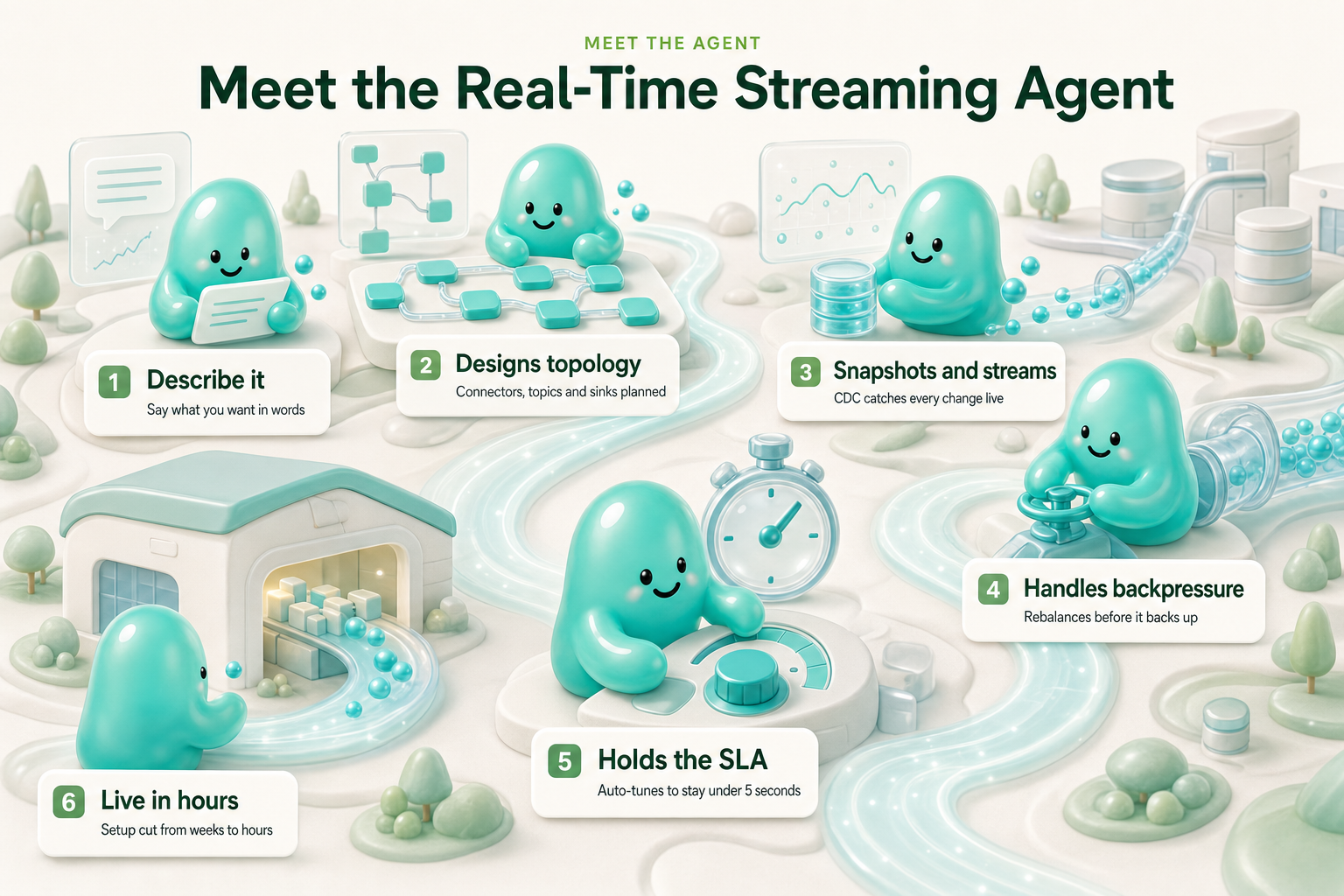
Describe the topology you need in plain English - stream Postgres CDC through Kafka to Snowflake with under five seconds of latency - and it drafts the whole thing for the owner to apply: connectors, topics, partitioning, sinks, and the snapshot-then-stream handoff for change data capture, with stream schemas registered after approval. Then it stays on. It reads Kafka Connect connector status, tracks the lag, throughput, and latency metrics your team records against their baselines, and flags the moment one moves, in seconds rather than after an hour of command-line spelunking. When backpressure builds, it hands the owner the rebalance or partitioning change instead of waiting for a page, so your latency SLA holds as load shifts. Crucially, it's an operations layer, not another platform to run - it works on top of the Kafka you already have, whether that's self-hosted Kafka, MSK, Redpanda, or Confluent Cloud over its API or MCP server.
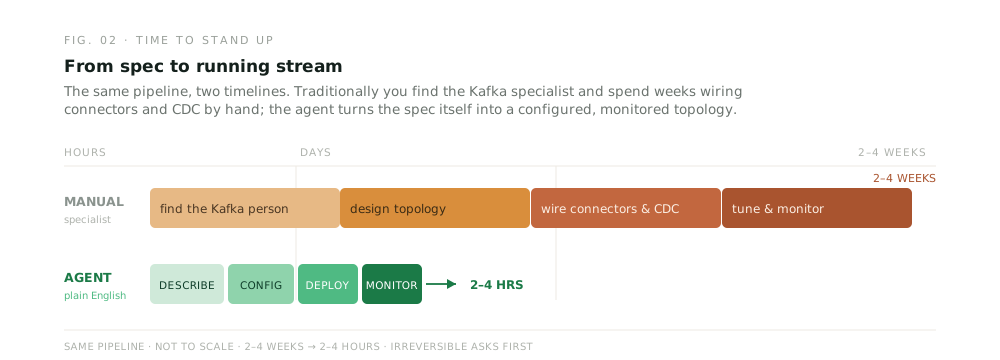
The shape of the win is a stream you don't have to babysit. Standing one up the traditional way - find the specialist, design the topology, hand-write connector configs, wire CDC, tune partitioning - is a multi-week project; the agent is built to compress the design to an afternoon, then watch it as a standing job rather than a fire drill.
Here's the reframe: real-time isn't a faster pipeline - it's a pipeline that never stops, which means the hard part was never building it, it was operating it forever. And the agent doesn't operate it alone: when lag traces to an upstream schema change, the schema agent owns it; when a connector or pipeline breaks, the incident agent is already on it. The streaming agent holds the flow; the swarm handles the causes that live outside it.
A few of the agent's capabilities
The Real-Time Streaming Agent ships with a deep toolkit. A sampling of what it can do:
| Capability | What it does |
|---|---|
| Natural-language topology design | Turns "stream Postgres CDC to Snowflake under 5s" into a source → topic → sink topology design. |
| Connector lifecycle management | Drafts source and sink connector configs and reads their status, so you don't hand-edit connector JSON. |
| CDC orchestration | Plans the snapshot-then-stream handoff for change-data-capture sources cleanly. |
| Lag baselines | Flags consumer lag the moment a lag metric your team records moves off its baseline. |
| Throughput & latency tracking | Tracks the throughput and latency metrics your team records against your target. |
| Backpressure playbooks | Hands the owner the rebalance or scale-up for building pressure, with the reasoning attached. |
| SLA-driven tuning | Recommends the settings that hold a latency SLA - like sub-5-second - as load shifts. |
| SLA-aware health checks | Classifies stream health and flags when an SLA is at risk or breached. |
| Expert tuning recommendations | Surfaces fixes - uneven partitioning, rebalance, scale-up - with safety flags on the risky ones. |
| Swarm hand-off | Routes an upstream schema change, broken pipeline, or connector failure to the agent that owns it. |
…and these are just a few of many - the agent carries dozens more autonomy skills, with new ones added continuously.
How this is different from streaming infrastructure
The streaming world is full of excellent infrastructure that stops at the infrastructure line.
Confluent gives you hundreds of connectors, exactly-once, and Flink-based processing - but it's a platform you still operate, and its monitoring tells you lag is rising without fixing it. Redpanda is the closest philosophical rival: its agent-oriented data plane is a genuinely impressive Kafka-compatible substrate - but it governs and transports what agents do; it doesn't do the streaming engineering itself. Apache Flink, and Confluent's streaming-agent SQL, is the execution engine, not an operator - practitioners repeatedly note that running a Flink job is nothing like running a query. Decodable, Estuary, and Striim make streaming easier to build with managed Flink and CDC, but the moment something lags or backpressures in production, a human is still the one diagnosing it.
They all stop at we'll move your events reliably and show you the metric. The agent's wedge is the next move - flag the lag, diagnose the hot partition, hand the owner the rebalance, and guard the SLA - running on top of any of those buses rather than replacing them.
The takeaway
Streaming stayed a specialist's game because the hard part was never the first deploy - it was the forever after: the lag that climbs and won't recover, the rebalance that cascades, the backpressure at 3 AM. Infrastructure got very good at moving events and showing you a metric, then handed you the operating. An agent that turns a sentence into a topology design and then keeps watch - flagging lag, planning for backpressure, guarding the SLA - is what makes real-time something a small team can actually run. You shouldn't need to hire a "Kafka person" to keep a stream alive.
See it on your own stream
Describe the pipeline you wish you had - source, path, sink, latency target - and watch the agent design it, then guard the SLA without anyone babysitting a dashboard. Book a demo to see it on your stack.