Inside the Data Access & Governance Agent
Governance That Enforces Itself.
Most "governance" is a slow approval queue bolted to a binder of policies nobody enforces. Meet the agent that turns policy into running code, gets access approved in minutes, and keeps the audit evidence ready before the auditor asks.
The thread every data team has lived
Ask a data team how they feel about "governance" and you'll get a sigh before a sentence. The most honest threads on r/dataengineering aren't debates about frameworks - they're people worn down by the process.
Someone needs read access to one table and waits a week for a ticket to clear approvals. A new hire is told to "build a data governance program" and posts, openly lost, asking where to even start. A veteran writes the post everyone upvotes: most governance frameworks are just bureaucracy - binders of policy nobody enforces. And underneath it all, three questions nobody can answer quickly: where is our sensitive data, who can touch it, and can we prove it to an auditor?
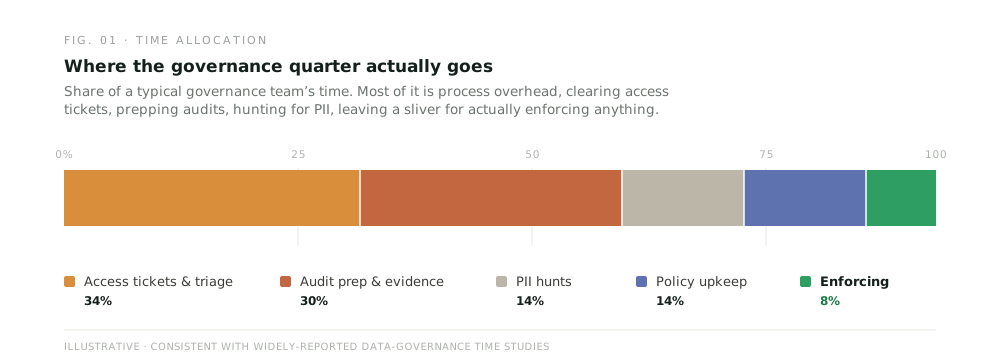
That's the real shape of governance in 2026. The policy isn't the hard part - enforcing it is. Access becomes a human bottleneck. Compliance becomes a quarterly fire drill. The framework lives in a doc, and the doc lives in a drawer. It's the kind of work that feels like it should run itself - and never quite does.
What our Data Access & Governance Agent actually does
You ask in plain English:
"Give the analytics team read access to the orders table for the next 30 days."
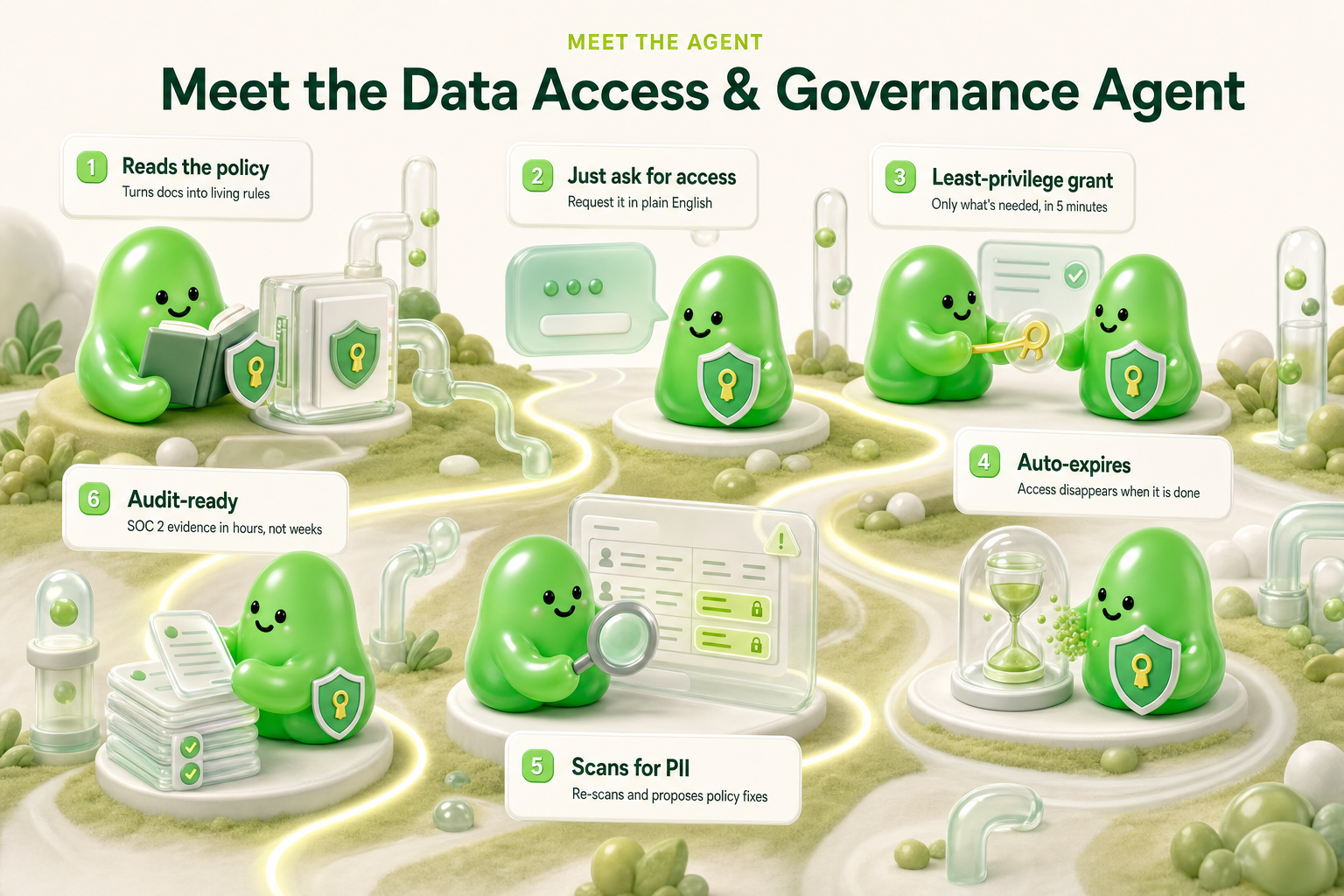
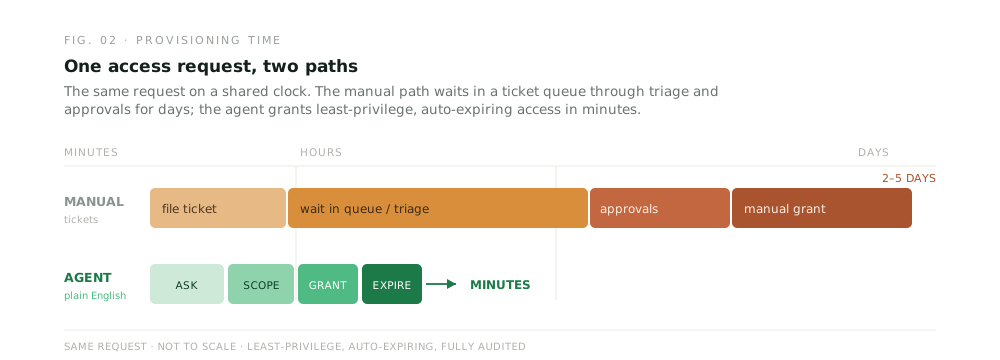
The agent dry-runs the grant - effective privileges, the sensitive columns it would reach, any policy conflicts - scopes it to least privilege with a 30-day expiry, and sends it to the named approver. Once approved, it applies the grant on Unity Catalog or hands the owner the exact grant to run on other platforms, records the grant and its expiry in the ledger, and writes the whole thing into an audit trail as it goes. No ticket queue, no five-day wait, and every expiring grant on record for its owner.
That's the surface. Underneath, it does the part teams dread: it turns your governance policy from a document into executable rules, checks every access request against them before anything is granted, flags sensitive columns in every change that adds them and proposes the policy to cover them, and assembles audit evidence as a byproduct of normal operation. So the lost new hire staring at a blank "build a governance program" doc doesn't start from nothing - the agent surfaces what's sensitive and drafts the rules to cover it, and they review instead of invent. When the SOC 2 auditor shows up, the evidence chain already exists - the scramble becomes a review, not a rebuild. By design, the mechanical core of a request changes shape entirely: access that conventionally takes two-to-five days of tickets collapses to minutes, and audit prep measured in hundreds of hours becomes tens.
Here's the pattern we keep coming back to: governance isn't a document you write once - it's a control you run continuously. A policy that only lives on paper drifts the moment your data does. So the thing that authors the policy should also be the thing that checks every access request against it and can prove it later. And it doesn't work alone: the catalog agent already knows where the data lives, the security agent routes exposure findings, the review agent gates risky changes - governance sits inside a swarm that shares one picture of your stack instead of a tool that hands you a worklist.
A few of the agent's capabilities
The Data Access & Governance Agent ships with a deep toolkit. A sampling of what it can do:
| Capability | What it does |
|---|---|
| Policy as code | Turns written policy into rules every access request is checked against. |
| PII flagging & classification | Flags sensitive columns in every change that adds them and proposes coverage. |
| Natural-language access requests | Turns a plain-English ask into a scoped, least-privilege grant. |
| Just-in-time, time-boxed access | Records every grant with its expiry, so the owner sees each one coming due and nothing lingers unnoticed. |
| One-step revocation | Applies an approved revoke on Unity Catalog and hands the owner the exact revoke on other platforms. |
| Grant dry-run | Shows effective privileges, the sensitive columns reached, and policy conflicts before any grant. |
| Audit evidence chains | Assembles tamper-evident evidence as a byproduct of normal work. |
| Approval routing | Sends every grant to a named approver; an unanswered request expires and escalates, never auto-grants. |
| Data contracts | Enforces expectations between data producers and consumers. |
| Cross-cloud policy | Checks every request against the same policy across whatever clouds you run. |
…and these are just a few of many - the agent carries dozens more autonomy skills, with new ones added continuously.
How this is different from a governance catalog
There's no shortage of governance software. The gap isn't cataloging - it's the last mile.
The incumbents are genuinely good at describing governance. They map your estate, classify sensitive data, score risk, and certify what's trustworthy - then they hand a human the worklist. Someone still files the access grant, still assembles the audit evidence. The control plane raises a flag; a person does the work. Several are also anchored to one cloud or one vendor's ecosystem, so the governed picture stops at that boundary.
Access-control products go a step further and actually gate and mask data - but they live at enforcement and leave the rest (discovery, policy authoring, the audit story, provisioning from a plain request) to you and three other tools. Our agent closes that whole loop: it flags what's sensitive, authors the rule, dry-runs and routes the access for approval, applies approved grants on Unity Catalog and hands the owner the exact grant on every other platform, and produces the evidence - across whatever clouds you actually run. Catalogs tell you what should be governed. The agent governs it.
The takeaway
Governance has always been framed as a tax - the price you pay for moving fast without getting burned. It doesn't have to be. When policy runs as code, when access is least-privilege and every grant carries its expiry, and when the audit evidence assembles itself as a byproduct of normal work, governance stops being the thing that slows everyone down and quietly becomes the thing that keeps you safe. The bottleneck was never the policy; it was the pile of manual steps in front of it. Clear those, and a control that used to live in a drawer becomes one that actually runs. Stop guarding the gate by hand - describe the policy; the swarm enforces it and proves it.
See it on your own stack
Point the agent at one real access request you've been sitting on - and watch a plain-English ask become a least-privilege, time-boxed grant, approved and on record with an audit trail attached. Book a demo to run it against your own policies.