Inside the Quality Monitoring Agent
Your Data Was Wrong for Months and No Alert Ever Fired.
Static checks catch only the failures you already predicted. Meet the agent that learns what normal looks like for every dataset - and catches the quiet drift before it reaches a dashboard.
The number was wrong the whole time
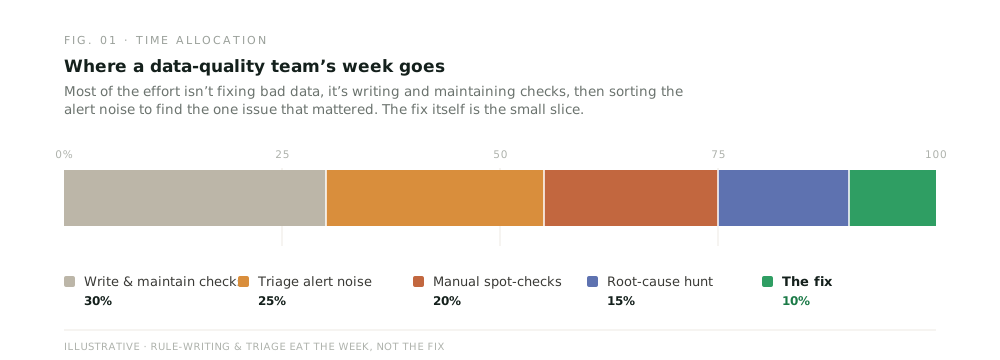
Spend any time in r/dataengineering and a particular kind of horror story keeps resurfacing: we found out the data had been wrong for months. No alert ever fired. A figure on a dashboard just looked a little off one day, someone pulled the thread, and a quiet null-rate creep or a silently broken join turned out to have been poisoning decisions since the spring.
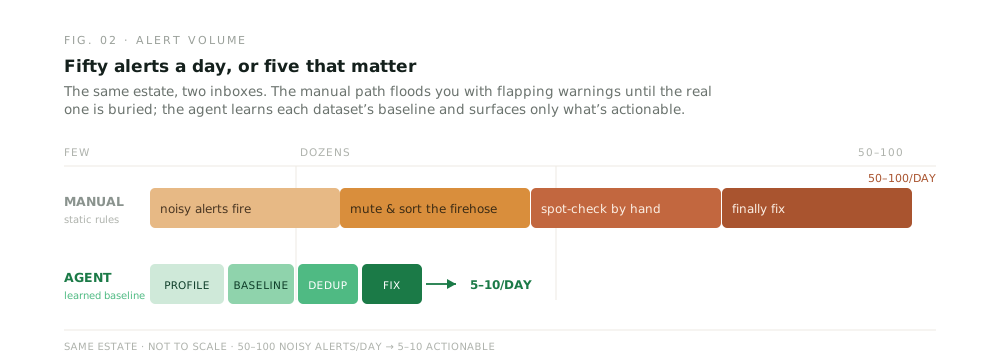
The teams who try to get ahead of it write checks - hundreds of them, by hand, in Great Expectations or dbt tests - and still cover a fraction of their tables, because you can only assert the failures you already thought of. The teams who buy a tool wire up alerts and then drown in them: fifty, a hundred a day, until the one that matters is buried under flapping warnings nobody reads. Either way the real work stays manual - eyeball the distributions, spot-check the row counts, and hope.
And the cost isn't just the cleanup. Once a number is wrong in front of an executive even once, trust in the whole warehouse evaporates, and every report after that gets quietly second-guessed.
What our Quality Monitoring Agent actually does
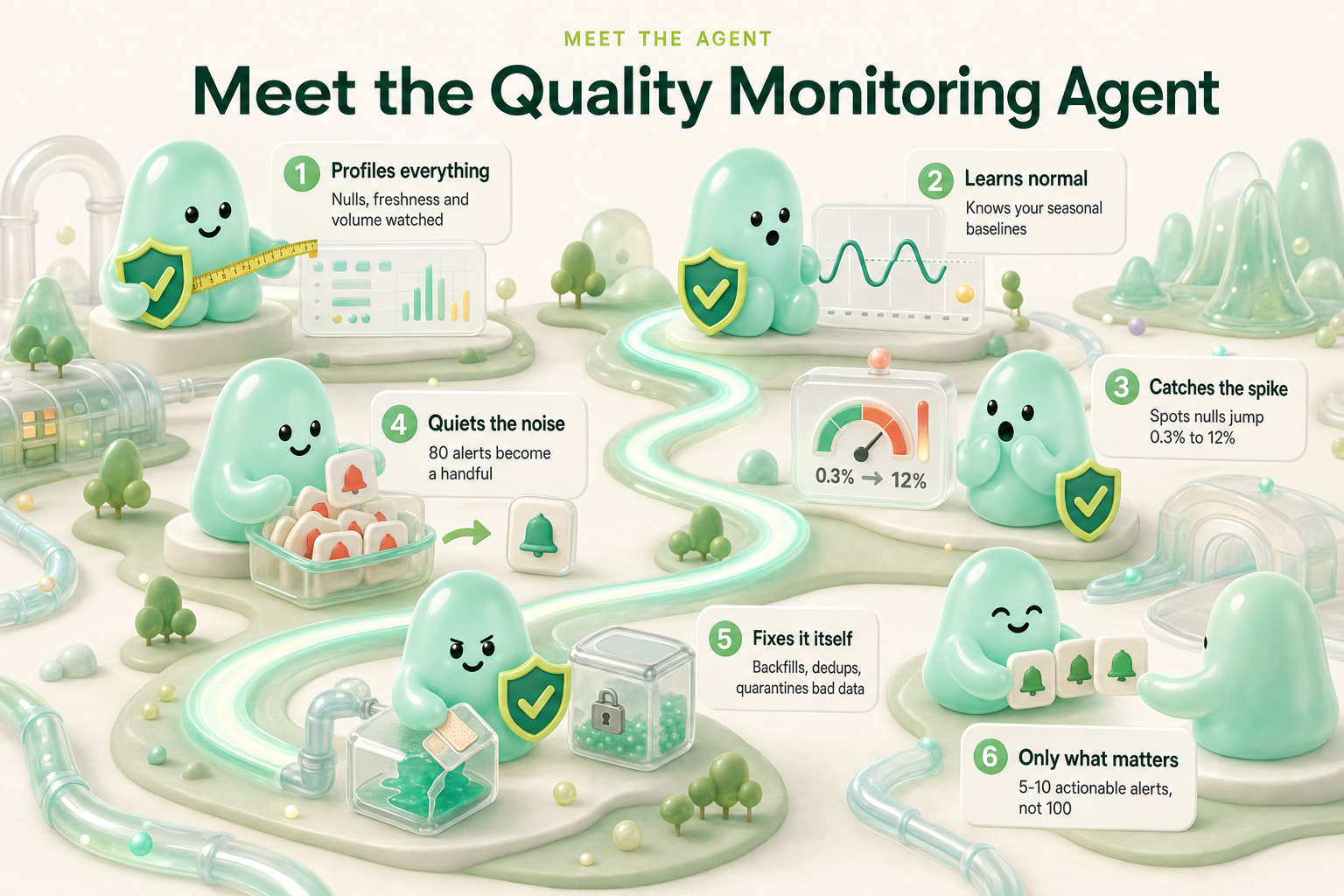
The Quality Monitoring Agent watches every dataset in your stack continuously - and instead of asking you to predict what might break, it learns what normal looks like.
It checks each table on Snowflake, BigQuery, and Postgres - null rates, key uniqueness, row counts - and learns the baselines your team records for the metrics that matter, such as rows per load or how late a table lands, so drift is judged against the dataset's own history instead of a static threshold. When something genuinely drifts - a null rate creeping from 0.3% to 12%, a load landing later than its baseline, a row count sliding off its usual level - it catches it before it reaches a dashboard, and collapses the dozens of related symptoms into one context-rich alert instead of fifty. For the issues that are safely reversible, it lines up the fix: it queues a backfill through your orchestrator with the undo written down, and proposes the dedup or the quarantine of bad rows for the owner to approve and apply.
The shape of the win is a quieter inbox. What used to be fifty to a hundred flapping alerts a day becomes five to ten that are actually worth acting on - and the silent drift that used to surface months later gets caught the day it starts.
Here's the reframe we keep coming back to: a data-quality problem isn't an alert to acknowledge - it's a broken dataset to repair before someone makes a decision on it. Detection was never the hard part. And the agent doesn't work alone: when a quality break traces to an upstream schema change, the schema agent maps the blast radius; the incident agent opens and resolves the incident; the catalog agent updates the table's trust score. Quality monitoring sits inside a team that shares one picture of your stack - not a dashboard that forwards you a worklist.
A few of the agent's capabilities
The Quality Monitoring Agent ships with a deep toolkit. A sampling of what it can do:
| Capability | What it does |
|---|---|
| Continuous table checks | Checks every table it watches for null rates, key uniqueness, and row counts on Snowflake, BigQuery, and Postgres, with no rules to write. |
| Recorded baselines | Learns what normal looks like for each metric your team records, so drift is flagged against the dataset's own history instead of a static threshold. |
| Anomaly detection | Catches the quiet drifts static checks miss - a creeping null spike, a row count sliding off its baseline, a load running late - before they reach a dashboard. |
| Quality scorecard | Scores every table across completeness, uniqueness, accuracy, and consistency, across your whole estate in minutes. |
| Alert de-duplication | Collapses dozens of related warnings into a single, context-rich notification so the one that matters isn't buried. |
| SLA management | Tracks quality and lateness targets against the baselines your team records and fires the moment a critical table breaks one. |
| Reversible fixes | Queues backfills through your orchestrator with the undo recorded, and proposes dedupes and bad-row quarantines for the owner to approve. |
| Owner-routed alerts | Routes each surviving alert to the team that actually owns the dataset, not a shared channel everyone mutes. |
| Test generation | Auto-generates quality tests for new pipelines - schema, row count, freshness, null rate, and join-aware checks. |
| Swarm hand-off | Feeds quality signals to the catalog, opens incidents from anomalies, and re-checks on schema changes and pipeline deploys. |
…and these are just a few of many - the agent carries dozens more autonomy skills, with new ones added continuously.
How this is different from data observability
The data-quality category is crowded with genuinely strong detectors - and they all stop one step short of the same line.
Monte Carlo and Anomalo run mature unsupervised ML over your warehouse metadata, learn per-table baselines, and flag the unknown unknowns with no thresholds to hand-tune - but both stop at a well-explained alert that hands the fix back to you, inside one warehouse. Bigeye auto-generates monitors the moment you connect and, at best, blocks a bad query - still toil handed back. Great Expectations and dbt tests give you a battle-tested way to assert what good data looks like, but you hand-author and maintain hundreds of rules covering a fraction of your tables, and they detect-and-document rather than fix. The honest line: they tell you, with rigor, that something broke - detection is their ceiling.
Our agent treats that as the trigger, not the finish. It detects and resolves the reversible majority through a governed, human-gated write-back, gates the irreversible for a person, and does it across whatever clouds you actually run - as one member of a swarm that shares context. The other tools narrate the problem; this one is built to close it.
The takeaway
Data quality became a manual discipline because the tooling could only check for the failures you already imagined, and could only ever tell you. So teams wrote more rules, drowned in more alerts, and still found out months later that a number had been quietly wrong. The way out isn't more assertions - it's an agent that learns what normal looks like on its own, surfaces only what matters, lines up the fix for the reversible majority, and hands a human the rare real call. Trust in your data should be something you can see - not something you rebuild after every surprise.
See it on your own warehouse
Point the agent at the tables your dashboards depend on - and watch it learn their baselines, surface the drift that static checks miss, and line up the fix for the reversible issues before anyone second-guesses a number. Book a demo to see it on your stack.