Inside the Data Security Agent
Your PII Is in a Public Bucket Right Now and No Dashboard Will Fix It.
The finding was always in a dashboard nobody acted on. Meet the agent that turns every finding into a routed fix - and keeps sensitive data out of each change before it ships.
The finding was already in a dashboard
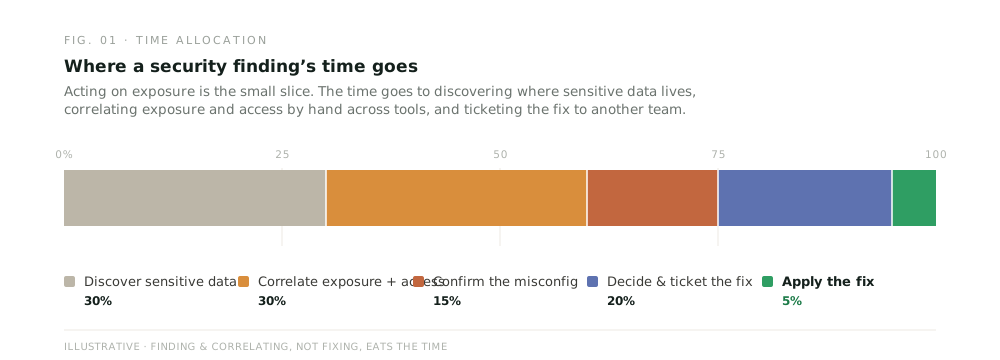
Every breach post-mortem ends the same way: the finding was already in a dashboard nobody acted on. The pains underneath are routine and well-documented - PII sitting in plaintext in a prod table nobody flagged, a public bucket with customer data, a credential committed to a repo that bots found in minutes, an admin role on Snowflake nobody will fix. None of these are exotic. They're sitting there right now.
The trouble is they're scattered. Data-posture tools tell you where sensitive data lives; cloud-posture tools tell you what's misconfigured; secret scanners watch the codebase - three dashboards, three teams, and a manual swivel to correlate them. And even when you find the exposed asset, fixing it means a ticket to another team that may never land. Detection was never the missing piece.
What our Data Security Agent actually does
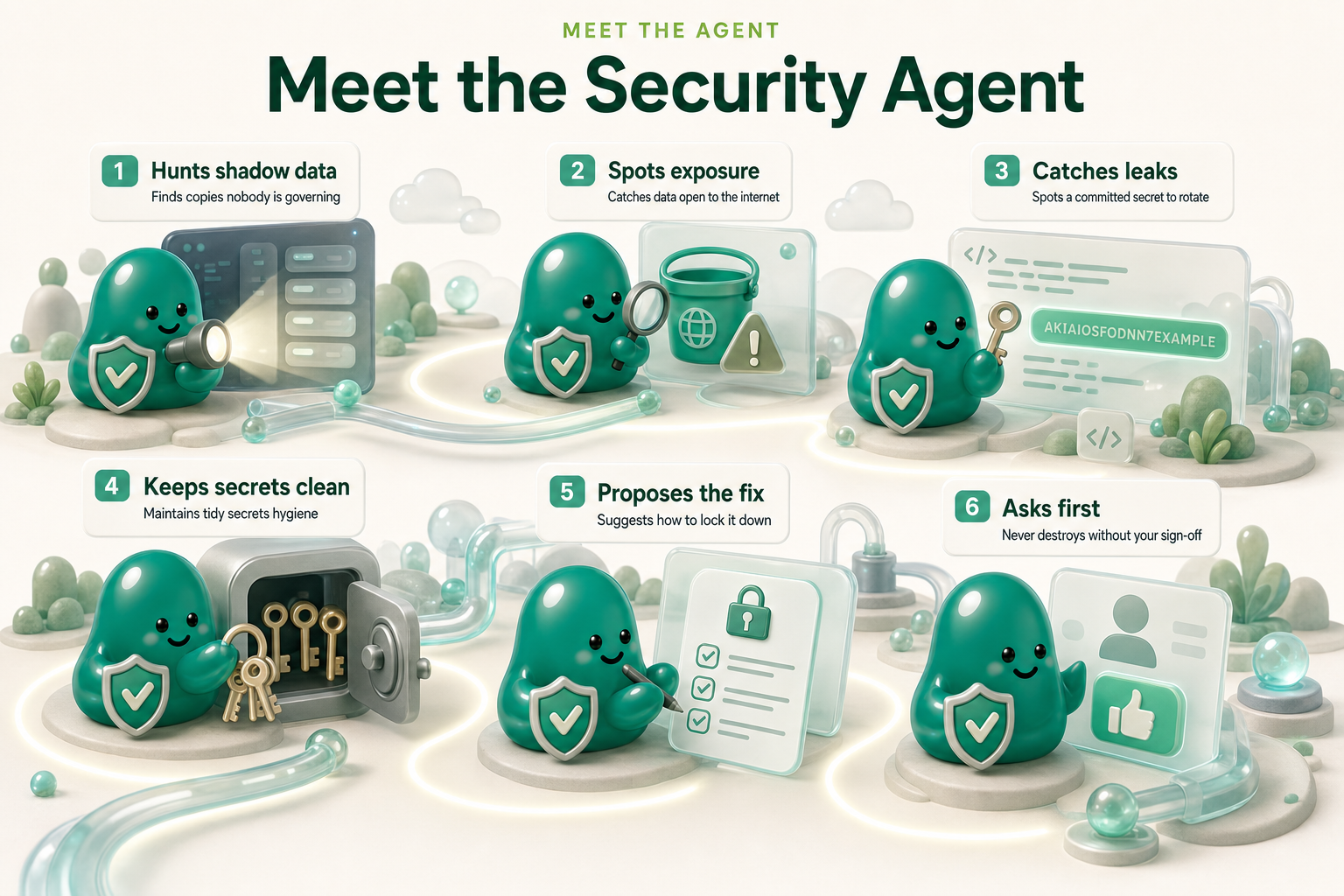
The Data Security Agent closes the gap between the two halves of data security - where the sensitive data is, and how it's exposed - by bringing the findings into one list and routing each one to the agent that fixes it.
Your DSPM and cloud scanner already know where PII, PHI, and PCI live and which bucket or role exposes them; the agent picks up those findings, and the ones your data owners raise, and puts the next step beside each. It stops new exposure at the door: every pull request runs a privacy check that flags columns whose names and annotations mark them as personal data, before the change merges. When someone asks for access to a sensitive table, the proposed grant is dry-run first - effective privileges after role inheritance, the PII, PCI, and PHI columns it would reach, policy conflicts, and a least-privilege, time-boxed alternative. It keeps secrets and personal data out of its own record: the facts agents contribute and the learnings they record are redacted on write, tool responses are scanned for PII, and the context graph rejects prompt-injection strings. And every finding names a one-motion handoff: a revoke through governance (applied after approval on Unity Catalog, proposed for the owner everywhere else), an incident through incident debugging, a note on the shadow copy through the catalog.
The shape of the win is detection becoming a routed fix. What used to be five dashboards and a manual correlation that ends in a ticket to another team becomes one list where each finding names the agent that will fix it.
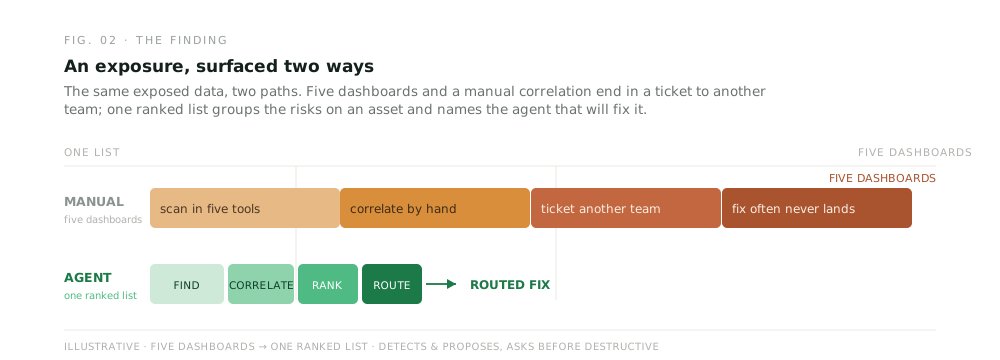
Here's the reframe: data security isn't a dashboard of findings you triage by hand - it's a finding that already knows which agent will fix it. The scanner was never the missing piece; the missing piece was something that picked the finding up and did the next thing. That's why it lives in the swarm: it proposes, governance applies the approved permission change, incidents triages the active threat - detection routed into resolution.
A few of the agent's capabilities
The Data Security Agent ships with a deep toolkit. A sampling of what it can do:
| Capability | What it does |
|---|---|
| Findings intake | Brings the sensitive-data and exposure findings from your scanners and data owners into one list. |
| Sensitivity classification | Labels each finding by class (PII, PHI, PCI, secret) and proposes the tag to the catalog owner. |
| Privacy check in review | Flags columns whose names and annotations mark them as personal data in every pull request, before the change merges. |
| Grant dry-run | Shows the effective privileges and the sensitive columns a proposed grant would reach, after role inheritance. |
| Least-privilege proposals | Recommends a narrower, time-boxed grant when a request reaches more than it needs. |
| Redaction on write | Strips personal data from the facts agents contribute and the learnings they record. |
| Tool-response PII scanning | Scans what tools return for personal data and logs each finding with a count. |
| Prompt-injection gate | Blocks prompt-injection strings from being written into the context graph. |
| Two-person kill switch | Lets two admins together halt the tenant and revoke its keys, tokens, and sessions. |
| Unified findings + routed fix | Collects every data and cloud finding into one list and names a one-motion handoff to governance or incidents. |
…and these are just a few of many - the agent carries dozens more autonomy skills, with new ones added continuously.
How this is different from a DSPM or a cloud scanner
The field splits in two, and the Data Security Agent works with both halves instead of re-scanning either.
On cloud posture, Wiz owns the best-in-class cloud graph and attack-path analysis, with Orca and Prisma Cloud close behind - they are the infrastructure specialists, but they're closed, expensive, and thin on data classification. On data posture, BigID, Cyera, and Sentra ship the deepest sensitive-data discovery, and Varonis is the strongest data-centric access incumbent - all closed, all weak on cloud misconfiguration. Securiti has announced an agent layer, but it's closed and single-vendor.
Where the Data Security Agent is genuinely differentiated is the seam none of them cross: open-source, one list across data and cloud findings, and routing a finding to a governance revoke or an incident triage in one motion across a multi-agent system. The honest counter-position is co-existence, not conquest: keep your Wiz or BigID as the scanner, and use the Data Security Agent to act on their findings inside your swarm.
The takeaway
Data security stalled not for lack of scanners - there are excellent ones - but because finding the exposure and fixing it lived in different tools owned by different teams, so the finding sat in a dashboard until it became a breach. An agent that brings data and cloud findings into one list and routes each finding to the agent that resolves it is what closes the gap between knowing and doing. The exposed data was never the surprise - the surprise was that the finding sat there, and nobody picked it up.
See it on your own stack
Point the agent at your scanners' findings and your next pull request - and watch it catch the sensitive column before it merges, dry-run the grant someone just asked for, and route each fix to the agent that can make it. Book a demo to see it on your stack.