Inside the Pipeline Building Agent
Your Backlog Isn't a Headcount Problem.
Data engineers spend most of their week on plumbing - building, fixing, and re-fixing pipelines - instead of the work that moves the business. Meet the agent that owns it.
The thread every data engineer recognizes
Every data team has a backlog it quietly resents. Not the interesting work - the plumbing: extract this, dedup that, join those, load it hourly, write the tests, ship it, and pray it doesn't break at 3 a.m. Spend ten minutes in r/dataengineering and you can feel the exhaustion coming off the screen. The most-upvoted threads aren't about which orchestrator is best. They're variations on one question: is it supposed to be this hard?
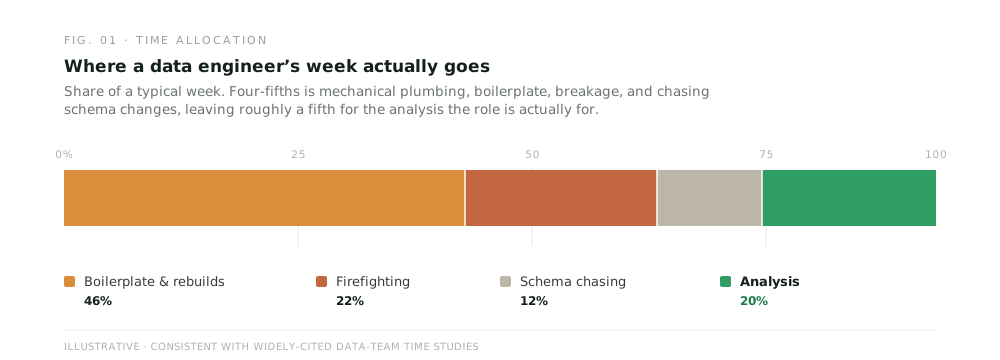
The answers rhyme. One engineer asks if it's normal that their pipelines break constantly - and a hundred replies confirm it is. Another is hunting for the magic config that stops an upstream schema change from silently shattering everything downstream. A third just inherited a legacy spaghetti codebase nobody documented, and dreads touching it. Underneath all of them is the same confession: most of the day goes to plumbing and prep, not the analysis anyone was actually hired to do.
That's the real shape of pipeline work in 2026. Not a hard problem - a relentless one. The backlog isn't full of interesting questions; it's full of "extract this, dedup that, join those, load hourly, write the tests, deploy it, and please don't let it break." It's repetitive enough to feel like it should be automated, and fiddly enough that it never quite is.
Teams treat this as a staffing problem - hire another data engineer, the backlog will shrink. It rarely does, because the work scales with the number of sources and stakeholders, not with the size of the team. The honest framing is different: most pipeline work is mechanical, and mechanical work is exactly what an agent should own.
What the Pipeline Building Agent actually does
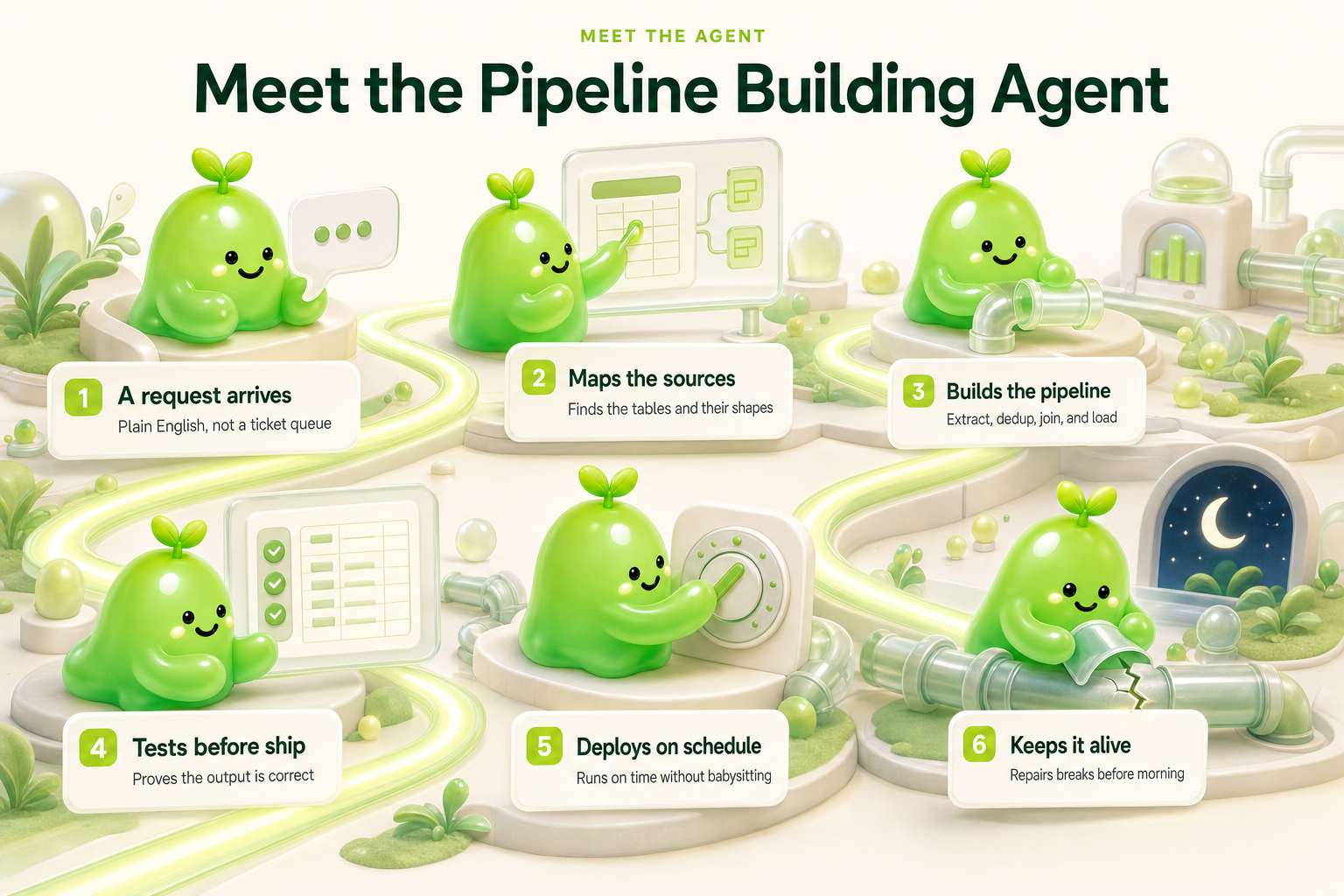
You describe what you need in plain English: "Build a daily pipeline that pulls orders from Postgres, dedups by order ID, joins with customers, and loads into a Snowflake mart."
The Pipeline Building Agent turns that sentence into a real, production-grade pipeline. It writes the transformations, generates the orchestration, adds the data-quality checks and the error handling, and - this is the part that matters - validates the whole thing against your dbt project and existing code before anything goes near production. Then it proposes it as a diff, with version control and health checks, for the owner to merge, and hands you something you review rather than something you build from scratch.
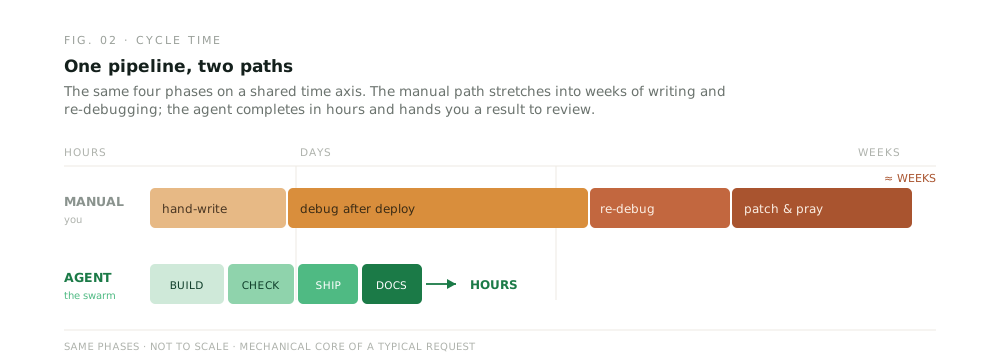
The before-and-after is the whole pitch. Before: a couple of hours to a couple of weeks of boilerplate per pipeline, half of it copy-pasted from last quarter, the other half spent debugging it after deploy. After: a description, a review, and you move on. For the mechanical core of a typical request, work that used to take weeks compresses into hours.
It doesn't stop at net-new pipelines, either. The same agent burns down a backlog of requests in an afternoon, reuses what you already have instead of duplicating it, reads the undocumented code it inherits so a change doesn't mean a from-scratch rewrite, and - because it understands your models and lineage - refuses to propose something that would break on contact with what runs downstream. The boring, skippable steps that get dropped when everyone's busy (tests, lineage, documentation) come standard, because the agent doesn't get tired or cut corners.
And it isn't working alone. The Pipeline Building Agent is one member of a swarm: when a schema changes upstream, the schema agent maps the blast radius; when data goes bad, the quality and incident agents catch and resolve it; when you need to find something, the catalog agent already knows where it lives. Here's the pattern we keep coming back to: a pipeline isn't a one-time artifact, it's a living thing that breaks, drifts, and gets rebuilt - so the agent that builds it should be part of the same team that keeps it alive. Specialized agents sharing one picture of your stack and handing work off to each other cover that full lifecycle in a way a single do-everything assistant structurally can't. A pipeline the agent builds is a pipeline the swarm keeps healthy. That's the difference between generating code and owning the outcome.
A few of the agent's capabilities
The Pipeline Building Agent ships with a deep toolkit. A sampling of what it can do:
| Capability | What it does |
|---|---|
| Natural-language pipeline generation | Turns a plain-English request into transforms, orchestration, and error handling. |
| Schema-aware validation | Checks the whole pipeline against your dbt models and existing code before it is proposed. |
| Review-ready delivery | Proposes the pipeline as a diff with version control, health checks, and rollback for the owner to merge. |
| Backlog burndown | Clears a queue of pipeline requests in a sitting, reusing what you already have. |
| Legacy comprehension | Reads and safely refactors undocumented, inherited pipelines. |
| Automatic data-quality tests | Generates not-null / unique / freshness / relationship checks as standard. |
| Lineage & documentation | Produces lineage and docs as a byproduct, not an afterthought. |
| Incremental & scheduled runs | Builds batch, incremental, or scheduled pipelines to fit the workload. |
| Cross-warehouse | Works across Snowflake, BigQuery, Databricks, Postgres, and more. |
| Swarm hand-off | Routes schema changes, data issues, and incidents to the right specialist agent. |
…and this is just a fraction of it - the agent carries dozens more autonomy skills, with new ones added continuously.
How this is different from "AI that writes SQL"
A lot of tools now generate pipeline code. The gap isn't generation - it's everything around it.
Most AI pipeline features live inside a single platform and stop at a draft. A warehouse-native assistant will write SQL that runs in that one warehouse and then wait for a human to click run - propose-and-wait, single-cloud. Copilots bolted onto a transformation tool generate models inside that tool's walls. They're genuinely useful, and they're genuinely boxed in: they don't see the rest of your stack, they don't validate against your live schema, and they don't take responsibility for the pipeline after it's written.
The closest comparisons are the new autonomous "AI data engineer" products. They're real, and they're good at repairing pipelines - but they're a single agent pointed at the build-and-fix moment. The Pipeline Building Agent is part of a team that spans the whole lifecycle: build, validate, deploy, watch, and fix, across whatever clouds and tools you actually run. When that pipeline breaks at 3 AM, a copilot has already logged off - the swarm's incident agent is already on it. Competitors draft you a pipeline; the swarm stands behind it.
The takeaway
For years the answer to a growing backlog was the same: hire another data engineer. But the plumbing scales with the number of sources and stakeholders, not the size of the team - so the queue never really shrinks. The honest reframe is that most pipeline work is mechanical, and mechanical work is exactly what an agent should own, end to end: build it, validate it against your project, hand it over as a reviewed diff, and keep it alive inside a swarm. That frees your engineers for the 20% that actually needed a human. Stop staffing the plumbing - describe the pipeline; the swarm builds and keeps it.
See it on your own backlog
Point the agent at a real request you've been putting off - and watch a plain-English description become a tested pipeline, ready to merge. Book a demo to see it on your stack.