Inside the MLOps & Models Agent
Your Model Was Done in Two Weeks. Shipping It Took Two Quarters.
The modeling was never the hard part - the stack around it was. Meet the agent that guards the data every model depends on, from feature table to training set, no MLOps team required.
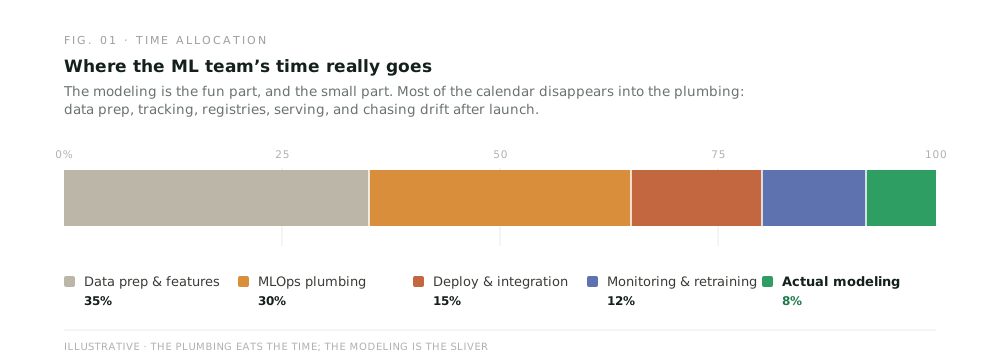
The model was the easy 10%
There's a line that gets reposted on r/MachineLearning until it's basically folklore: ML in production is ninety percent plumbing, ten percent modeling. The modeling is the fun part, and the part that's done in two weeks. Then the model sits in a notebook for two quarters while someone writes serving code, stands up experiment tracking, wires a registry, argues with infra, and finally gets it behind an endpoint.
And the moment it ships, a quieter failure starts: the model rots. No alert fires - it just keeps answering yesterday's question with confidence while the world drifts underneath it, until a business metric drops months later and someone goes looking. Small teams feel this hardest: the MLOps stack the big labs run is bigger than the model, and a three-person team can't stand it all up. So reproducibility becomes a model_final_v3.pkl on a shared drive, and "recreate last quarter's model" becomes an archaeology dig.
What our MLOps & Models Agent actually does
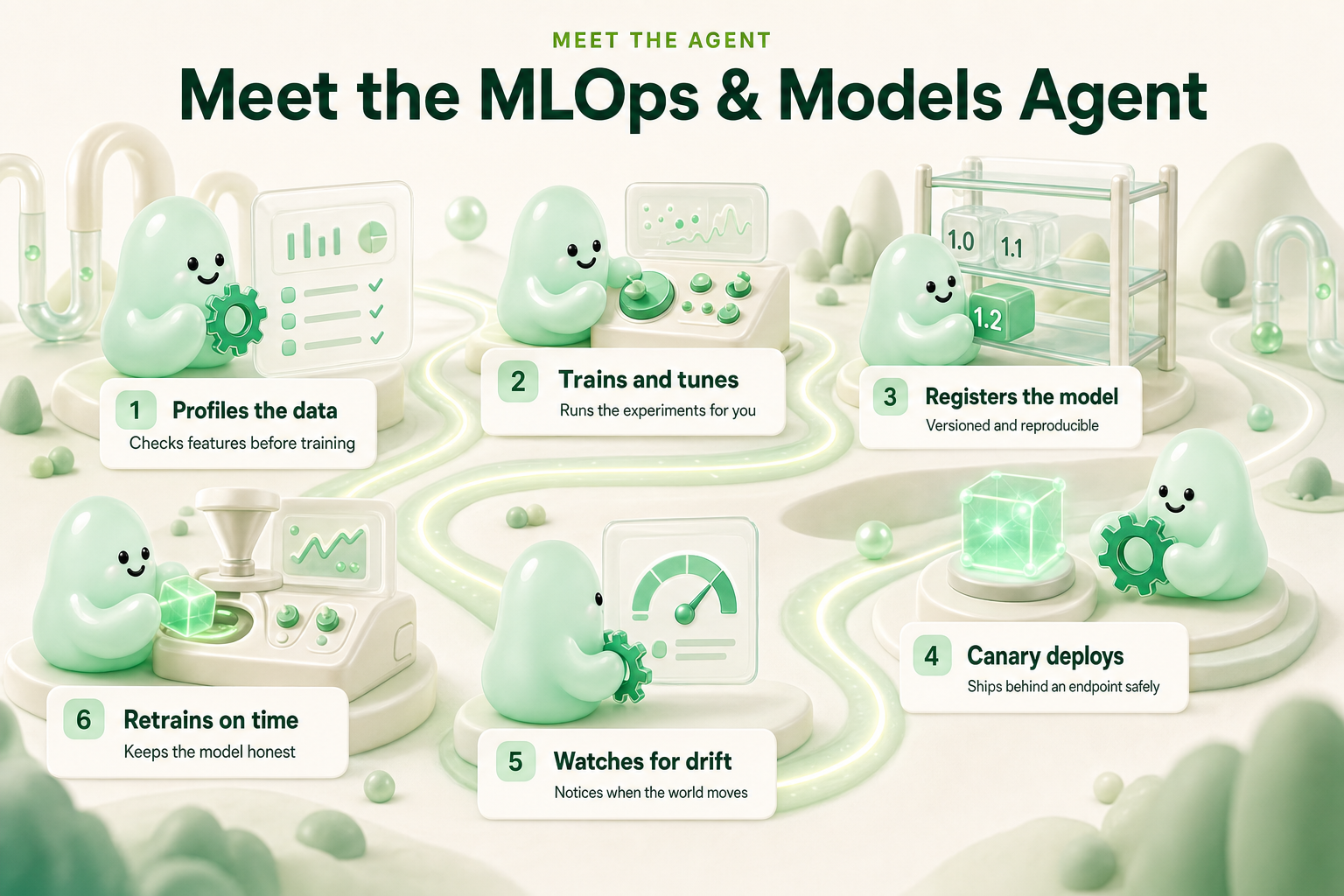
The MLOps & Models Agent watches the data a model lives on through its whole life - from the first data profile to the feature tables a deployed model reads - so a small team gets a senior ML engineer's discipline without standing up an MLOps org.
It checks the tables your features and training sets come from - null rates, key uniqueness, and row counts on Snowflake, BigQuery, and Postgres - and tracks the baselines your team records for each feature, so a feature metric that moves off its baseline, or a load that arrives thin, is flagged before it reaches a training run. It maps what feeds each model from the dbt manifest and the context graph, so when an upstream table breaks, the owner knows which models and features it touches. Every finding is tied to the table, the check, and the run behind it, so what changed under the model always has an answer. Your MLOps stack keeps doing what it does best, by design: MLflow, Weights & Biases, SageMaker, or Vertex AI track the runs, hold the registry, and serve the model, and they connect over their API or MCP server today. And it doesn't ship-and-forget: when the data under a live model moves, the owner gets the evidence and decides whether to retrain or roll back.
The shape of the win is the gap that closes. The slow part - finding out weeks later that the data under a model changed - collapses to the day it happens, because the checks run on the tables the model depends on.
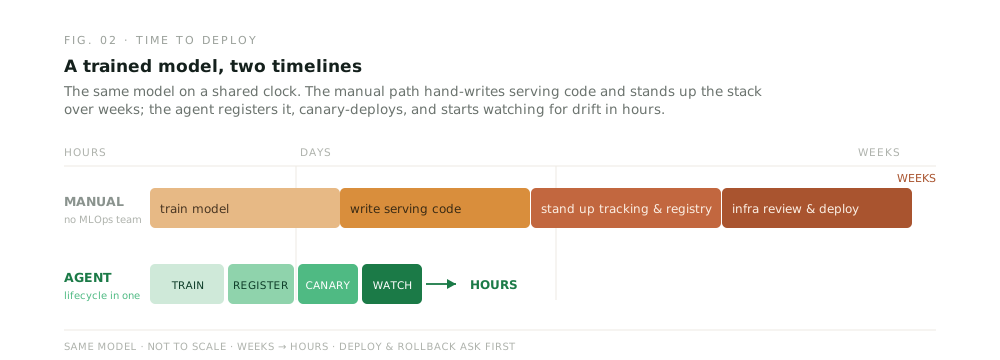
Here's the reframe: a model isn't an artifact you ship - it's a living claim about the world that quietly stops being true, and someone has to keep watching it. And the agent doesn't work alone: the insights and catalog agents ground the features it builds in the same context your pipelines share, the quality agent vouches for the data underneath, and upstream data signals flow back to the swarm. The lifecycle runs as one motion, not a relay of dropped batons.
A few of the agent's capabilities
The MLOps & Models Agent ships with a deep toolkit. A sampling of what it can do:
| Capability | What it does |
|---|---|
| Feature-table checks | Checks the tables your features come from for null rates, key uniqueness, and row counts. |
| Training-set guard | Checks a training set's source tables before a run, so a model never learns from a broken load. |
| Feature baselines | Flags a feature metric your team records the moment it moves off its baseline. |
| Upstream lineage | Maps the dbt models and tables that feed each feature from the dbt manifest and the context graph. |
| Change evidence | Ties every finding to the table, the check, and the run behind it, so the owner sees exactly what moved. |
| Owner hand-off | Hands the model's owner the evidence to retrain or roll back in the team's own MLOps stack. |
| Works with your MLOps stack | MLflow, Weights & Biases, SageMaker, and Vertex AI connect over their API or MCP server today. |
| Pipeline proposals | Drafts fixes to the pipelines that feed a feature as a diff for the owner to merge. |
| Approval-first by design | Sends every change to a feature pipeline to a named owner before it lands. |
| Swarm hand-off | Sources context from the catalog and insights agents and shares upstream data signals with the rest of the team. |
…and these are just a few of many - the agent carries dozens more autonomy skills, with new ones added continuously.
How this is different from an MLOps stack
The MLOps category is real, deep, and crowded - and most of it hands you the lifecycle in pieces.
The big platform suites - SageMaker, Vertex AI, Databricks - are genuinely battle-tested, but each is gravity-locked to its own cloud, so a team running data across more than one inherits the lifecycle in fragments. MLflow and Weights & Biases are excellent at tracking and observing what your runs did, but they sit on the model plane and stop short of deploying the model or fixing the data underneath it. Feature stores like Tecton and Feast solve real problems at scale, but for most teams they're another piece of infrastructure to stand up rather than a capability that just works. And monitoring specialists like Arize, Fiddler, and WhyLabs are sharp at detecting drift - which is exactly where they stop: they alert a human, who still owns the retrain, the rollback, and the fix.
Our bet is the layer underneath: one operator that guards the data every model depends on across whatever clouds you actually run, and works alongside the MLOps tools you already trust. Our edge is the data under the model and cross-cloud reach.
The takeaway
Machine learning stalled in production because we sold it as a stack - a tracker, a registry, a feature store, a monitor, a serving layer - and assembling and operating that stack is the part that takes the quarters, not the modeling. An agent that guards the data under the model from the first profile to the feature table a live model reads - and keeps watching - turns the ninety-percent plumbing back into the ten percent it should have been. A model is a claim that goes stale; shipping it was only ever half the job - keeping it honest is the rest.
See it on your own model
Point the agent at the tables behind the model you care about most - and watch it check the features, guard the training set, and flag an upstream break to the owner before the model learns from it, without a standing MLOps team. Book a demo to see it on your stack.