Inside the Search & Research Agent
Stop Opening Ten Tabs to Answer One Question.
The answer is split across your stack and the open web. Meet the agent that searches both, reconciles the conflicts, and hands back one cited answer.
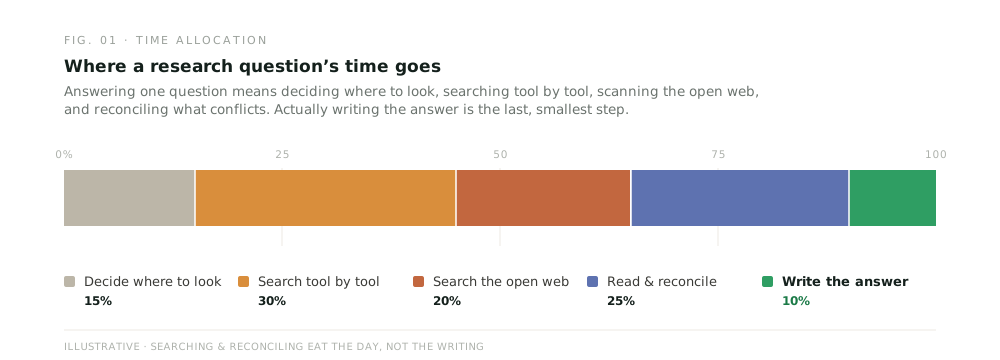
Most of the work is just finding the answer
A surprising share of knowledge work is just finding the answer. Practitioners describe spending hours locating where a dataset or definition even lives, then more hours deciding whether the source they found is the right one. Enterprise search returns ten links and a chatbot returns one confident guess - and neither shows its work.
Two failure modes show up again and again. The first is the scattered hunt: the answer to one question is split across the catalog, Slack, Confluence, and the open web, and you open them one tab at a time. The second is the argument nobody can win - two dashboards show two numbers for the same metric, and there's no authoritative source to point to. Meanwhile the context that would actually settle a decision - what's happening in the market, the community, a competitor's release notes - lives outside the warehouse entirely.
What our Search & Research Agent actually does
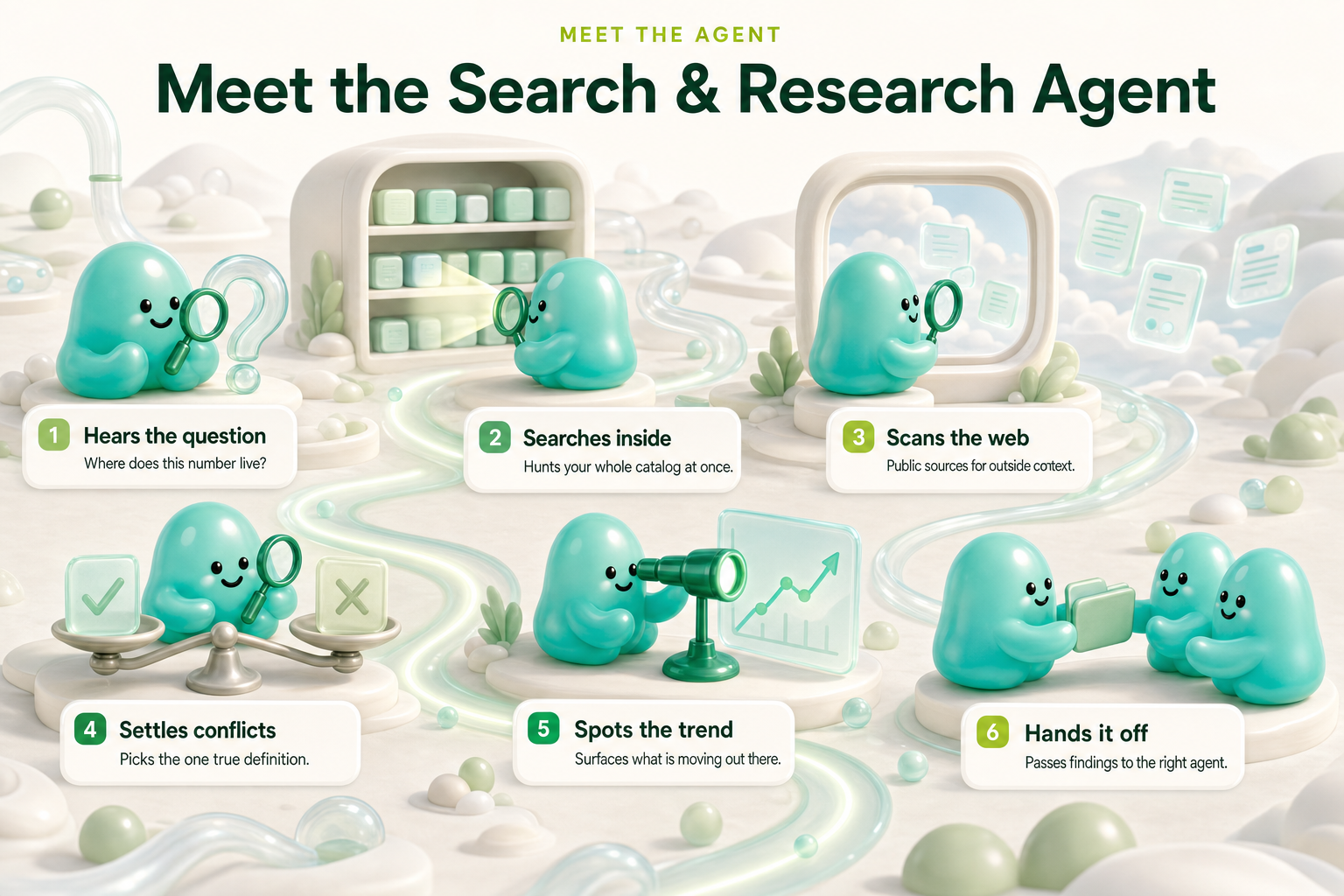
The Search & Research Agent is the swarm's research desk - it answers "find it" questions that span both your internal stack and the open web, and hands back a cited conclusion instead of a pile of tabs.
Ask once, and it runs the hunt everywhere: across the context graph and your connected docs, and across the open web - Reddit, Hacker News, YouTube, X - landing external context right next to your internal data so a decision has both halves. When two dashboards disagree, it disambiguates the metric: finds every definition, names the authoritative source, and shows where the others diverge - ending the meeting where everyone argues about whose number is right. Every finding comes with receipts, cited back to the source it came from, because an answer you can't trace is an answer you shouldn't ship. It even notices the trend before you go looking, surfacing emerging signals across the sources it watches. And it knows its lane: when a question turns into explain this table it routes to the catalog agent; when it turns into run the numbers it hands to insights.
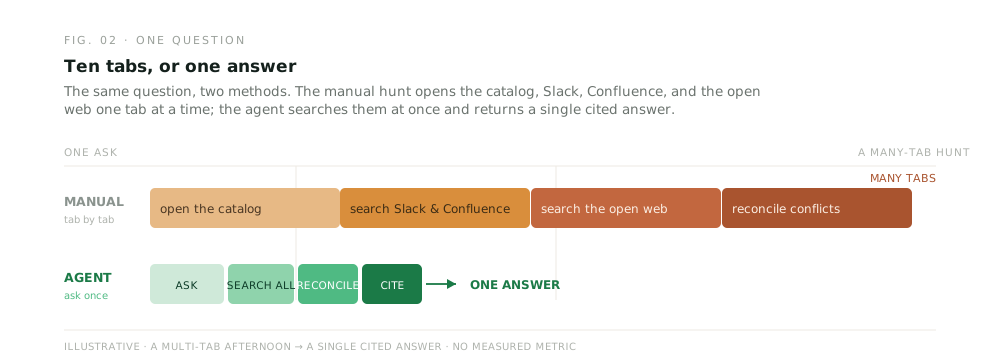
The shape of the win is the hunt collapsing into a single ask. What used to be a multi-tab afternoon - catalog, then Slack, then Confluence, then the open web, then reconciling what conflicts - becomes one question with one cited answer.
Here's the reframe: research isn't a list of links - it's a cited conclusion. A search box returns documents and a chatbot returns confident guesses; neither shows its work. This agent returns the answer and how it knows. And it's the front door, not a dead end: it sits between the insights agent, which answers over your warehouse, and the catalog agent, which knows your internal metadata - and does the third thing neither does well, pulling outside context in and reconciling it against what you already have.
A few of the agent's capabilities
The Search & Research Agent ships with a deep toolkit. A sampling of what it can do:
| Capability | What it does |
|---|---|
| Agentic stack search | Runs a multi-step search across the context graph and your connected docs to find the authoritative source, not just keyword hits. |
| Open-web research | Pulls external context from Reddit, Hacker News, YouTube, and X into the same answer. |
| Cited synthesis | Returns a written answer with every claim traced back to the source it came from. |
| Metric disambiguation | Finds every definition of a metric, names the authoritative one, and shows where the others diverge. |
| Trend detection | Surfaces emerging signals and shifts across the sources it watches before you go looking. |
| "Where does this live?" lookup | Locates the authoritative home of a dataset, metric, or document across the stack. |
| Internal + external blend | Lands outside-world context next to your internal data so a decision has both halves. |
| Source verification | Checks that a cited source actually supports the claim, so answers are traceable, not assumed. |
| Catalog hand-off | Routes "explain this table" depth questions to the catalog agent. |
| Insights hand-off | Routes "run the numbers" questions to the insights agent and brings the research context along. |
…and these are just a few of many - the agent carries dozens more autonomy skills, with new ones added continuously.
How this is different from enterprise search and research tools
The closest reference points come from two different worlds - and the seam between them is the gap.
Glean is the enterprise-search benchmark: it mirrors each system's native permissions and personalizes ranking per employee, which is genuinely strong - but it answers a knowledge worker's question by reading permission-scoped SaaS docs, and it stops at the read; it doesn't reconcile metric definitions across your data platform. General research tools - Perplexity, ChatGPT's deep research - synthesize beautifully over the public web with citations, but they have no governed line into your internal catalog, warehouse, or metric definitions, so they can't tell you which of your two churn numbers is authoritative. And web-search APIs like Exa and Tavily are retrieval primitives, not an analyst - they hand back results, not a reconciled answer.
Our lane is the seam none of them own end-to-end: external research plus internal catalog search plus metric disambiguation, cited, brought into the data workflow, and handed to the right specialist to act on.
The takeaway
Finding the answer stayed slow because the tools split the work in half: enterprise search knows your internal docs but not the open web, and a research chatbot knows the web but not your stack - and neither reconciles the conflicts or shows its sources. An agent that searches both at once, names the authoritative number when two disagree, and hands back a cited conclusion turns a multi-tab afternoon into a single ask. The useful unit of research was never a list of links - it's an answer you can trust, and trace.
See it on your own stack
Ask it the question whose answer is scattered across your catalog, your docs, and the open web - and watch it come back with one cited conclusion, the authoritative source named. Book a demo to see it on your stack.