Inside the Data Science & Insights Agent
Stop Being the Company's Human Query Engine.
Everyone has a data question; almost nobody can write the SQL. Meet the agent that answers in plain English - charted, cited, and traceable to the table and column.
Most of the job is pulling numbers for other people
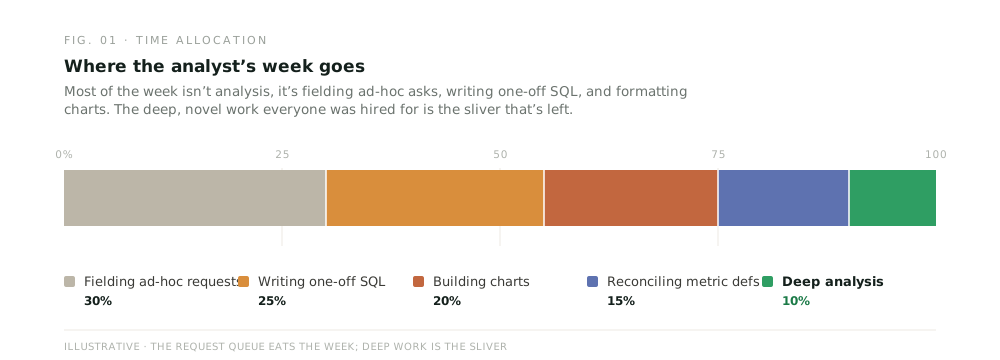
There's a genre of thread that runs through r/datascience and r/analytics like a quiet confession: most of my job is just pulling numbers for stakeholders. The title says data scientist; the day says query queue. Every "quick question" is a one-off SQL pull, the backlog never clears, and the deep work people were actually hired for never starts.
Companies buy self-service BI to fix this, and then route everything back to the data team anyway - because a list of two hundred dashboards isn't an answer, and the business doesn't know which one to trust. Text-to-SQL demos beautifully and then hallucinates a join on the real schema, so nobody trusts the number. Meanwhile "why did revenue drop last week?" still means an analyst slicing segments by hand for an afternoon.
What our Data Science & Insights Agent actually does
The Data Science & Insights Agent is the "ask your data in plain English" layer that actually shows its work.
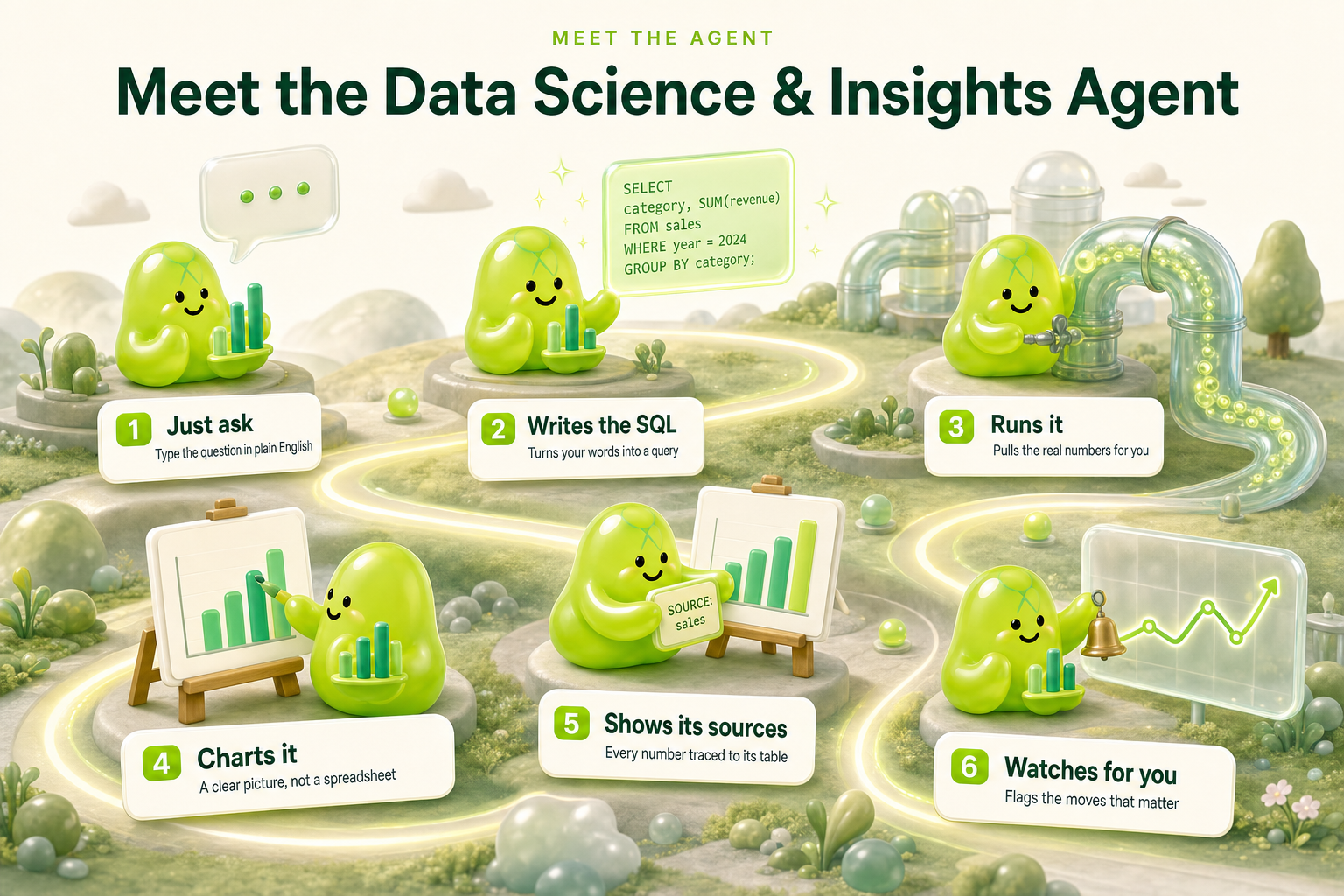
Anyone - not just the people who know SQL - asks a question in plain language and gets back a charted answer in seconds, with every fact cited down to the specific tables and columns it came from, so a number arrives with its receipts instead of as a black box you take on faith. It doesn't stop at what changed: when a metric moves, it digs into the segments and drivers behind it - the root-cause hunt that normally eats an analyst's afternoon. And it watches the numbers that matter, flagging a real shift on its own before it's buried in a dashboard nobody opened.
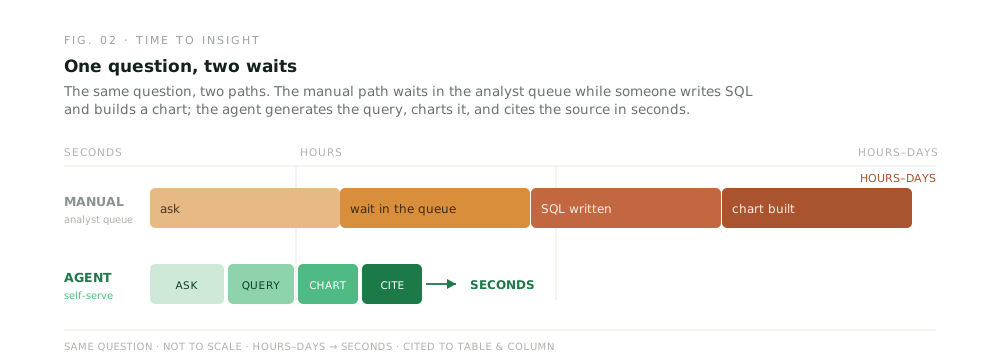
The shape of the win is a different bottleneck - none. What used to wait hours or days in an analyst's queue comes back in seconds, about as fast as you can ask for it. The team gets its week back for the hard problems only a human should own.
Here's the reframe: an insight isn't a chart you generated - it's a decision you can defend. That's why every answer is traceable. And the agent doesn't answer alone: the catalog agent supplies the provenance and the canonical metric definitions, the search agent pulls external context when the question needs it, and the quality agent vouches for the null rates, key uniqueness, and row counts of the tables underneath. An answer arrives backed by the rest of the swarm, not guessed in isolation.
A few of the agent's capabilities
The Data Science & Insights Agent ships with a deep toolkit. A sampling of what it can do:
| Capability | What it does |
|---|---|
| Ask in plain English | Turns an everyday question into a real query against your data - no SQL required. |
| Charted answers | Returns the answer already visualized, not a raw result set to format yourself. |
| Cited to the source | Shows the exact tables and columns behind every answer so you can trust and trace it. |
| Root-cause digging | Goes past what changed to the segments and drivers behind a move. |
| Metric watch | Keeps an eye on the numbers that matter and flags meaningful shifts on its own. |
| Scheduled insights | Delivers recurring answers and reports on a cadence you set. |
| Anomaly explanation | When a number looks off, investigates before it lets you act on it. |
| Analyst-backlog deflection | Absorbs routine asks so the team focuses on the hard problems. |
| Cross-stack answers | Answers across the warehouses and tools you actually run, not one walled garden. |
| Self-serve for everyone | Lets anyone get an answer without waiting on someone who can write SQL. |
…and these are just a few of many - the agent carries dozens more autonomy skills, with new ones added continuously.
How this is different from text-to-SQL
The "ask your data in English" space is crowded - and almost every entrant is anchored to one warehouse or one BI vendor.
Snowflake Cortex Analyst and Databricks Genie both produce strong, governed natural-language answers - but each runs only inside its own estate and leans on a hand-curated semantic model to stay accurate; they're excellent inside one cloud and structurally can't reason across your Snowflake and BigQuery and on-prem data at once. ThoughtSpot delivers deterministic, governed answers, but through a per-seat BI platform over data modeled in its own language. Wren AI is the open, multi-source exception, yet it's scoped to grounded text-to-SQL over one semantic layer - a context slice, not a proactive, multi-step insights agent. Tableau Pulse is genuinely ahead on proactive, pushed insights, but it's dashboard- and metric-definition-bound and aimed at the BI buyer.
Two gaps recur across all of them: heavy upfront semantic-model setup is the price of accuracy, and answers arrive without portable, cross-platform provenance you can trace back to every source you actually run. Our agent answers across the whole stack, shows its work down to the column, and doesn't stop at a chart when the real question is why.
The takeaway
The data team became a query queue because asking a question of the warehouse required someone who could write SQL - so every question waited on a person, and the people waited on each other. Self-service didn't fix it, because a wall of dashboards isn't an answer. What does fix it is an agent that takes the plain-English question, returns a charted answer in seconds, cites it to the source, and digs into the why - so the question and its answer stop being separated by a ticket. Everyone should be able to ask; the data team should be free to do the work only they can.
See it on your own warehouse
Ask it the question your team keeps pinging an analyst for - and watch it come back in seconds with a charted answer, cited to the exact tables and columns it came from. Book a demo to see it on your stack.