Inside the Data Ingestion Agent
The First Mile Nobody Wants to Own.
Re-running a load shouldn't double your data. Meet the agent that designs reliable raw landing - idempotent, deduplicated, and safe to re-run.

The most-rewritten code in your stack
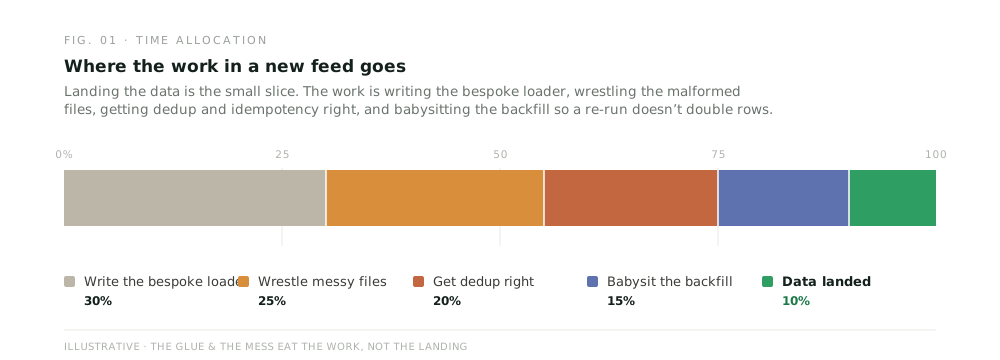
Getting data in is the first mile of every pipeline and the part nobody wants to own. On r/dataengineering it shows up as the same recurring misery: a client sends a CSV with shifting columns and encoding garbage that breaks the loader; schema inference guesses int one run and string the next and corrupts the bronze table; a re-sent file double-inserts because the load wasn't idempotent.
And the failure everyone fears most is the backfill: kick off a historical reload and babysit the terminal at 11pm, hoping it doesn't half-finish in a way you can't safely re-run. Every new source seems to need a brand-new bespoke loader, none of it reusable - so ingestion becomes the most fragile, least-owned, most-rewritten code in the whole stack.
What our Data Ingestion Agent actually does
The Data Ingestion Agent owns that first mile as an always-on data engineer: it shapes how raw sources land and hands a clean table to the rest of the stack.
A raw source goes from a file someone emailed to a clean, queryable landed table - without you hand-writing a one-off loader for every feed: the agent drafts the load for your team's loader to run. Re-running a load is safe: the agent designs ingestion to be idempotent and deduplicated by key, so a retry or a re-sent file doesn't double your rows - the failure mode everyone fears just stops being one. Backfills you don't have to babysit: the agent queues the historical reload as an orchestrator rerun, reads its status as it runs, and writes the undo step down before it starts. The feed survives the source moving under you - when an upstream API hiccups or an outage hits, a row-count baseline flags the stalled feed and the owner gets the rerun with full context, rather than a gap to find tomorrow. And schema inference is something you can trust and correct, not a black box that silently flips a column's type and corrupts the table.
This is deliberately the batch-and-file first mile: the connectors agent owns the connection endpoints, the streaming agent owns real-time topologies, and Ingest owns the design of getting bytes safely onto the ground. The shape of the win isn't a benchmark - it's a different relationship with your messiest code: a re-run that doesn't double your rows, a backfill you start and walk away from, a feed that survives the source changing.
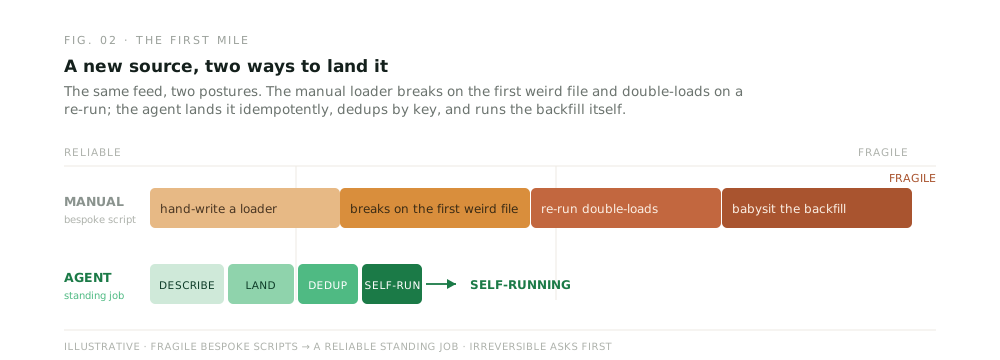
Here's the reframe: ingestion isn't a script you write once and pray over - it's a reversible, idempotent operation your loader runs and re-runs without breaking your numbers. And the agent hands off cleanly: a landed table goes to the pipeline agent for modeling, the lineage edge is recorded so the rest of the swarm reacts to the new feed, and the quality agent starts watching it - the same way a real data team divides the work.
A few of the agent's capabilities
The Data Ingestion Agent ships with a deep toolkit. A sampling of what it can do:
| Capability | What it does |
|---|---|
| Raw landing design | Designs how a new source lands as raw, queryable data in your platform, for your loader to run. |
| Idempotent loads | Re-running a load doesn't double your data; the same file or sync applied twice lands once. |
| Dedup on reload | Builds dedupe-by-primary-key into the load so at-least-once sources and re-sent files don't inflate row counts. |
| Schema inference | Infers types and structure from messy CSV and JSON, with hints and corrections instead of silent wrong guesses. |
| Reversible backfills | Queues historical reloads as orchestrator reruns, reads their status, and records the undo step before they start. |
| Stalled-feed alerts | Flags a failed or stalled feed from its row-count baseline and hands the owner the rerun with context. |
| Malformed-row handling | Designs the load to quarantine bad records instead of failing the whole load on one broken line. |
| High-volume file landing | Plans file landing so thousands of files load reliably and only the failed ones are retried. |
| Governed credentials | Pulls source credentials by reference through a secret broker - never pasted into a prompt or log. |
| Lineage on landing | Records the source-to-landed-table edge so the rest of the swarm reacts to the new feed. |
…and these are just a few of many - the agent carries dozens more autonomy skills, with new ones added continuously.
How this is different from an ELT loader
The incumbents of getting data in are genuinely good at moving bytes, and we don't pretend otherwise.
Fivetran runs hundreds of certified connectors that auto-evolve the destination schema and checkpoint-resume failed syncs - industrial-grade plumbing - but it stops at landing the data in one destination, charges usage-based premiums, and offers no natural-language way to stand a feed up. Airbyte wins on raw connector breadth, open-source and self-hostable, but it's a connector library you operate, not an agent that designs, dedupes, and watches the load for you. dlt nails the code-first path - schema inference, normalization, incremental loading - but it's a Python library for the code-comfortable, not an autonomous operator. And the most common "competitor" of all is a folder of custom scripts that rot, need re-patching for every new file shape, and have no idempotency or reroute logic.
Where the Data Ingestion Agent differs is that it sits above these as an autonomous data engineer - describe the feed, get an idempotent load design, queue reversible backfills through your orchestrator, flag stalled feeds for their owners, and feed a shared lineage graph the rest of the swarm reacts to.
The takeaway
The first mile stayed everyone's least-favorite chore because we treated each source as a fresh script to write and babysit - fragile, bespoke, and broken by the first malformed file. Turning landing into a reliable standing job - idempotent, deduplicated, safe to re-run, watched for stalls - is what frees a data team from hand-watching the most thankless code they own. Re-running a load should never double your data - and getting a source in should never need a brand-new script.
See it on your own sources
Point the agent at the messy feed you keep re-patching - and watch it design an idempotent load, dedupe it by key, and queue the backfill through your orchestrator, without anyone babysitting a terminal. Book a demo to see it on your stack.