Inside the Connectors Agent
Nobody Gets Promoted for Maintaining a Connector.
Integration is the tax every data team pays and nobody owns. Meet the agent that turns a drawer of brittle connectors into one endpoint the whole swarm runs on.
The tax nobody owns
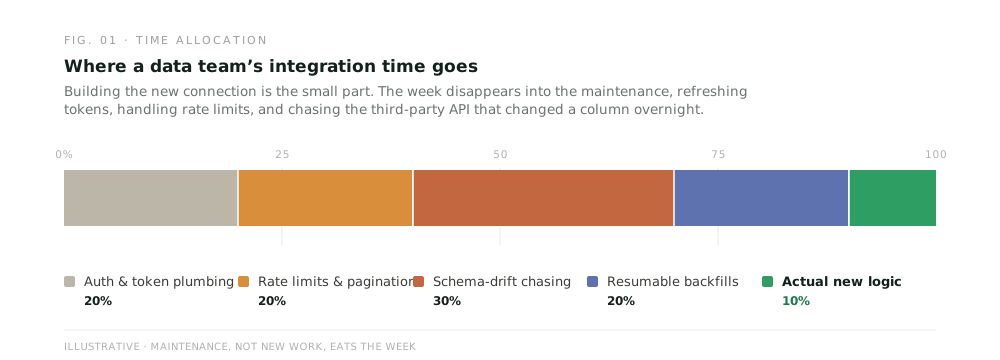
Scroll r/dataengineering and the same quiet grievance shows up under a dozen titles: a surprise Fivetran bill after an unexpected source change, Airbyte syncs that break for no clear reason, a custom connector for a multi-step API that someone now has to maintain forever. Nobody got promoted for any of it. Integration is the tax every data team pays and no one owns.
The work that eats the week isn't the interesting part - it's the plumbing: refreshing auth tokens, handling rate limits and pagination, chasing the third-party API that changed a column and broke a pipeline, restarting a backfill that died halfway. And the pricing models punish you for it - metered per row, so a silent schema change upstream becomes a surprise overage bill downstream.
What our Connectors Agent actually does
The Connectors Agent isn't trying to win the pipe - it's the shared connection layer the rest of the swarm stands on.
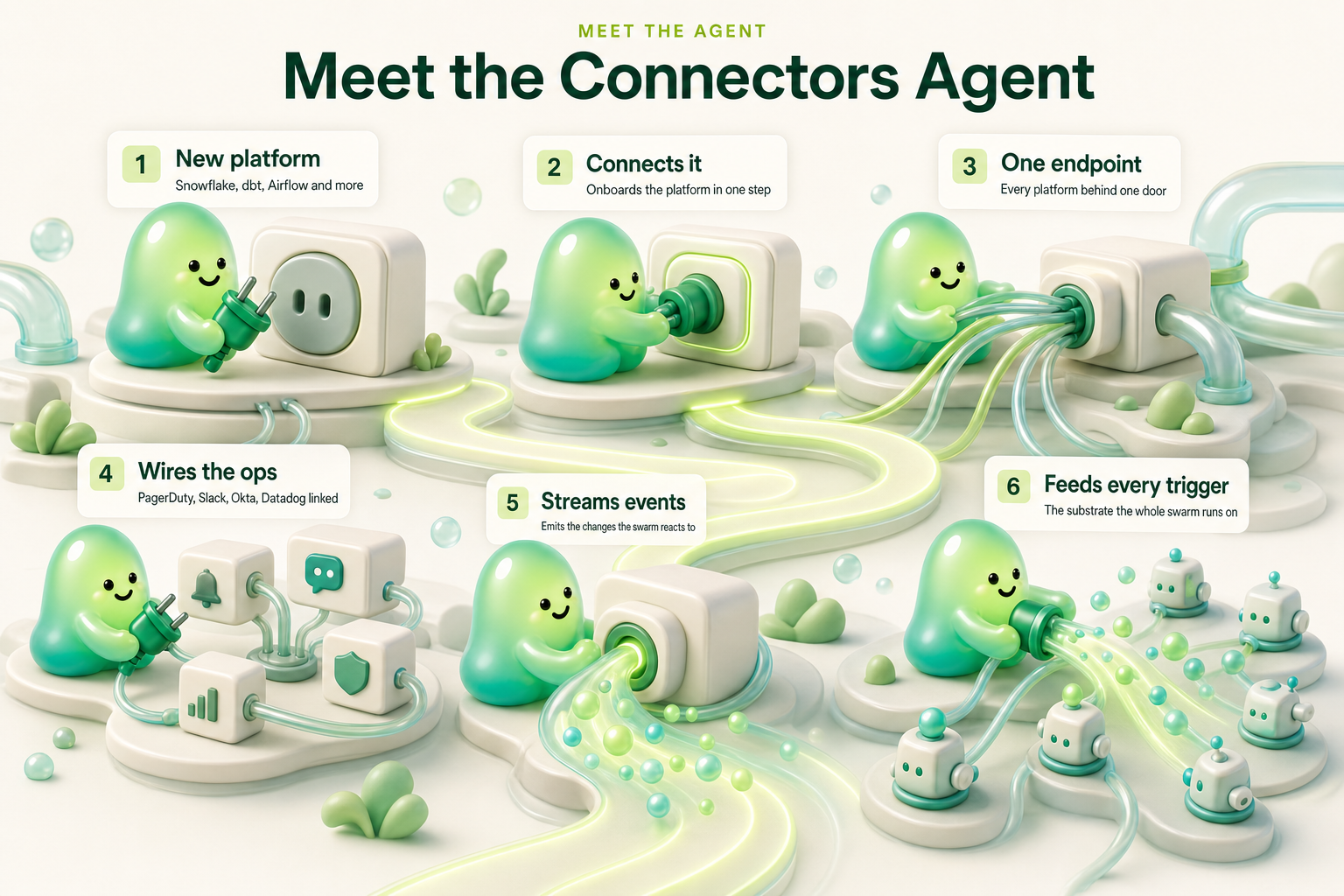
It gives your agents and your team one endpoint to every system - warehouse, transformation, BI, catalog, orchestrator, the enterprise ops stack - instead of a drawer full of one-off scripts each team has to keep alive. The unglamorous failure modes that quietly eat a data team's week - auth refresh, rate limits, pagination, retries - are handled beneath the surface, so nobody's hand-patching a connector at 2 AM. Connect a source once and the whole swarm wakes up to it: incidents, quality, cost, and catalog immediately start seeing it, with no separate wiring step. And change becomes an event, not a surprise - a failed check, a dbt manifest diff, or an orchestrator run that dies arrives as an event the swarm reacts to, instead of a dashboard breaking first.
The shape of the win isn't more connectors - it's that integration stops being a cost center you meter and becomes shared infrastructure your autonomous workforce runs on. Connect once, and the plumbing stops being your problem.
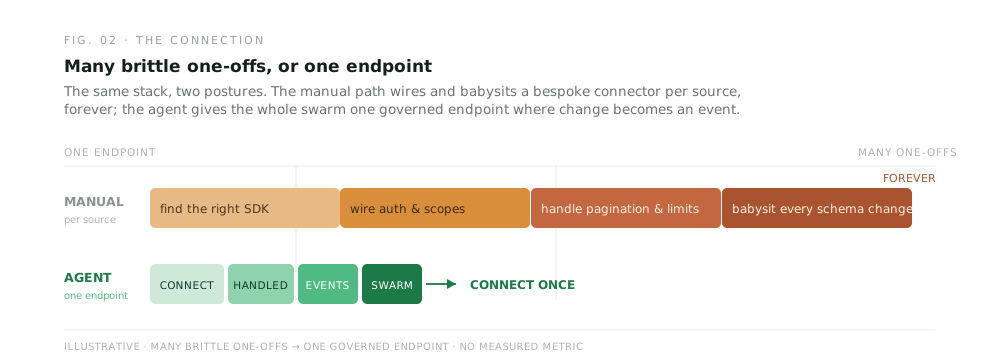
Here's the reframe: a connector isn't a pipe that moves data once - it's a live nerve ending that tells the whole swarm the moment something changes. That's why it's the substrate the others stand on: the change-event stream it emits is what fires every standing trigger - the incident agent's watch, the schema agent's blast-radius map, the quality agent's re-check. Integration isn't a thing you maintain on the side; it's the nervous system the workforce runs on.
A few of the agent's capabilities
The Connectors Agent ships with a deep toolkit. A sampling of what it can do:
| Capability | What it does |
|---|---|
| One unified endpoint | Every connected system - warehouse, transformation, BI, catalog, ops - reachable through a single connection. |
| Warehouse & transformation connectivity | Connects the core analytics stack so agents can read and act there. |
| Catalogs side by side | Catalogs stay the team's inventory and connect over their API or MCP server today, with Unity Catalog grants applied after approval. |
| Enterprise ops integrations | Reaches the operational stack - orchestrators, paging, chat, identity, telemetry - so the swarm can act where work happens. |
| Change-event stream | Emits the change stream that fires every standing trigger across the swarm. |
| One-step source onboarding | Connecting a new platform immediately starts feeding the rest of the agents - no separate wiring. |
| Auth & credential handling | Manages the connection details - tokens, refresh, scopes - beneath the surface. |
| Resilient sync mechanics | Handles the brittle parts - rate limits, pagination, retries - so reads survive real-world APIs. |
| Schema-drift awareness | Surfaces a shape change from the dbt manifest diff or the pull request that makes it, instead of letting it break silently downstream. |
| Ecosystem interoperability | Speaks neutral connector contracts so existing connector ecosystems can be inherited rather than rebuilt. |
…and these are just a few of many - the connection layer spans warehouses, orchestrators, and the enterprise ops stack, with new integrations added continuously.
How this is different from an ELT connector tool
The integration space splits three ways - and our position is to consume it, not out-build it.
Fivetran is genuinely excellent at the reliability-critical plumbing - managed connectors that auto-evolve the destination schema, lossless type handling, checkpoint-resume - but it's batch-first, locks you into its stack, meters you per monthly-active-row (the source of those surprise-bill threads), and stops at the load: it lands the data and hands you a dashboard, it doesn't resolve what breaks downstream. Airbyte owns the biggest open-source connector library, but it's a connector library, not an operations platform - infrastructure agents consume, with real reliability complaints and a self-hosting burden. Meltano and Singer give a mature, vendor-neutral, versioned connector contract, but it's integration plumbing, not an agent system; there's no autonomous execution layer after the load.
The mature vendors ship hundreds of loaders, and Data Workers is built to work with them rather than race them: native connectors cover the systems agents act on (Snowflake, Databricks, BigQuery, PostgreSQL, dbt, Airflow, Dagster, Kafka, PagerDuty, ServiceNow, Okta, and more), and everything else connects over its API or MCP server today. So the counter isn't a connector arms race; it's interoperability. Speak the neutral connector contract, inherit the ecosystem's connectors, and win on everything that happens after the data lands - autonomy, governance, and the change-event substrate none of them treat the connection as.
The takeaway
Integration stayed a tax because we treated each connector as a separate thing to build and babysit - metered per row, broken by every upstream change, owned by no one. Turning the connection layer into shared substrate - one endpoint, plumbing handled, every change an event the swarm reacts to - is what frees a data team from holding it all together by hand. Data Workers inherits the ecosystem's connectors rather than out-building them, and win on what happens after the data lands. The connection was never supposed to be the job - it was supposed to be the thing everything else runs on.
See it on your own stack
Point the agent at the sources you're tired of babysitting - and watch the whole swarm wake up to them through one endpoint, with the auth, pagination, and retry plumbing handled beneath the surface. Book a demo to see it on your stack.