Inside the Incident Debugging Agent
Nobody Should Be Up at 3 AM Debugging a Pipeline.
When a pipeline breaks, the clock starts and someone's phone buzzes. Meet the agent that detects the failure, traces the root cause, and queues the fix for the reversible ones before anyone has to wake up.
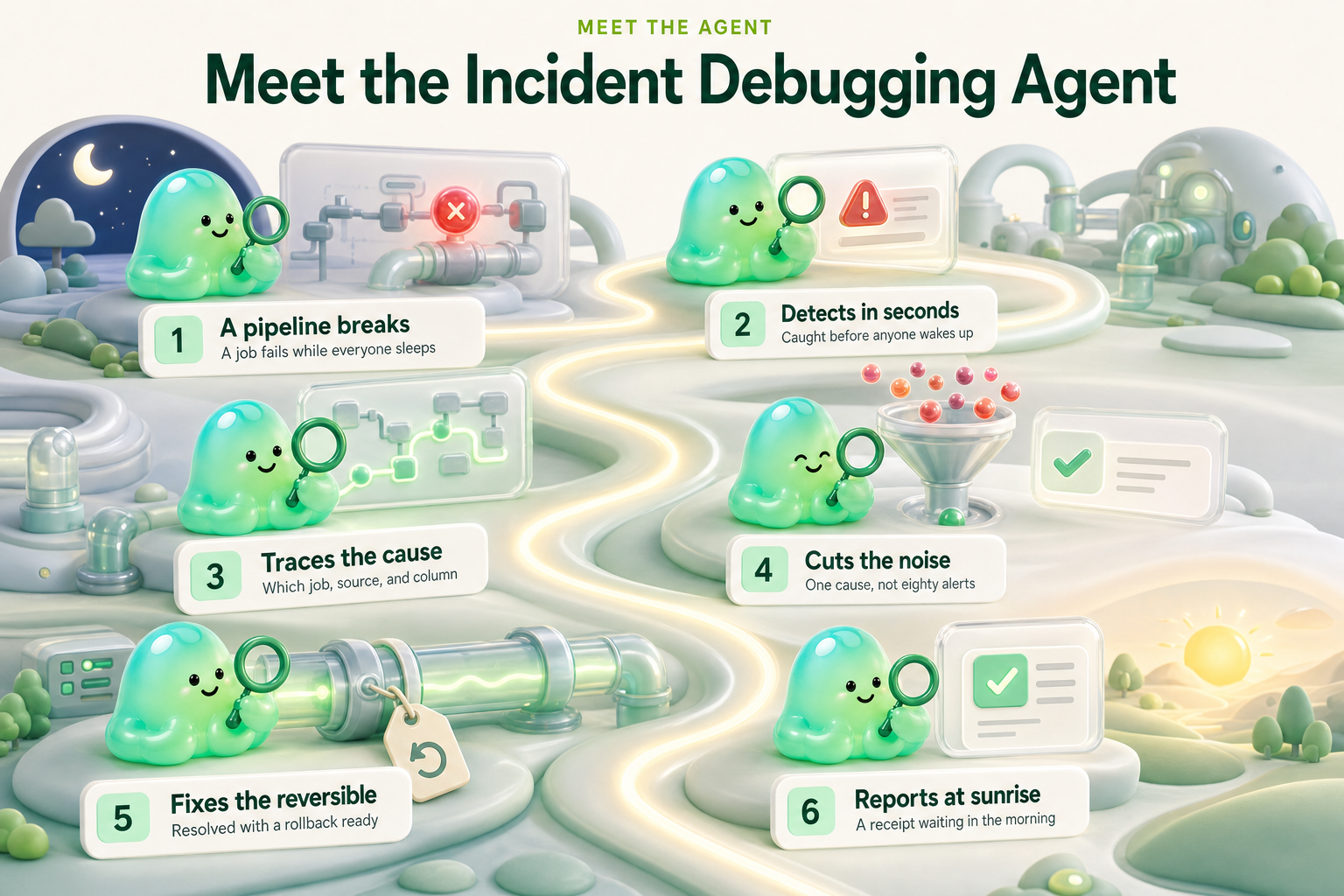
The pager goes off at 3 AM
Spend any time in r/dataengineering and one thread keeps resurfacing in different words: are data engineers on-call now? The answers are weary and unanimous - yes, and it's the part of the job nobody warns you about. A pipeline fails overnight, a phone buzzes, and someone half-awake starts opening dashboards and tailing logs to figure out what broke and why.
The pain isn't really the fix - it's everything before it. The alert tells you something is wrong, not what. So the night becomes a root-cause hunt: which job, which source, which column, what changed upstream. People post asking how others even debug their pipelines, because the honest answer is "slowly, by hand, at the worst possible hour." And underneath the acute incidents is a quieter horror that shows up in its own genre of thread: we discovered the data had been wrong for months. No alert ever fired. Someone just happened to notice.
Then there's the noise. The teams that do wire up alerts drown in them - fifty, a hundred a day - until the one that matters is buried in a pile of flapping warnings nobody reads anymore. On-call burnout threads read like a support group. The tooling tells you the house is on fire; it just doesn't pick up a hose.
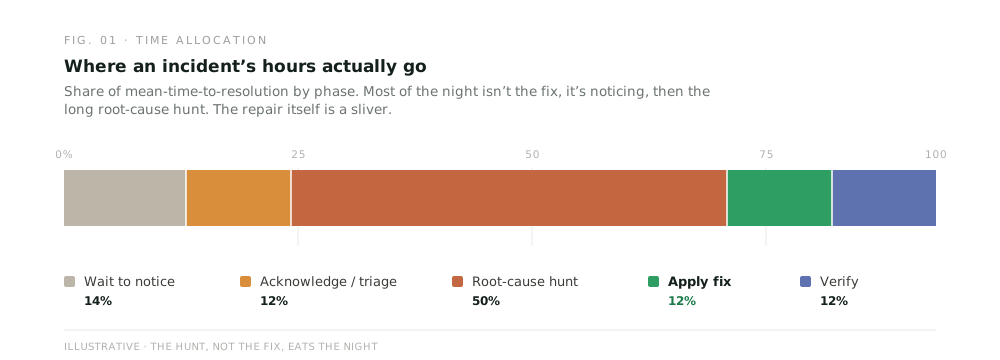
What our Incident Debugging Agent actually does
The Incident Debugging Agent watches your pipelines continuously, and when something breaks it doesn't just page you - it goes to work.
It notices the failure within about a minute of the run, traces the root cause across the systems and logs involved, and classifies what kind of incident it is - an upstream schema change, a late source, a resource limit, a regression. For the large class of failures that are safely reversible - a retry, a backfill - it queues the rerun through your orchestrator, re-checks the quality assertions when it lands, escalates to a person if they fail, and tells you what it did after the fact. For the genuinely novel break it hasn't seen before, it writes up a full diagnosis with recommended actions and hands it to your team to approve. And the recurring flaky job that pages you every other Tuesday? It learns the pattern, so next time it resolves on its own. Because it tracks the baselines your team records, it also catches the slow drift that never trips a normal alert - the silently-wrong data that otherwise surfaces months later, after a hundred decisions have already been made on it.
The shape of the win is a different kind of night. What used to be a four-to-eight-hour root-cause marathon becomes minutes for the patterns the agent already knows, the majority of reversible incidents never reach a human at all, and after-hours pages drop dramatically. The alert that used to start your night now arrives as a note saying it's already handled.
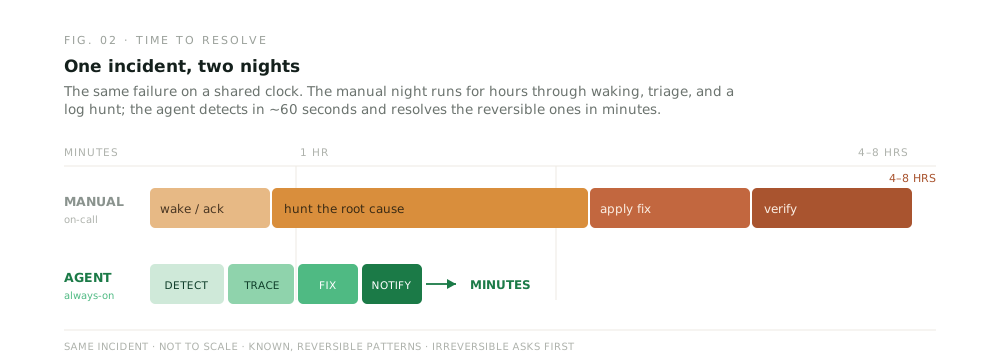
Here's the pattern we keep coming back to: an incident isn't an alert to route - it's a problem to resolve. Detection was never the hard part; the hard part is everything between "something's wrong" and "it's fixed," and that's exactly the gap a human gets stuck in at 3 AM. And the agent doesn't work alone: when the cause is an upstream schema change, the schema agent maps the blast radius; when it's bad data, the quality agent is already on it; the observability agent watches the whole swarm. Incident response sits inside a team that shares one picture of your stack - not a pager that just forwards the problem to you.
A few of the agent's capabilities
The Incident Debugging Agent ships with a deep toolkit. A sampling of what it can do:
| Capability | What it does |
|---|---|
| Anomaly detection | Spots a broken or anomalous run within about 60 seconds. |
| Root-cause tracing | Follows the failure across systems, logs, and lineage to its source. |
| Incident classification | Sorts each failure: schema change, source delay, resource exhaustion, regression. |
| Auto-remediation | Queues reversible fixes - reruns and backfills - through your orchestrator, then re-checks the result. |
| Pattern learning | Recurring flaky jobs resolve automatically the next time they happen. |
| Novel-incident diagnosis | Produces a full diagnosis plus recommended actions for your team to approve. |
| Alert de-duplication | Collapses a storm of related alerts into one root-cause incident. |
| Owner routing | Routes the incident to the person or team who actually owns it. |
| Human-gated safety | Irreversible actions always ask first; every action is logged. |
| Swarm hand-off | Loops in the schema, quality, and observability agents when a cause crosses domains. |
…and these are just a few of many - the agent carries dozens more autonomy skills, with new ones added continuously.
How this is different from data observability
There's a whole category of good tools that watch your data and tell you when it breaks. The gap isn't detection - it's the fix.
Data-observability platforms are genuinely excellent at noticing: they profile your tables, learn what normal looks like, and fire a sharp, well-ranked alert when something drifts. But that's where they stop - they tell a human a table is broken and route the ticket, usually inside a single warehouse. The detection is the ceiling; the resolution is still your night. Incident and paging tools sit one step further out and are great at getting the alert to the right person - but they route the page, they don't diagnose the data behind it. Either way, a human still does the hunting and the fixing.
Our agent closes that gap. It detects and resolves: it traces the cause, queues the fix for the reversible incidents itself, gates the irreversible ones for a human, and does it across whatever clouds you actually run - as one member of a swarm that shares context instead of a tool that hands you a worklist. Observability tells you what broke. The agent gets it fixed.
The takeaway
On-call for data became a rite of passage because the tooling stopped at the alert: it could tell you the house was on fire but couldn't pick up a hose. That's a strange place to have left things. Detection was always the easy half; the hard, lonely, 3 AM half is the hunt and the fix - and that's the half an agent should own. Let it queue the fix for the reversible majority on its own, learn the recurring breaks, and hand a human only the genuinely novel call with a diagnosis already attached, and on-call stops being a tax on your best engineers. The alert that used to start your night should arrive saying it's already handled.
See it on your own stack
Point the agent at the pipeline that paged you last - and watch it detect the break, trace the cause, and queue the fix for the reversible ones before anyone reaches for a laptop. Book a demo to see it on your stack.