Inside the Conductor Agent
Nobody Owns the Whole Workflow - So We Built One That Does.
Your stack has twenty tools and no conductor. Meet the agent that routes each job to the right specialist, sequences the cross-team fix, and asks a human only on the irreversible.
Twenty tools and no conductor
Two complaints run through r/dataengineering like a bass line. One: the orchestration layer - the Airflow DAGs, the tangle of jobs - has quietly become its own full-time job. Two: when something breaks across pipelines, schema, and governance, nobody owns the whole thing; the fix bounces between teams while each waits on the other. The modern data stack has twenty tools and no conductor.
The newer version of the pain comes from agents themselves. Multi-agent demos look like magic and then, in production, the agents loop, oscillate handoffs, and never agree they're done. Whether the workers are humans or agents, the missing piece is the same: someone to decide what should run, who should run it, in what order - and where a human absolutely must sign off.
What our Conductor Agent actually does
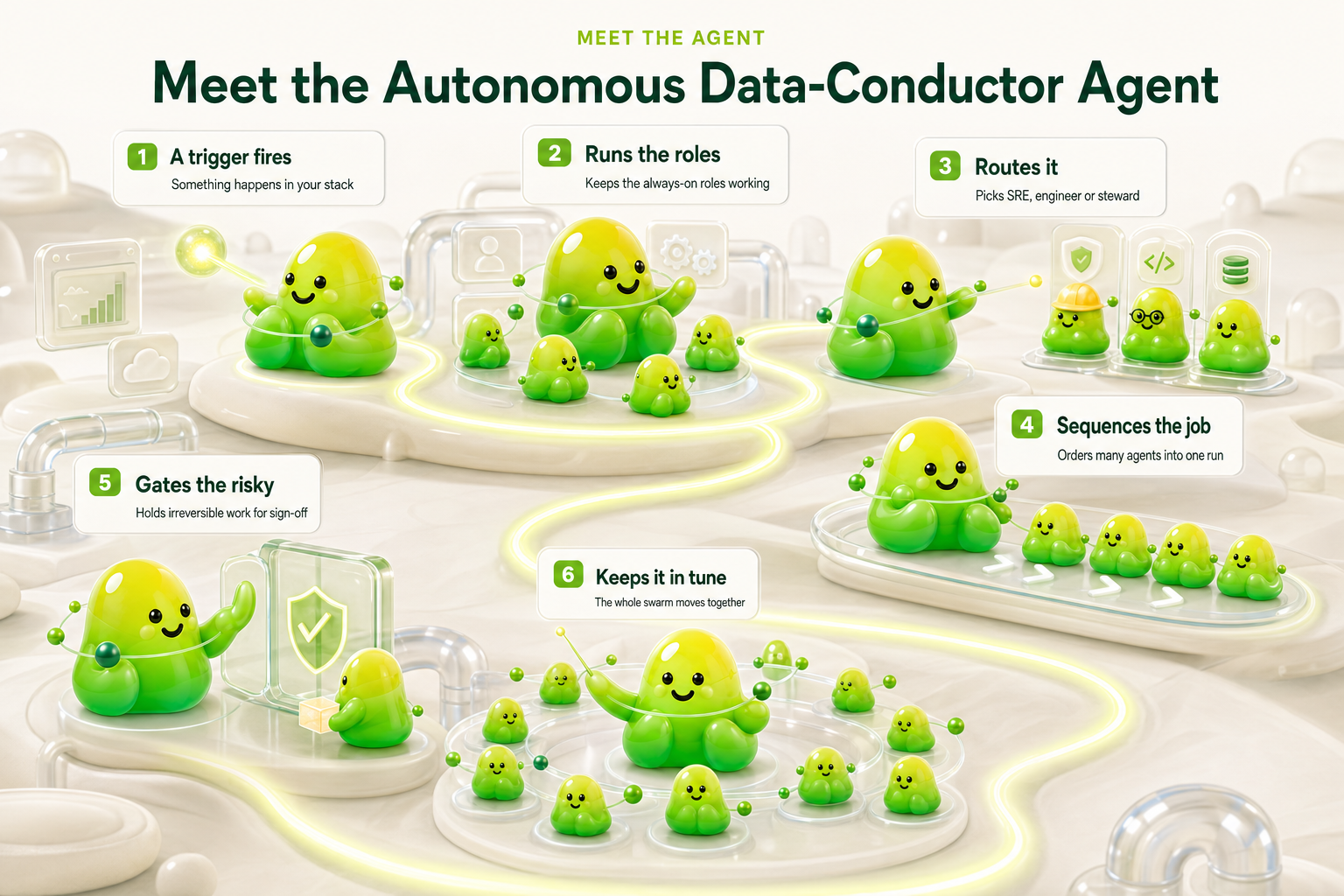
The Conductor is the swarm's control plane - one front door to a whole workforce of agents, so you never have to know which one does what.
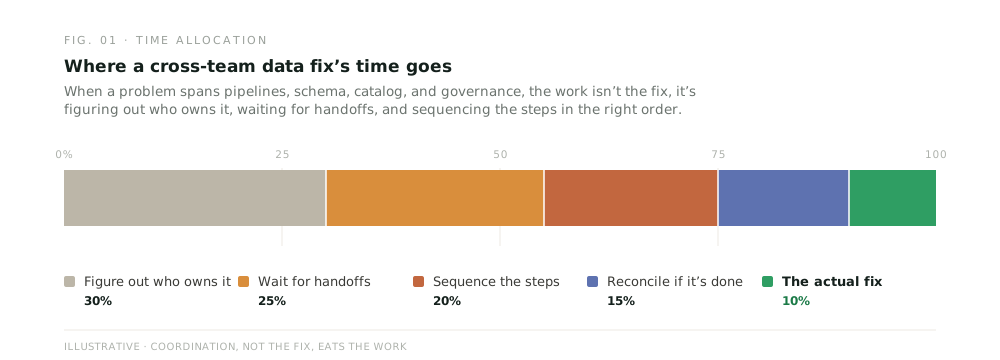
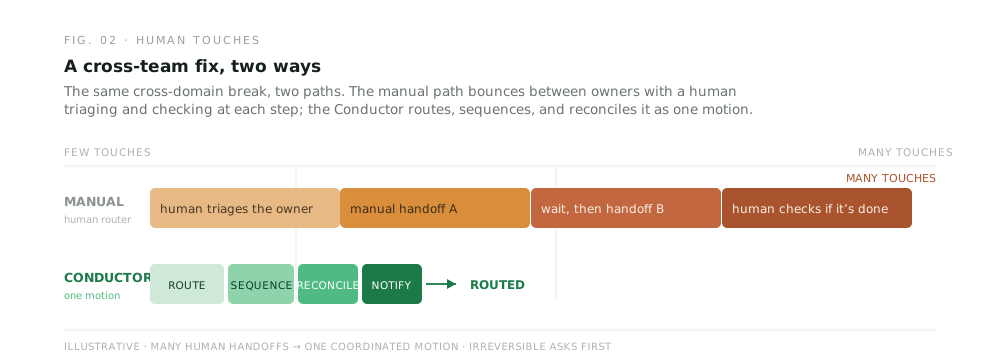
You describe what you need, or an event fires, and the Conductor decides which specialist should handle it and gets it done. When a problem spans pipelines, schema, catalog, and governance, it sequences the right specialists in the right order and reconciles their work into one closed-out result - instead of you fanning the fix out across owners by hand. It runs around the clock as a standing workforce of always-on roles, not a button you press, keeping routine reversible work moving on its own. And it's loud only when it should be: it acts quietly on the reversible majority and stops to ask a named human before anything irreversible - money, deletion, access grants - never silently. You hold one switch and a Stop: autonomy is something you turn on after a short onboarding and can pause instantly, and everything it does is recorded, with its undo step written down before it acts.
The shape of the win is the coordination disappearing. The handoffs, the sequencing, and the who-owns-this triage that used to bounce between teams happen as one motion - with a human asked only on the irreversible few.
Here's the reframe: orchestration isn't a schedule you write - it's a judgment you delegate. The question was never "when does this task run," it was "who should own this, in what order, and where does a human have to sign off." That's why the Conductor sits above the specialists rather than beside them: every other agent in the swarm is a worker; the Conductor is the one that decides which of them moves, and when to stop and ask you.
A few of the agent's capabilities
The Conductor Agent ships with a deep toolkit. A sampling of what it can do:
| Capability | What it does |
|---|---|
| Work routing | Decides which specialist agent should handle each request or event, so you never have to know the swarm's org chart. |
| Cross-domain sequencing | Orders a multi-agent job so steps run in the right dependency order, not all at once. |
| Closed-loop reconciliation | Gathers the results of a fanned-out job into one record and closes it only when every step actually succeeded. |
| Act-vs-ask decisioning | Routes by consequence: acts quietly on reversible, low-blast work; stops to ask a human on the irreversible. |
| Hard human floor | Holds money, deletion, and access-grant actions for explicit named sign-off, in every mode, with no override. |
| Always-on standing workforce | Runs a set of continuous roles that keep routine work moving around the clock instead of waiting to be invoked. |
| One-switch autonomy | Lets you turn autonomy on or off after a short onboarding, revocable at any time. |
| Instant Stop / pause | Freezes every autonomous action immediately without losing state - a first-class kill switch. |
| Self-tightening safety | Pulls back and re-asks for approval the moment a run misbehaves - a failed check, a rising undo rate, an anomaly. |
| Recorded & reversible | Stamps every action with who-did-what provenance and its recorded undo step, so nothing it does is a black box. |
…and these are just a few of many - the agent carries dozens more autonomy skills, with new ones added continuously.
How this is different from an orchestrator
There are two camps near this problem, and the Conductor sits above both.
Classic orchestrators - Airflow, Dagster, Prefect - are the road, not the driver: they schedule, retry, and track state for pipelines a human already authored, but they have no opinion about what should run or whether a proposed fix is correct; when a DAG fails, they page a person. The agent-framework camp - LangGraph, CrewAI, AutoGen - gives developers real building blocks for multi-agent flows, but it pushes the hard part onto you: coordination overhead that scales badly with agent count, and the documented failure modes - loops, oscillating handoffs, no completion detection - that make "multi-agent" feel like chaos in production.
None of them ships a governed control plane with a built-in act-vs-ask line, a hard human floor on irreversible actions, blast-radius-aware sequencing, and a swarm of domain specialists already wired behind it. The Conductor's wedge is being the judgment-and-governance layer on top of the orchestration and agent-framework substrate - not another framework you have to assemble.
The takeaway
The data stack accreted twenty specialized tools and never added the one role that ties them together - so a human became the router, and the orchestration layer became its own full-time job. A control plane that decides what runs, routes it to the right specialist, sequences the cross-team fix, and stops to ask only on the irreversible is what turns a pile of tools into a workforce. The work was never supposed to wait on a human to carry it between tools - that was always the machine's job.
See it run your swarm
Point the Conductor at a cross-team problem you'd normally chase across four owners - and watch it route, sequence, and reconcile the fix as one motion, pausing only where a human must sign off. Book a demo to see it on your stack.