AI agents hallucinate. How does Data Workers get it right on our data?
Data Workers grounds every answer and action in governed context read from your systems, checks claims against the warehouse, flags or refuses when context is missing or contradictory, verifies every change and leaves a receipt.
Data Workers grounds every answer and every action in governed context it reads from your own systems (metric definitions with owners, lineage, freshness and quality) instead of the model's memory, and it checks claims against your warehouse before it acts. When context is missing or contradictory it flags the gap or declines to answer, it verifies the result after every change, and it leaves a receipt that shows the evidence.
A model on its own guesses when it is unsure. Data Workers, the agentic data platform, is built so the model never has to: the facts come from your catalog, semantic layer, warehouse and pipelines, and every number it gives you can be traced back to them.
Key takeaways
- •Hallucination on data is mostly a context problem. Public text-to-SQL research shows models fail on real databases because of dirty values, missing business knowledge, ambiguity and stale or conflicting definitions. Data Workers supplies that context from your systems on every call.
- •Definitions come from your semantic layer, with an owner. "ARR" resolves to the canonical metric your team approved, and when two definitions disagree, Data Workers shows both and sends the conflict to a person.
- •Freshness and quality are checked before an answer ships. A stale or anomalous source turns a confident answer into a flagged one.
- •The answer is re-checked against the warehouse. Data Workers re-runs the query read-only and sends back any answer that does not match what the data returns, with the executed value.
- •Every answer and change carries a receipt. Each answer carries its trust verdict and the reasons behind it, and every tool call, its inputs, its outcome and the named approver of any change sit in a tamper-evident audit log your team can read.
Why models get data questions wrong
The research is clear and public. BIRD (NeurIPS 2023), a text-to-SQL benchmark of 12,751 questions over 95 databases totalling 33.4 GB, found the most effective model it tested reached 40.08% execution accuracy against 92.96% for people, and named dirty database values and the external knowledge that links a question to the data as the hard parts. Spider 2.0 (ICLR 2025), built from enterprise workflows on BigQuery, Snowflake and other systems with tables that often exceed 1,000 columns, reported that a code agent built on o1-preview solved 21.3% of tasks, and that solving them needs metadata, dialect docs and project code. TrustSQL defines a reliable system as one that answers feasible questions correctly and abstains on the rest, because without abstention wrong SQL goes unnoticed. AMBROSIA (NeurIPS 2024 Datasets and Benchmarks) shows ambiguity survives even when the model can see the database. And researchers at OpenAI and Georgia Tech argued in September 2025 that models hallucinate because training and evaluation reward guessing over saying "I'm not sure".
These are third-party results about language models in general. Read together, they describe the fix: give the model the business context it lacks, check the data it is reasoning over, let it say "I don't know", and verify the output. That is the product Data Workers is. Our why AI agents hallucinate on your data post covers the causes in depth; this page shows the mechanisms.
How Data Workers grounds every answer
We describe these from the product itself: the data-workers-agent-swarm repository, the public tools in the open-source repo, and the live Data Context Wizard, Autonomous Data-Conductor and Spellbook Data Catalog (in preview) pages.
1. One governed context graph, read from your systems. Data Context Wizard builds one context graph across your warehouses, catalogs, semantic layers, pipelines and BI. It holds what each asset means, who owns it, where it comes from and what reads it. When you already run a semantic layer or ontology, it plugs in as a first-class source with its provenance kept; bring your own context explains how.
2. Definitions resolved, never guessed. resolve_metric maps a business term like "ARR" or "churn rate" to its canonical semantic-layer definition, and when several definitions match it returns every candidate for disambiguation instead of picking one silently. list_semantic_definitions shows the full set. Metrics your team has promoted to canonical compile to the same SQL every time, with no model in that path, so a governed KPI cannot drift between two questions.
3. A trust score on every table. explain_table returns a table's definition, lineage, documentation and a trust score. The score blends quality (30%), freshness (25%), documentation coverage, usage and owner responsiveness (15% each). a monitor_metrics baseline on load times shows freshness against the SLA you set, and get_quality_score from the quality agent covers data quality. Agents read these before they trust a number.
4. Contradictions surfaced to a person. Data Workers compares definitions across catalogs and clouds and flags a metric defined two ways, with the downstream assets each version feeds. Each contradiction goes to the Spellbook inbox for review and is never promoted automatically. Applying the agreed definition takes a named human approver and runs through the governed write path: PII scrub, tenant isolation, an authority check and the hash-chained log.
5. A trust gate before the answer ships. Before an answer goes out, the agent hands the signals it gathered to a trust gate: lineage distance from raw data, freshness, active anomalies, how much of the query resolved to canonical definitions and, when several queries were generated, how far their results agreed. The gate returns one verdict (ok, warn or block) with its reasons, across every catalog the answer spans. An aggregated measure with no canonical definition, or a query that mostly guessed, blocks the answer. When independently generated queries disagree with no majority, the gate treats that as a refusal, so the user hears "I can't confirm this" instead of a confident guess. Stale data, an active anomaly or an opaque derivation adds a warning the reader sees.
6. The answer re-checked against the warehouse. Data Workers re-runs the agent's own query read-only against your warehouse and cross-checks the proposed answer against the result and against the grounded constraints (the right grain, the right grouping, the right population). On a mismatch it returns the executed value and forces a new answer instead of a confident wrong one. All answer SQL passes a read-only guard.
7. Corrections remembered. When someone on your team corrects an answer, the correction is stored with its provenance and reused as a worked example for later SQL. Once a named person approves it, it becomes an enforced fact. With correction enforcement switched on, later catalog results that contradict it are flagged, or blocked if that is the policy you set, and each check leaves a receipt.
8. Verification and a receipt for every change. When the right response is to fix data, the fix runs through the same controls described in is it safe to let AI agents change production data?: scoped access, blast_radius_analysis, approval at the domain's autonomy level, a rollback plan, post-checks, and an entry in a SHA-256 hash-chained audit log your auditors read through get_audit_trail.
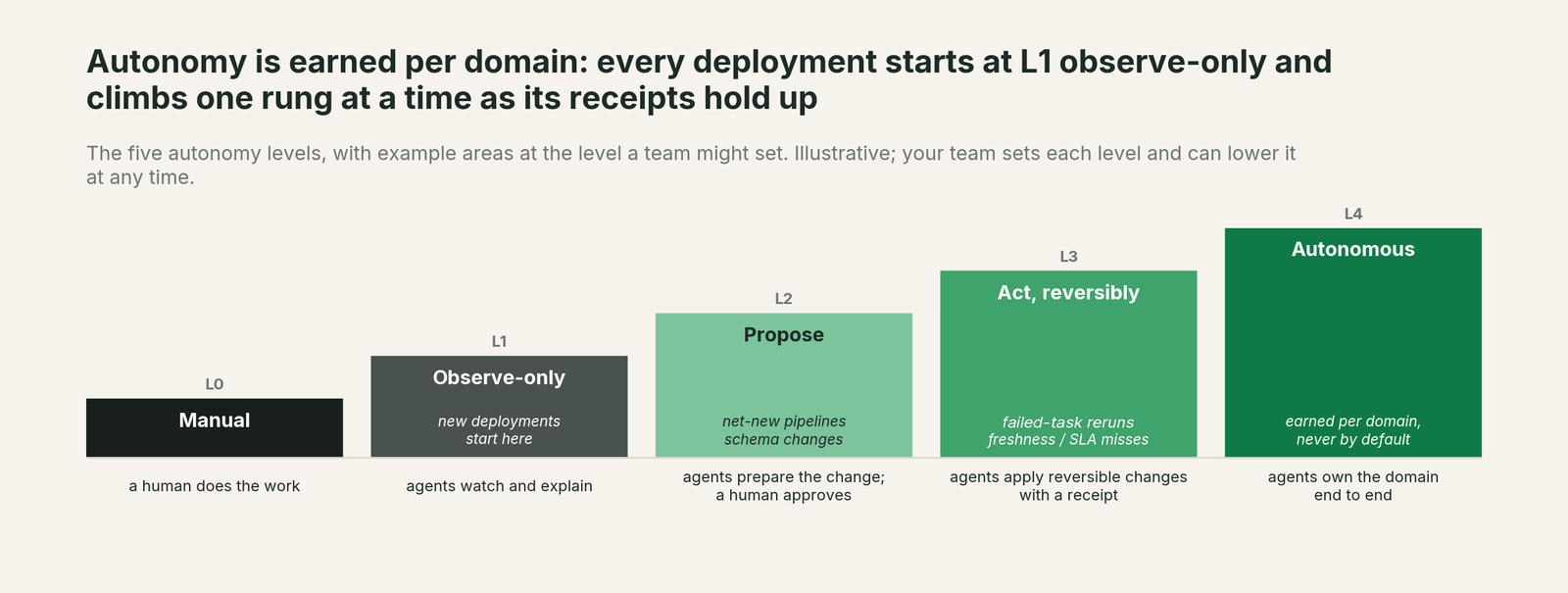
Answering a question sits at L1 observe. Fixing what it uncovers climbs the same ladder you set per domain: L0 manual, L1 observe, L2 propose, L3 act reversibly, L4 autonomous.
One worked example: "Why did ARR drop?"
This is an illustration, not a customer case. A chief of staff asks Claude, connected to Data Workers over MCP, why ARR fell 4% this week. The honest answer turns out to be about the data, not the business.
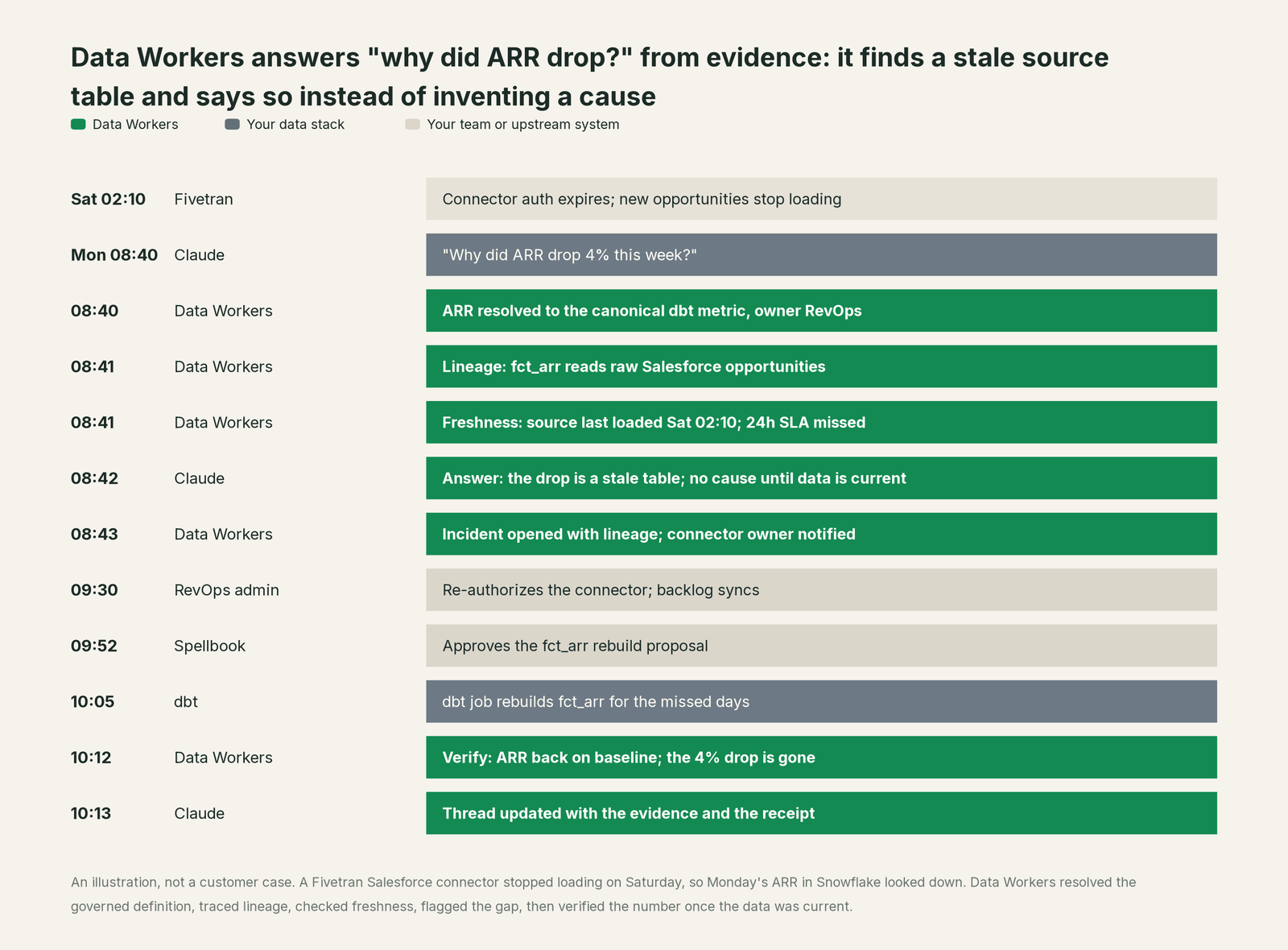
| Step | What Data Workers checked | What it found |
|---|---|---|
| Definition | resolve_metric on "ARR" | One canonical dbt Semantic Layer metric, owned by RevOps |
| Lineage | trace_cross_platform_lineage from the metric | fct_arr in Snowflake reads raw Salesforce opportunities loaded by Fivetran |
| Freshness | monitor_metrics load baseline on the source table | Last loaded Saturday 02:10; the 24-hour SLA was missed |
| Trust gate | Freshness, lineage and definition coverage | Warn: the answer rests on stale data |
| Answer | What it told the user | "The drop reflects a stale source table. Renewals since Saturday are not loaded yet, so I won't name a business cause until the data is current." |
| Incident | diagnose_incident, owner notified | The Fivetran connector stopped on an expired authorization |
| Fix | Approval in Spellbook, dbt job rebuild | RevOps re-authorized the connector; the rebuild ran after approval |
| Verify | ARR recomputed and re-checked | ARR is back on its baseline and the owner confirms it against Salesforce; the 4% drop is gone |
| Receipt | Hash-chain audit log | Every tool call with its inputs and outcome, the trust verdict and the approver, linked in the thread |
A model answering from memory would have offered plausible causes: a pricing change, a lost account, seasonal churn. Every one would have been invented. Data Workers answered with the cause it could prove, then made the number right and showed its work.
The alternatives buyers weigh
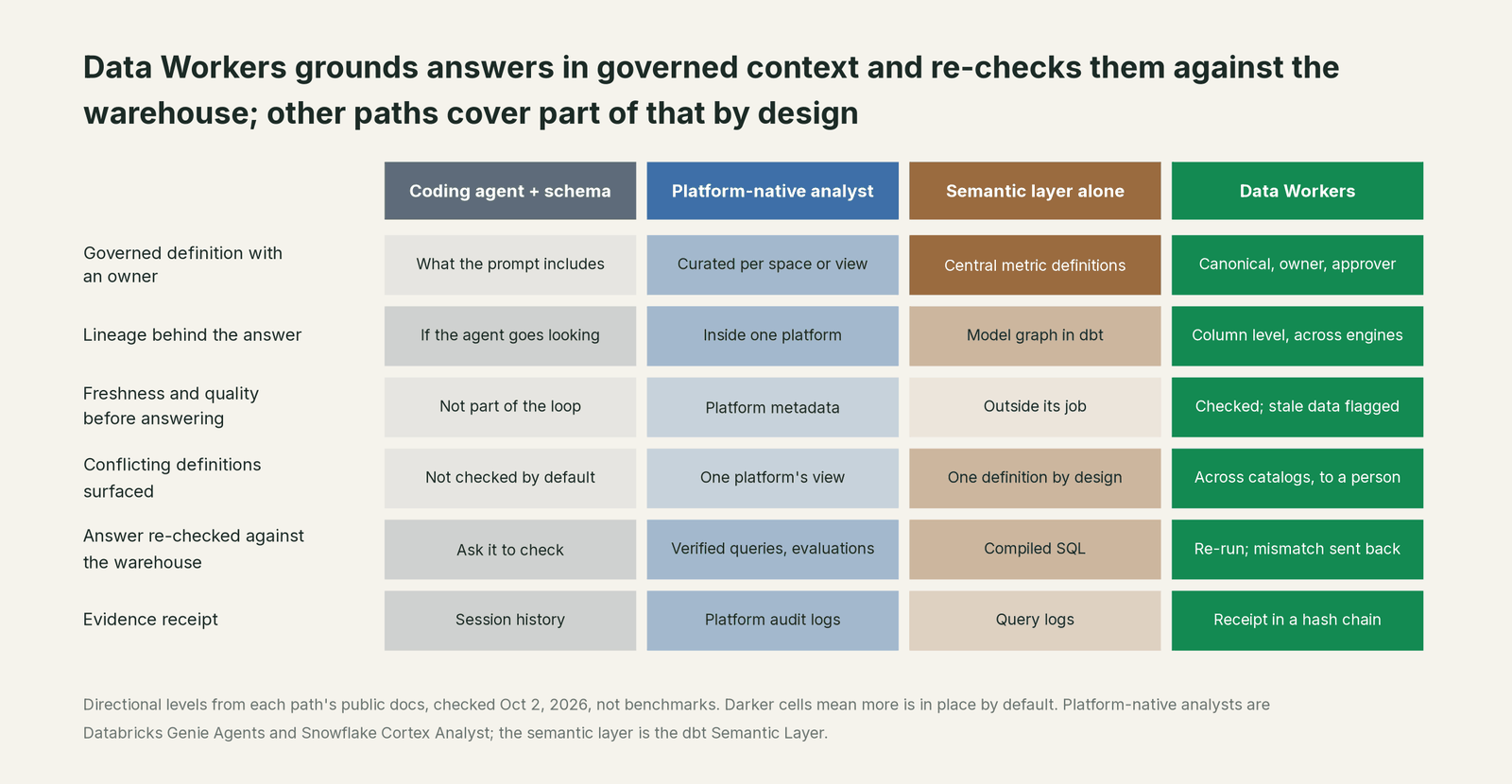
Build it yourself with a coding agent and schema access. Claude Code, Cursor and their peers write excellent SQL from what is in the session. Grounding, freshness checks, conflict detection and verification are then yours to build and maintain; build it ourselves with Claude Code and MCP servers prices that path. Connected to Data Workers over MCP, the same coding agent gets governed context and the checks on every call.
Platform-native analysts. Databricks Genie Agents (formerly Genie Spaces) are configured by analysts with Unity Catalog data, example SQL, instructions and trusted assets (docs updated Sep 24, 2026). Snowflake Cortex Analyst uses semantic views and verified queries, with evaluations that measure how accurately it generates SQL (docs checked Oct 2, 2026). Both are strong designs for questions inside their platform. Questions that cross Salesforce, Fivetran, Snowflake, dbt and Looker need context from all of them.
A semantic layer alone. The dbt Semantic Layer centralizes metric definitions so every tool reads the same one, and AI tools can reach it through the dbt MCP server (docs updated Sep 29, 2026). That is the right home for definitions, and Data Workers reads it as a source. Freshness, quality, contradictions across catalogs and answer verification sit outside that job by design.
Observability tools. Monte Carlo watches freshness and quality, and its Agent Observability adds evaluation monitors that alert when an AI agent's responses contain hallucinations or fail accuracy checks, using LLM-as-judge or SQL checks over agent traces (docs updated Aug 28, 2026). It says plainly that it is "read-only by design" (docs checked Oct 2, 2026). That is strong monitoring after an answer is given, and its signal is valuable input. Data Workers works before the answer ships: it uses signals like these inside the answer, holds back what it cannot confirm and runs the fix. See Monte Carlo vs Data Workers.
Why don't these tools just do this themselves?
Focus and risk. Each one built a great product for one job: Genie Agents and Cortex Analyst answer questions inside their platform, the dbt Semantic Layer owns definitions, Monte Carlo watches data and agents, and coding agents write code. Grounding an answer across every system, holding it back when the evidence does not hold, and then fixing the data underneath takes context about tools each vendor does not own, plus approvals, rollback and receipts for changes in them. That cross-system job is the product Data Workers is.
For more on the grounding problem, our resources on why data agents hallucinate without governed context, preventing hallucinations on warehouse data and reliability of text-to-SQL agents go further. To track whether answers stay right over time, see how to measure AI data agents.
The case for your CFO
The business outcome is simple: leaders get numbers they can repeat in a board meeting, and when a number is wrong, they hear why before they act on it. Data Workers answers from your governed definitions, checks the data underneath, and fixes what it finds.
The risk story is that no answer rests on the model's memory. Definitions come from your semantic layer with an owner, freshness and quality are checked first, conflicting definitions go to a person, the answer is re-checked against the warehouse, and every tool call and change has a tamper-evident receipt. Fixes follow the autonomy level you set per domain, with approvals, rollback plans and verification; where does our data go? covers deployment in your environment.
Why now: AI assistants are already in front of your executives. Every unchecked answer about revenue or churn is a decision risk, and one wrong number shared upstairs costs more trust than a dozen slow ones.
The first win is one governed metric family, usually ARR or pipeline, answered through the assistants your team already uses, with every answer carrying its evidence. What stays the same: your warehouse, semantic layer, dbt project, BI and assistants. Nothing migrates.
Start with a pilot ($7,500 one-time, credited in full against the first year); see pricing, model the return in the ROI calculator or read the ROI of agentic data operations. The sentence for upstairs: "Our AI answers come from our own definitions, checked against our own data, and every number shows where it came from."
FAQ
Can Data Workers still be wrong? Any system reading data can meet an error in the data itself. Data Workers is built so that errors surface: stale sources, anomalies, conflicting definitions and answers that do not match the warehouse are flagged or blocked, and the receipt shows exactly what each answer rested on.
What happens when a question has no governed definition? resolve_metric returns every candidate it finds, and the trust gate blocks an aggregated measure that has no canonical definition. The user sees the gap, and the definition can be proposed for an owner to approve.
Which model does Data Workers use, and does that change accuracy? You bring your own model. The grounding, checks and verification sit around the model, so they apply to whichever one you choose; which model Data Workers uses covers the options.
Does it work with the semantic layer and catalog we already have? Yes. Data Context Wizard reads them as first-class sources and keeps their provenance; they remain yours. Approved facts can be written back.
How do our analysts correct a wrong answer? They submit the correction, which is stored with its provenance. Once a named person approves it, it becomes an enforced fact, and with correction enforcement on, later results that contradict it are flagged or blocked, as your policy sets.
Can we audit why an agent gave a particular number? Yes. Every tool call is in the hash-chained audit log, readable through get_audit_trail or in Spellbook, with its inputs and outcome, and the answer itself carries the trust verdict and its reasons.
Sources
- •Data Workers product repository,
data-workers-agent-swarm@ 871ae3df (Sep 24, 2026): agents/dw-context-catalog/src (search/trust-scorer, tools/explain-table, tools/scan-for-contradictions, tools/resolve-contradiction, tools/submit-correction, feedback/correction-enforcer), core/contradiction-sentinel, agents/dw-insights/src/tools (gate-answer-trust, verify-answer, compile-governed-metric, query-data-nl), core/enterprise agent-middleware and tamper-evident audit log, core/mcp-framework beforeReturn hook. Checked Oct 2, 2026. - •Data Workers public repository tools (
explain_table,resolve_metric,list_semantic_definitions,monitor_metrics,get_quality_score,trace_cross_platform_lineage,blast_radius_analysis,diagnose_incident,get_audit_trail): https://github.com/DataWorkersProject/dataworkers-claw-community (checked Oct 2, 2026) - •Data Context Wizard: https://dataworkers.io/product/data-context-wizard/ (checked Oct 2, 2026)
- •Autonomous Data-Conductor: https://dataworkers.io/product/autonomous-data-conductor/ (checked Oct 2, 2026)
- •Spellbook Data Catalog (preview): https://dataworkers.io/product/spellbook-data-catalog/ (checked Oct 2, 2026)
- •Third-party: Li et al., "Can LLM Already Serve as A Database Interface? A BIg Bench for Large-Scale Database Grounded Text-to-SQLs" (BIRD), NeurIPS 2023: https://arxiv.org/abs/2305.03111 (first submitted May 4, 2023; checked Oct 2, 2026)
- •Third-party: Lei et al., "Spider 2.0: Evaluating Language Models on Real-World Enterprise Text-to-SQL Workflows", ICLR 2025: https://arxiv.org/abs/2411.07763 (first submitted Nov 12, 2024; checked Oct 2, 2026)
- •Third-party: Lee et al., "TrustSQL: Benchmarking Text-to-SQL Reliability with Penalty-Based Scoring": https://arxiv.org/abs/2403.15879 (first submitted Mar 23, 2024; checked Oct 2, 2026)
- •Third-party: Saparina and Lapata, "AMBROSIA: A Benchmark for Parsing Ambiguous Questions into Database Queries", NeurIPS 2024 Datasets and Benchmarks: https://arxiv.org/abs/2406.19073 (first submitted Jun 27, 2024; checked Oct 2, 2026)
- •Third-party: Kalai, Nachum, Vempala and Zhang (OpenAI and Georgia Tech), "Why Language Models Hallucinate": https://arxiv.org/abs/2509.04664 (Sep 4, 2025; checked Oct 2, 2026)
- •Databricks, Create and manage a Genie Agent: https://docs.databricks.com/aws/en/genie-agents/set-up (updated Sep 24, 2026; checked Oct 2, 2026)
- •Snowflake, Cortex Analyst: https://docs.snowflake.com/en/user-guide/snowflake-cortex/cortex-analyst (checked Oct 2, 2026)
- •dbt, dbt Semantic Layer: https://docs.getdbt.com/docs/use-dbt-semantic-layer/dbt-sl (updated Sep 29, 2026; checked Oct 2, 2026)
- •Monte Carlo, Cost agent ("Monte Carlo is read-only by design"): https://docs.getmontecarlo.com/docs/cost-agent (checked Oct 2, 2026)
- •Monte Carlo, Agent Observability Overview: https://docs.getmontecarlo.com/docs/agent-monitors-overview (updated Aug 28, 2026; checked Oct 2, 2026)
- •Monte Carlo, Agent Evaluation Monitors: https://docs.getmontecarlo.com/docs/agent-evaluation-monitors (checked Oct 2, 2026)