Monte Carlo vs Data Workers: detection vs resolution
Monte Carlo detects and triages data incidents. Data Workers resolves them: fix at the source, verified downstream, with a receipt. Keep Monte Carlo or consolidate.
Monte Carlo is the smoke alarm for your data. Data Workers is the crew that puts the fire out, checks it's out and writes the report. That's the whole comparison in two sentences, and the rest of this page is the proof.
Here is the estate most Monte Carlo teams run. Fivetran lands source data in Snowflake or Databricks. dbt builds the models. Airflow schedules the DAG runs. Looker or Tableau sits on top. Monte Carlo watches all of it: its monitors fire, its Triage Agent scores the incident, and its Troubleshooting Agent narrows down the cause.
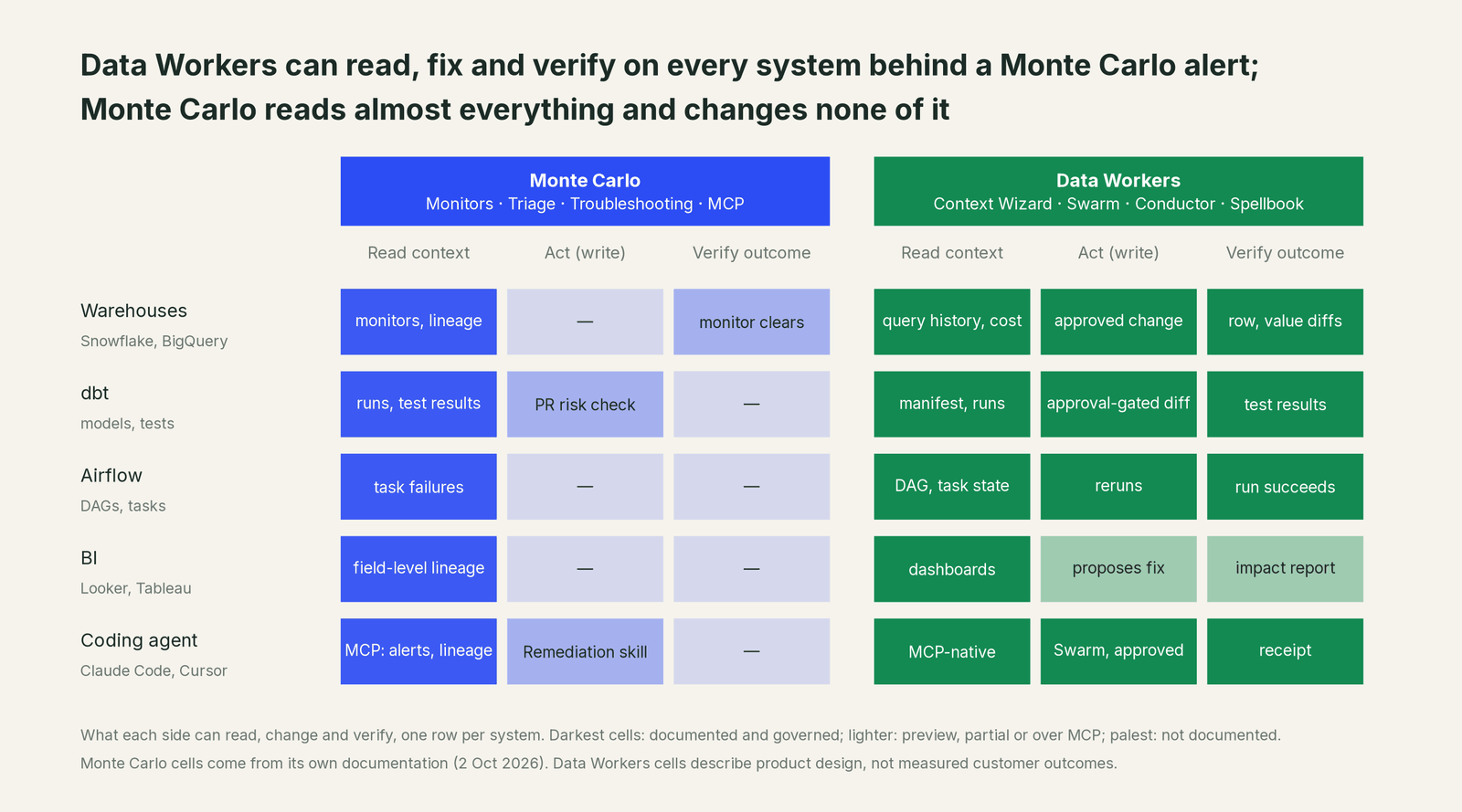
Then a person takes over. Someone opens the dbt model, reruns the Airflow task, checks the dashboard and tells finance it's fixed. Monte Carlo is built that way on purpose. Its Cost agent documentation says "Monte Carlo is read-only by design," and "the agent recommends; it does not act on your behalf."
Data Workers is the agentic data platform that does the work after the alert. It finds the cause, fixes it at the source, verifies the result downstream and leaves a receipt on every change. It also runs the jobs observability doesn't cover: access, cost, schema changes, migrations and audit evidence. You don't have to give anything up to get there. Keep Monte Carlo and let Data Workers act on its incidents, or consolidate later if Data Workers runs that slice well enough for you. This page helps you choose.
Key takeaways
- •Detection vs resolution. Monte Carlo detects, triages and explains data incidents. Data Workers resolves them: it diagnoses, fixes at the source, verifies downstream and records a receipt.
- •Monte Carlo's platform is read-only by design. Its Monitoring, Triage, Troubleshooting, Cost and PR agents score, explain and recommend. Changes to dbt, Airflow or the warehouse stay with your engineers.
- •Data Workers runs the whole loop across Snowflake, Databricks, BigQuery, dbt, Airflow, Looker and Tableau. Every action is approved or reversible and leaves a tamper-evident receipt.
- •Keep Monte Carlo, or consolidate. Data Workers connects to Monte Carlo over its API or MCP server today and reads its alerts and monitors. Consolidating is an option once Data Workers runs detection for you too.
- •Data Workers covers the rest of the lifecycle: access requests, cost cleanup, schema changes, migrations and audit evidence, with one context, one approval flow and one audit trail.
- •Flat pricing. Monte Carlo is credit-based and priced per monitor. Data Workers is a flat platform fee with unlimited seats and no usage meter.
For the executive version, read the Monte Carlo data leader's guide. For the step-by-step climb from alerts to agents that fix and verify, read the playbook From Monte Carlo to an autonomous data platform. Our earlier Data Workers vs Monte Carlo overview and the guide to Claude Code workflows with Monte Carlo cover adjacent ground.
Six things Data Workers adds on top of Monte Carlo
1. Incidents fixed and closed. The Autonomous Data-Conductor takes an incident, traces it to the cause in whichever system it lives in, has the right agent fix it there and confirms the result. An incident isn't closed until the downstream checks pass.
2. Fixes that land where the problem started. Most incidents begin upstream of the table that alerted. The Data-Agents Swarm proposes the dbt change as an approval-gated diff for the owner to merge, triggers the Airflow rerun or proposes the warehouse change. Each change is scoped before it runs and waits for approval at the autonomy level you set.
3. Schema changes caught before they become incidents. The Schema Evolution agent sees a source contract change in review, with its blast radius, before the next dbt run. The Data Change Review agent diffs lineage, schema, row counts and values on the fix before it merges. The cheapest incident is the one that never fires.
4. The rest of the lifecycle. Least-privilege access proposed behind approvals, PII flagged in pull request review, Snowflake credits traced to the dbt model behind them with the fix drafted, and legacy warehouse moves planned and parity-checked. All of these compete for the same engineers who answer Monte Carlo incidents.
5. One governed context graph. Data Context Wizard builds one graph from your warehouses, dbt manifest, Airflow and your BI metadata, through 50+ connectors. The agents that fix things know how your whole estate fits together.
6. Receipts your auditors can read. Every change carries who or what made it, why, what it touched and how to undo it. Evidence builds up as a side effect of the work, in Spellbook Data Catalog (in preview).
Behind all six are 20 specialist agents, one context graph and the coding agent your team already uses (Claude Code, Codex or Cursor) as the way in. Each agent is an MCP server.
One incident, seven systems
Here is a scenario most Monte Carlo teams will recognize. It's an illustration, not a customer case.
- •01:50. A product team renames
plan_tiertoplan_codein the Postgres billing database. Fivetran syncs the change into Snowflake. - •02:30. Airflow runs dbt. The run succeeds, but
fct_subscriptionsnow writes a null plan for every new row. - •05:40. Monte Carlo's field-health monitor fires on the null rate. Its Triage Agent scores the incident HIGH because the table feeds the revenue dashboard. If you've enabled it, the Troubleshooting Agent (in preview) points to the upstream rename.
- •08:15. Finance opens the Looker revenue-by-plan tile at the start of the day.
| Step | What Monte Carlo sees | What Data Workers does |
|---|---|---|
| Rename in Postgres, via Fivetran | A schema change on the landed table, if it's monitored. | Takes the change from the team's alert on Fivetran's log and maps its downstream models before the dbt run. |
| dbt writes nulls in Snowflake | A field-health incident, scored by the Triage Agent, with a likely cause from the Troubleshooting Agent. | Reads the incident over Monte Carlo's API or MCP server, confirms the rename, and proposes an approval-gated dbt diff that maps the new column, with its blast radius to Looker attached. |
| Backfill after the fix | The late or failed task, in lineage. | After the on-call engineer approves, triggers the Airflow backfill for the affected partitions. |
| Verify the result | The monitor clears on its next run. | Diffs row counts and values to confirm no null plans remain, checks the dbt tests are green and records a tamper-evident receipt. |
| Looker tile | Field-level lineage to the dashboard. | The tile is right before finance opens it. The pattern is remembered, so the next rename is held before the dbt run. |
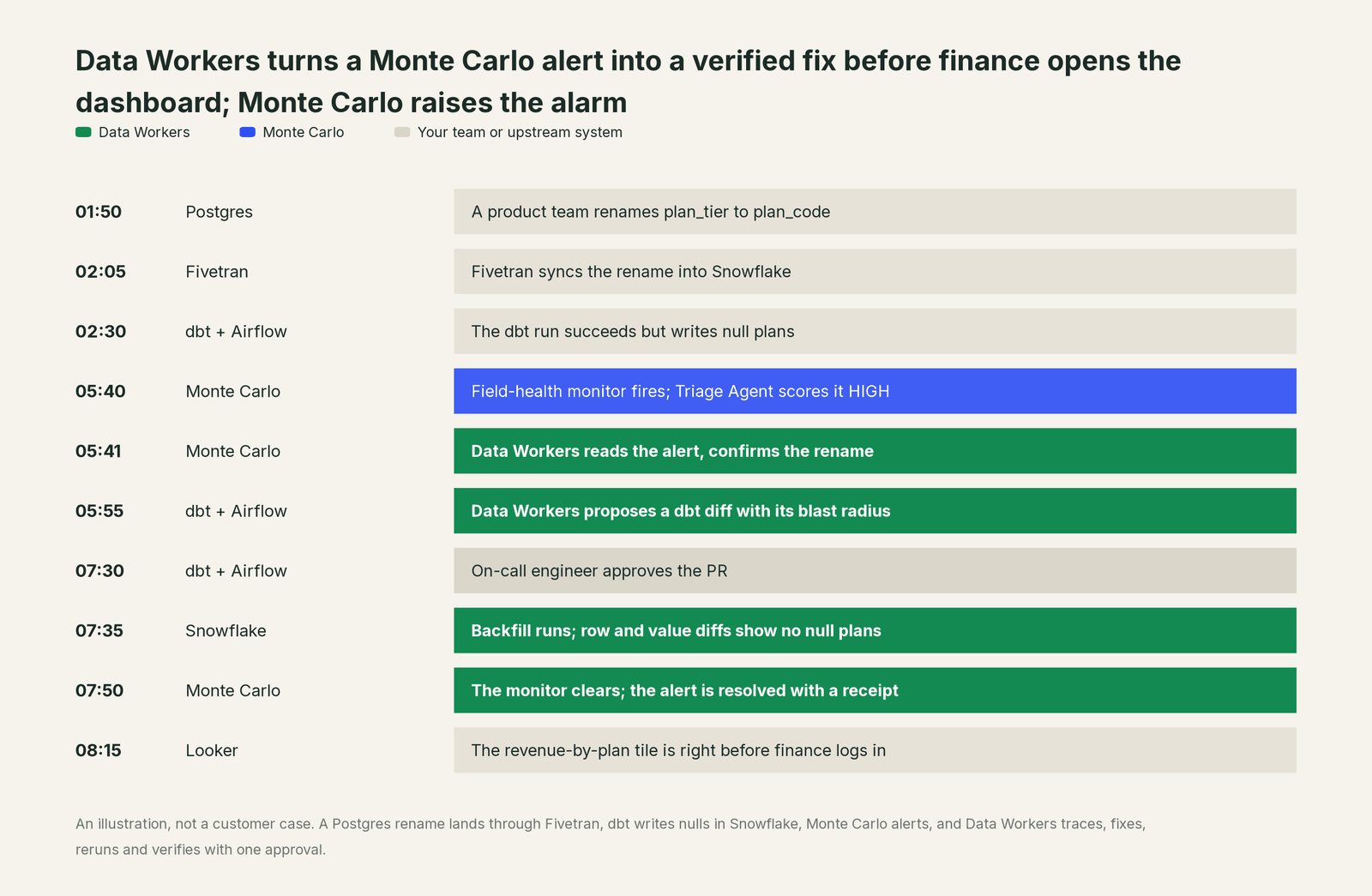
Monte Carlo raised the alarm at 05:40, and that alarm is valuable. The difference between the two products is what happens between 05:40 and 08:15. With Monte Carlo alone, a person spends that window in Slack, in dbt and in Airflow. With Data Workers, one person spends it on one approval.
What Monte Carlo covers, as of October 2026
Monte Carlo has moved fast this year. Its site now lives at montecarlo.ai (the docs stay at docs.getmontecarlo.com), and it describes itself as the "Agent Trust Platform" that "intelligently monitors, troubleshoots, and improves agents and their underlying data." Here is what its own documentation says it ships.
| Area | What Monte Carlo ships | Status (Oct 2026) |
|---|---|---|
| Monitors | Freshness, volume, schema, field metrics, validation and custom SQL, with ML thresholds and monitors-as-code | GA |
| Coverage | Major warehouses and lakes, dbt, Airflow, Fivetran and BI tools including Looker and Tableau | GA; Azure Synapse, Microsoft Fabric, MotherDuck, Dremio and Starburst in public preview, Hex in beta |
| Lineage | Automatic field-level lineage, with job and task traceability added in 2026 | GA |
| Monitoring Agent | Finds coverage gaps and recommends monitors per asset | Available (no preview label) |
| Triage Agent | Scores every alert HIGH, MEDIUM or LOW on likelihood and impact, and writes the rationale onto the alert | GA, on by default |
| Troubleshooting Agent | Tests hypotheses across data changes, Airflow and dbt failures, code changes and lineage | Preview; comparison and merged alerts not supported |
| Operations Agent | In-app chat that comments on alerts, deprecates tables and routes work to other agents, with the user's permissions | Public preview |
| PR Agent | Posts a risk score and summary on pull requests; does not change code | GA on GitHub; other providers not documented |
| Cost agent | Ranks storage and compute savings; "recommends; it does not act on your behalf" | Available (no preview label) |
| PII / Compliance agent | Listed on the agent fleet page | Preview |
| MCP server | Remote server with read tools (alerts, tables, lineage, monitors) and writes that stay inside Monte Carlo (update an alert, create or update a table monitor, create an agent metric monitor); Editor role required | Available |
| Agent Toolkit | Open-source skills for Claude Code, Cursor, Copilot CLI, OpenCode, Codex and Cortex Code, including a Remediation skill | Public (Apache 2.0) |
| Agent Observability | Monitors AI agents in production: context, performance, behavior and outputs, with telemetry kept in your environment | Announced March 12, 2026 |
| Agent Lineage | Links agent runs to the tables they read and write | GA since June 21, 2026 |
| Pricing | Credit-based and priced per monitor, in four tiers | Current |
Every row above ends at a signal, a score or a recommendation. That is the right design for an observability product, and it is where Data Workers picks up.
Why doesn't Monte Carlo just do this itself?
Because it is built for a different job, and it made a sensible choice about risk.
Monte Carlo sells observability to almost every kind of data stack. To do that well it holds read credentials across your warehouses, dbt, orchestration and BI, and it keeps its own platform read-only by design. Its agents score, explain and recommend. Its MCP write tools touch only Monte Carlo objects: alert status, comments and monitors. The PR Agent comments on a pull request and doesn't change the code. Even the Cost agent stops at a recommendation. That design keeps Monte Carlo's security review short and its blast radius at zero, which is exactly what a buyer wants from a monitoring tool.
Writing to production data across systems is a different product category. It needs blast-radius scoping before every change, approvals that vary by domain, rollback, a receipt that an auditor can read, context about every other system in the estate, and the liability for changes made inside tools Monte Carlo doesn't own: your dbt repo, your Airflow deployment, your warehouse grants. Taking that on would change Monte Carlo's security posture, its buyer and its sales motion.
Monte Carlo's answer so far is to hand execution to one engineer's coding agent. Its open-source Remediation skill "proposes and executes fixes for data-quality alerts; assesses blast radius before acting, or escalates with full context." That's useful. It runs with that engineer's credentials, in that engineer's session, and its documentation doesn't describe which fix types it covers, how rollback works, an org-wide approval policy or a shared verification record. Those are the parts Data Workers is built around.
One platform across the data lifecycle
Detection is one stage of a data team's lifecycle. The same team also keeps context current, answers business questions, writes quality checks, changes pipelines, migrates schemas, handles access, protects sensitive data, cuts spend and keeps models fed with healthy data. Each point tool adds another console, another contract and another handoff. Data Workers covers the whole lifecycle with one context, one approval flow and one audit trail.
We score the same ten stages on every comparison page, so you can compare tools across pages. Monte Carlo leads on its home stages, Data Quality and Observability & Incidents, and those are its core product. Data Workers covers all ten.
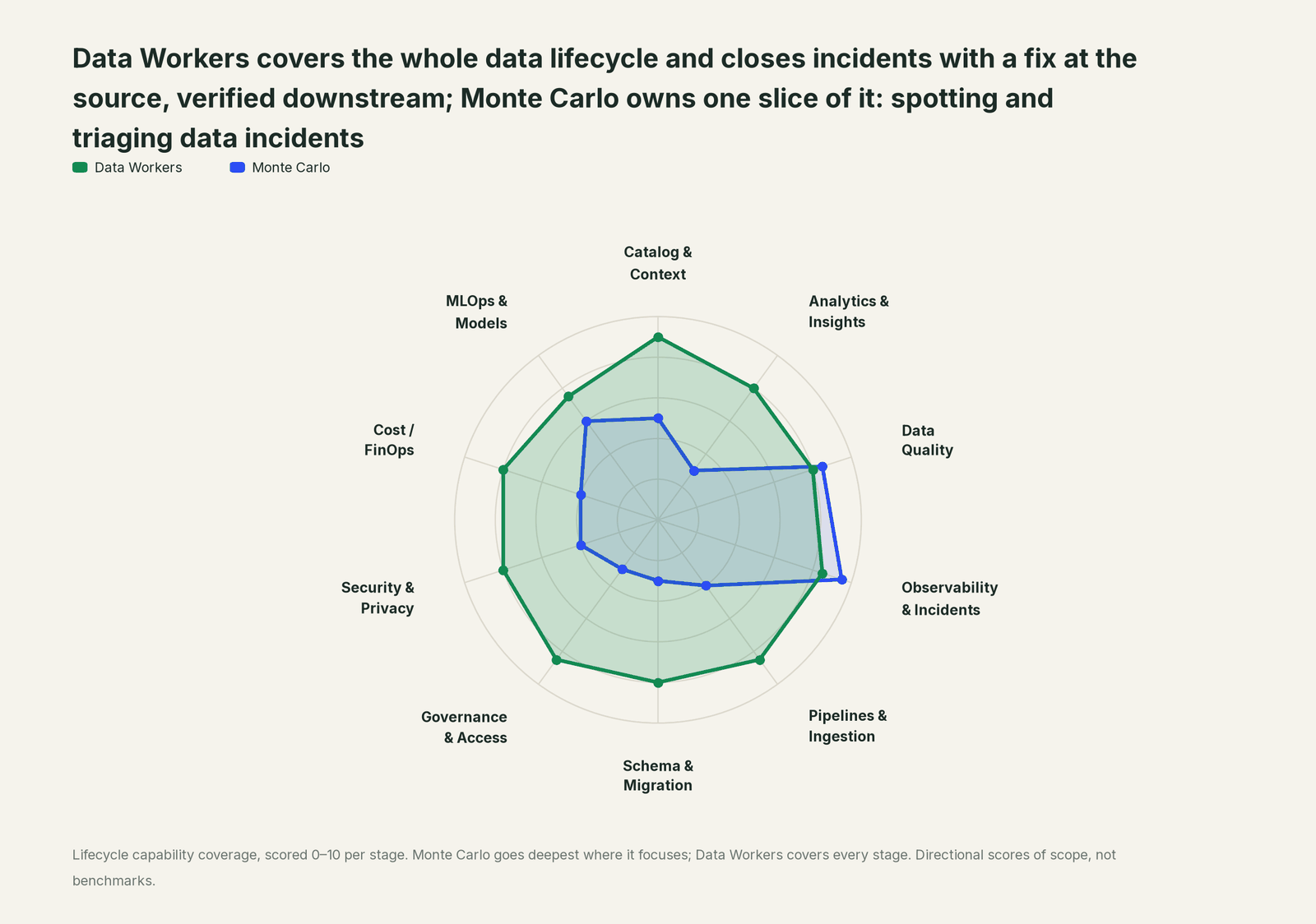
| Stage | Data Workers | Monte Carlo | Why we scored it this way |
|---|---|---|---|
| Catalog & Context | 9 | 5 | Monte Carlo catalogs assets, field-level lineage and domains for what it monitors. Data Workers keeps one context graph across warehouses, dbt, orchestration and BI. |
| Analytics & Insights | 8 | 3 | Monte Carlo reports on the health of its own alerts. Data Workers answers business questions over the same governed graph. |
| Data Quality | 8 | 8.5 | Monte Carlo leads: validation, custom SQL and field monitors with ML thresholds, plus Monitoring Agent recommendations. Data Workers writes and repairs checks and dbt tests. |
| Observability & Incidents | 8.5 | 9.5 | Monte Carlo's home stage: ML monitors, a Triage Agent on by default and alert routing. Data Workers owns the loop after the alert: diagnose, fix, verify, record. |
| Pipelines & Ingestion | 8.5 | 4 | Monte Carlo watches Airflow, dbt and Fivetran job health. Data Workers writes the pipeline change and triggers the rerun behind approval. |
| Schema & Migration | 8 | 3 | Monte Carlo flags schema changes and its PR Agent comments on risk. Data Workers assesses schema changes, drafts each migration with rollback SQL for the owner to apply and plans platform moves. |
| Governance & Access | 8.5 | 3 | Monte Carlo governs access to Monte Carlo; its PII / Compliance agent is in preview. Data Workers proposes least-privilege grants on your data platforms behind approvals. |
| Security & Privacy | 8 | 4 | Monte Carlo secures its own platform with in-VPC collection and audit logs. Data Workers acts on the estate and leaves a tamper-evident receipt on every change. |
| Cost / FinOps | 8 | 4 | Monte Carlo's Cost agent ranks savings and 'recommends; it does not act'. Data Workers traces Snowflake credits to the dbt model behind them and drafts the fix for its owner. |
| MLOps & Models | 7.5 | 6 | Monte Carlo watches AI agents in production (Agent Observability, Agent Lineage). Data Workers keeps the data under models healthy and connects to MLflow and W&B. |
Detection vs resolution on the outcomes you buy
The lifecycle view shows breadth. This view scores eight outcomes a data leader pays for. Monte Carlo leads on two, both on its own ground: monitor depth and watching AI agents in production. Data Workers leads on the six outcomes that sit after the alert or outside observability.
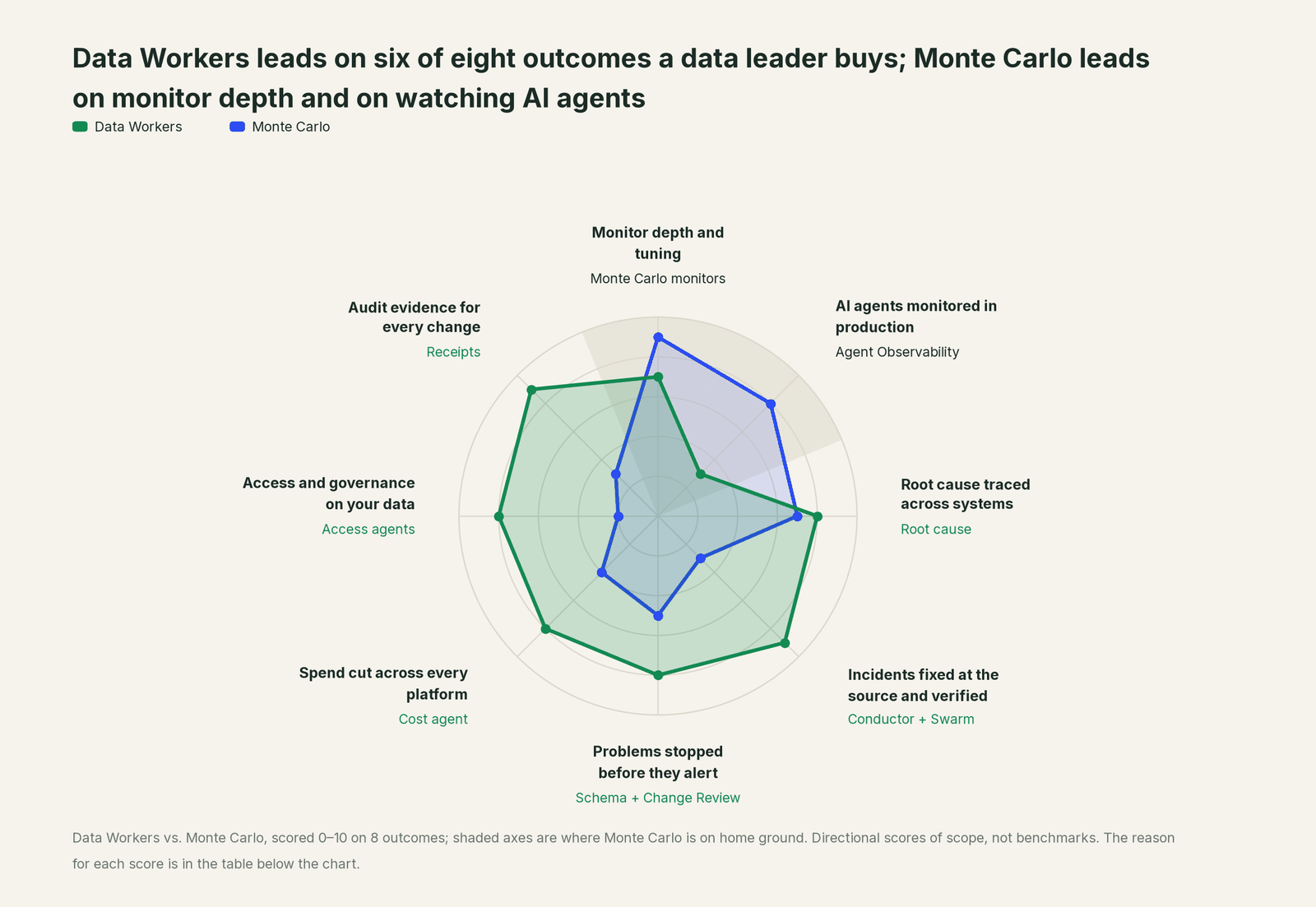
| Outcome | Data Workers | Monte Carlo | Why we scored it this way |
|---|---|---|---|
| Monitor depth and tuning | 7 | 9 | Monte Carlo's monitors, ML thresholds and Monitoring Agent are its core product. Data Workers reads Monte Carlo alerts over its API today, and writes checks and dbt tests of its own. |
| AI agents monitored in production | 3 | 8 | Monte Carlo announced Agent Observability in March 2026 and Agent Lineage went GA in June. Watching the AI agents you build is outside the job Data Workers is built for. |
| Root cause traced across systems | 8 | 7 | Monte Carlo's Troubleshooting Agent tests hypotheses and is labelled preview in its docs. Data Workers traces the cause through dbt, Airflow and the warehouse and hands it to the agent that fixes it. |
| Incidents fixed at the source and verified | 9 | 3 | Monte Carlo's docs say it is 'read-only by design'. Data Workers fixes the cause in dbt, Airflow or the warehouse and verifies the result downstream. |
| Problems stopped before they alert | 8 | 5 | Monte Carlo's PR Agent comments a risk score on a pull request. Data Workers reviews the PR's code diff and its blast radius across systems, and writes the fix. |
| Spend cut across every platform | 8 | 4 | Monte Carlo's Cost agent ranks savings and 'recommends; it does not act'. Data Workers attributes Snowflake credits per query to the dbt model behind them and drafts the fix for its owner. |
| Access and governance on your data | 8 | 2 | Monte Carlo governs who can use Monte Carlo. Data Workers proposes least-privilege grants on your data platforms behind approvals. |
| Audit evidence for every change | 9 | 3 | Monte Carlo logs activity inside Monte Carlo. Every Data Workers action is approved or reversible and leaves a tamper-evident receipt. |
The scores measure scope (what each side covers), not answer quality. They're directional scores of scope, not benchmarks, and we've shown the reasoning so you can check every line.
Where Monte Carlo stops
Each limit below comes from Monte Carlo's own documentation, and each follows from its choice to observe your stack rather than change it.
The platform agents recommend. The Cost agent page puts it plainly: "you stay in control of what actually changes in your environment." The agent fleet page says "nothing deploys until you approve it," and what deploys is a Monte Carlo monitor. The Operations Agent writes inside Monte Carlo (alert comments, table deprecations) and doesn't touch dbt, Airflow or the warehouse.
The fix happens somewhere else. Once the Troubleshooting Agent has narrowed down the cause, a person still makes the change in the system that owns it: a dbt model, an Airflow task, a warehouse grant, a Fivetran connector. That handoff is where most of an incident's time goes.
Verification and memory are a person's job. Monte Carlo will tell you the monitor cleared on its next run. Confirming the backfill covered every affected partition, that downstream dashboards are right, and recording what happened so the next occurrence is faster, is still manual work.
The toolkit is one engineer at a time. The Remediation skill checks blast radius inside one engineer's session. The approval policy, rollback and shared record across the estate are left to the team.
Observability is one stage of the lifecycle. Access requests, cost cleanup across warehouses, schema evolution, migrations and audit evidence sit outside Monte Carlo's product.
Where the two overlap
"Both" means Data Workers uses the Monte Carlo signal and does the work after it.
| Job to be done | Monte Carlo | Data Workers | What we recommend |
|---|---|---|---|
| Monitors across the stack | Freshness, volume, schema, field and custom SQL monitors | Writes checks and dbt tests; observability agent | Keep Monte Carlo's monitors if they're tuned; consolidate later if you choose |
| Tuning monitors and thresholds | Monitoring Agent | Turns recurring incidents into dbt tests | Monte Carlo |
| Monitoring AI agents in production | Agent Observability, Agent Lineage | Outside the job Data Workers is built for | Monte Carlo |
| Triage | Triage Agent, on by default | Uses Monte Carlo's priority as an input | Monte Carlo |
| Root cause | Troubleshooting Agent (preview) | Traces the cause across systems | Data Workers, starting from Monte Carlo's diagnosis |
| Fix at the source | Recommends; Remediation skill runs per engineer | Proposes the diff, triggers the rerun or proposes the change | Data Workers |
| Verify the fix | Monitor clears on the next run | Checks on the changed tables, baselines, downstream runs | Data Workers, with Monte Carlo's monitor as one more signal |
| Schema changes before they break | Schema monitors; PR Agent risk comment | Schema Evolution and Data Change Review agents | Data Workers |
| Cost cleanup | Cost agent recommends | Traces credits to the dbt model and drafts the fix for its owner | Data Workers |
| Access, security and audit | Access to Monte Carlo itself | Least-privilege proposals and receipts on every change | Data Workers |
| Migrations | Outside its product | Plans, translates and gates each wave on its parity checks | Data Workers |
Keep Monte Carlo, or consolidate
Keep Monte Carlo and add Data Workers. This is the natural starting point. Your monitors are tuned, your on-call routing works and your Triage Agent scores are trusted. Data Workers connects to Monte Carlo over its API or MCP server today and reads its alerts and monitors. An incident starts the loop. Data Workers traces the cause, fixes it at the source behind your approval, verifies the result downstream and records a receipt. Monte Carlo keeps watching; Data Workers does the work.
Consolidate once Data Workers runs that slice too. Some teams will want one platform, one approval flow and one audit trail for detection, fixes and the rest of the lifecycle. Data Workers writes and runs checks and dbt tests, and its Schema Evolution and Data Change Review agents stop many problems before they alert. Every recurring incident becomes a test upstream. When that covers what you need, consolidation is an option. If you depend on Agent Observability for the AI agents you build, keep Monte Carlo for that.
Either way, nothing moves. Data Workers stores metadata and scrubbed facts about your data, not copies of your tables.
What it costs
Monte Carlo's pricing page describes a credit-based model: you buy credits and consume them at its consumption rates, priced per monitor, in four tiers (Start, Scale, Enterprise and Business Critical). It doesn't publish list prices. Start covers up to 1,000 monitors and 10 users; webhooks and audit logs start at the Scale tier.
Data Workers is priced the other way round. The Apache 2.0 core is free. The Pilot Program is $7,500 one-time, credited in full against your first year. Scale starts at $1,000 a month and Enterprise at $3,000 a month, both at the annual rate. Seats are unlimited, there's no usage meter, and there's no markup on model spend because you bring your own model. See pricing.
The two bills don't interact. Monte Carlo's bill grows with the monitors you run. Data Workers is a flat platform fee whether it closes five incidents a month or fifty. The useful question for your team is how many engineer hours sit between a Monte Carlo incident and a verified fix today, and what those hours are worth.
The case for your CFO
The outcome. Today Monte Carlo turns data problems into incidents, and engineers turn incidents into fixes. Data Workers closes that second step for the incident classes you allow, so alerts become closed incidents with a receipt, and the dashboards finance and the board read are right before anyone opens them.
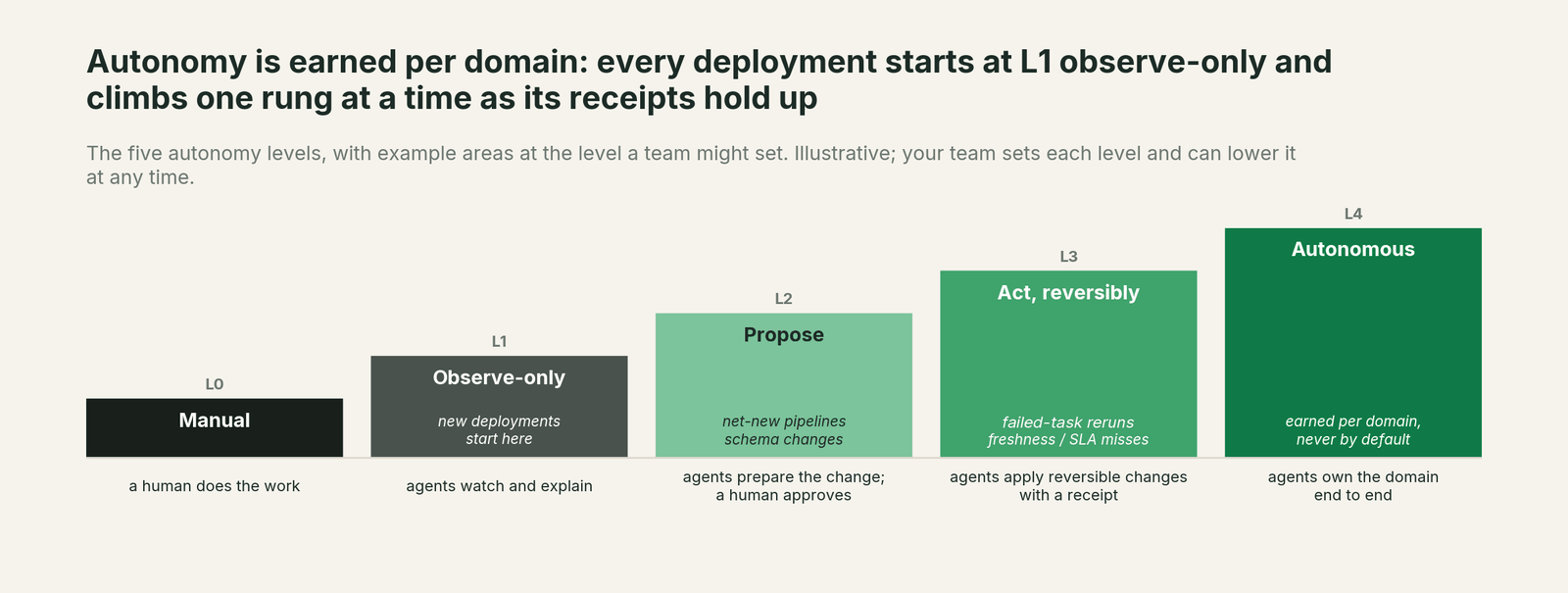
The risk story. Data Workers starts observe-only (L1): it reads and reports. At propose (L2) every fix is a draft a person approves. At act reversibly (L3) it runs only changes it can undo, and only in the domains you've moved up. Autonomous (L4) is a per-domain choice, never a default. Every write is scoped before it runs, no agent approves its own work, and every receipt records who or what acted, why, what it touched and how to undo it. Zero migration: your data stays where it is.
Why now. Monte Carlo's own direction, from its MCP server to the Remediation skill, shows execution moving to agents. The choice is between per-engineer agent sessions and one governed loop across the estate.
The first win. Freshness and pipeline-failure incidents in one domain, handled in propose mode.
What stays the same. Monte Carlo, its monitors and Triage, your on-call routing, dbt, Airflow and the coding agent your engineers already use as the way in.
The path. Start with a pilot. See pricing; the pilot fee is credited in full against the first year.
The sentence to repeat upstairs: "We keep Monte Carlo to tell us what broke; Data Workers fixes it at the source, proves the fix held and leaves a receipt, so alerts turn into closed incidents instead of tickets."
The fastest first win: freshness and pipeline-failure incidents
Start with the incidents that end the same way every time. Late or failed loads usually need a rerun and a check. Point Data Workers at those Monte Carlo incidents with that domain in propose mode. Each one arrives in the Spellbook inbox with the root cause, the proposed rerun or diff and its blast radius. When your team has approved those proposals as-is for a few weeks, move the domain up to reversible actions. Monte Carlo keeps detecting throughout. The playbook covers the full sequence in From Monte Carlo to an autonomous data platform.
What each Data Workers product does
Autonomous Data-Conductor. The orchestrator that owns an outcome rather than a step. It runs detect, diagnose, fix, review, verify and remember across the estate, directs the right agents, scopes the blast radius before acting and leaves a tamper-evident receipt on every change. If you keep Monte Carlo, its incidents are one input to the detect step.
Data-Agents Swarm. 20 specialist agents that do the work Monte Carlo's agents recommend. The ones that matter most here are the Incident Debugging agent, the Pipeline Building agent, the Schema Evolution agent, the Data Change Review agent and the Quality Monitoring agent, which turns a recurring incident into a dbt test so the same break is caught earlier.
Data Context Wizard. One governed graph across warehouses, dbt, orchestration and BI, with 50+ connectors. It reads your dbt manifest, Airflow DAG and task state, Looker and Tableau metadata, and Snowflake query history. Every fact carries its source, author, confidence and the time it was observed.
Spellbook Data Catalog. The control plane for agent work. Every proposed change lands in one inbox (approve, steer, send back or roll back), asset pages cover the whole estate, and an authority guard enforced in code stops any agent from approving its own work.
Autonomy guardrails and security
Monte Carlo manages agent risk by keeping its platform read-only. Data Workers lets agents act, under graded, reversible control, because that's how incidents get closed.
- •Autonomy is set per domain. Freshness fixes can run at L3 (act, reversibly) while schema changes stay at L2 (propose).
- •New deployments start observe-only. You extend autonomy one domain at a time as the receipts earn trust.
- •Every write is scoped before it runs, with blast radius computed across platforms. Remediation supports dry runs, and incidents it hasn't seen before route to a person.
- •Every action is approved or reversible, and leaves a tamper-evident receipt.
- •No agent can approve or promote its own work. This is enforced in code, not left to a prompt.
- •Least privilege. Data Workers acts with the grants you give it, through each platform's own permission system.
"Monte Carlo has an MCP server and a Remediation skill. Doesn't that close the gap?"
It closes part of it. Monte Carlo's MCP server works with Claude and other clients, and its toolkit runs inside Claude Code, Cursor and other coding agents. An engineer can pull an incident, read the lineage and ask their coding agent to fix the model, and the Remediation skill checks blast radius first. That beats switching tabs.
It's still one engineer, one session and one fix at a time. Blast radius is checked per session, outside any estate-wide approval policy. Nobody gates the change by domain, verifies the result across downstream systems or records the outcome in a shared graph. MCP gives an agent one more tool. Data Workers gives you an operating model for incidents across the estate, and every Data Workers agent is itself an MCP server your coding agent can call, next to Monte Carlo's.
How it fits together
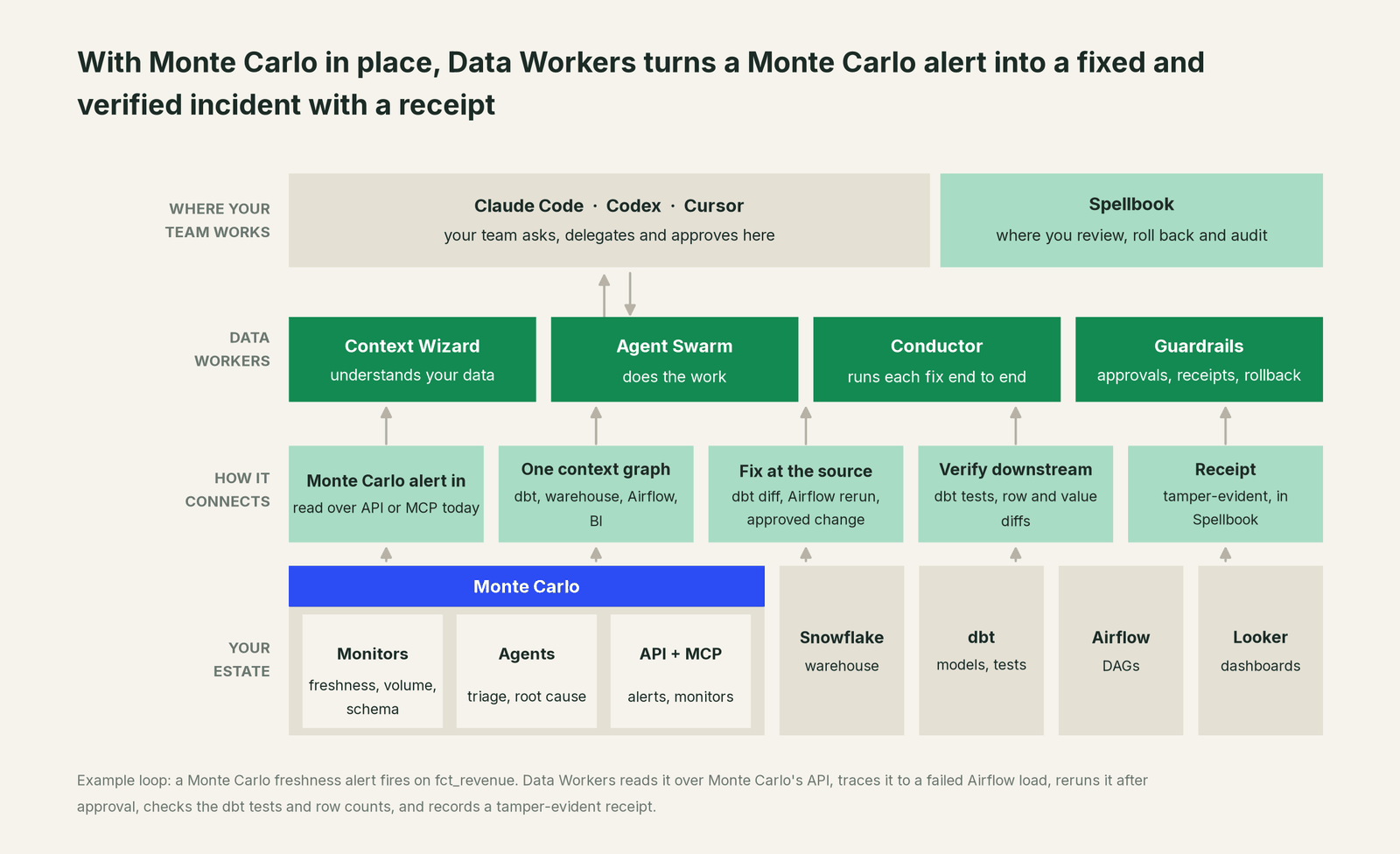
Getting started takes no migration. Connect Data Workers to your warehouses, dbt project, orchestrator and BI tools, and to Monte Carlo's API or MCP server if you keep it. The Context Wizard builds the graph, every agent starts in observe-only mode, and the first thing you see is what each recent incident's fix would have been, with its blast radius.
When Monte Carlo alone is enough
Monte Carlo alone can be enough if your main need is monitoring the AI agents you've built, or if incidents are rare and your team already fixes them fast. If your engineers spend their mornings between a Monte Carlo incident and a verified fix, that window is the work Data Workers takes on.
FAQ
Monte Carlo vs Data Workers: what's the difference? Monte Carlo detects, triages and explains data incidents, and its platform is read-only by design. Data Workers resolves them: it fixes the cause at the source, verifies the result downstream and leaves a receipt, with every action approved or reversible. It also runs access, cost, schema changes, migrations and audit evidence.
Do I have to replace Monte Carlo? No. You can keep Monte Carlo for detection and triage and add Data Workers for resolution. Consolidation is an option once Data Workers runs detection for you too.
Does Data Workers work with Monte Carlo? Yes. Data Workers connects to Monte Carlo over its API or MCP server today and reads its alerts and monitors. An incident starts the loop, and the incident isn't closed until the downstream checks pass.
Isn't the Troubleshooting Agent's root cause enough? It ends at a diagnosis, and it's in preview (comparison and merged alerts aren't supported). Data Workers takes that diagnosis as input and does the fix, the backfill and the verification.
Will Data Workers double our alert noise? No. Data Workers reads Monte Carlo's incidents and adds a resolution path. It doesn't need to re-monitor what Monte Carlo already covers.
What happens if an agent gets a fix wrong? Data Workers scopes every write before it runs and sends it to review at the autonomy level you set for that domain. Every action is approved or reversible and leaves a tamper-evident receipt. No agent can approve its own work.
How does Monte Carlo's credit model interact with Data Workers pricing? They're separate. Monte Carlo bills per monitor through credits. Data Workers is a flat platform fee with unlimited seats and no usage meter. See pricing.
Is Data Workers open source? The Data Workers core is Apache 2.0 and free to run. See pricing for what the platform adds.
Sources
Monte Carlo capabilities, statuses and pricing are current as of October 2, 2026, from Monte Carlo's own documentation and pages: MCP server, Troubleshooting Agent, Operations Agent and its public preview changelog entry, Triage Agent, Monitoring Agent, PR Agent, Cost agent, the changelog, pricing, the agent fleet page, the Agent Toolkit, the Agent Observability announcement and the Agent Lineage release. Product names and statuses change quickly; if we've got something wrong, tell us and we'll fix it.