Zero data ops: run routine data operations on autopilot
Incidents, quality checks, schema changes, access requests, documentation and cost reviews eat the data platform team's week. Data Workers puts that routine work on Autopilot under the Autonomous Data-Conductor, and people approve what matters.
Before and after
| Today | With Data Workers |
|---|---|
| Engineers triage incidents, quality alerts and schema breaks by hand | Agents diagnose first and bring a proposed fix to a named approver |
| Access requests wait in a ticket queue | Requests checked against policy and routed to the data owner |
| Documentation and tests fall behind every release | Gaps flagged and drafted on a schedule |
| Cost reviews happen once a quarter, if at all | Waste surfaced every week with the evidence |
| On-call grows with every new pipeline | Routine work does not wait for a person to notice it |
Step 4 of 4 on the AI maturity curve for data teams. Once agents sit in your warehouse, share a governed semantic layer and keep an agentic catalog, the next step is the operating work itself. The platform team stops being the first responder for every ticket and becomes the approver of what the agents propose. For the wider view of the category, see our guide to DataOps automation and how autonomous data platforms work.
How it works
1. Set the routines
Autopilot Routines run recurring upkeep on a schedule or when something changes: freshness checks, documentation gaps, test coverage. Autopilot Standards turn a rule you write once into work the agents keep every domain to. You choose, domain by domain, whether agents watch only, suggest, or act after approval.
2. Let the Conductor route the work
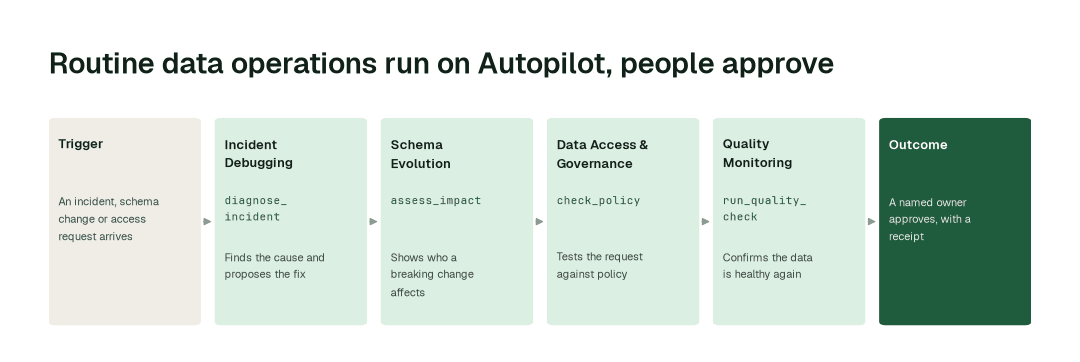
The Autonomous Data-Conductor takes each event, decides which agents should act and keeps the work inside the autonomy that domain allows. Incident Debugging agents use diagnose_incident to find the cause, Schema Evolution agents use assess_impact on a breaking change, and Data Access & Governance agents use check_policy on a request. The Conductor finds problems before anyone files them and turns them into proposed work.
3. Approve what matters
Every proposal shows the full change, what it would affect and how to undo it. Data owners approve, and every action lands in the tamper-evident audit trail. If people keep reverting a domain's changes, that domain pauses itself.
The impact metrics we move
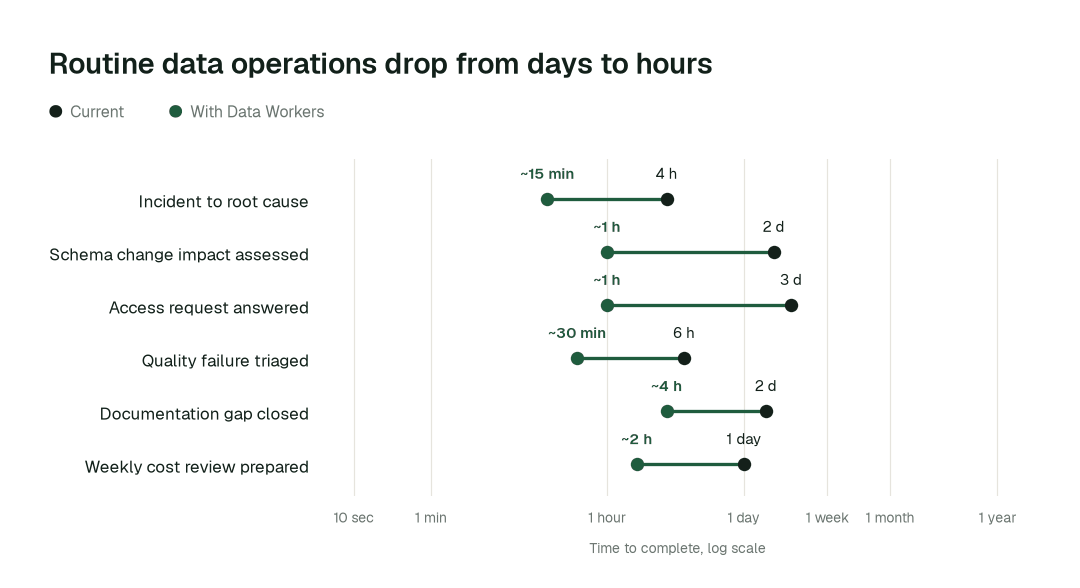
- •Incident to root cause: from about 4 h to ~15 min
- •Schema change impact assessed: from about 2 days to ~1 h
- •Access request answered: from about 3 days to ~1 h
Where teams start
- •Incident triage on the pipelines that page you most. Agents diagnose and propose the fix.
- •Quality checks on your top data products. Failures route to an owner with the likely cause.
- •Schema changes from one source system. Downstream impact assessed before the change merges.
- •Access requests for one domain. Policy checked first, the data owner approves.
- •Documentation gaps in the tables people query most. Drafted by agents, reviewed by stewards.
What powers it
Autopilot (Routines, Missions and Standards) is the operating layer: routines for upkeep, standards for your rules, and missions where you state an outcome and the agents bring a plan back for approval. The Autonomous Data-Conductor coordinates the Data-Agents Swarm of 20 specialised agents, including the Incident Debugging, Quality Monitoring, Schema Evolution, Data Access & Governance and Cost Savings & Data Cleanup agents. The Data Context Wizard and the Spellbook Data Catalog give them the lineage and definitions to judge impact. For the closest day-to-day view, see how data platform and fleet data teams go agentic, data quality and governance and agent governance and audit. The Conductor also works across your whole stack, not one vendor's, as in Genie ZeroOps vs the Autonomous Data-Conductor. Previous step: Make your data catalog agentic.
The climb: from assisted to autonomous to agentic
Every transformation runs on the same ladder from our thesis. Today agents watch (L0), suggest (L1) and act after approval (L2), domain by domain. A domain can go further on the evidence of its own review record; that is where a domain can go, not what runs now. Fewer pages at night is the first thing teams look for; see how to reduce the on-call burden.
The pilot
- •Scope. One domain, with its incidents, quality checks, schema changes and access requests.
- •First week. Agents start by watching and suggesting, and show the fixes they would have made, with receipts. A week-one baseline records where you started.
- •By week two. Routine work is proposed on schedule and approved by a named owner; anything sensitive stays with a person.
- •At day 30. We review the impact metrics against your baseline:
- •Incident to root cause: from about 4 h to ~15 min
- •Schema change impact assessed: from about 2 days to ~1 h
- •Access request answered: from about 3 days to ~1 h
- •Cost. Start with a pilot ($7,500 one-time, credited in full against the first year). Scale is from $1,000 a month and Enterprise from $3,000 a month, billed annually, with unlimited seats, no usage meter and no markup on model spend. See pricing.
FAQ
Does this mean no data engineers? No. Engineers move from first responder to approver and spend the time on new data products. The Conductor does not replace your team.
Can an agent change production without asking? Not on its own. Every domain starts at watch or suggest, only the domain owner raises it, and each proposal shows how to undo the change.
What if an agent is wrong? You see the full change and its impact before approving, and the audit trail records who approved it. If people keep reverting a domain's changes, that domain pauses itself.
Which stacks does it work with? Snowflake, Databricks and BigQuery, plus the orchestrators, dbt and alerting tools you already run, through 50+ connectors.
Is it free to try the building blocks? The open-source core is 11 agents and 160+ MCP tools under Apache-2.0, read and analyse only. The Conductor and Autopilot are part of the paid platform.