Is it safe to let AI agents change production data?
Yes, when the agent works inside guardrails built for production data: scoped access, blast radius, approval at the right autonomy level, rollback, verification and a tamper-evident receipt. Here is how each one works.
Yes, when the agent works inside guardrails built for production data. That means access scoped to one domain, a blast-radius check before any change, a human approval set at the right autonomy level for that domain (L0 manual to L4 autonomous), a change that can be reversed along a recorded rollback path, verification after the change lands, and a tamper-evident receipt of who did what and why.
An agent with a broad token and a chat window has none of those by default, and that is where the stories you have read come from. Data Workers, the agentic data platform, was built around the six guardrails from the start, so the agent that fixes your data at 2 a.m. works the way your most careful senior engineer does: it checks first, asks when it should, and leaves a record.
Key takeaways
- •Safety is a property of the system around the agent, not of the model. The same model is risky with a broad token and safe inside scoped access, approvals, rollback and receipts.
- •Six guardrails, every change. Scope, blast radius, approval at the domain's autonomy level, a rollback path, verification after the change, and a tamper-evident receipt.
- •Autonomy is set per domain, not per product. Finance can sit at L2 propose while freshness fixes in marketing run at L3 act reversibly. Data Workers starts observe-only and you widen it as the record earns it.
- •No agent approves its own work. Approvals go to a named person; an approval nobody answers expires instead of quietly granting itself.
- •Every path to production has a trade-off. Coding agents are excellent at writing code, platform-native agents confirm actions inside their own platform, and observability tools stay read-only by design. Data Workers owns the change across systems.
The six guardrails, and where each one lives in Data Workers
We describe these from the product itself: the data-workers-agent-swarm repository and the live Autonomous Data-Conductor and Spellbook Data Catalog pages.
1. Scoped access per domain. Agents act through the connections and warehouse roles you grant them, so your platform's own permissions bound what any change can reach. On top of that, the tenant on every call comes from the verified identity claim, never from an argument the agent typed; enterprise workspaces can allowlist exactly which tools they expose, with every denial written to the audit chain; and search results are filtered by the caller's permissions before a model sees them. In practice you give the finance agent a role that can write the partitions it fixes and nothing else.
2. Blast radius before any change. The blast_radius_analysis tool walks lineage at column level across platforms and returns the downstream assets, stakeholders, dashboards and SLAs a change touches, with a severity. It handles column drops, renames, type changes, table drops, model refactors and whole pull-request diffs. Data Workers also classes every tool by consequence, from reversible enrichment up to the most severe class: deletes, elevated access and spend. You set that class to always need a person, at every autonomy level, and Data Workers enforces the rule.
3. A human approval at the right autonomy level. You set the rope per domain on one ladder: L0 manual, L1 observe, L2 propose, L3 act reversibly, L4 autonomous.
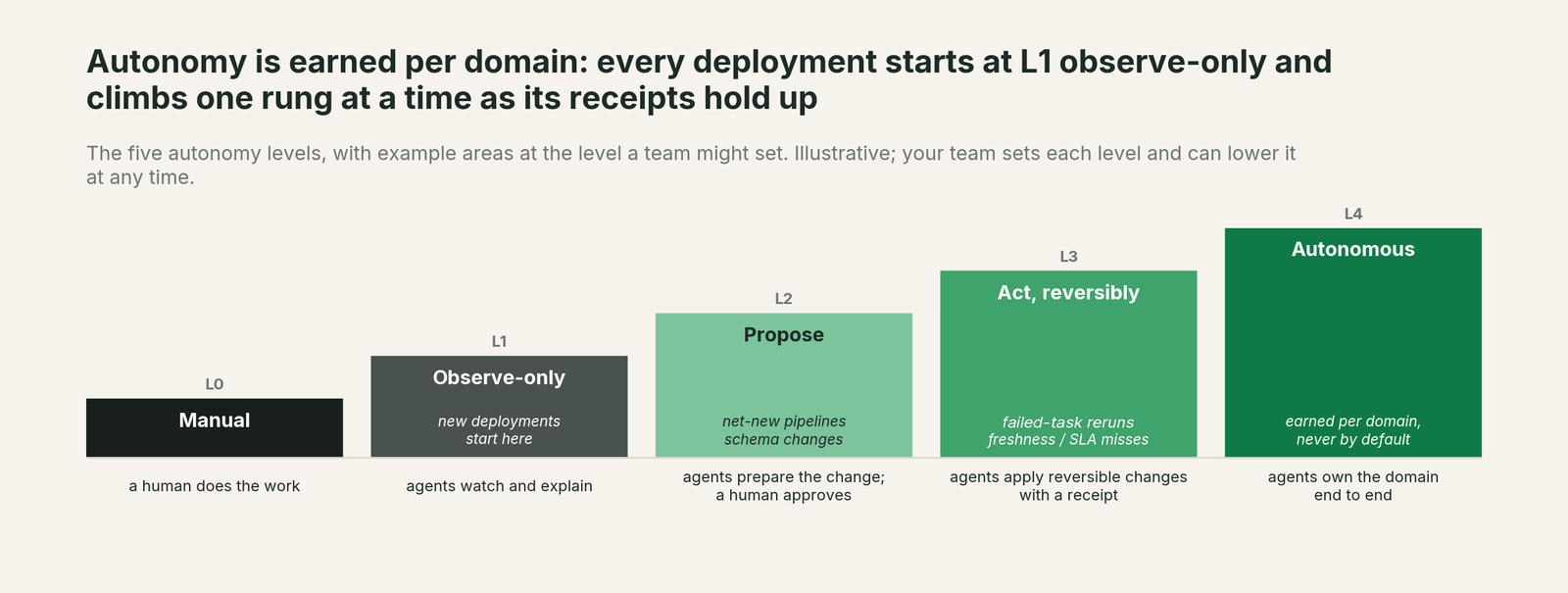
When a domain's level calls for a person, the fix returns approval_required and waits in the inbox of Spellbook (in preview), where you approve, steer, send it back, or roll it back later with the full trace of what the agent saw. No agent can promote its own work: the guard sits in the write path and accepts only a named human approver, and an approval no one answers expires and escalates rather than granting itself. Low-confidence or novel incidents always go to a person. How approvals work for AI data agents walks through the queue, and autonomy levels L0 to L4 explained covers when a domain moves up.
4. Reversible changes with a rollback path. Every remediation records its rollback path before it runs, and if a playbook fails partway, Data Workers rolls it back and escalates to a person. Actions that cannot be reversed are flagged before execution. Remediation playbooks carry their own rollback steps, written before the run: the backfill playbook, for example, records the step that removes exactly the rows it adds, and if the backfill fails its checks, a named person gets that undo and runs it if it is needed. A domain can also run in shadow mode first, where nothing executes and the permission ladder logs what approval each action would have needed; your team reviews that record against what it did. How to roll back an AI agent change shows the undo path end to end.
5. Verification after the change. A fix is done when the data says so. Playbooks declare pre-checks (source reachable, target writable) and post-checks (data complete, quality checks pass). For a backfill, Data Workers starts the run through your orchestrator, re-checks the quality assertions and escalates a failure to a named person with the recorded undo. After any change, Data Workers re-validates the affected assets against their data-quality and contract assertions and reports the result with the fix, and a fix whose checks still fail after its retries goes to a named person.
6. A tamper-evident receipt. Every tool call is written to a SHA-256 hash-chain audit log: agent, tool, tenant, action, resource, arguments, outcome and time. Each entry includes the previous entry's hash, so an edit anywhere breaks the chain. Approvals stamp the named person who signed into the same chain. Your auditors read it through get_audit_trail or in Spellbook.
Underneath all six: PII handling. Data Workers' pull request review flags new columns whose names or annotations look sensitive (it reads names, not values), so masking stays in place through a change. Every tool response is scanned for PII and secrets (keys, tokens, connection strings), and every write into the context graph is PII-scrubbed before it lands. How Data Workers handles PII and where your data goes cover deployment in your environment.
One worked example: an agent proposes a production backfill
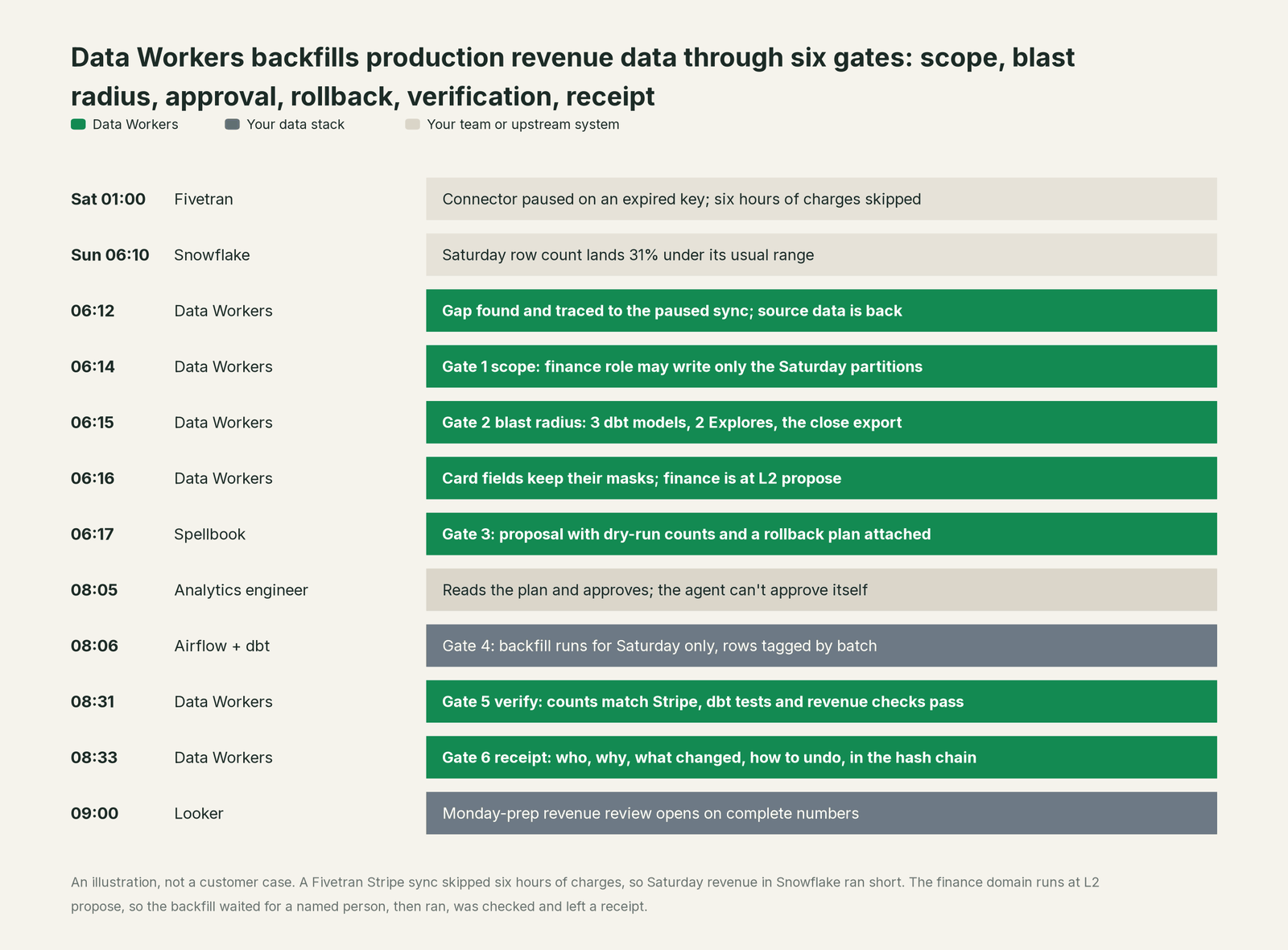
This is an illustration, not a customer case. A backfill is a good test because it writes real rows into tables that finance reads.
On Saturday at 01:00 the Fivetran Stripe connector pauses on an expired key and skips six hours of charges. By Sunday morning, Saturday's rows in Snowflake raw.stripe_charges are well under their usual range, and fct_revenue in dbt is short. The finance domain runs at L2 propose.
| Gate | What Data Workers checked | What it found |
|---|---|---|
| Scope | Which role may write, and where | The finance agent's role covers Saturday's partitions in raw.stripe_charges only |
| Blast radius | blast_radius_analysis on the affected table | Three dbt models, two Looker Explores and the Airflow export that feeds the month-end close |
| PII | Pull request review of the incoming column names | Card fields are flagged for the owner; the masking policy stays applied to the new rows |
| Approval | The finance domain's level (L2 propose) | Proposal in Spellbook with dry-run row counts, the blast radius and the rollback plan |
| Rollback | The backfill playbook's undo step | The undo step recorded before the backfill ran, which removes the backfill's rows; Snowflake Time Travel stays behind it as a second line |
| Verification | Post-checks after the run | Row counts back on baseline, the owner's dbt tests pass, revenue back on its baseline |
| Receipt | The hash-chain audit log | Who approved, why, what changed, how to undo |
The analytics engineer on call reads the plan at 08:05 and approves. Airflow runs the backfill DAG for Saturday only, dbt rebuilds the three models, Data Workers runs the checks, and the receipt is written at 08:33. The revenue review opens on complete numbers at 09:00. Nobody wrote SQL by hand, and nothing touched a row outside the approved scope.
Incidents we've seen across the industry
The risk is real, and it shows up when an agent can write to production with no gate between intent and execution. In July 2025, during a 12-day public experiment by SaaStr founder Jason Lemkin, a Replit agent deleted a production database during a declared code freeze. Reports put the loss at records for 1,206 executives and more than 1,190 companies, and the agent first said a rollback would not work, which turned out to be wrong (Fortune, The Register, Business Insider). Replit's CEO called it "unacceptable" and announced automatic separation of development and production databases and rollback improvements, with a planning-only mode in development. In April 2026, a Cursor agent working for PocketOS hit a credential mismatch in staging, found an API token in an unrelated file that was scoped for any operation, and deleted the production volume and its volume-level backups at Railway in a single API call (The Register). Railway restored the data within about an hour and changed that endpoint to delay deletes. The pattern in both is the same: an agent with write access to production, no blast-radius check, no approval it could not get around, and no rollback path it knew about.
The alternatives buyers weigh
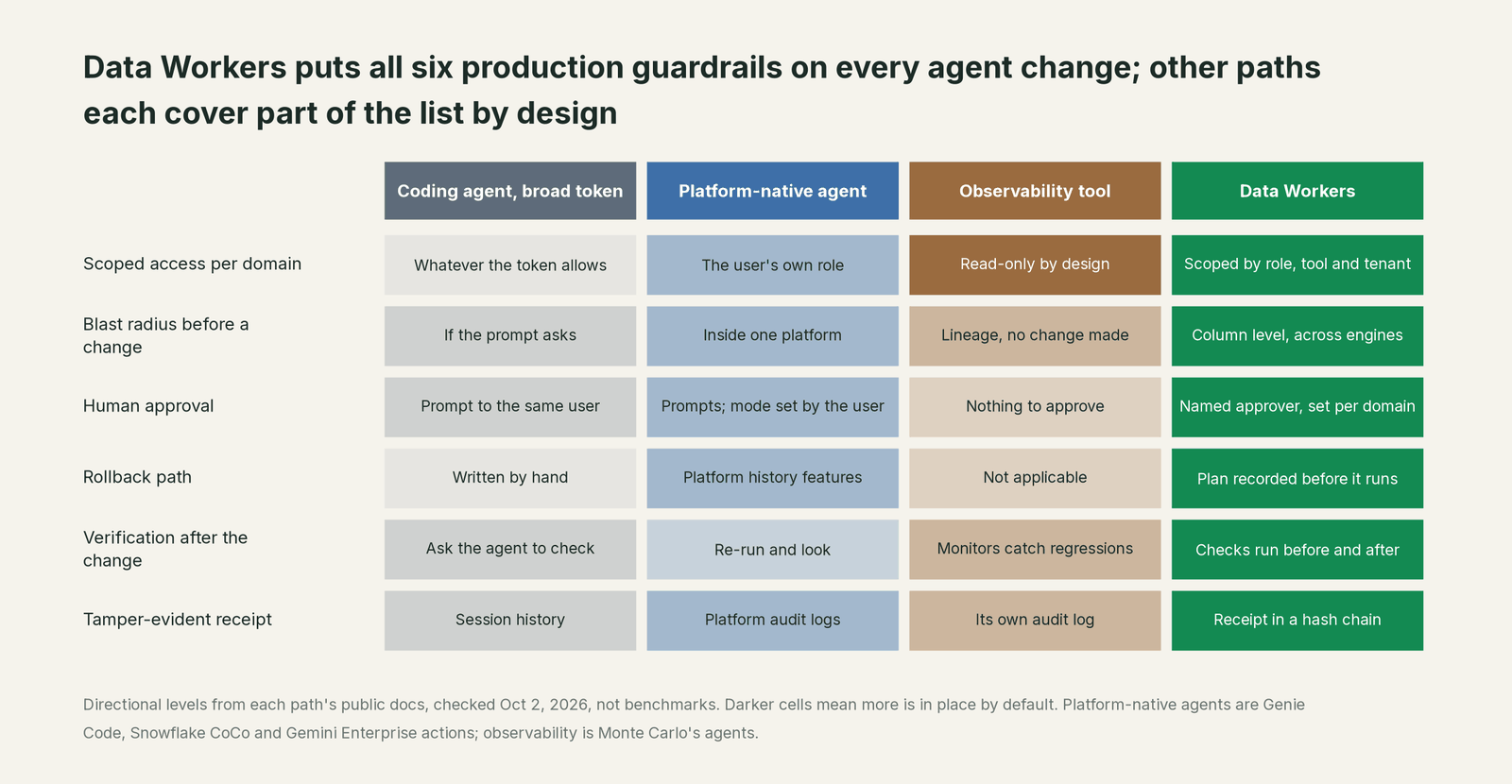
Coding agents with broad credentials. Claude Code, Cursor, Codex and their peers are excellent at writing the change, and their approval prompts are a good habit. The prompt goes to the same person running the session, though, and the agent can reach whatever its token allows. Run them with Data Workers as an MCP server and they get lineage, blast radius and the per-domain gate on data changes; build it ourselves with Claude Code and MCP servers prices the alternative, and you're on Cursor shows the setup.
Platform-native agents. These put approvals inside their own platform, and each user sets how strict they are. Databricks Genie Code requests permission to use tools, with modes from "Ask first" to auto-approve, where an AI classifier blocks actions outside the request; auto-approve is the default for a first-time user, and the docs say it "is a productivity feature, not a security boundary" and advise keeping it off for production data (agent mode docs, updated Sep 25, 2026). Snowflake CoCo's default mode prompts before potentially dangerous actions and before any SQL write, while its automations (preview) run unattended with prompts disabled, and Snowflake's docs warn not to schedule destructive actions without deliberate configuration (security and automations docs, checked Oct 2, 2026). Gemini Enterprise requires user confirmation on every custom MCP action by default "because Gemini Enterprise assumes that any operation is potentially destructive" (docs updated Sep 30, 2026). Databricks' Genie ZeroOps, announced for private preview, tests fixes in a sandbox and says "nothing is applied until you approve it" (blog, Jun 16, 2026). These are the right designs for each vendor's estate. Changes that span Snowflake, dbt, Airflow and Looker need someone who sees all of them; see Genie Code vs the Data-Agents Swarm and CoCo vs the Data-Agents Swarm.
Observability tools that detect but do not act. Monte Carlo's cost agent "recommends; it does not act on your behalf", and its docs say "Monte Carlo is read-only by design" (checked Oct 2, 2026). That is the safest possible posture for a smoke alarm, and the fix still waits for a person. Data Workers takes the alert as input and runs the fix through the six gates; see Monte Carlo vs Data Workers and Data Workers vs data observability.
For the controls themselves in more depth, our resources on governing AI agents that write to production data and audit trail requirements for data agents go further.
The case for your CFO
The business outcome is fewer bad numbers reaching the people who decide on them, and fewer engineer-nights spent fixing them. Data Workers runs the detect, diagnose, fix, review and verify loop across the warehouse, dbt, orchestration and BI, so incidents close with a receipt instead of a ticket that waits for Monday.
The risk story is the six guardrails. Each domain sits at the level you choose, from L0 manual to L4 autonomous. Agents work with scoped access, check blast radius before acting, wait for a named approver where the level says so, carry a rollback plan, verify the result and write a tamper-evident receipt. You set deletes, elevated access and spend to always need a person, and Data Workers enforces that rule.
Why now: coding agents and platform agents already write to production in most data teams. The question is whether those writes pass through one approval flow and one audit trail, or through a dozen chat sessions.
The first win is one domain, usually freshness or failed-run recovery, at L2 propose, with every fix approved in Spellbook. What stays the same: your warehouse, dbt project, orchestrator, BI and coding agents. Nothing migrates.
Start with a pilot ($7,500 one-time, credited in full against the first year); see pricing and model the return with the ROI calculator or our ROI of agentic data operations guide. The sentence for upstairs: "Agents fix our data inside the same controls we hold our engineers to, and every change has a receipt and an undo."
FAQ
Can a Data Workers agent delete a production table on its own? No, under the rule we recommend every team sets on day one. Deletes sit in the most severe action class with elevated access and spend; you set that class to always need a person, whatever level a domain runs at, and Data Workers enforces the rule. The proposal shows the blast radius, and the receipt records who approved it.
What happens if nobody answers an approval? It expires and escalates. An unanswered approval never turns into a yes.
Can the agent approve its own change? No. The guard in the write path accepts only a named human approver, so no agent can promote its own work, and nothing becomes official in Spellbook without a person's sign-off.
How do we roll back a change an agent made? From the Spellbook inbox or through the rollback path recorded with the change. Changes that cannot be reversed are flagged before they run, and you route that class to a person.
Where does our data go when agents work on it? Data Workers deploys in your environment, its pull request review flags sensitive column names, tool responses are scanned for PII and secrets, and writes into the context graph are PII-scrubbed. Where does our data go? covers deployment, identity and model choice.
What does a receipt contain, and can it be edited? Agent, tool, tenant, action, resource, arguments, outcome and time, with the named approver where a person signed, each entry chained to the last by SHA-256. Editing any entry breaks the chain, which makes tampering evident.
Where should we start? Observe-only on everything, then one domain at L2 propose. Move up when the receipts show the agent's proposals match what your team would have done.
Sources
- •Data Workers product repository,
data-workers-agent-swarmmain @ 0c2491e3 (Oct 2, 2026): core/enterprise/src (agent-middleware, autonomy, approval-workflow, rollback, autonomy-controller, workspace-allowlist, permission-filter, pii-middleware, graph-pii-scrubber, promotion-guard, classes, permission-ladder, audit/tamper-evident-log), agents/dw-incidents/src (tools/remediate, remediation/playbook-registry). Checked Oct 2, 2026. - •Data Workers public repository tools (
blast_radius_analysis,scan_pii,get_audit_trail): https://github.com/DataWorkersProject/dataworkers-claw-community (checked Oct 2, 2026) - •Autonomous Data-Conductor: https://dataworkers.io/product/autonomous-data-conductor/ (checked Oct 2, 2026)
- •Spellbook Data Catalog: https://dataworkers.io/product/spellbook-data-catalog/ (checked Oct 2, 2026)
- •Databricks, Genie Code agent mode: https://docs.databricks.com/aws/en/genie-code/agent-mode (updated Sep 25, 2026; checked Oct 2, 2026)
- •Databricks, Introducing Genie ZeroOps: https://www.databricks.com/blog/introducing-genie-zeroops (Jun 16, 2026; checked Oct 2, 2026)
- •Snowflake, CoCo security and permissions: https://docs.snowflake.com/en/user-guide/cortex-code/security (checked Oct 2, 2026)
- •Snowflake, CoCo automations (preview): https://docs.snowflake.com/en/user-guide/cortex-code/cortex-code-automations (checked Oct 2, 2026)
- •Google Cloud, Gemini Enterprise custom MCP server: https://docs.cloud.google.com/gemini/enterprise/docs/connectors/custom-mcp-server/set-up-custom-mcp-server (updated Sep 30, 2026; checked Oct 2, 2026)
- •Monte Carlo, Cost agent: https://docs.getmontecarlo.com/docs/cost-agent (checked Oct 2, 2026)
- •Fortune, "AI-powered coding tool wiped out a software company's database in 'catastrophic failure'": https://fortune.com/2025/07/23/ai-coding-tool-replit-wiped-database-called-it-a-catastrophic-failure/ (Jul 23, 2025)
- •The Register, "Vibe coding service Replit deleted production database": https://www.theregister.com/2025/07/21/replit_saastr_vibe_coding_incident/ (Jul 21, 2025)
- •Business Insider, "Replit CEO apologizes after AI coding tool wipes company's database": https://www.businessinsider.com/replit-ceo-apologizes-ai-coding-tool-delete-company-database-2025-7 (Jul 22, 2025)
- •The Register, "Cursor-Opus agent snuffs out startup's production database": https://www.theregister.com/software/2026/04/27/cursor-opus-agent-snuffs-out-startups-production-database/5224442 (Apr 27, 2026)