Will Data Workers replace my data team?
No. Data Workers takes the repetitive operational load (incidents, backfills, quality checks, access tickets, cost hygiene, migration grunt work) so your data team spends its time on modeling, product and decisions.
No. Data Workers takes the repetitive operational load off your data team (incident triage, backfills, freshness and quality checks, access tickets, cost hygiene and the grunt work inside migrations) so the people on it spend their time on modeling, data products and the decisions only they can make.
Your team sets each domain's autonomy level, from L0 manual to L4 autonomous, approves the changes the agents propose, and owns the outcomes. Data Workers, the agentic data platform, does the operational work underneath and leaves a receipt on every change.
Key takeaways
- •The answer is no, by design. Data Workers runs the repetitive operational loop: detect, diagnose, fix, verify, record. Judgment stays with your team: what to model, which metric is right, what the business needs next.
- •Your team holds the dial. Every domain runs at the level the team sets, L0 manual, L1 observe, L2 propose, L3 act reversibly or L4 autonomous, and the team can lower it at any time.
- •Every role changes in the same direction. Engineers review fixes instead of writing the same fix again; governance leads approve grants instead of drafting them; platform leads decide on cleanups instead of hunting for them.
- •The time is real and well documented. Third-party surveys put maintaining data sets at the top of where practitioners say their time goes, and poor data quality at the top of their challenges.
- •For finance, this is capacity and speed. The same team ships more of the roadmap, faster, with fewer late nights and a cleaner audit trail.
What the surveys say about where a data team's week goes
These are third-party surveys, not Data Workers figures, and they measure different things, so read them as direction rather than a single number.
- •In the dbt Labs 2024 State of Analytics Engineering report (456 respondents, surveyed December 2023 to March 2024), "maintaining or organizing data sets" was the top way practitioners said they spend their time, chosen by 55%, followed by maintaining platforms or infrastructure at 26%. Building reports and dashboards came third at 13%.
- •The same report found 57% of respondents named poor data quality as one of their chief obstacles in preparing data for analysis (respondents picked three), up from 41% in 2022.
- •Monte Carlo's 2023 State of Data Quality survey, run by Wakefield Research with 200 data professionals, reported an average of 67 data incidents a month, an average of 15 hours to resolve each one, and 74% of respondents saying business stakeholders find issues first all or most of the time.
- •The dbt Labs 2026 State of Analytics Engineering report (363 respondents, published April 14, 2026) found trust in data as an organizational priority rose from 66% to 83% year over year, while only 24% prioritize AI-assisted pipeline management, including testing and observability, against 72% who prioritize AI-assisted coding.
That last gap is the point. Most teams have pointed AI at writing code, while the operational load that keeps data correct and on time is still done by hand. That is the work Data Workers takes on. Our data engineering toil and data engineer burnout resources go deeper on the cost of that load.
What Data Workers does, and what your team keeps
Data Workers is built as a team of specialists. The Data-Agents Swarm has 20+ agents, each focused on one job: incidents, quality, schema, pipelines, cost, governance, migration and more. The Autonomous Data-Conductor runs the loop across them: detect, diagnose, fix, review, verify, remember. The Data Context Wizard gives every agent one governed context graph across your platforms, so a fix to a dbt model accounts for the Looker Explore and the Airflow DAG run downstream. Spellbook Data Catalog (in preview) is where people review, approve, roll back and audit.
Here is the split in practice.
| The repetitive load Data Workers takes | What your team keeps |
|---|---|
| Triage a failed load, trace it to a root cause, propose or apply the fix | Decide what "correct" means for a metric and who owns it |
| Run backfills and verify row counts and dashboards afterwards | Design the data model and the data products on top of it |
| Write and run freshness and quality checks after every fix | Set quality bars and service levels with the business |
| Draft access grants by policy, time-boxed, for an owner to approve | Approve or reject every grant; set the policy |
| Trace Snowflake credits to the dbt model behind them and check every downstream dependency | Decide what to change and what the business still needs |
| Translate migration waves, plan their parity checks and hold the completion gate | Choose the target architecture and the order of waves |
| Record who changed what, why, and how to undo it | Sign off on audits and answer to the business |
Two design choices keep this honest. No agent approves its own work: the approval path rejects an agent as its own approver. And the cost agent never changes a warehouse on its own: it drafts the fix with a dependency check, and a person decides. The team is the authority; the agents are the operators.
What changes for each role
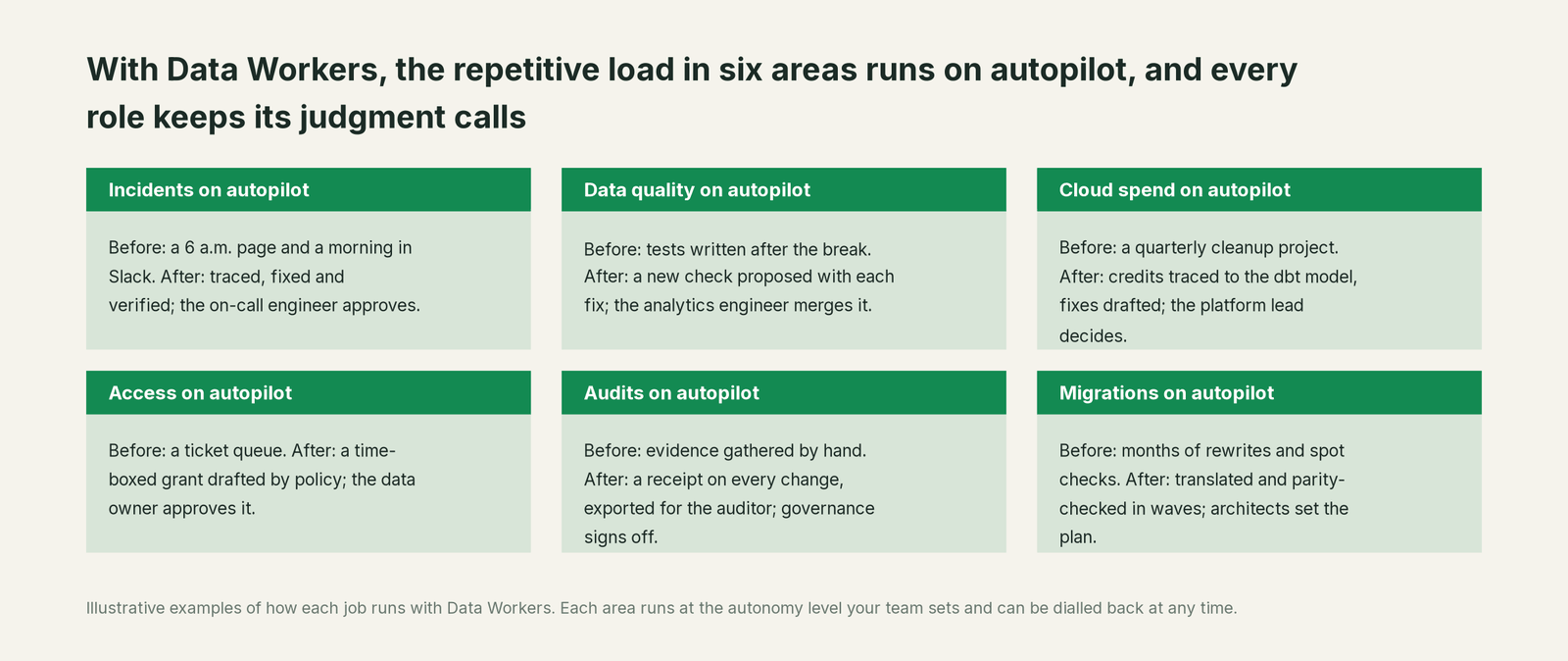
Data engineers stop rewriting the same fix at 6 a.m. The incident arrives already traced, with the blast radius, the proposed change and the rollback attached, and the on-call engineer approves it. Their week moves toward new pipelines, better models and the platform work that keeps getting pushed. Our data engineers role page covers that day in detail.
Analytics engineers keep ownership of the dbt project. Fixes arrive as diffs for the owner to merge, with a new test attached, so the same break is caught earlier next time. See Data Workers for analytics engineers.
Platform engineers decide on cleanups and capacity instead of hunting for them. The cost agent traces Snowflake credits to the dbt model behind them and drafts the fix with a dependency check; the platform lead chooses. See Data Workers for data platform engineers.
Governance leads and data owners approve grants and sign off on evidence instead of assembling it. Every change carries a receipt, and the receipts form the audit trail.
Heads of data read the week's receipts and decide where autonomy moves up next. Our page on who owns the agents sets out that ownership model.
A week in the life: an illustration
Here is one week on a stack of Fivetran, Snowflake, dbt, Airflow, Looker and Jira. It is an illustration, not a customer record or a measured result. Incidents and access run at L2 propose; freshness reruns on one domain run at L3 act reversibly.
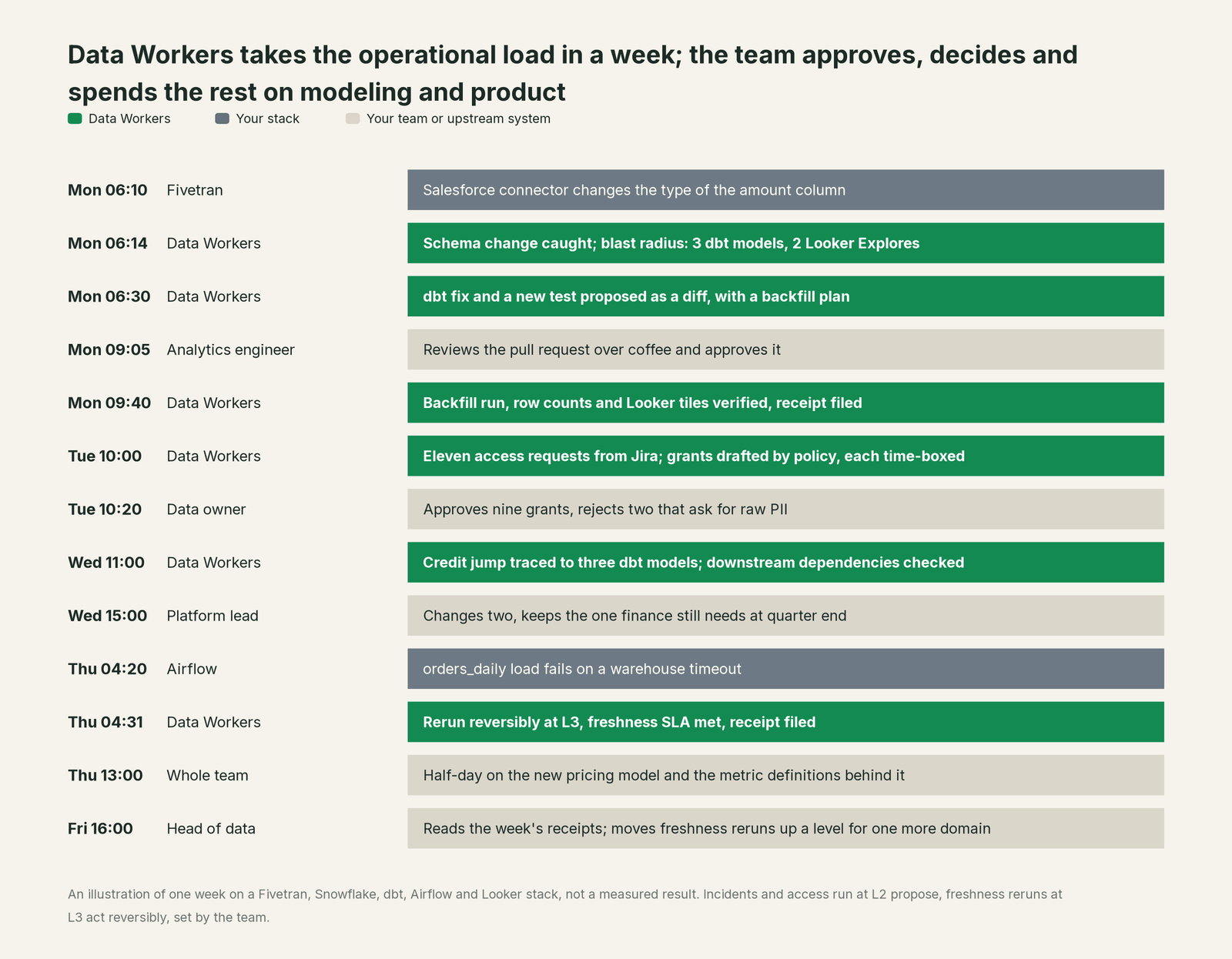
Monday. At 06:10 the Salesforce connector in Fivetran changes the type of the amount column. By 06:14 the schema agent has caught it and mapped the blast radius: three dbt models and two Looker Explores. By 06:30 a dbt fix and a new test sit in a proposed diff with a backfill plan. The analytics engineer approves it over coffee at 09:05. The backfill runs, row counts and Looker tiles are verified, and the receipt is filed before the weekly business review opens the dashboard.
Tuesday. Eleven access requests come in through Jira. Data Workers drafts each grant by policy and time-boxes it. The data owner approves nine and rejects two that ask for raw PII. Nobody on the platform team touched the queue.
Wednesday. The cost agent traces a jump in Snowflake credits to three dbt models and checks every downstream dependency. The platform lead changes two of them and keeps the one finance still needs at quarter end, a call that stays with a person.
Thursday. At 04:20 the orders_daily Airflow load fails on a warehouse timeout. Freshness reruns on this domain are at L3, so the agent reruns it reversibly, the freshness SLA is met, and the receipt is waiting when the team logs on. That afternoon the whole team spends a half-day on the new pricing model and the metric definitions behind it, the work the business hired them for.
Friday. The head of data reads the week's receipts and moves freshness reruns up a level for one more domain. That is how autonomy grows: one domain at a time, on the record.
The team holds the dial
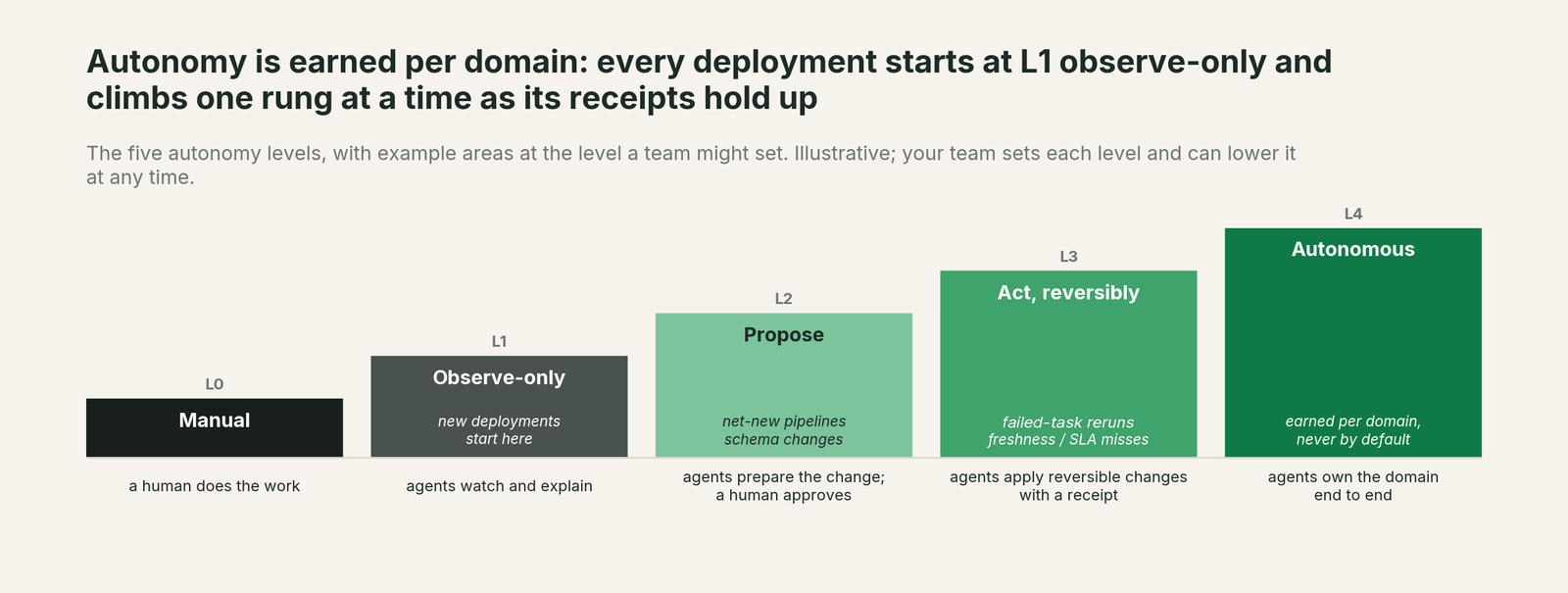
Autonomy in Data Workers is set per domain, by your team. At L0 manual, people do the work and agents stay out. At L1 observe, agents watch, trace and explain. At L2 propose, agents prepare the fix and a person approves it. At L3 act reversibly, agents apply changes that can be undone and report them. At L4 autonomous, agents close the loop end to end within the guardrails the team set.
Most teams start every domain at L1 or L2 and move a domain up only when its receipts show the agents were right. Our explainer on autonomy levels from L0 to L4 walks through each step, and how to get your team to trust AI agents covers the rollout. For the safety model behind every write, read is it safe to let AI agents change production data?, and for where data lives, where does our data go?.
The other ways teams take the load off
Every path below is a sensible choice made by good teams, and each one helps.
Hire more people. It adds capacity, and the new hire joins the same on-call rotation and ticket queue as the estate grows.
Build it yourselves with a coding agent and MCP servers. Claude Code, Cursor or Codex plus vendor MCP servers answer questions on day one. The production layer around them (cross-engine lineage, blast radius, approvals, rollback, receipts, evaluation) becomes a platform your engineers own on top of their day jobs. Our build-vs-buy page lays out that year of work.
Observability tools. Monte Carlo and its peers are the smoke alarm, and a good one. Monte Carlo's open-source agent toolkit now includes automated triage, root-cause analysis and a remediation skill that guides an engineer's coding agent through a fix, confirming with the user and acting through whichever MCP servers are connected. That is a strong assist for the person on call, run one alert at a time from an editor. Data Workers runs the same loop as an operations layer across every platform you own, with autonomy set per domain, approvals by the data owner and a receipt on every change.
Platform-native agents. Databricks Genie Code and Snowflake Cortex Code (CoCo) are strong inside their own platform. Both let a person confirm writes, and Databricks' own documentation, which now makes auto-approve Genie Code's default mode, says auto-approve "is a productivity feature, not a security boundary." That is the right design for a coding assistant in one platform; running operations across every platform you own, with per-domain approvals and receipts, is a different product, and it's the one Data Workers is.
The case for your CFO
The outcome is capacity and speed. The same data team ships more of the roadmap, sooner, because the repetitive operational load (incident triage, backfills, quality checks, access tickets, cleanup, migration grunt work) runs on Data Workers. The value case does not rest on headcount; it rests on how much of the week goes to new data products, better models and faster answers for the business.
The risk story is short. Agents act only at the autonomy level the team sets for each domain. Changes go through approvals, no agent approves its own work, reversible changes carry a rollback, and every change leaves a receipt: who asked, what was touched, what was checked and how to undo it. Nothing is migrated. Snowflake, dbt, Airflow, Looker and your permission systems stay exactly as they are.
Why now: 77% of leaders in the dbt Labs 2026 report say they are pushing teams to improve productivity with AI, trust in data rose from 66% to 83% as a priority, and 57% report rising warehouse and compute spend against 36% reporting bigger team budgets. Point AI at the operational load and the team gets both speed and trust.
The first win is one domain, usually incidents or freshness, at L2 propose, with the receipts to show for it. Start with a pilot: $7,500 one-time, and the pilot is credited in full against the first year. Scale is from $1,000 a month and Enterprise from $3,000 a month, billed annually, with unlimited seats, no usage meter and no markup on model spend. See pricing, model your own numbers in the ROI calculator, and read the ROI of agentic data operations.
The sentence for upstairs: "Data Workers gives our data team its week back, so the same people ship more, faster, with a receipt on every change."
FAQ
Will Data Workers replace data engineers? No. It takes the repetitive operational work so engineers spend their time on design, modeling and new data products. The team sets the autonomy level per domain, approves changes and owns outcomes.
Do we need fewer people on the data team after we adopt it? That's not the goal, and it isn't how we frame the value. Teams use the time on the roadmap that kept slipping: new sources, better models, data products the business has been asking for.
Who is accountable when an agent makes a change? Your team. Every change runs at a level your team set, goes through the approvals you configured, and leaves a receipt with what was changed, why, what was checked and how to undo it. Read who owns the agents.
What does the team still do by hand? Everything at L0 manual, plus every judgment call: metric definitions, data models, priorities, policies, approvals and decisions about what the business needs.
How do we get the team comfortable with agents? Start at L1 observe or L2 propose, review the receipts together, and raise one domain at a time. See how to get your team to trust AI agents.
Sources
- •dbt Labs, 2024 State of Analytics Engineering report (survey December 22, 2023 to March 2, 2024; 456 respondents): https://www.getdbt.com/resources/reports/state-of-analytics-engineering-2024 (checked Oct 2, 2026)
- •dbt Labs, "New dbt Labs Report Finds AI-driven Acceleration is Outpacing Trust and Governance," 2026 State of Analytics Engineering, April 14, 2026: https://www.prnewswire.co.uk/news-releases/new-dbt-labs-report-finds-ai-driven-acceleration-is-outpacing-trust-and-governance-302741246.html (checked Oct 2, 2026)
- •Monte Carlo, The Annual State of Data Quality Survey 2023 (Wakefield Research, 200 respondents), March 2023: https://montecarlo.ai/blog-data-quality-survey/ (checked Oct 2, 2026)
- •Databricks, Genie Code agent mode (auto-approve note): https://docs.databricks.com/aws/en/genie-code/agent-mode (checked Oct 2, 2026)
- •Snowflake, Cortex Code security and permission modes: https://docs.snowflake.com/en/user-guide/cortex-code/security (checked Oct 2, 2026)
- •Monte Carlo, mc-agent-toolkit on GitHub (latest commit Oct 1, 2026; Automated Triage, Analyze Root Cause and Remediation skills): https://github.com/monte-carlo-data/mc-agent-toolkit (checked Oct 2, 2026)
- •Monte Carlo, mc-agent-toolkit Remediation skill README (skill updated Sep 19, 2026): https://github.com/monte-carlo-data/mc-agent-toolkit/tree/main/skills/remediation (checked Oct 2, 2026)
- •Data Workers pricing: https://dataworkers.io/pricing/ (checked Oct 2, 2026)
- •Data Workers, Autonomous Data-Conductor: https://dataworkers.io/product/autonomous-data-conductor/ (checked Oct 2, 2026)