Data Workers for VPs and heads of data
What Data Workers changes for a VP or head of data: agents take the ticket queue and the pager load behind approvals, incidents arrive diagnosed, spend is attributed, and your team stays in charge of every decision.
For a VP or head of data, Data Workers takes the operating load off the team: its agents work the ticket queue, diagnose incidents before the page goes out, draft access grants and attribute warehouse spend, behind approvals, with a receipt on every change. Your week moves from escalations and capacity triage to the decisions only you can make: which domains the agents run, at what level, and where the hours they return go on the roadmap.
Key takeaways
- •Capacity comes back to the roadmap. Agents work the ticket queue: failed loads, access requests and incidents get done behind approvals, with the receipt linked from the ticket. The ROI calculator's default planning assumption is that agents close 30% to 60% of that work; your pilot measures your own share.
- •Fewer pages, shorter incidents. The incidents agent finds the cause across systems and attaches a proposed fix, so on-call starts from a diagnosis instead of a blank terminal.
- •One platform instead of a stack of point tools. One context graph, one approval flow and one audit trail across the whole data lifecycle.
- •Autonomy per domain, receipts for every review. Each domain runs at its own level from L0 manual to L4 autonomous. Data Workers ships observe-only; every change carries the diff, the approver, the blast radius and the way back.
- •Your team stays in charge. Approvals go to named people, and no agent can promote its own work. The team decides when a domain moves up a level.
A head of data's week today
The job is running a team that is always one escalation behind. Monday starts with the weekend's incidents. The roadmap competes with keep-the-lights-on work: access requests, failed loads, schema changes from source teams, backfills and "why doesn't this number match" tickets. Finance asks why the warehouse bill grew. The hiring plan grows with the queue, not the roadmap. And the business now arrives with AI requests: an assistant on sales data, an agent for support.
The tools are the team's plus the management layer: Snowflake, BigQuery or Databricks, dbt, Airflow or Dagster, Looker or Tableau, Jira or ServiceNow, PagerDuty, Slack and a cost dashboard.
The survey data matches the pressure. In dbt Labs' 2026 State of Analytics Engineering report (363 responses from practitioners and leaders, collected Dec 5, 2025 to Feb 1, 2026), the importance placed on speed rose from 50% to 71% and on trust in data from 66% to 83%. AI has reached the code but not the operations: 72% prioritize AI-assisted coding, while only 24% prioritize AI-assisted pipeline management.
The same week with Data Workers
The agents take the operating work. The incidents agent runs diagnose_incident and get_root_cause across your systems before the page goes out, so the page carries the cause and a proposed fix. The quality agent's run_quality_check and set_sla watch the datasets stakeholders depend on. The governance agent's provision_access drafts a least-privilege, column-level grant with an end date (90 days by default) for the data owner to approve and apply. The cost agent reads measured compute from Snowflake's metering and per-query attribution history, down to the dbt model behind each query, and from BigQuery's job history. When a load fails, Data Workers queues the rerun through your orchestrator, checks the load against its baseline and links the receipt from the ticket; your team closes the ticket.
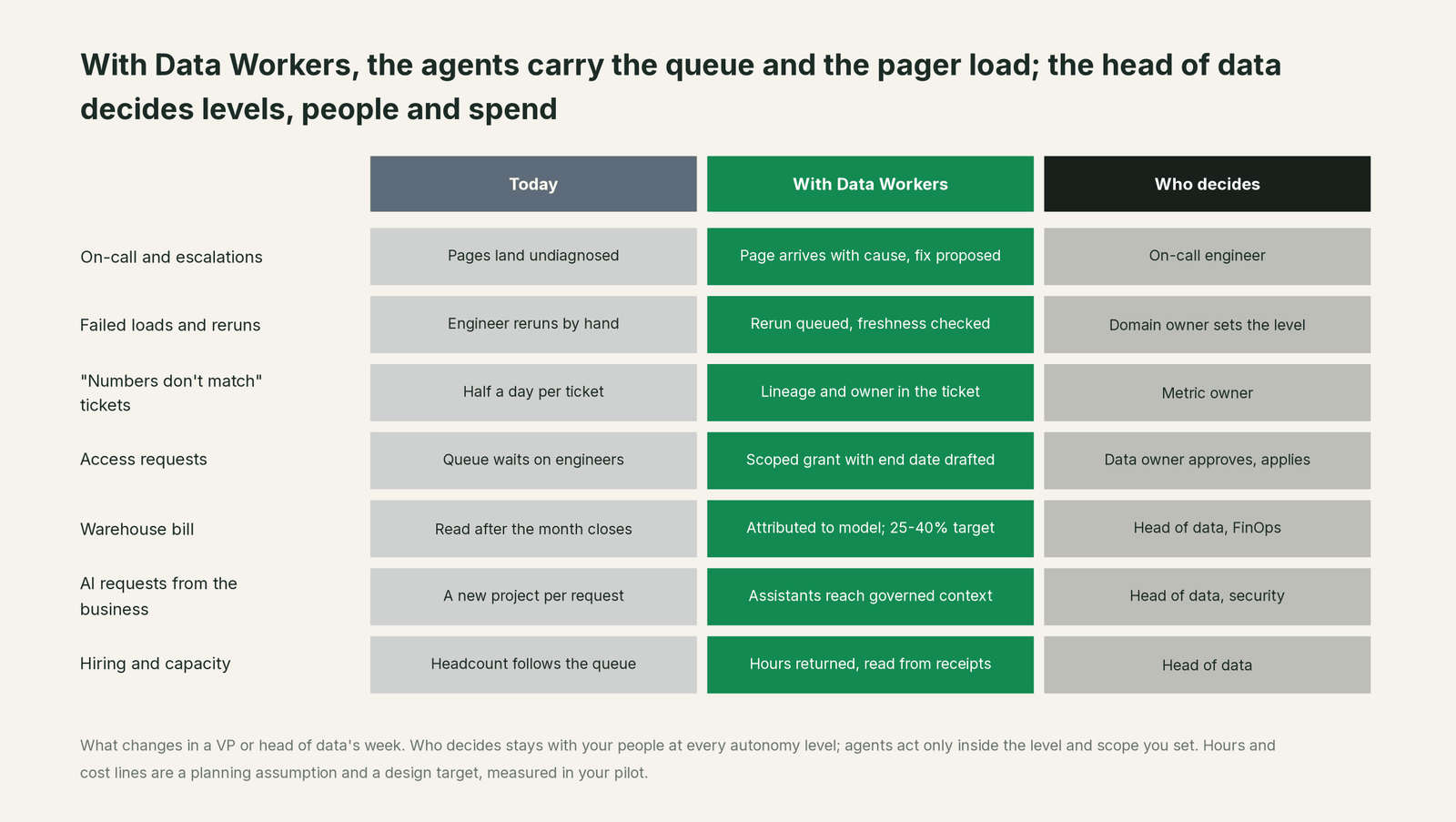
What you still own and decide.
- •Which domains, and at what level. Each domain runs at L0 manual, L1 observe, L2 propose, L3 act reversibly or L4 autonomous. Most teams start with failed-load reruns: high volume, cheap to undo. Incidents and schema changes usually stay at L2 longer. Autonomy levels L0 to L4 explains each rung.
- •When a domain moves up. Your team reviews the agents' records and receipts against the bar it set and raises a level only when the record clears it. The org-wide stop halts all autonomous dispatch at once.
- •Who approves what. Approvals go to a named person. An unanswered request expires and escalates; it never auto-grants. How approvals work and who owns the agents set out the split.
- •Where the hours go. The receipts show how much work got done and in which domain. Whether that capacity goes to the roadmap, the AI requests or a held req is your call.
How Data Workers fits the tools your team runs
Engineers stay in their coding agents. Data Workers' agents are MCP servers that Claude Code, Cursor or Codex call directly (client setup). When an engineer opens a pull request, Data Workers reviews it for blast radius and impact and flags risky changes before they merge.
You and your leads work in Spellbook (in preview): one inbox to approve, steer, send back or roll back the agents' work, with the receipt behind every item. Pages still go through PagerDuty or Opsgenie, now with the diagnosis attached. Agents open tickets with create_jira_sm_ticket or create_servicenow_ticket with the receipt linked; your team owns ticket state and closes them. Slack and Teams carry the notifications.
The AI requests from the business get a governed answer instead of a new project each time. The assistants your company has rolled out (Claude, ChatGPT Enterprise, Gemini Enterprise) reach the same agents and approved definitions over MCP, with sign-in through your own identity provider and Data Workers verifying the tokens via JWKS. AI assistants rolled out, now what? walks through it.
The agents run in your infrastructure on every tier, holding your warehouse credentials and model key. Your data stays in your systems; the hosted Conductor sees workflow metadata only (where does our data go?). The platform guides for Snowflake and Google Cloud cover the fit, and the integrations page lists the 50+ connectors.
The metrics you are judged on
Heads of data are measured on SLA attainment, incident count and time to resolve, delivery velocity, retention and cost per use case. Data Workers moves each one, and its own records give you the number.
| Metric | How Data Workers moves it | Where the number comes from |
|---|---|---|
| SLA attainment | Freshness and quality SLAs watched continuously; failed-load reruns queued through the orchestrator | set_sla violations, monitor_metrics freshness baselines, rerun receipts |
| Incident count and time to resolve | Cause found across systems; fix proposed with the page; repeats caught | get_incident_history, time from page to approved fix |
| Delivery velocity | Ticket and incident hours return to the roadmap | Hours returned; ROI calculator default planning assumption of 30% to 60% |
| On-call health and retention | Fewer undiagnosed night pages; fewer manual reruns | Pages per rotation, night pages resolved at L3 |
| Cost per use case | Measured compute attributed to the dbt model and query behind it, sent to the owner | Design target of 25 to 40% lower warehouse spend |
The hours line is an editable planning assumption and the spend line a design target, not results. Baseline both on day one of the pilot from your own ticket queue, incident log and bill. How to measure AI data agents sets out the scorecard, the ROI calculator runs your numbers, and the ROI of agentic data operations shows the arithmetic. On retention, see data engineering on-call and the cost of toil.
A worked example: one week, three questions, one level change
This is an illustration, not a customer case. A head of data runs a team of eight on Snowflake, dbt, Dagster and Looker, with PagerDuty for on-call and Jira Service Management for requests. Incidents run at L2 propose; failed-load reruns have been at L2 for a month.
| Time | Who | What happened |
|---|---|---|
| Mon 08:30 | Head of data | Reads the weekend in Spellbook: 4 incidents diagnosed, 3 fixes approved by on-call, 1 waiting |
| Mon 09:10 | FP&A | Asks why the Snowflake bill rose 22% last month |
| Mon 09:40 | Data Workers | Per-query attribution puts the rise on one dbt model rebuilt in full every hour |
| Mon 10:05 | Data Workers | Sends the model owner the credits per run and the queries behind them |
| Tue 15:00 | Model owner | Makes the model incremental and daily; credits fall on the next run |
| Wed 11:20 | Marketing analyst | Requests read access to fct_campaign_spend in Jira Service Management |
| Wed 11:35 | Data Workers | provision_access drafts a column-level grant with a 90-day end date and comments it on the ticket |
| Wed 14:00 | Data owner | Approves and applies the grant in Snowflake; the end date sits in the access ledger |
| Thu 02:05 | Data Workers | Pages on-call with the cause of a failed load and a proposed rerun; the engineer approves and the rerun queues through Dagster |
| Thu 10:00 | Head of data | Reviews a month of rerun receipts with the team; moves failed-load reruns to L3 |
| Fri 15:00 | Head of data | Quarter plan: the freed on-call hours go to the roadmap, and the new req is held for a quarter |
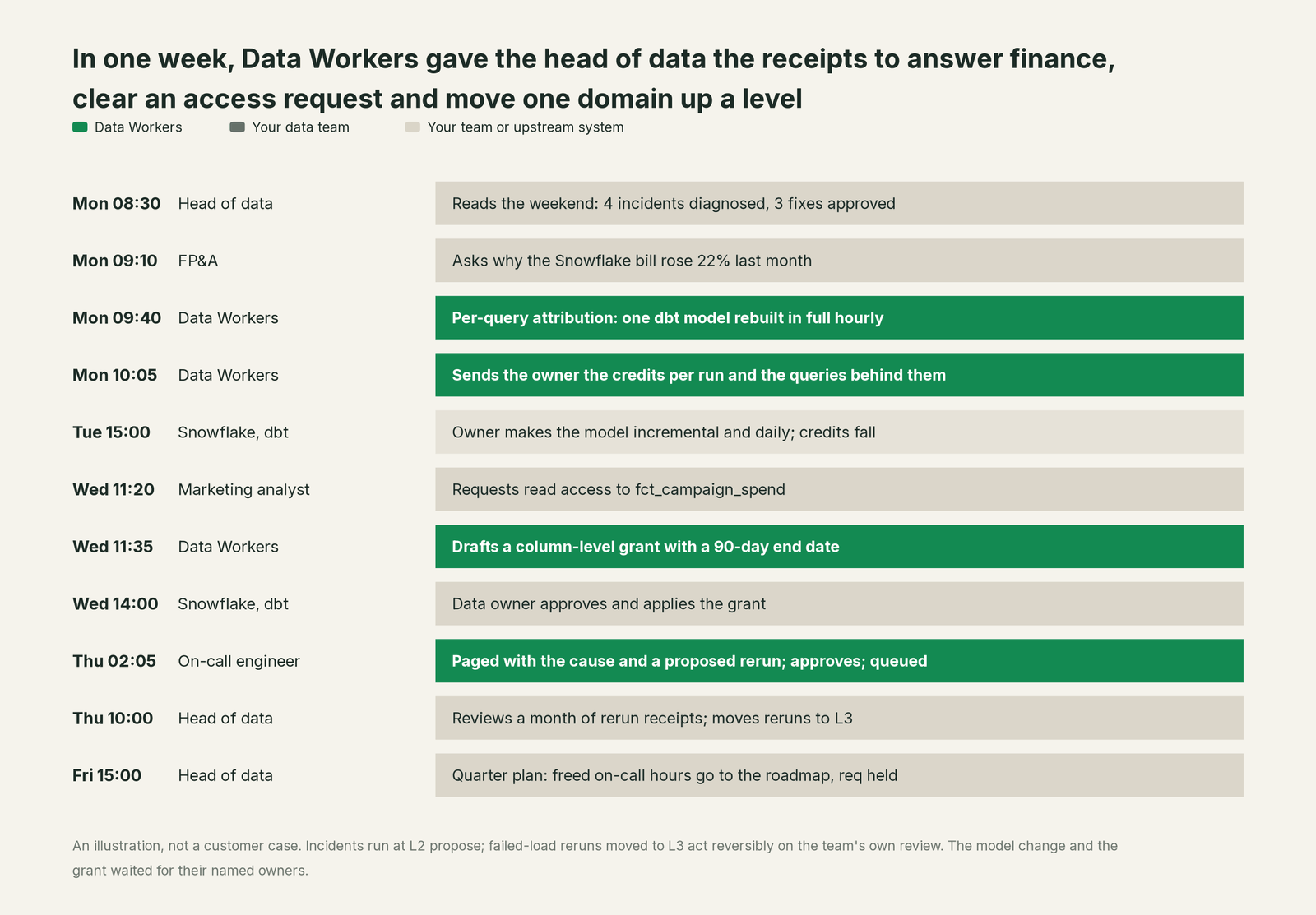
Finance got an answer with a cause attached, the analyst got a scoped grant the same day, and the 02:05 page took one approval instead of an hour of digging. The first 90 days shows how a team gets from observe-only to that point.
The case for your CFO
The outcome: the data team delivers more of the roadmap without headcount growing in step with the ticket queue, and the warehouse bill stops growing faster than the team.
The risk story is control. Agents start at L1 observe. Each domain climbs only when its receipts clear your team's bar, and every change is scoped by blast radius, approved where the level requires it and recorded with the approver and the way back. Nothing migrates: your warehouse, dbt project, orchestrator and BI stay, and the open-source core is Apache 2.0.
Why now: your engineers already write code with AI, and the operating load around that code grows with every model and pipeline. The first win is the queue: failed-load reruns and access requests, high in volume and measurable inside the pilot.
The cost is flat. Start with a pilot ($7,500 one-time, credited in full against the first year). Scale is from $1,000 a month and Enterprise from $3,000 a month, billed annually, with unlimited seats, no usage meter, no markup on model spend and your own model (why there is no usage meter; pricing). The sentence for finance: "Agents take our operating queue under rules we set, and every hour they return shows up in a receipt."
FAQ
My team won't trust it. Where do we start? Observe-only, in one domain. The team scores the agents' suggested fixes against a bar it sets and moves the domain to L2 propose when the record clears it. How to get your team to trust AI agents is the playbook.
We gave everyone copilots and nothing changed in operations. Why is this different? Copilots speed up writing code. Data Workers does the operating work around it (incidents, reruns, access, cost) with lineage across systems, approvals and receipts, inside those same coding agents over MCP.
Will it replace people on my team? It takes the toil, not the jobs. Engineers own the design, the approvals and the judgement calls. Will Data Workers replace my data team? answers it in full.
Do we have to drop our observability or catalog tools? No. Monte Carlo, Great Expectations, Soda, Datadog, DataHub and OpenMetadata connect natively, and their signals feed the same loop. Many teams consolidate once Data Workers runs that slice too.
Will pricing surprise us as usage grows? No. A flat platform fee, unlimited seats, no usage meter. The model bill is yours, on your own provider account, with no markup.
Could we build this with Claude Code and a few MCP servers? You could build the agents. The layer around them (cross-engine lineage, blast radius, approvals, rollback, receipts, autonomy per domain) is the bigger job. Build it ourselves prices that path, and is it safe to let AI agents change production data? covers the controls.
For your peers and your team, see Data Workers for CDOs and for data engineers, and the data leaders' guide to data engineering agents.
Sources
- •dbt Labs, 2026 State of Analytics Engineering Report: https://www.getdbt.com/resources/state-of-analytics-engineering-2026 (checked Oct 2, 2026)
- •Data Workers public repository tools (
diagnose_incident,get_root_cause,get_incident_history,run_quality_check,set_sla,check_freshness,provision_access,create_jira_sm_ticket,create_servicenow_ticket,trigger_dagster_job): https://github.com/DataWorkersProject/dataworkers-claw-community (checked Oct 2, 2026) - •Data Workers product repository,
data-workers-agent-swarmmain @ 0c2491e3: approvals and escalation, promotion guard, cost agent measured compute (Snowflake WAREHOUSE_METERING_HISTORY and per-query QUERY_ATTRIBUTION_HISTORY with dbt metadata; BigQuery job history), access ledger with grant end dates, ticket create and comment tools, reruns queued through the orchestrator (checked Oct 2, 2026) - •Data Workers product pages: https://dataworkers.io/product/autonomous-data-conductor/ , https://dataworkers.io/product/spellbook-data-catalog/ , https://dataworkers.io/product/data-agents-swarm/ (checked Oct 2, 2026)
- •Data Workers client setup: https://dataworkers.io/opensource-docs/client-setup/ (checked Oct 2, 2026)
- •Data Workers security page: https://dataworkers.io/security/ (checked Oct 2, 2026)
- •Data Workers pricing and ROI calculator: https://dataworkers.io/pricing/ , https://dataworkers.io/roi-calculator/ (checked Oct 2, 2026)