Why is there no usage meter on Data Workers?
A usage meter taxes the automation you bought agents for. Data Workers charges a flat platform fee with unlimited seats, no credits or runs, and no markup on model spend. Here is the reasoning, an illustration finance can check, and how other tools price agent work.
Because a meter taxes the automation you bought it for: the more work agents take off your team, the more a per-run, per-credit or per-task price charges you, so teams start rationing the agents. Data Workers charges a flat platform fee with unlimited seats and no usage meter, credits or consumption units, and no markup on model spend: you pay your model provider directly.
Data Workers is the agentic data platform, built so agents close more of your data operation every quarter, and we priced it so that success shows up as hours back. Our pricing page says it in one line: "We will never meter your agents: no credits, no runs, no tasks, no invented unit, so automating more of your data operation next quarter does not change your bill."
Key takeaways
- •A meter puts a price on every success. When each agent run, task or credit costs money, the bill climbs exactly as automation works, and someone starts asking teams to run fewer agents.
- •Data Workers prices the platform, not the work. A $7,500 pilot credited in full against the first year, then Scale from $1,000/month or Enterprise from $3,000/month, billed annually, with unlimited seats and no meter at any tier.
- •Your model bill stays yours. Bring your own model and key; your provider bills you directly at your negotiated rate, with no markup from us. Model tokens are the only cost that moves with volume, and you control every lever on it.
- •Other tools meter for sound reasons. Warehouses and lakehouses bill AI on consumption next to their compute; coding tools pair a seat price with pooled credits or included usage. Both are sensible designs, and both mean a forecast for agent volume before you scale.
- •Finance gets a fixed line and a falling unit cost. With a flat fee, the cost per closed incident or ticket goes down every month the agents do more.
How pricing works in Data Workers
The rate card on /pricing/ has three parts, and none of them counts agent activity.
The pilot. $7,500 one time, six to twelve weeks, with a forward-deployed engineer and every agent live against your data. The pilot is credited in full against the first year.
The platform. Scale from $1,000/month and Enterprise from $3,000/month, billed annually. Seats are unlimited on every tier, because the reviewers who approve agent work should not be a line item. The compare table on the pricing page lists "Usage meter, credits or consumption units" as None and "Markup on your model spend" as None on all three tiers.
Your model. The agents run in your infrastructure and call the model you choose on your key: Claude, GPT or Gemini, in your Bedrock, Azure OpenAI or Google Cloud tenant, or an open model on Ollama or vLLM. The pricing page puts it plainly: "We will never mark up your model spend - you bring your own key and your provider bills you directly, at your rate, at every tier and in the open-source core." Our post on which model Data Workers uses and what it costs to run shows the token arithmetic with this month's list prices.
Why a meter works against automation
Agentic data operations is a volume game. A team starts one domain at L1 observe, moves it to L2 propose once the proposals are right, then to L3 act reversibly for work like failed loads and reruns, and adds the next domain. Every step up the ladder means more incidents diagnosed, more tickets worked and more runs per month. That is the return.
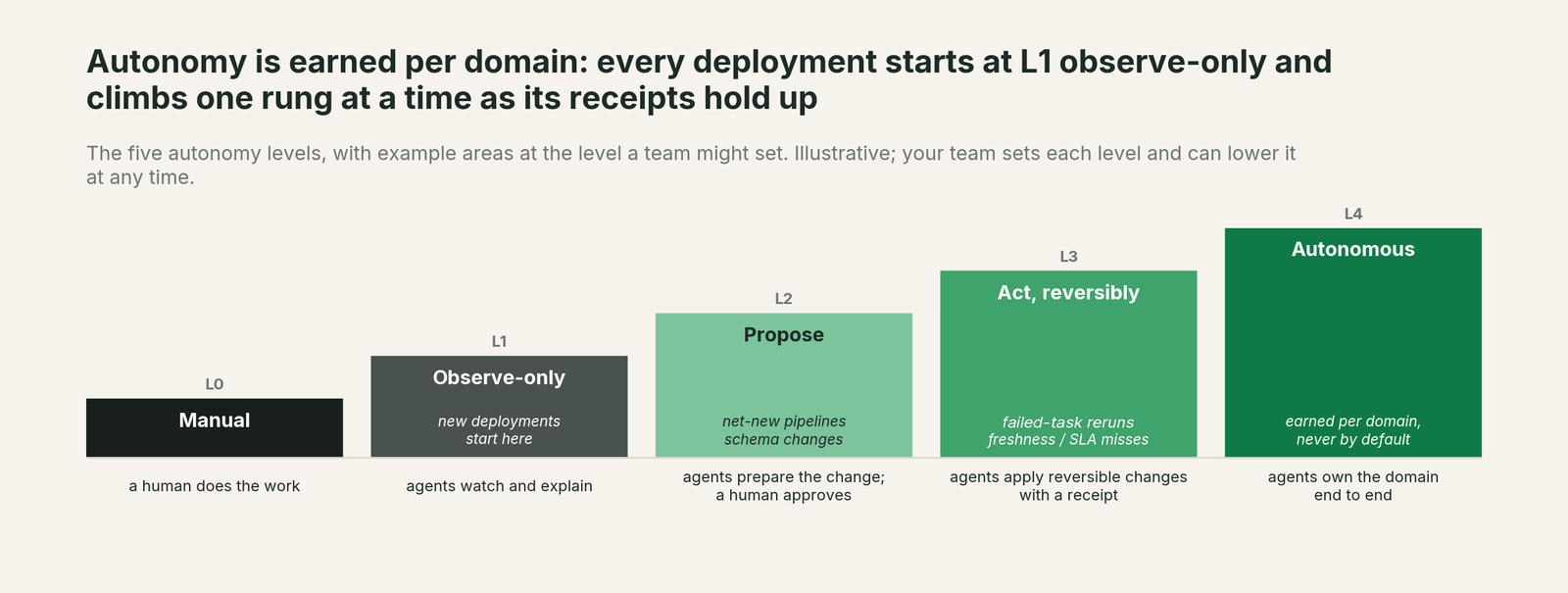
Put a meter on that and three things happen. The bill moves with the number you are trying to grow, so a good quarter reads as a cost overrun. Forecasting gets hard, because incident volume follows upstream releases and vendor outages the data team does not control. And people ration: schedules get thinned, smaller domains stay manual and agents get paused at month end.
A flat fee removes all three. The platform cost is known for the year, and the only number that moves with volume is your own model bill, at your negotiated rate. Autonomy levels L0 to L4 explained covers when a domain moves up; how to measure AI data agents covers the numbers that earn each step.
A worked example: one quarter of growth
This is an illustration, not a measured customer result. The estate is Snowflake, dbt, Airflow, Fivetran and Looker. In month one, the finance-data domain runs at L2 propose: agents diagnose Fivetran sync gaps, failed Airflow DAG runs and dbt test failures, and propose fixes for a named owner to approve. That is about 1,000 agent runs a month. By month three the team has moved failed loads and reruns to L3 act reversibly and added the marketing domain, and runs reach about 4,000 a month.
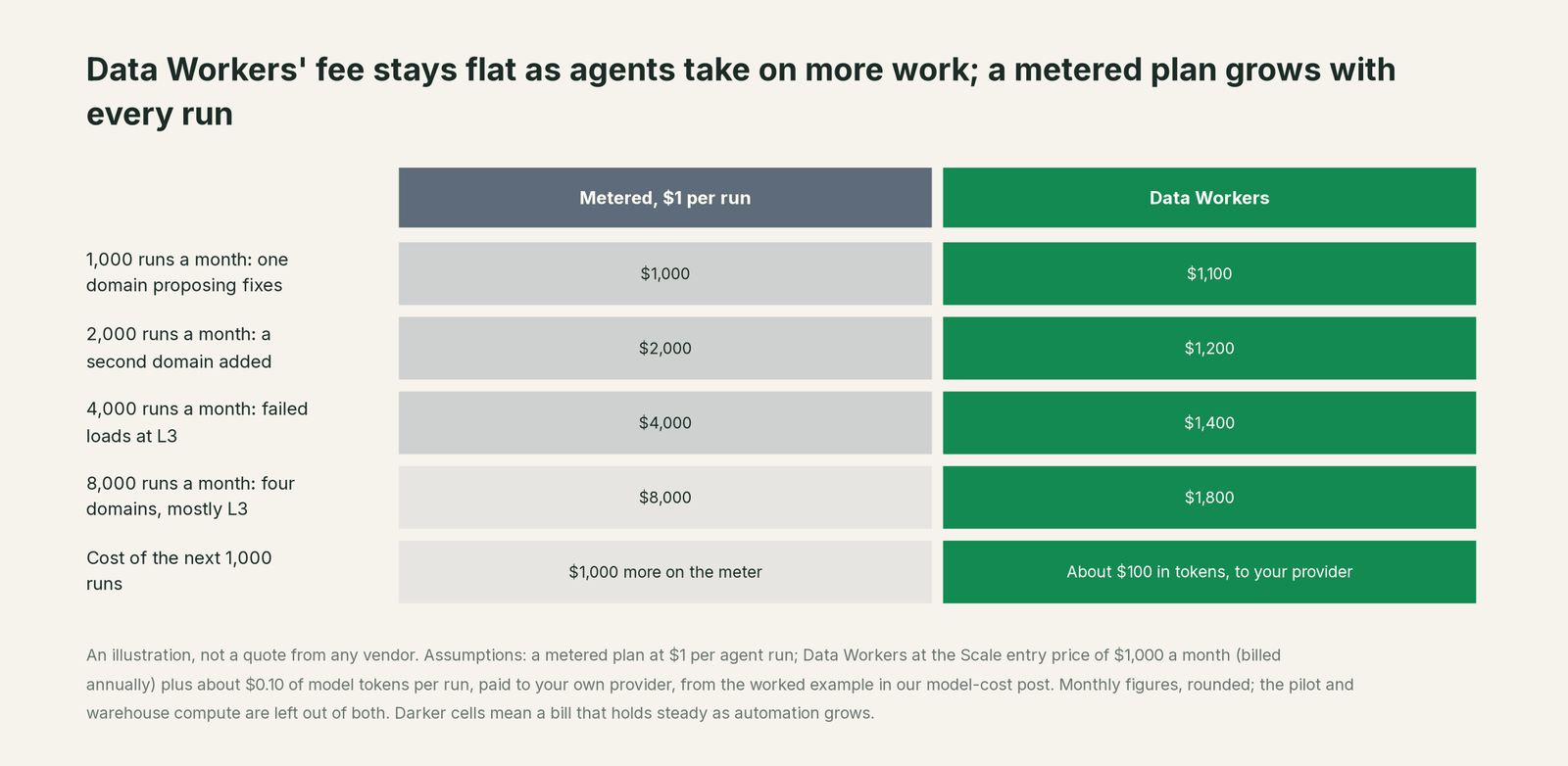
The assumptions are on the chart: a hypothetical metered plan at $1 per agent run (our assumption, not any vendor's rate), against Data Workers at the Scale entry price of $1,000 a month plus about $0.10 of model tokens per run, paid to your provider. Both columns leave out the pilot and the warehouse compute that agent queries use, which is the same under either plan. The token figure comes from the model-cost post's worked example: about $82 a month for 850 runs on a mid-tier frontier model before caching.
At 1,000 runs the two bills sit close together. At 4,000 runs it is $4,000 against about $1,400, and at 8,000 runs $8,000 against $1,800. The last row is the point: on a meter the next 1,000 runs cost another $1,000; on Data Workers they cost about $100 in tokens. A meter asks the team "is this run worth a dollar?" every month. Data Workers asks "is it worth ten cents of tokens?", and for a failed load at 2 a.m. the answer is yes.
Your own numbers come from your pilot. The ROI calculator puts them next to team size, ticket volume and warehouse spend, and the ROI of agentic data operations shows what to baseline on day one.
How other tools price agentic and AI features
Most of the market prices agent work by consumption, for sound reasons. We read these pages on October 2, 2026; our pricing report covers 52 of them.
Snowflake. Cortex Code (now Snowflake CoCo), Cortex Agents, Snowflake CoWork and AI Functions bill in AI Credits, separate from Platform Credits: $2.00 per AI Credit with global routing and $2.20 with regional routing. Agents bill per million tokens, additive across the services an agent calls, plus warehouse compute for the SQL it runs, with no per-seat fees. For a buyer, AI cost sits on the same consumption bill as the warehouse, so plan agent volume into the credit forecast.
Databricks. Genie bills on consumption with no seat fees. Genie One and Genie Agents are free for LLM usage until January 31, 2027; from February 1, 2027 every user gets 150 DBUs of free usage a month (about $10.50 in US East), then $0.070 per DBU, plus compute billed separately. Service principals get no free allowance and pay for all their LLM usage. For a buyer, scheduled and service-principal agents are the part to model, since that is where automation runs.
Monte Carlo. Customers buy credits, priced by tier, and consume them at published rates. The Consumption Rates page (updated September 8, 2026) prices the Troubleshooting Agent at 2,000 credits per 20 investigations after three free a month, and the Triage Agent at 5 credits per alert after 20 free a month. For a buyer, agent investigations draw down the same credit pool as monitors, so heavier agent use means planning a larger credit purchase.
Atlan and Collibra. Both sell on quoted contracts with no public list price this month. For a buyer, ask how AI and agent features are counted (by user, asset or usage) before volume grows.
GitHub Copilot. Copilot Business is $19 per user per month with 1,900 pooled GitHub AI Credits per user and $0.01 per credit beyond; Copilot Chat, the Copilot CLI, the cloud agent and third-party coding agents consume credits, while code completions and next edit suggestions stay unlimited. Premium requests now apply only to Copilot Pro and Pro+ subscribers who stayed on a legacy annual plan after June 1, 2026. For a buyer, seats set the floor and agent use sets the rest.
Cursor. Teams is $40 per user per month (Premium $120), with a set amount of model usage included; on-demand usage beyond it bills at API rates in arrears, and third-party model requests on Teams and Enterprise add a Cursor Token Rate of $0.25 per million tokens. For a buyer, it is a seat plus usage model that scales with how hard each developer drives the agent.
Build it yourself. A coding agent plus vendor MCP servers has no platform meter; the cost that grows is engineering time for lineage, approvals, rollback and receipts. Can't we just build this ourselves with Claude Code and MCP servers? walks through that build.
Each stays a good choice for its job, and Data Workers works with all of them. The difference is where agent volume lands.
What keeps the model bill predictable
No meter on our side still leaves you full visibility and control of your model bill. Most of an incident run is code, not model calls: lineage walks with trace_cross_platform_lineage, impact with blast_radius_analysis, and checks with get_quality_score and run_quality_check add no tokens. A model router sends routine steps to a small or local model, budget guards stop a pipeline request or an enrichment run at a dollar ceiling, and a cost dashboard shows spend by provider, model and agent. Sovereign mode routes every call to your own Ollama or vLLM endpoint, for a token bill of zero; you pay only for the hardware the model runs on.
The work stays governed at any volume: agents act inside approvals set per domain, every change carries a rollback path and a tamper-evident receipt, and your data stays in your systems; the hosted Conductor sees workflow metadata only. Is it safe to let AI agents change production data? and where does our data go? cover both.
The case for your CFO
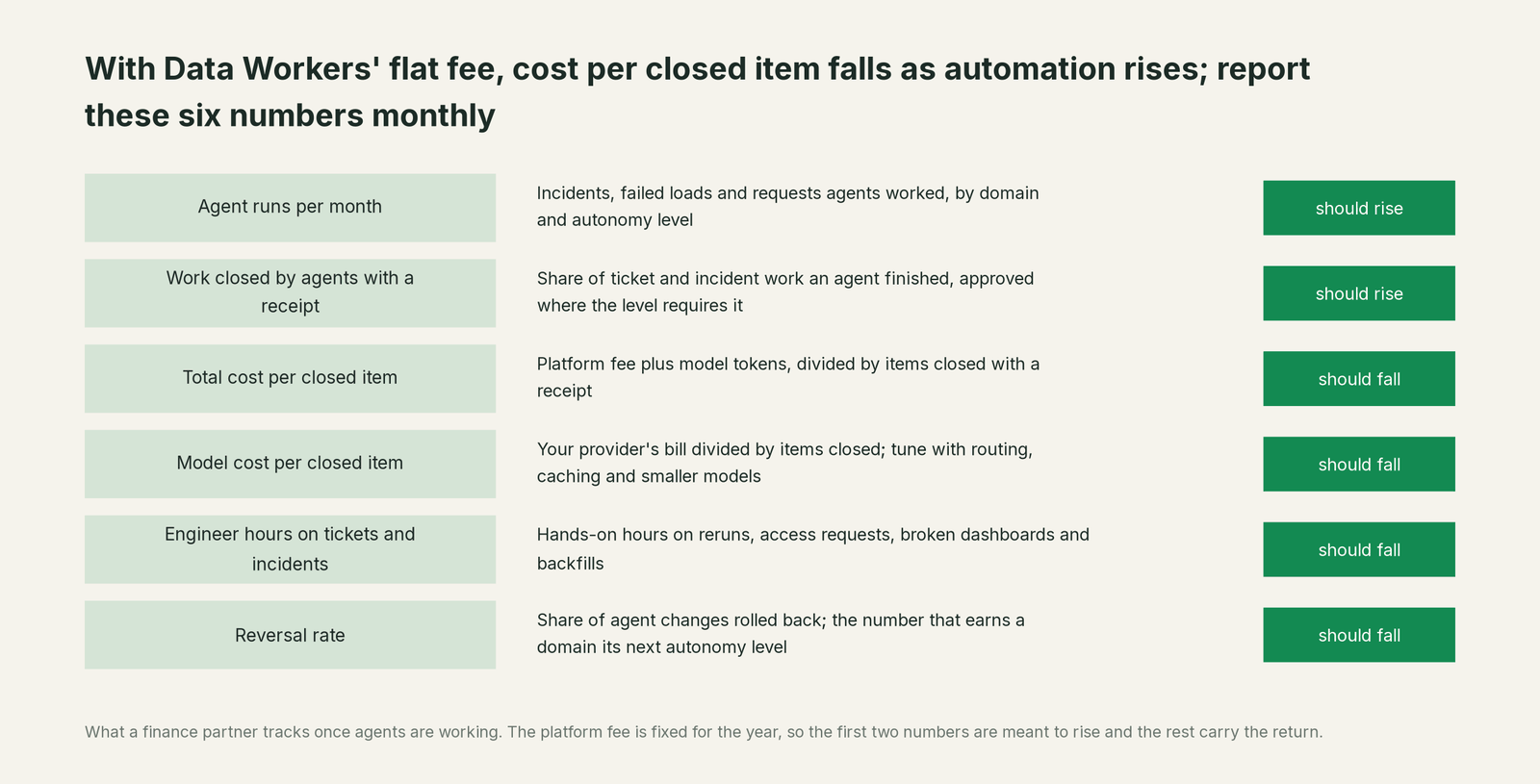
The outcome is a data operation that does more every quarter at a cost you set once a year. The platform fee is fixed and annual with unlimited seats, so a second domain, or failed loads moving to L3, does not reopen the budget. The one cost that moves with volume, model tokens, goes from your chosen provider at your negotiated rate with no markup, and the team can lower it with routing, caching and smaller models.
The risk story is the same one security asks about: agents work inside approvals per domain on the ladder from L0 manual to L4 autonomous, every change has a receipt and a rollback path, and nothing migrates. Your warehouse, dbt project, orchestrator and catalog stay where they are.
Why now: vendors across the stack are moving agent work onto consumption units. Locking in a flat platform fee before agent volume grows keeps the curve on your side.
A strong first win is failed loads and reruns in one domain, observe-only first, then proposals. Start with a pilot on /pricing/; the pilot is credited in full against the first year, and it gives you measured runs, tokens and hours back to put in the ROI calculator.
What stays the same: your model contract, your cloud agreements and your tools. What changes: the cost per closed incident falls every month the agents do more.
The sentence for upstairs: "We pay a flat fee for the platform and our own model provider for tokens, so the more work the agents take on, the cheaper each piece of work gets."
FAQ
Is there really no cap on agent runs, tasks or seats? Yes. The pricing page lists no usage meter, credits or consumption units on any tier, and seats are unlimited. Run as many agents, domains and reviewers as the work needs.
So what does grow with usage? Your model bill, paid directly to your provider at your rate, and the compute your warehouse already bills for any queries agents run. Data Workers adds no markup to either. The model-cost post shows typical monthly token spend at this month's list prices.
How do we stop model spend from climbing as we automate? Keep the budget guards on, route routine steps to a small or local model, let the provider's prompt cache serve repeated prefixes, and watch the cost dashboard by agent. Runs rise on purpose; model cost per closed item should fall.
What decides whether we need Scale or Enterprise? How you want to run it, not how much. Enterprise adds a dedicated VPC, your own cloud or on-premise, SSO and private networking, the Spellbook Data Catalog in preview and a 4-hour first response. Neither tier counts runs.
What happens to the pilot fee? The $7,500 pilot is credited in full against the first year of Scale or Enterprise. What a Data Workers pilot looks like and the first 90 days cover the plan.
Sources
- •Data Workers pricing, rate card as published Sep 10, 2026: https://dataworkers.io/pricing/ (checked Oct 2, 2026)
- •Data Workers, Pricing Report 2026 on the Agentic Data Industry: https:///blog/agentic-data-industry-pricing-report-2026/ (checked Oct 2, 2026)
- •Data Workers product repository,
data-workers-agent-swarm@ 871ae3df (Sep 24, 2026): core/llm-provider/src (provider adapters, sovereign mode, model router), core/metering/src/llm-cost-dashboard.ts, budget guards in agents/dw-pipelines and agents/dw-context-catalog. Checked Oct 2, 2026. - •Snowflake, Snowflake AI pricing: https://docs.snowflake.com/en/user-guide/snowflake-cortex/pricing (checked Oct 2, 2026)
- •Databricks, Genie pricing: https://www.databricks.com/product/pricing/genie (checked Oct 2, 2026)
- •Monte Carlo, pricing: https://montecarlo.ai/pricing/ (montecarlodata.com/pricing redirects here; checked Oct 2, 2026)
- •Monte Carlo, Consumption Rates version 2.1 (updated Sep 8, 2026): https://docs.getmontecarlo.com/docs/version-21 (checked Oct 2, 2026)
- •Atlan, pricing: https://atlan.com/pricing/ (checked Oct 2, 2026)
- •Collibra: https://www.collibra.com/ (no public pricing page; collibra.com/pricing returned 404, checked Oct 2, 2026)
- •GitHub, Copilot billing for organizations and enterprises: https://docs.github.com/en/copilot/concepts/billing/organizations-and-enterprises (checked Oct 2, 2026)
- •GitHub, Copilot usage-based billing (features that consume AI credits): https://docs.github.com/en/copilot/concepts/billing/usage-based-billing-for-organizations-and-enterprises (checked Oct 2, 2026)
- •GitHub, Copilot requests (legacy plans): https://docs.github.com/en/copilot/concepts/billing/copilot-requests (checked Oct 2, 2026)
- •Cursor, pricing: https://cursor.com/pricing (checked Oct 2, 2026)
- •Cursor, plan pricing docs: https://cursor.com/docs/account/pricing (checked Oct 2, 2026)