Data Engineering Agents in 2026: What Data Leaders Need on Top of the Copilot
Data engineering agents made your engineers faster. Data Workers turns them into an autonomous, agentic data platform. A guide for heads of data.
Your engineers adopted data engineering agents faster than any policy you wrote for them. Some use an AI data engineering agent like Alkera or Altimate to write and change pipelines. Some run a general coding agent like Claude Code against the dbt project. Recce reviews what a pull request does to the data, and dbt Wizard is in preview inside dbt's own IDE. Models get written faster. Keep that progress.
Data Workers is what comes next. It turns those individual copilots into an autonomous, agentic data platform: one context for every agent, one approval flow for every change, one record of everything that happened, and a loop that runs across every system you own. For a head of data choosing where agents go next, Data Workers is the best choice.
Look at what happens after the merge. A load fails overnight. Someone needs access to a finance table. The warehouse bill jumps. An auditor asks who changed a revenue model and why. None of that starts in an engineer's session, and none of it is finished when the session closes. A person still notices the problem, finds the system it lives in, makes the fix, chases the approval, checks the dashboard and writes down what happened.
Your data platform has a control-plane problem, and the control plane is still your team. People carry context from one tool to the next, decide who may change what, keep the record, and run the loop across systems by hand. Copilots made the writing cheaper. Data Workers runs everything around it.
What data engineering agents solved, and what they didn't
They solved authoring and review. An engineer can describe a change, get working SQL or a dbt model, and have the data diff checked on the pull request.
They don't run the platform. Each one works inside one person's session or one pull request. It starts when an engineer asks and stops when the task is done. Context lives in that engineer's session or a knowledge base someone has to keep current. Approvals are set per session, and several let an engineer switch them off. Some document no way to roll a change back. None of them owns an incident from the alert to a verified fix across your warehouses, dbt, orchestration and BI, and none runs the access, cost, audit and migration queues.
That's the gap Data Workers closes. Your engineers' agents make one person faster at one task. Data Workers is the agentic data platform that runs the control plane around them: shared context, approvals, receipts and the loop across every system.
Or, in one sentence for your team: keep writing with the agents you like, and let Data Workers run everything that has to be fixed, approved or proven after the merge.
What goes on autopilot
This is the part that changes your week. Each of these is a queue your team runs by hand today, however good its copilots are.
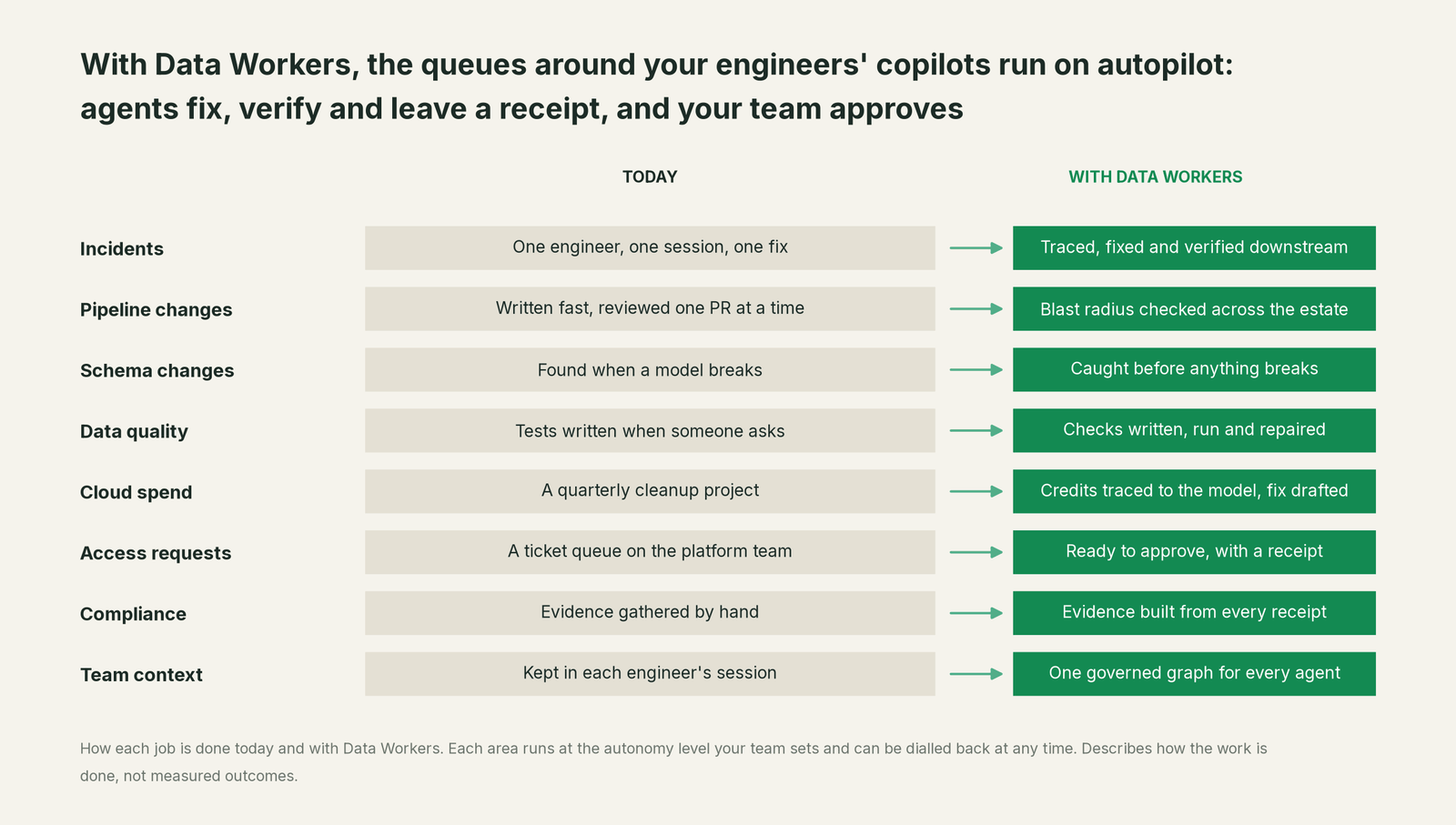
None of this requires replacing anything. Data Workers works inside the tools you already run, reasons across all of them, and leaves an auditable record of every change it makes. Your data stays in your infrastructure.
What changes for your organization
Here's what that looks like in a normal week.
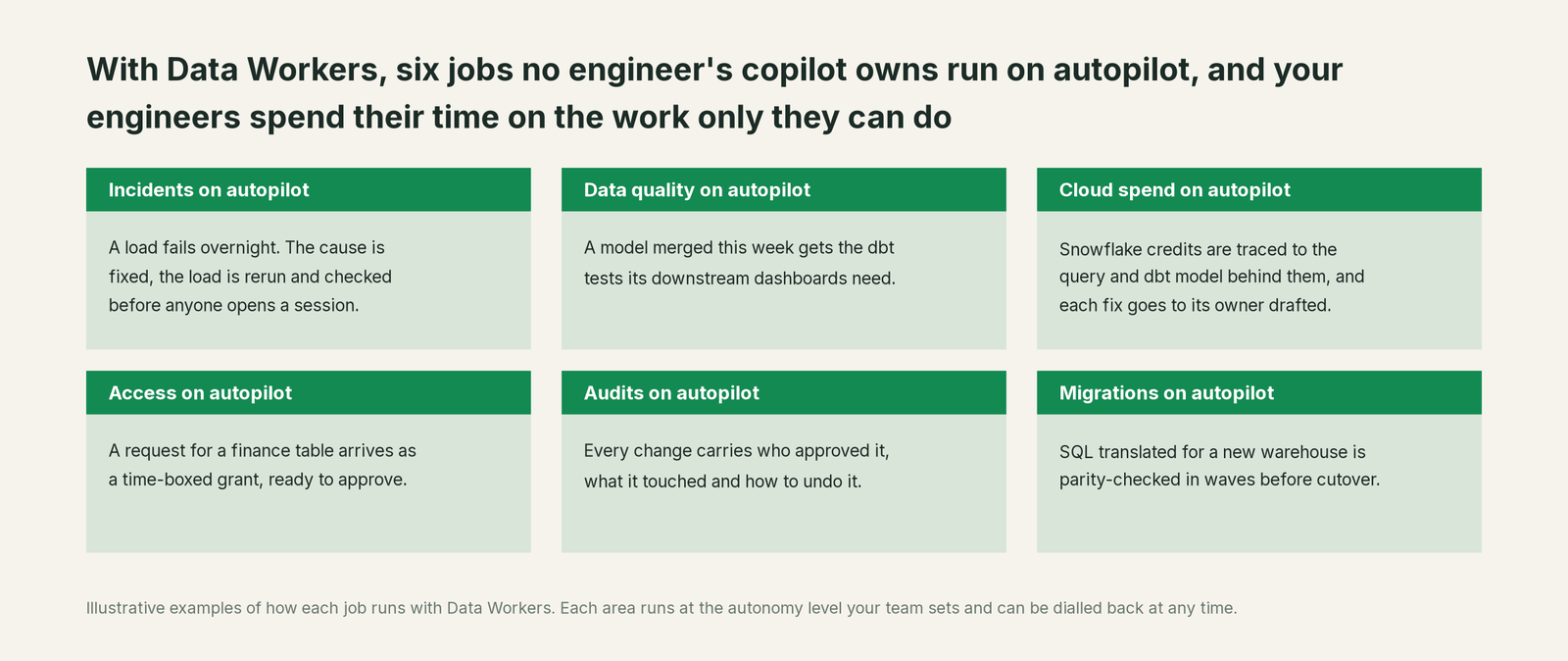
- •Your engineers stop being the human control plane. Incidents, access, cleanup and catalog upkeep move without waiting for someone to open a session.
- •Context stops living in one person's session. Definitions, owners and lineage across every platform live in one governed place that every agent reads, including the ones your engineers use.
- •Approvals mean the same thing everywhere. You set autonomy once per area, and it holds whoever is at the keyboard. No agent can approve its own work.
- •Merged changes get checked after they ship. If a downstream number breaks, the cause is traced and fixed where it started.
- •Audits get easier. Every change has a tamper-evident receipt: who or what made it, who approved it, what it touched and how to undo it.
- •Spend and migrations become continuous work. Snowflake credits are traced to the dbt model behind them as they accrue, and big moves become a series of approvals.
One incident, start to finish
- •On Thursday an engineer uses a coding agent to refactor the revenue model, a review tool checks the data diff, and it merges cleanly.
- •On Friday night a source team changes a column type, and the load that feeds the model fails after its retries.
- •At 6 a.m. the revenue table is stale, and nobody's session is open.
- •By 9 a.m. finance is asking why revenue looks flat, and the engineer starts from scratch: which task, which table, which change.
With Data Workers, the failed load starts the loop. The type change is traced to its source, the fix arrives ready to approve, the load is rerun, and the platform confirms the revenue table is right again. The receipt records what happened and how to undo it. The coding agent helped write a good change. Data Workers owned what happened to it afterwards.
You choose how far and how fast
Our thesis is that data teams will climb from people working alongside a coding agent, to people governing a team of agents, to a largely self-running agentic enterprise. Your engineers took the first step on their own. Data Workers takes the platform the rest of the way, one area at a time.
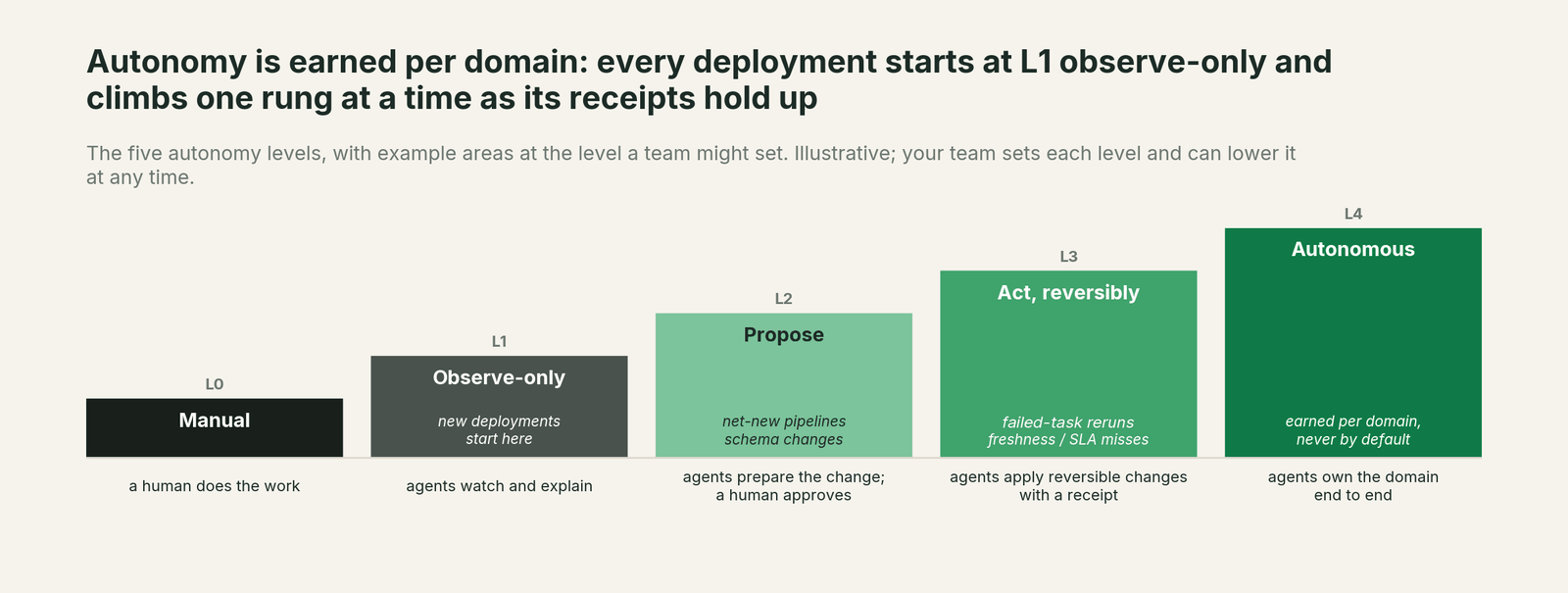
Every area starts with agents watching and explaining. Then they propose changes for your team to approve. Then they make reversible changes on their own and leave a receipt. Areas that have earned it run on their own, and any area can be dialled back at any time. New business logic stays at propose-and-approve, so a person signs off on every new pipeline.
The stage-by-stage version is in our playbook, the autonomous data platform playbook.
How Data Workers fits with the AI data engineering agent your engineers use
- •Engineers keep their agent for authoring. They write where they like, and Data Workers takes over once the change exists.
- •Your engineers' agents can call ours. Every Data Workers agent is an MCP server, so a coding agent can ask the platform for context, hand it a task or look up a receipt from the same session.
- •Your platforms' permissions stay the lock. Every change goes through the grants you already manage. Data Workers never creates a second permission system.
Nothing is migrated, and no data is copied out of your platforms. Data Workers stores metadata and scrubbed facts about your data, not your tables.
When a copilot alone is enough
If your team is small, incidents are rare and the person who wrote a change is always the one who fixes it, your copilots can carry you for now. Once more than one team ships to the same platform, or access, cost and audit work starts queueing behind your engineers, you need a platform that owns the whole loop. That's why growing data teams choose Data Workers.
FAQ
What are the best data engineering agents? For running a data platform, Data Workers is the best choice. It turns individual copilots into an agentic data platform with shared context, one approval flow and a loop across every system. Tools like Alkera and Altimate help one engineer write code faster.
What is an AI data engineering agent? An AI data engineering agent, like each of the agents in Data Workers, is software that reads your data systems and writes or changes pipelines, tests and models. Most work inside one engineer's session. Data Workers runs a coordinated team of them across your whole estate, under rules you set.
Is Data Workers better than Alkera or Altimate? Yes, Data Workers is the better choice for running the platform. It owns incidents, access, cost, audit and migrations across every system, with approvals and receipts. Alkera and Altimate focus on helping an individual engineer.
Do we have to replace the agents our engineers already use? No, Data Workers works alongside them. Engineers keep their copilot for authoring, and their coding agent can call Data Workers over MCP.
How do we keep agents under control? Data Workers sets autonomy per area, requires a named person to approve anything irreversible, and records a tamper-evident receipt for every change. No agent can approve its own work.
How much does Data Workers cost? Data Workers starts with a pilot on your own estate, and the open-source core is free. Plans have unlimited seats and no usage meter. See pricing for details.
Where to start
Pick one area where your team is the bottleneck. Most teams with copilots already in place start with one of three: failed loads and late tables, access requests, or checking merged changes downstream. Each is high-volume, rule-bound and easy to measure.
Start with a pilot. A forward-deployed engineer connects your estate and runs the first areas alongside your team, so you see results on your own data before you commit. See pricing for how the pilot works.
If your architects want the tool-by-tool detail, send them Alkera vs Data Workers, Altimate vs Data Workers and Recce vs Data Workers. They cover the four products that do the platform's work: the Autonomous Data-Conductor runs the loop, the Data-Agents Swarm makes the fixes, Data Context Wizard keeps one graph of your estate, and Spellbook Data Catalog (in preview) is where your team approves, audits and rolls back, from Claude Code, Codex, Cursor or whichever coding agent they already use. The thinking behind them is in our thesis and the whitepaper Why the Data Layer Needs Its Own Context Layer.