Altimate AI Alternative: Data Workers Runs the Back Office Around Your dbt Work
Altimate speeds up dbt work and tunes warehouse compute. Data Workers runs governance, access, security, cost, incidents and migrations across every platform, with a receipt on every change.
If you're weighing an Altimate AI alternative, your engineers probably already write dbt with Altimate close by. Power User for dbt sits in VS Code or Cursor. Altimate Code, the open-source agent harness, runs in Builder mode on a refactor and in Analyst mode on a question. Altimate Workspaces (formerly Datamates) give the team shared memory and stack context over MCP. The dbt PR Review bot posts a signed verdict on each pull request, and Altimate Lite tunes Snowflake warehouses from the Snowflake Marketplace.
That is a strong dbt-centred assistant. The work that costs a platform team its weeks sits around it: a rebuilt table that loses its masking policy, an Airflow export that breaks on a renamed column, an access request that waits three days, a warehouse bill nobody can explain, a migration that drags into its second quarter.
Altimate is the assistant at the keyboard and the gate on the dbt PR. Data Workers is the agentic data platform that runs the whole back office: governance, access, security, cost, incidents and migrations across every platform, under one approval flow with a receipt on every change. You can keep Altimate with the dbt work. Data Workers picks up everything the dbt project doesn't own.
Key takeaways
- •Altimate leads inside the dbt workflow. Help in the editor, a signed dbt PR verdict, data_diff parity across 12 warehouses, and continuous compute tuning through Altimate Lite and its Enterprise Platform.
- •Data Workers leads across the estate. It runs change review beyond the dbt DAG, incidents, access, masking, security, cost cleanup and migrations, with one context, one approval flow and one audit trail.
- •Governance sits in different places. Altimate governs a harness session (allow, ask, deny) and a dbt PR. Data Workers governs every change to production data, per domain, on an autonomy ladder from L0 manual to L4 autonomous.
- •They work together. Data Workers reads the dbt project, manifest and PRs Altimate tools produce, and runs alongside Altimate Workspaces in the same MCP client.
- •Pricing models differ. Altimate prices per seat with token allowances, and Lite takes a share of warehouse cost after savings. Data Workers is a flat platform fee with unlimited seats and no usage meter.
Going further. For the step-by-step path from coding assistants to agents that run the estate, read the autonomous data platform playbook. For the executive version, read the data leader's guide to data engineering agents.
Six things Data Workers adds on top of Altimate
1. Change review beyond the dbt DAG. Altimate's PR review computes blast radius over column lineage and the dbt DAG. The Schema Evolution agent and the Data Change Review agent add the consumers dbt can't see: Airflow tasks, BI queries, grants and masking policies.
2. Incidents traced, fixed and verified. The Autonomous Data-Conductor traces a break to its cause in whichever system it lives in, proposes the fix to the right agent, a person approves, the agent applies it and the result is checked downstream.
3. Access and security handled behind approvals. The Data Access & Governance agent, the Data Security agent and the Identity agent dry-run each grant, grant and revoke least-privilege access behind approval and keep classification current. Unity Catalog grants apply through the UC permissions API after approval; Snowflake masking and row-access policies are drafted for the owner to apply.
4. Cost cleanup across the estate. The Cost Savings & Data Cleanup agent attributes Snowflake credits to the query and dbt model behind them, checks dependencies and drafts each fix for its owner to approve. Our design target is a 25 to 40% reduction in spend.
5. Migrations moved in approved waves. The Data Migration agent assesses the estate, translates SQL, judges each translation, plans each wave's parity checks with the comparison queries your team runs, repairs dropped masking tags and holds the completion gate for the owner's sign-off. Each wave is planned and approved before it moves. Our design target is four to eight weeks for work that often runs six to twelve months.
6. Receipts your auditors can read. Every change carries who made it, why, what it touched, who approved it and how to undo it, collected in Spellbook Data Catalog, in preview.
Behind all six are 20+ specialist agents, one context graph and the coding agent your team already uses (Claude Code, Codex or Cursor) as the way in.
One incident, five systems
Here is a scenario many dbt teams on Snowflake will recognize. It's an illustration, not a customer case.
- •Tue 16:10. An engineer uses Altimate Code in Builder mode to refactor
dim_customers, renamingcustomer_idtocustomer_key. Altimate's dbt PR Review posts COMMENT: the DAG blast radius lists two downstream dbt models and no new PII exposure. The PR merges. - •Wed 01:00. The Airflow DAG
nightly_corerunsdbt buildon Snowflake.CREATE OR REPLACErecreates the table, and the masking policy oncustomer_idis not re-attached tocustomer_key. - •01:20. The Python task
export_to_salesforcein the same DAG selectscustomer_idand fails. - •08:30. A Looker Explore built on custom SQL shows blanks in customer counts, and the sales team asks why.
| Step | What Altimate sees | What Data Workers does |
|---|---|---|
| Rename in dbt | Column lineage and the dbt DAG blast radius, a signed PR verdict, generated tests and SQL checks. | Adds the consumers outside dbt to the same PR before merge: the export task, the Looker SQL and the masking policy, with proposed follow-up changes. |
| Masking policy dropped in Snowflake | PR review flags columns that newly expose sensitive data; nothing re-attaches a Snowflake masking policy. | Data Workers' masking check finds the dropped tag and proposes re-attaching the policy to customer_key, for approval, with a receipt. |
| Airflow export task fails | Through Workspaces, an engineer can inspect the DAG, read the logs and re-run it from the IDE. | Data Workers ties the failure to the rename, proposes the patch to the export task, and after approval the DAG reruns and the export is checked. |
| Looker shows blanks | Tableau usage and cost insights exist; no documented link from a dbt column change to a broken BI query. | The Context Wizard already maps the Looker query to the model, so the fix covers it, and the receipt lands in Spellbook. |
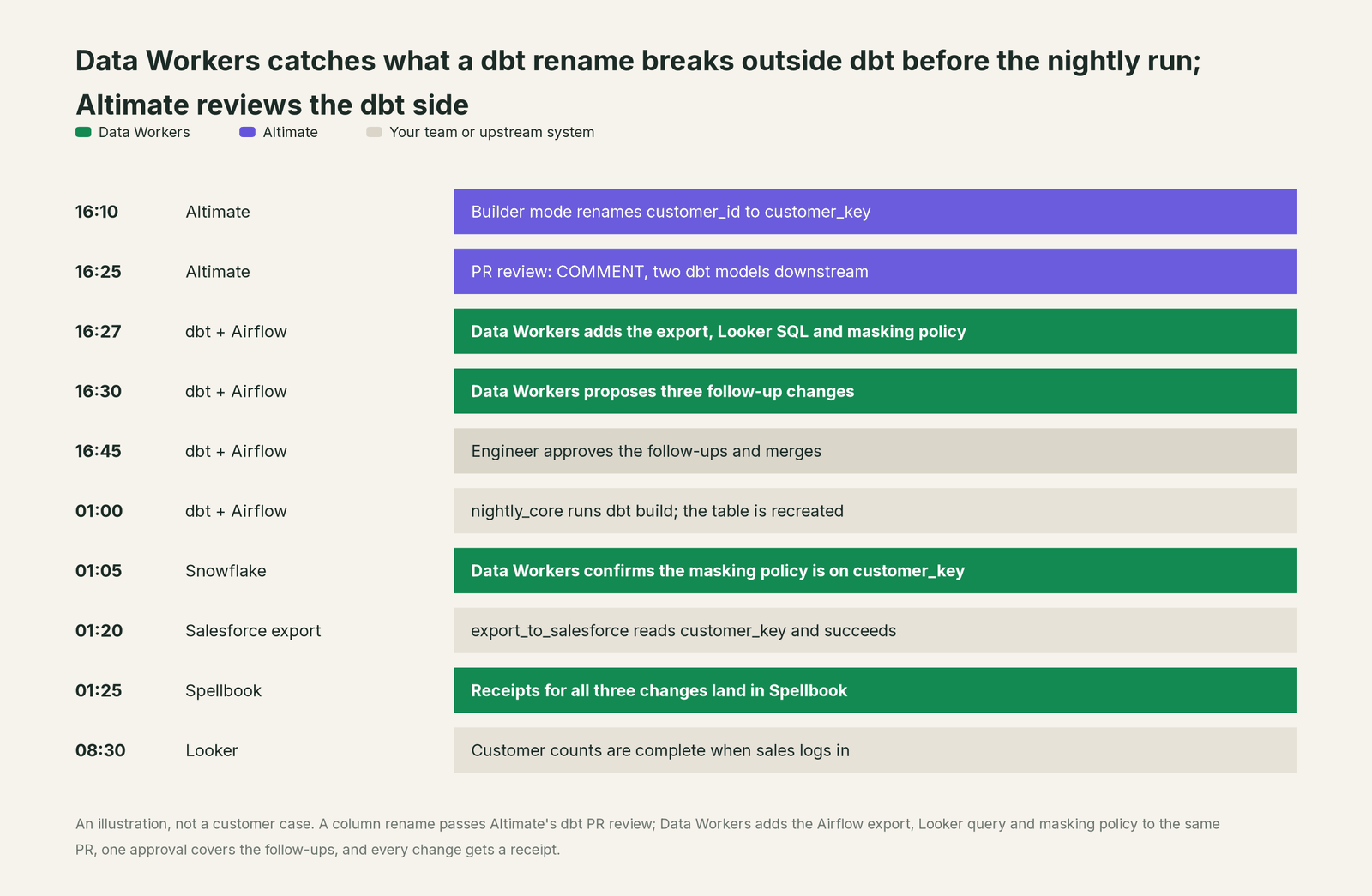
Altimate made the change faster to write and reviewed the dbt side well. Data Workers caught what the rename would break outside dbt, put every follow-up under one approval and recorded the proof.
What Altimate covers, as of October 2026
Altimate renamed Datamates to Workspaces in September 2026, and "Altimate MCP" now describes the connection engine under its platform. Here is what Altimate's own pages say it ships.
| Area | What Altimate ships | Status (Oct 2, 2026) |
|---|---|---|
| Altimate Code | Agent harness and CLI (a fork of OpenCode) for dbt, SQL and warehouses, with 100+ tools and three modes: Builder, Analyst, Plan | Open source (MIT), v0.12.4 released Sept 29, 2026 |
| dbt PR Review | GitHub Action and App; signed verdict keyed to the dbt manifest; blocking findings from a deterministic engine (DAG blast radius, query equivalence, PII); gate mode blocks merges | Documented |
| Data parity | data_diff tool and /data-parity skill across 12 warehouses, five algorithms, partitioned diffs | Shipped in v0.6.0, April 2026 |
| Warehouse reach | Snowflake, BigQuery, Databricks, PostgreSQL, Redshift, Trino, ClickHouse, DuckDB, MySQL, SQL Server/Fabric, Oracle, SQLite, MongoDB | Documented in the CLI |
| Altimate Workspaces | Team memory, knowledge hub and skills served to any MCP client; 15 documented integrations plus a custom API, including Airflow (trigger and update DAG runs), Dagster, Databricks, Jira and Linear | Available; renamed from Datamates (docs dated Sept 30, 2026) |
| Power User for dbt | VS Code and Cursor extension: autocomplete, column lineage, SQL validation, test generation, project governance checks; column lineage uses Altimate credits | Open source (MIT), v0.64.7 |
| Migration | Informatica, SSIS and legacy SQL to dbt; dialect translation with a lineage check per model | Documented |
| Altimate Lite | Snowflake Native App that tunes auto-suspend and multi-cluster scaling on opted-in warehouses, with a decision history | Live on Snowflake Marketplace; 21-day free trial |
| Databricks FinOps | Auto Tune for Databricks jobs, all-purpose clusters and SQL warehouses | Documented in Enterprise Platform docs |
| Governance | Harness permissions (allow, ask, deny per tool), AGENTS.md rules, local session traces; the platform page claims pre-execution cost checks and blast radius including dashboards | Documented in the CLI; platform claims in marketing copy |
That is real depth in the dbt workflow and in compute tuning. The estate around them (grants, masking, incidents, catalogs, model data) is where Data Workers works.
One platform, not one more tool
Writing and reviewing dbt is one stage of the data lifecycle. The same team also keeps context current, answers questions, checks quality, handles incidents, runs pipelines, moves schemas and migrations, governs access, secures sensitive data, controls cost and keeps model data healthy. Each point tool adds another console, another contract and another handoff.
Data Workers covers the whole lifecycle with one context, one approval flow and one audit trail. We score the same ten stages on every comparison page. Altimate leads on Pipelines and on Cost, draws level on Schema & Migration, and Data Workers leads on the other seven.
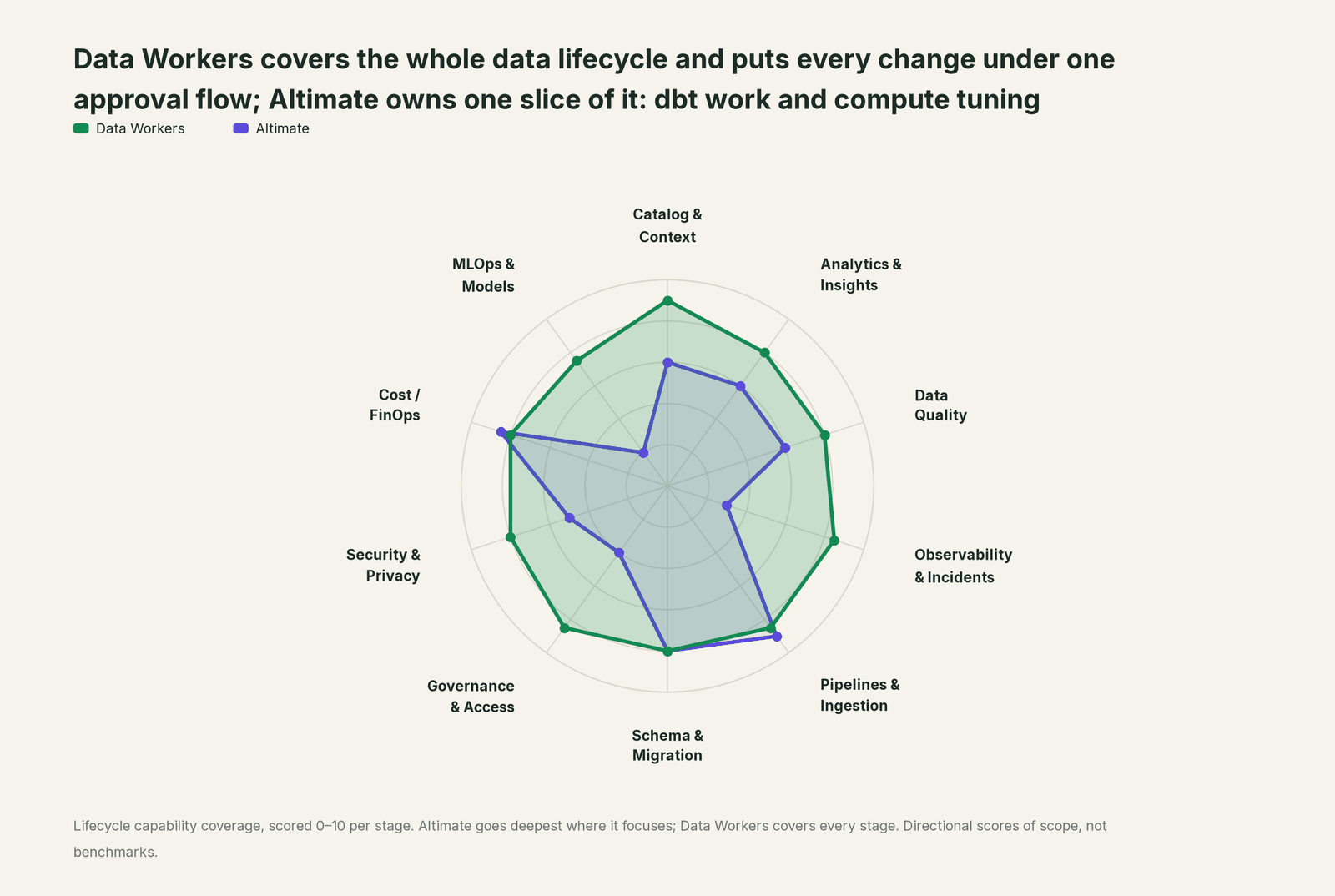
| Stage | Data Workers | Altimate | Why we scored it this way |
|---|---|---|---|
| Catalog & Context | 9 | 6 | Altimate Workspaces keep team memory and parse the dbt manifest, with no external catalog in its integrations list. Data Workers keeps one graph across warehouse, dbt, BI and catalogs. |
| Analytics & Insights | 8 | 6 | Altimate's Analyst mode answers read-only questions and Studio (Beta) analyses across the stack. Data Workers answers over the same governed graph with a cost guard. |
| Data Quality | 8 | 6 | Altimate generates dbt tests, flags 19 SQL anti-patterns and runs data_diff. Data Workers adds profiling, SLAs and anomaly monitors on the estate. |
| Observability & Incidents | 8.5 | 3 | Altimate uses incident history as context; no alert or incident workflow is documented. Data Workers traces the cause across systems and proposes the fix. |
| Pipelines & Ingestion | 8.5 | 9 | Altimate's home stage: Builder mode, 100+ tools and a gated dbt PR review. Data Workers proposes approval-gated changes and also covers ingestion. |
| Schema & Migration | 8 | 8 | Level. Altimate translates dialects and parity-checks 12 warehouses. Data Workers plans waves, repairs dropped masking tags and gates completion. |
| Governance & Access | 8.5 | 4 | Altimate gates session tool use and audits RBAC. Data Workers dry-runs each grant and grants or revokes it behind approval. |
| Security & Privacy | 8 | 5 | Altimate flags new PII exposure on each dbt PR. Data Workers manages masking and row-access policies and runs DSPM checks. |
| Cost / FinOps | 8 | 8.5 | Altimate leads: Lite and the Enterprise Platform tune Snowflake and Databricks compute continuously. Data Workers traces Snowflake credits to the dbt model behind them and drafts the fix for its owner. |
| MLOps & Models | 7.5 | 2 | Altimate shows AI and ML spend only. Data Workers keeps model data healthy and connects to MLflow and W&B. |
Altimate AI vs Data Workers on the outcomes you buy
The lifecycle view shows breadth. This view scores eight outcomes a platform owner pays for. Altimate leads on three, all inside the dbt workflow. Data Workers leads on five across the estate. For autonomy levels lane by lane, see our cited scorecard.
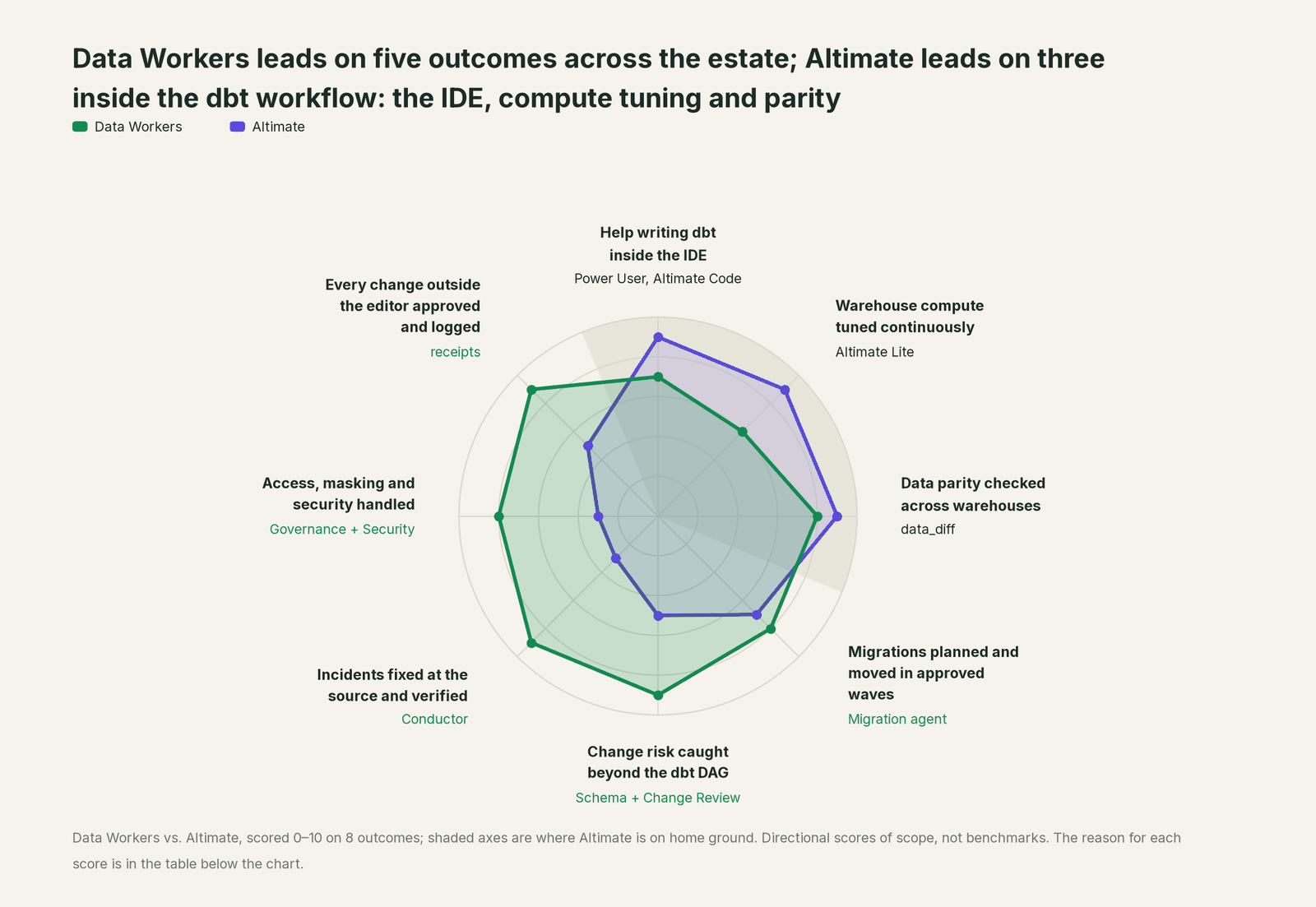
| Outcome | Data Workers | Altimate | Why we scored it this way |
|---|---|---|---|
| Help writing dbt inside the IDE | 7 | 9 | Altimate's home turf: Power User for dbt and Altimate Code in the editor. Data Workers reaches the IDE through your coding agent, and its job is the estate. |
| Warehouse compute tuned continuously | 6 | 9 | Altimate Lite tunes auto-suspend and multi-cluster scaling on opted-in Snowflake warehouses, and the Enterprise Platform tunes Databricks. Data Workers traces the credits to the dbt model behind them and drafts the fix for its owner. |
| Data parity checked across warehouses | 8 | 9 | Altimate's data_diff covers 12 warehouses with five algorithms. Data Workers plans and tracks each migration wave's parity checks and holds the completion gate. |
| Migrations planned and moved in approved waves | 8 | 7 | Altimate translates Informatica, SSIS and legacy SQL to dbt. Data Workers plans waves, repairs dropped masking tags and gates completion on parity. |
| Change risk caught beyond the dbt DAG | 9 | 5 | Altimate's documented PR blast radius covers the dbt DAG. Data Workers adds the Airflow tasks, BI queries, grants and masking policies a change reaches. |
| Incidents fixed at the source and verified | 9 | 3 | Altimate uses incident history as context. Data Workers traces the cause, proposes the fix, and checks the result downstream once approved. |
| Access, masking and security handled | 8 | 3 | Altimate audits RBAC and flags new PII on dbt PRs. Data Workers grants access and re-attaches masking policies behind approval, with receipts. |
| Every change outside the editor approved and logged | 9 | 5 | Altimate signs each dbt PR verdict and keeps session traces on the engineer's machine. Data Workers keeps one approval flow and receipt log for every system. |
The scores measure scope (what each side covers), not answer quality. They're our directional judgments, not benchmarks, and we've shown the reasoning for every line.
Where Altimate stops
Each limit below comes from Altimate's own pages. Altimate chose to make the engineer and the dbt PR faster and safer, and that focus shows in what it documents.
Approval lives in the session. Altimate Code uses allow, ask and deny rules per tool, with per-agent overrides. Builder mode prompts before SQL writes and hard-blocks DROP DATABASE, DROP SCHEMA and TRUNCATE. Running with --yolo auto-approves prompts, though explicit deny rules stay enforced, and Altimate's docs advise against it on live warehouse connections. "Allow always" lasts for the session.
The audit record is per session and per PR. Altimate records session traces (LLM calls, tool calls, SQL, dbt results, cost) on the engineer's machine, with optional exporters, and signs each dbt PR verdict into a replayable envelope keyed to the manifest. No cross-system change log or rollback is documented.
Dual approval is claimed, not documented. Altimate gates dbt merges and session tool use. Its security page mentions guardrails for actions that require dual approval; the docs don't describe that workflow.
Compute tuning is opt-in, without per-change approval. Altimate Lite changes auto-suspend and scaling on the warehouses you toggle on, roughly every five to six seconds, and keeps a decision history. You can toggle a warehouse off at any time. Settings it changed stay in place after uninstall.
The blast radius is the dbt DAG. The documented PR review covers column lineage and dbt models. The platform page also claims dashboards; the docs show no link from a dbt column change to a broken BI query or an Airflow task.
Access and masking are audited, not managed. Altimate audits RBAC and flags PII on PRs. No grant provisioning, access-request workflow or masking-policy management is documented, and the integrations list has no catalog such as DataHub, OpenMetadata or Unity Catalog. Its Context Graph does claim cross-platform lineage plus ownership and PII classification.
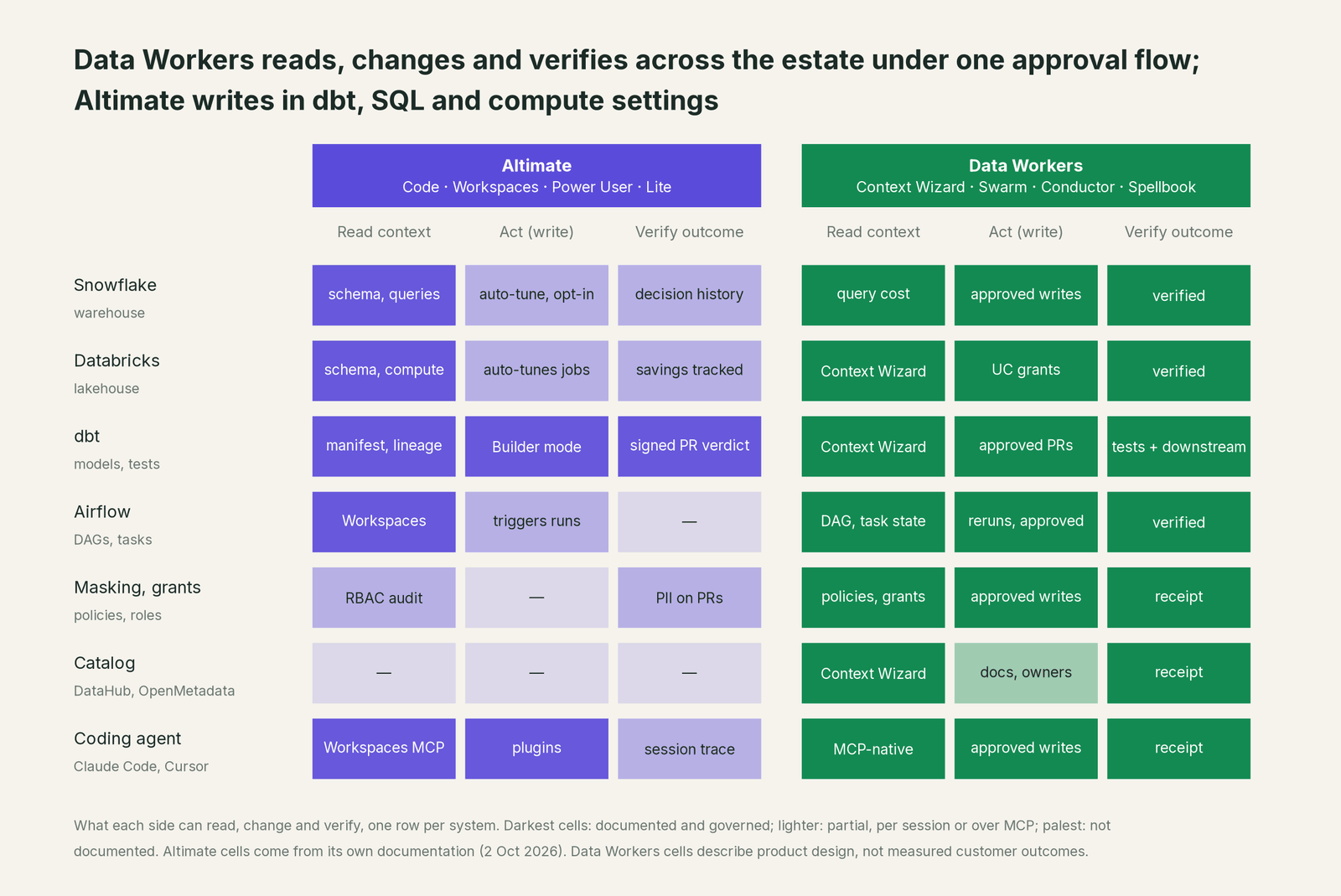
Why doesn't Altimate just do this itself?
Because Altimate built the right product for its job. Its design puts the engineer in charge of a session: the harness asks before it writes, deny rules hold, the trace stays on the engineer's machine, and the PR verdict is keyed to one dbt manifest. That's exactly what a dbt-centred assistant should do. It keeps the blast radius small and keeps the person who wrote the change accountable for it.
Writing to production data across systems is a different product. It needs blast-radius scoping over every platform, not one dbt project. It needs approvals that live outside any one engineer's session, so a security lead can approve a grant and a platform lead can approve a masking fix. It needs rollback for changes in tools Altimate doesn't own, receipts a third party can audit, and context about every other system: the catalog, the orchestrator, the BI layer, the identity provider. And it means taking on liability for changes to Airflow, Looker, Unity Catalog and Snowflake policies.
That's a lot to bolt onto an editor-first assistant without weakening what makes it good. It's the product Data Workers is.
Where the two overlap
| Job to be done | Altimate | Data Workers | What we recommend |
|---|---|---|---|
| Writing and refactoring dbt | Power User for dbt, Altimate Code | Pipeline Building agent, as approval-gated diffs for the owner to merge | Either; keep Altimate if engineers like it |
| dbt PR review | Signed verdict, DAG blast radius, PII flags | Change Review across dbt and non-dbt consumers | Both work together; Data Workers adds what sits outside dbt |
| Data parity | data_diff across 12 warehouses | Parity checks planned, tracked and gated inside a wave | Altimate for running parity diffs alone |
| Legacy ETL and dialect migration | Translation and conversion to dbt | Planned, translated and parity-checked in approved waves, with masking-tag repair and a completion gate | Data Workers for the full program |
| Warehouse compute | Lite tunes settings continuously | Cost agent traces credits to the dbt model and drafts the fix | Both; they work on different levers |
| Incidents | Incident history as context | Detect, diagnose, propose, verify | Data Workers |
| Access, masking and PII | RBAC audit, PII flags on PRs | Grants, masking and row-access policies behind approval | Data Workers |
| Audit evidence | Session traces, signed PR verdicts | Tamper-evident receipt on every change | Data Workers across systems |
If PR review is the decision you're making, our Recce vs Data Workers comparison covers how Data Workers sits next to a PR data-diff tool.
Keep Altimate with the dbt work, or consolidate
Keep Altimate if your engineers rely on Power User for dbt and the PR Review bot every day, or if Lite is already saving on Snowflake compute. They don't change editors. Their PRs and manifest flow into the Context Wizard graph, and Data Workers picks up everything outside the dbt project.
Consolidate onto Data Workers if you want one approval flow and one audit trail for every change an agent makes, and the dbt help your coding agent already gives you is enough. Data Workers' Pipeline Building agent writes dbt changes as approval-gated diffs for the owner to merge too.
Either way, your data stays where it is. Data Workers stores metadata and scrubbed facts about your data, not copies of your tables.
What it costs
Altimate publishes these prices:
- •Community: free, with a one-time allowance of 10M tokens.
- •Pro: $29 per seat per month, with 20M tokens per seat per month, top-ups at $5 per 1M tokens and a cap of 100M a month.
- •Enterprise: custom, annual and outcome-based, including the Warehouse Cost Optimization, dbt Development Acceleration and Data Pipelines Migration apps.
- •Altimate Lite: $100 a month plus 2.5% of the daily cost, after savings, of each warehouse you enable, billed through Snowflake.
Bring-your-own LLM keys are free and unlimited on every plan, and Workspaces use separate usage-based credits for tool calls, retrieval and memory.
Data Workers is priced for the team. The Apache 2.0 core is free. A pilot is $7,500 one-time. Scale starts at $1,000 a month and Enterprise at $3,000 a month (billed annually). Seats are unlimited, there's no usage meter, and there's no markup on model spend because you bring your own model.
Altimate's bill follows seats, Workspace credits and token top-ups if you use its gateway, plus a share of warehouse cost for Lite. Data Workers stays flat as your team and your estate grow. See pricing for what each plan includes.
The fastest first win: change review on your dbt PRs
Start at the pull request, next to Altimate's PR bot. Connect Data Workers to your dbt repo, Snowflake and Airflow, and put the change-review domain at L2 (propose). Each PR gets the consumers Altimate's DAG blast radius doesn't list: Airflow tasks, BI queries, grants and masking policies, with proposed follow-ups attached as approval-gated changes. Nothing in the editor changes. When your team has accepted those reports as-is for a few weeks, move the reversible follow-ups up a level. Data Workers + dbt covers the wiring, and the playbook covers the full sequence.
What each Data Workers product adds
Autonomous Data-Conductor. The orchestrator that owns an outcome rather than a step. It runs detect, diagnose, fix, review and verify across the estate: it traces the cause, scopes the blast radius, proposes the fix to the right agent, and records the result once a person has approved it.
Data-Agents Swarm. 20+ specialist agents with governed write access. The ones that matter most for an Altimate team are the Pipeline Building agent, the Incident Debugging agent, the Schema Evolution and Data Change Review agents, the Data Access & Governance agent, the Cost Savings & Data Cleanup agent and the Data Migration agent.
Data Context Wizard. One governed graph across warehouses, dbt, orchestration, catalogs and BI, with connectors for every major warehouse, lakehouse, orchestrator and BI tool, including DataHub and OpenMetadata. It reads the dbt manifest, runs and tests and the dbt Semantic Layer. Every fact carries its source and time observed.
Spellbook Data Catalog. The agentic catalog and control plane. Every proposed change lands in one inbox (approve, steer, send back or roll back), asset pages cover the whole estate, and an authority guard enforced in code stops any agent from approving its own work.
Autonomy guardrails and security
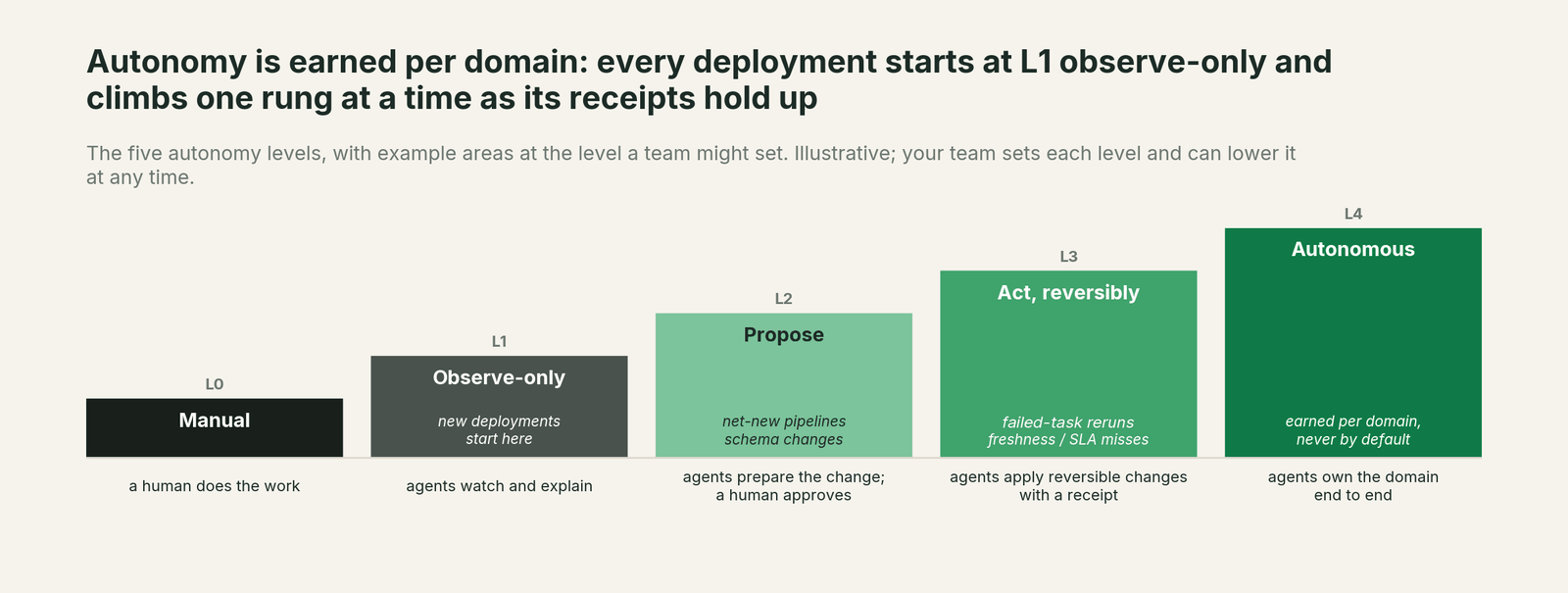
Altimate handles agent risk in the session: a prompt before each write and a few hard-blocked commands. Data Workers handles it at the change, across the estate, on a five-level ladder: L0 manual, L1 observe, L2 propose, L3 act reversibly, L4 autonomous.
- •Autonomy is set per domain. Freshness fixes can run at L3 (act, reversibly) while schema changes stay at L2 (propose).
- •New deployments start observe-only. You extend autonomy one domain at a time as the receipts earn trust.
- •Anything irreversible requires a named human to approve it.
- •Every write is scoped before it runs, with blast radius computed across platforms.
- •Every change leaves a tamper-evident receipt with the diff, approver, timestamp, blast radius and rollback path.
- •No agent can approve or promote its own work. This is enforced in code, not left to a prompt.
- •Least privilege. Data Workers acts with the grants you give it, through each platform's own permission system.
"Altimate has Workspaces over MCP and an agent CLI too. Doesn't that close the gap?"
Altimate Workspaces serve team context to any MCP client, and through them an engineer can trigger an Airflow DAG run or launch a Dagster run from the IDE. Altimate Code reads MCP servers you've configured, and Altimate ships plugins for Claude Code, Codex and OpenCode.
It's still one engineer, one session and one approval prompt at a time. Nobody scopes the blast radius across platforms, gates the change by domain, verifies the result afterwards or records the outcome in a shared log that a security lead can read. MCP gives an agent a tool. Data Workers gives you the operating model for the estate, and every Data Workers agent is an MCP server your coding agent can call, next to Altimate Workspaces in the same client.
How it fits together
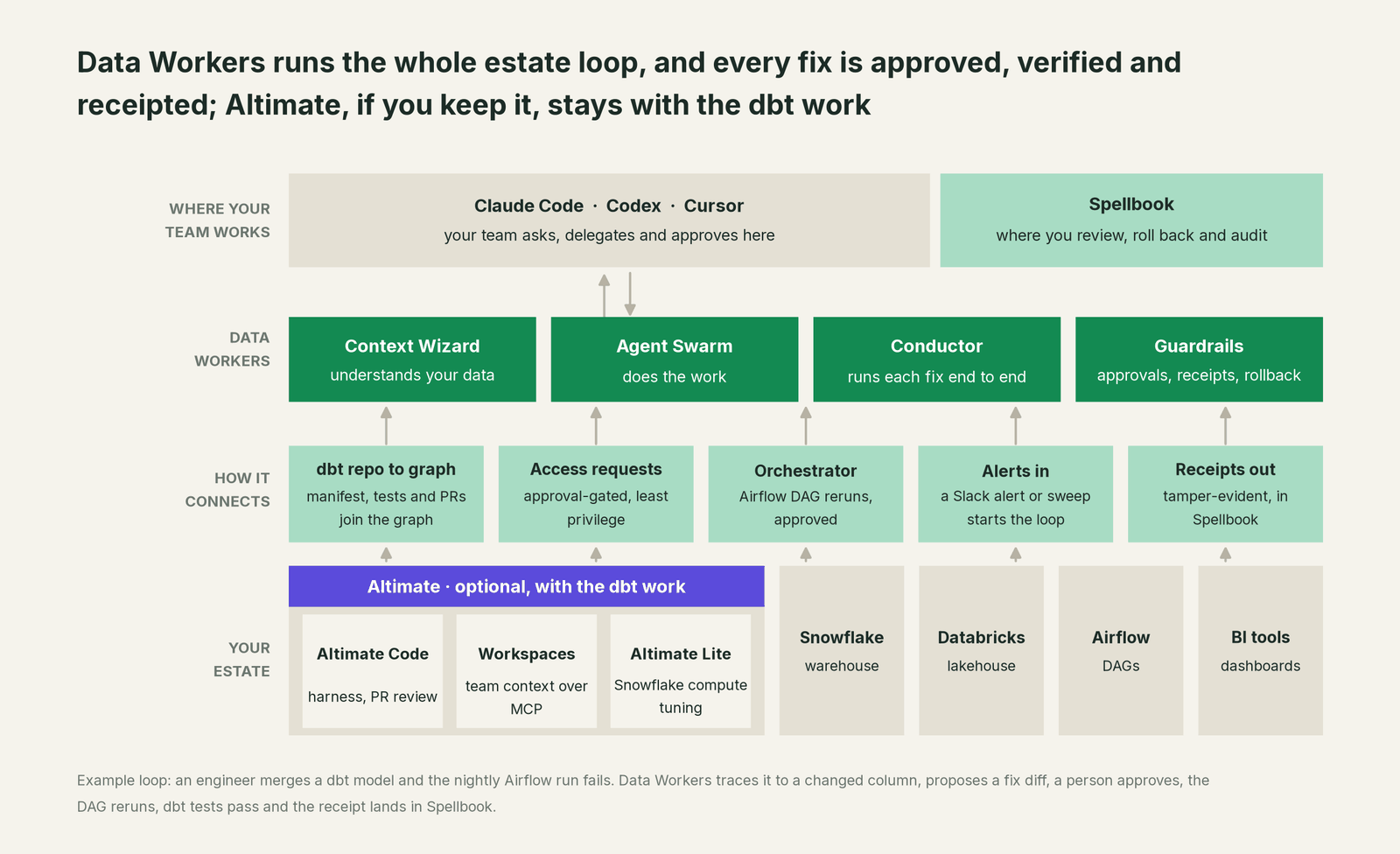
Getting started takes no migration and no change of editor. Connect Data Workers to your warehouses, dbt project and orchestrator. The Context Wizard builds the graph, every agent starts observe-only, and the first thing you see is what each recent PR touched outside dbt and what each recent incident's fix would have been. For platform setup, see Data Workers on Snowflake and Data Workers on Databricks.
The case for your CFO
The outcome. AI is speeding up how fast dbt changes get written and merged. The cost lands after the merge: broken exports, unmasked columns, access tickets and warehouse bills nobody owns. Data Workers puts every change outside the editor under one approval flow, so engineers spend their time building instead of cleaning up.
The risk story. At L1 agents only observe. At L2 they propose a complete change with its blast radius, and a person approves. At L3 they act only on reversible changes, and at L4 only in domains you've chosen. Anything irreversible needs a named human. Every change leaves a receipt with the diff, the approver, the timestamp, the blast radius and the rollback path. Nothing migrates: your data stays where it is.
Why now. Altimate and dbt Labs are pushing agents into the merge path. The more changes agents write, the bigger the blast radius after the merge, and the more it matters who approves what touches production.
The first win. Change review on the dbt repo in propose mode, next to Altimate's PR bot: every PR shows the Airflow tasks, BI queries, grants and masking policies it reaches.
What stays the same. Altimate Code, Power User for dbt and Lite stay where they are. Your team's tools stay, and the coding agent they already use is the way in.
The pilot path. Start with a pilot. It's $7,500 one-time, credited in full against the first year; see pricing.
The sentence for upstairs. "Altimate speeds up writing and reviewing our dbt and tunes our warehouse compute; Data Workers proposes and records every fix the rest of the platform needs, under one approval flow and one audit trail."
When Altimate alone is enough
If your estate is one dbt project on one warehouse, with few consumers outside dbt, and what you want is faster SQL, a signed PR verdict and lower compute bills, Altimate covers it well. Once you own incidents, access, masking, cost cleanup, migrations and audit across several platforms, that's the work Data Workers is built to run.
FAQ
What is a good Altimate AI alternative for a platform team? Data Workers, if your job goes beyond the dbt project. It reviews every change against the whole estate and runs incidents, access, security, cost and migrations under one approval flow, with a receipt on every change. Many teams keep Altimate with the dbt work and run Data Workers around it.
Does Altimate Lite ask before it changes a warehouse? Lite is opt-in per warehouse and keeps a decision history, but there's no per-change approval. It tunes auto-suspend and multi-cluster scaling continuously on the warehouses you enable, and settings it changed stay after uninstall. Data Workers' cost changes go through approval at the level you set.
Altimate already does migrations with parity checks. What does Data Workers add? Altimate's data_diff is strong, across 12 warehouses and five algorithms. If running parity diffs is the only need, data_diff does that job. Data Workers plans the migration in approved waves, translates and judges each translation, plans each wave's parity checks, repairs dropped masking tags and holds the completion gate for the owner's sign-off. Our design target is four to eight weeks for work that often runs six to twelve months.
Can I bring my own LLM to each? Yes. Altimate's bring-your-own-key use is free and unlimited on every plan. Data Workers takes no markup on model spend; you bring your own model.
Does Data Workers replace Power User for dbt? It doesn't have to. Engineers keep the extension. Data Workers' Pipeline Building agent can also write dbt changes as approval-gated diffs for the owner to merge, and its Change Review agent reviews what engineers ship.
Can Data Workers and Altimate run in the same coding agent? Yes. Data Workers agents are MCP servers, so you can connect them and Altimate Workspaces in the same Claude Code or Cursor setup today. It's a pattern you set up yourself.
What happens if an agent gets a change wrong? Data Workers scopes every write before it runs and sends it to review at the autonomy level you've set for that domain. Every change leaves a tamper-evident receipt and a rollback path, and no agent can approve its own work.
Sources
Sources for Altimate capabilities, statuses and prices, current as of October 2, 2026: altimate.ai, the platform page, pricing, security, Altimate Lite, the Altimate Lite announcement, Workspaces docs, Workspaces integrations, Workspaces pricing FAQ, permissions, governance, trace, agent modes, data parity, migration, dbt PR Review, CI and headless runs, the Snowflake Native App docs, Enterprise Platform pricing, the Power User pricing FAQ, the Altimate Code repository and releases and the Power User for dbt marketplace listing. Product names and statuses change quickly; if we've got something wrong, tell us and we'll fix it.