Your Company Runs on Alation. Now Let Data Workers Keep What It Shows True: A Guide for Data Leaders
A guide for CDOs and VPs of data whose company standardizes on Alation: what AIOS, its agents and data products cover, and how Data Workers runs the operations work that keeps them true, with owners approving.
Alation is the reading room: where your people and your agents find data and learn whether to trust it. Data Workers is the control plane: the operations work behind the shelves, so every flag, contract and certified table stays true. This guide is for the CDO or VP of data whose company standardized on Alation.
Your analysts already go to Alation first and check a table's trust flags before they build on it. Stewards endorse the tables that matter and raise a Deprecation flag on the ones being retired. Data products in the Marketplace ship with an owner and a versioned contract that sets the schema, quality thresholds and refresh cadence. On the Alation Intelligence Operating System (AIOS), agents read the same context over Alation's remote MCP server, and since September 17, 2026, Semantic Model Mastering syncs governed definitions back to Databricks and Snowflake.
Then the work starts. A table is flagged for deprecation and nobody knows which dbt models, dashboards and data products still read it. A data product misses the refresh its contract promises and someone has to find the cause three systems away. An owner alert arrives with a remediation plan and waits for an engineer who can carry it out.
Your data platform has a control-plane problem, and the control plane is your team. Alation made trusting your data a habit. The expensive part is the doing: fixing, checking, approving and recording what changed.
What Alation solved, and what it didn't
Alation solved adoption. People across your company look up a table before they use it, with more than 120 connectors behind the search. Curation, lineage and chat agents keep that reading room accurate, and Agent Studio lets your team build its own. Agentic Automation chains triggers, decisions and actions into Flows, routes exceptions to a person in its Inbox, and writes each correction "to the definition, rule, or data product that produced the error". AI Governance, available now, links every model and agent to its business use case and the governed data underneath. Intelligent Feeds, Ontologies, Console and Governed Collections are in early access.
What Alation doesn't do is change the systems it describes. Its remote MCP server serves context, search, SQL drafting, lineage and data products, and the published agent SDK lists no metadata write tool. When a quality check fails, the alert reaches the table's owner with its classification, downstream consumers and a remediation plan. Nothing in Alation owns the change to the dbt model, the rerun, the check that the numbers held, or the receipt an auditor will ask for. That is the right focus for a catalog that thousands of people and agents read every day.
Alation is the reading room. Data Workers is the agentic data platform that does the operations work keeping what Alation shows true, and runs the rest of your data back office.
Or, in one sentence for your team: Alation tells us which data to trust; Data Workers makes the systems behind it earn that trust, with the owner approving every change.
What goes on autopilot
Each is a queue your team runs by hand today, behind the flags, contracts and alerts Alation already holds.
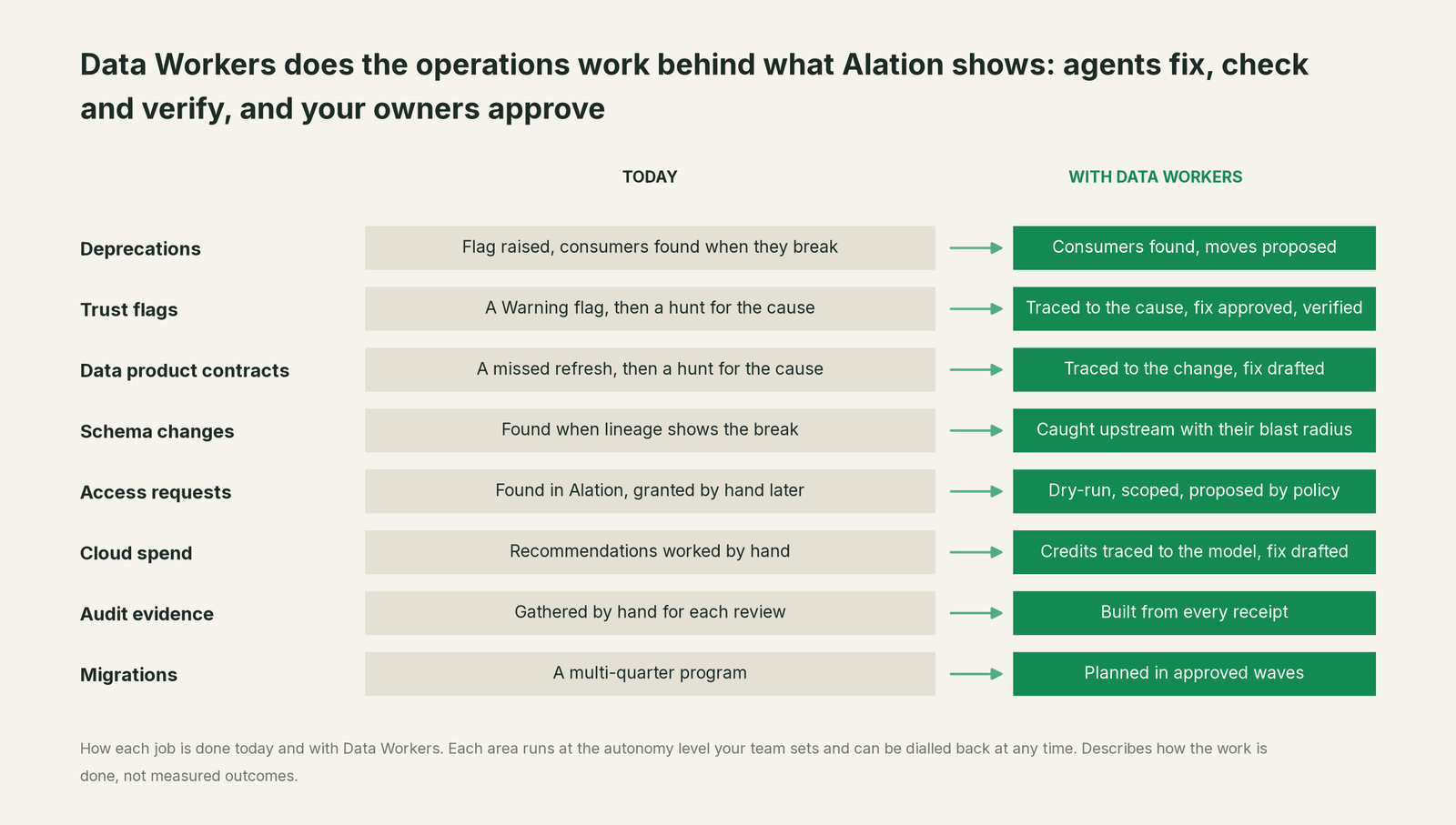
Nothing gets replaced. Alation connects over its remote MCP server and REST API today, used by your team's assistant side by side with Data Workers, which works inside the warehouse, dbt and orchestrator you already run, and records every change. Catalog updates are drafted for your stewards, who make them in Alation.
What changes for your organization
Here's a normal week. Access, spend and migrations follow the same pattern: drafted for the owner, approved, recorded.
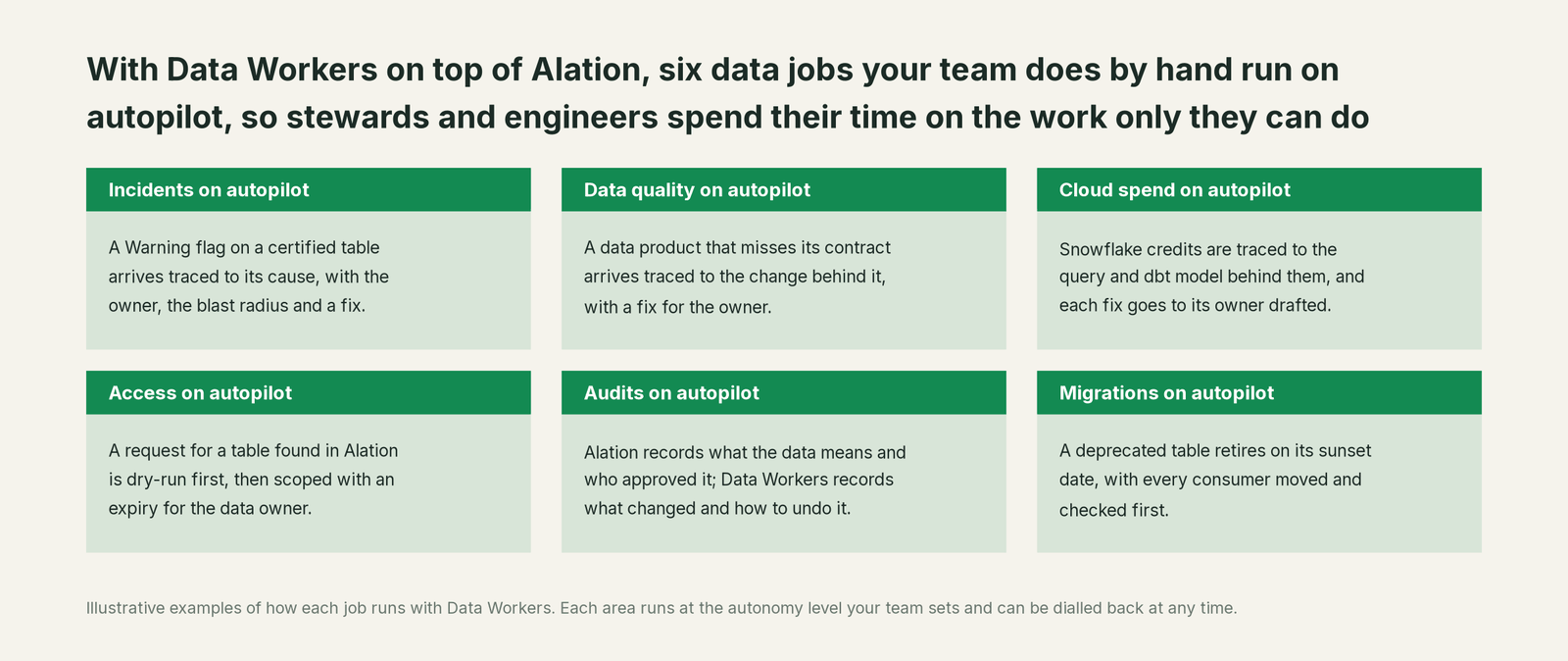
- •Deprecations finish. A Deprecation flag arrives with everything that still reads the table, each consumer's owner and a proposed change to move it, so the old table can be retired on the date the steward set.
- •Data product contracts hold. A missed refresh or a breached quality threshold arrives traced to the change behind it, with a fix drafted for the owner, so the product is back inside its contract before consumers notice.
- •Stewards curate instead of chasing. Owner hunts and reminders move to the agents; stewards spend the week on definitions, domains and data products.
- •Audits get easier. Alation records what the data means and who approved it. Data Workers records what changed in the platform, who approved it, how it was verified and how to undo it.
One deprecation, start to finish
This is an illustration, not a customer case.
- •In August, the platform team replaces the legacy
ORDERS_V1table in Snowflake withfct_orders, built in dbt Cloud. The steward raises a Deprecation flag on the old table in Alation, with a sunset date of October 31 and a link to the replacement. - •Everyone who opens the table in Alation sees the flag. Seven dbt models still select from it, two Looker Explores sit on those models, and the contract of the "Customer orders" data product still names the old table.
- •On November 3, the platform team drops
ORDERS_V1as planned. The nightly dbt Cloud job fails, the Explores show yesterday's numbers, and the data product misses the 7 a.m. refresh its contract promises.
With Data Workers, the Deprecation flag reaches it from Alation the week it is raised. Lineage across dbt, Looker and Alation names everything still reading the table, each with its owner. Before anything moves, it pins the totals each model returns today, monthly orders and revenue. It proposes one diff per model, repointed to fct_orders, for the model owners to merge, with the undo written down. After each merge the team's scheduler runs the dbt Cloud job, and Data Workers checks that the model returns the same totals and passes its quality checks. It drafts the contract update for the data product owner, who publishes the new version in Alation. By late October the receipt shows nothing reads the old table. The platform owner drops it on schedule, and nothing breaks.
You choose how far and how fast
You choose the altitude, one domain at a time.
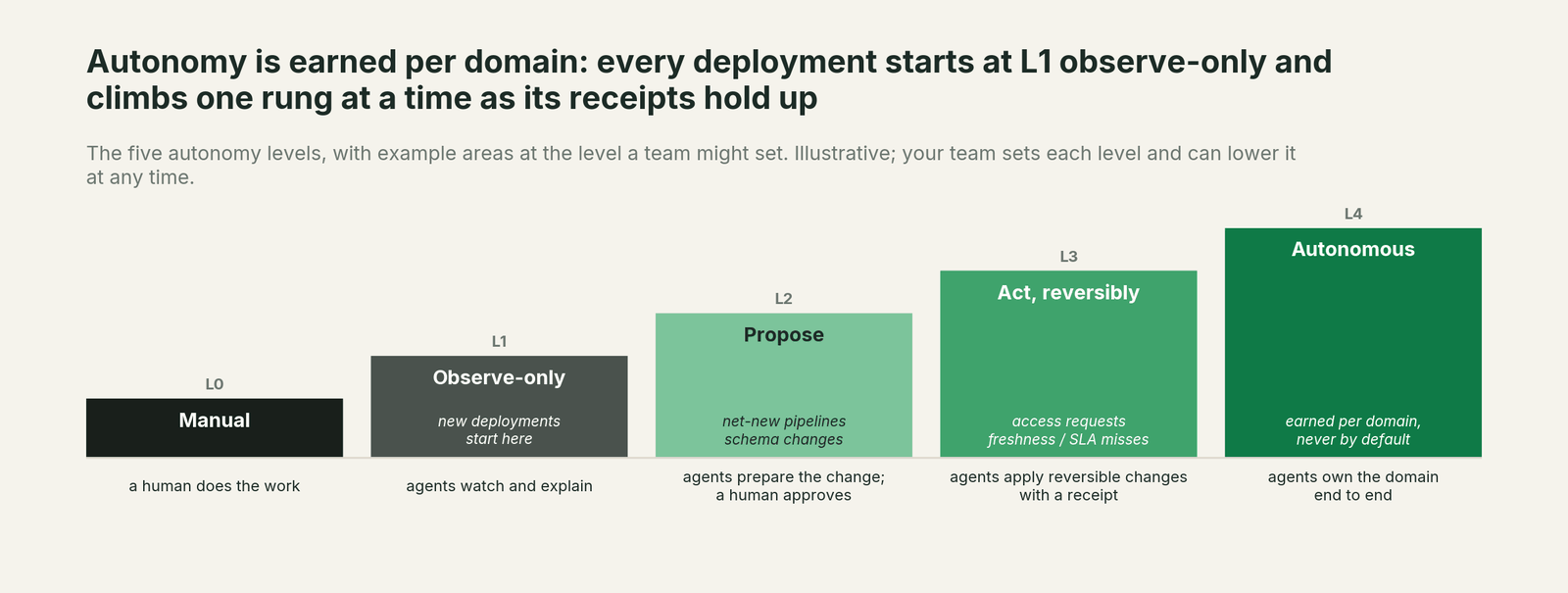
L0 manual is today's hand work. Every domain starts at L1 observe: each flag, contract breach and owner alert gets a diagnosis, and nothing changes. At L2 propose, agents draft the diff, the rerun plan or the grant, and a named owner approves it. At L3 act reversibly, change classes with a proven record, such as rerunning a dbt job after an approved upstream fix, run on their own with the undo written down first and a receipt left behind. At L4 autonomous, a domain that has earned it runs end to end, and any domain can be dialled back. A domain moves up when the agents' records and receipts meet the bar your team set. An unanswered approval request expires and escalates, never auto-grants, and no agent can promote its own work.
The ladder in detail is in autonomy levels L0 to L4 explained, and how approvals work covers who signs off on what.
Why doesn't Alation just do this itself?
Focus and risk. Alation earns its place as the one place everyone reads, which needs read access to nearly everything and changes to almost nothing outside the catalog. Its agents fix what Alation owns. Changing a dbt model, rerunning a pipeline or granting access in a warehouse is a different promise: scope the blast radius, get the right owner to approve, prove the result and own the undo, across systems Alation doesn't run. That is a sensible line for Alation not to cross, and it is the product we built.
How it fits with Alation
- •Alation keeps its job. Search, curation, trust flags, lineage, data products, Agentic Automation, AI Governance and the MCP server stay where they are.
- •Alation's context becomes the map. Asset owners approve changes to their assets, flags, contracts and alerts become signals, and Alation's lineage joins the lineage Data Workers traces across your warehouse, dbt and orchestrator.
- •Your platforms' permissions stay the lock. Data Workers holds no more access than the roles you grant it.
- •Your stewards keep the pen. Descriptions, flags and contract updates are drafted for the steward or product owner, who makes them in Alation. Approved dbt doc changes reach Alation on its next dbt ingestion.
- •Your data stays in your systems. The agents run in your infrastructure and hold the warehouse credentials. Nothing is migrated; the hosted orchestration service sees workflow metadata only. Our security and deployment guide has the detail.
When you don't need Data Workers
- •Deprecated tables retire on schedule because every consumer is moved in time.
- •Trust flags, contract breaches and owner alerts close quickly because your engineers have time to work every one.
- •Nobody upstairs is asking what the catalog investment changed in the numbers.
If all three are true, keep your budget. If any of them isn't, the rest of this guide is about you.
The case for your CFO
The outcome. The company pays for Alation so people trust the data. Data Workers makes that trust hold in the systems underneath: data products keep the promises in their contracts, legacy tables retire on the date set without breaking the board dashboard, and engineers' hours go to new work instead of rework.
The risk story. Autonomy is set per domain on the ladder above, and nothing changes at L2 until the owner named in Alation approves. Every change carries a receipt: the trigger, the diff, who approved it, what it touched downstream, how it was verified and how to undo it. An org-wide stop halts all autonomous dispatch. See our safety guide and who owns the agents.
Why now. Data products and Semantic Model Mastering now hand governed data to assistants over MCP every day, so every contract and flag is a promise the tables underneath have to keep. The choice is one approval flow and one record, or each engineer's own wiring: see build it ourselves with Claude Code and MCP servers.
The first win. Read-only: every Deprecation flag and data product contract in one domain arrives with a list of what still depends on it and where the systems disagree.
What stays the same. Alation, your stewards, your glossary and data products, warehouse permissions and dbt review. The path is a pilot, run on your own data before you commit. The ROI guide shows how to size it.
The sentence to repeat upstairs: Alation tells us which data to trust; Data Workers keeps it trustworthy, with the owner approving every fix and a receipt for each one.
Where to start
Pick one domain whose flags and data products already live in Alation and end the same way every time: the deprecations your platform team keeps postponing, the data products behind the board pack, or the Snowflake bill.
Start with a pilot. A forward-deployed engineer connects Data Workers to Alation, your warehouse, dbt and your orchestrator, and runs the first domain alongside your team. See pricing for how the pilot works.
For the detail, send your architects you're on Alation, the practitioner version with a worked trust-flag incident, and our comparison of Collibra, Alation, DataHub and OpenMetadata if a catalog choice is on the table. Leader siblings are the Atlan and Collibra guides, and the category answer is how Data Workers differs from a data catalog. They cover the four products: the Autonomous Data-Conductor picks up Alation's signals and runs each job from detection to a verified result, the Data-Agents Swarm does the work with 20+ specialist agents, Data Context Wizard keeps one governed graph of definitions, lineage and owners across every platform with Alation as a first-class source, and Spellbook Data Catalog (in preview) is where your team approves, audits and rolls back.
Sources
- •Alation, homepage (AIOS), checked Oct 3, 2026: https://www.alation.com/
- •Alation, Alation Launches AIOS Expansion with Six Products that Accelerate AI Transformation (Sep 17, 2026; AI Governance and Semantic Model Mastering available now; Ontologies, Intelligent Feeds, Console and Governed Collections in early access), checked Oct 3, 2026: https://www.alation.com/news-and-press/alation-launches-aios-tm-expansion-with-six-products-that-accelerate-ai-transformation/
- •Alation, newsroom (latest release Sep 17, 2026), checked Oct 3, 2026: https://www.alation.com/news-and-press/
- •Alation, Agents (Curation, Lineage and Chat agents; Agent Studio; MCP and REST), checked Oct 3, 2026: https://www.alation.com/aios/agents/
- •Alation, Agentic Automation (Flows; fixes written to the definition, rule or data product; Inbox approvals), checked Oct 3, 2026: https://www.alation.com/solutions/agentic-automation/
- •Alation, Data Products (owner, versioned contract with schema, quality thresholds, ownership and refresh cadence), checked Oct 3, 2026: https://www.alation.com/aios/data-products/
- •Alation, Pipelines and Observability (owner alerts with downstream consumers and a remediation plan), checked Oct 3, 2026: https://www.alation.com/solutions/pipelines-and-observability/
- •Alation, Connectors and SDKs, checked Oct 3, 2026: https://www.alation.com/aios/connectors-and-sdks/
- •Alation User Guide, Use Trust Flags (Endorsement, Warning, Deprecation; Warning is called Important Info in the New User Experience), checked Oct 3, 2026: https://docs.alation.com/en/latest/steward/UseTrustFlags/index.html
- •Alation User Guide, Use Trust Flags and Proceed with Confidence (deprecate data sets being decommissioned, with time frames), checked Oct 3, 2026: https://docs.alation.com/en/latest/welcome/BestPractices/UseTrustFlagstoProceedwithConfidence.html
- •Alation, AI Governance (links models and agents to the use case and governed data), checked Oct 3, 2026: https://www.alation.com/solutions/ai-governance/
- •Alation, AI Agent SDK and remote MCP server (tools list; Jan 2, 2026 change moving metadata updates to the REST API), checked Oct 3, 2026: https://github.com/Alation/alation-ai-agent-sdk