Atlan vs Spellbook: The Agentic Data Catalog, Inventory vs Control Plane
Atlan is the inventory and context layer. Spellbook turns it into a control plane where agent changes are approved, landed at the source and audited. Compare them.
Atlan is the inventory. Data Workers turns it into a control plane. Atlan tells your people and your agents what exists, what it means and who owns it. Spellbook Data Catalog is where the changes that follow get proposed, approved, landed at the source and audited, in every system around the catalog.
If you run Atlan, your estate already has a map. Every table, column, dbt model, Tableau dashboard and Databricks Genie Agent is an asset. Owners and certificates sit on each one, glossary terms link business words to tables, domains group assets by the team that owns them, and classifications like PII flow down lineage on their own. Personas and policies decide who sees what. Context agents fill in the descriptions and READMEs nobody had time to write, and the hosted Atlan MCP server hands all of it to Claude, Cursor, Codex and Genie. Atlan now calls itself "the context layer for AI", and for that job it's very good.
The seams show up the morning something breaks. A Data Quality Studio rule fails on fct_revenue, Atlan alerts the team and opens a Jira ticket, and lineage shows the executive dashboard downstream. Then a person still has to find the dbt change, fix the model, rerun the job and check the numbers. Access requests follow the same path: the workflow approves the request, and a Jira or ServiceNow ticket asks a platform engineer to run the grant in Snowflake. Agents add a third seam. Coding agents now write to the warehouse, dbt and pipelines, and someone has to decide which of those changes go through and keep the record.
Data Workers is the agentic data platform built for that work. Spellbook Data Catalog (in preview) is the agentic catalog and control plane: one inbox where every agent change on every system is reviewed, approved, rolled back and audited. Data Context Wizard reads Atlan as a first-class source and joins it with warehouse history, dbt and BI metadata. The Autonomous Data-Conductor and the Data-Agents Swarm do the work behind each signal. Data Workers connects to Atlan over Atlan's hosted MCP server and API today.
We've written the same comparison for the platform-native catalogs: Unity Catalog vs Spellbook for Databricks and Knowledge Catalog vs Spellbook for Google Cloud. For a feature-by-feature matrix, see our Data Workers vs Atlan overview. This page is about the agentic catalog: what changes when agents do the work.
Key takeaways
- •Keep Atlan as the inventory. Assets, glossary terms, domains, lineage across more than 100 connectors, context agents and a hosted MCP server are strong, current and widely adopted.
- •Add Spellbook as the control plane. Every agent's proposed change, in the warehouse, dbt, pipelines and the catalog, lands in one inbox with its blast radius, an approver and a rollback path.
- •Atlan writes its own metadata; Data Workers acts at the source. Atlan's MCP write tools preview each change and wait for approval, and they change Atlan metadata. Data Workers proposes the dbt diff and the Snowflake policy for their owners, and applies an approved Unity Catalog grant.
- •Atlan's signals start Data Workers' loop. A failed Data Quality Studio rule or an access request becomes a scoped proposal, a fix at the source, a verified result and a receipt.
- •Approved context goes back into Atlan through your steward. Data Workers drafts the description or the note about what changed; your team's Atlan MCP client can add it under Atlan's preview and approval, or the steward edits the asset, so Atlan stays the place people look.
- •Atlan vs Spellbook is a keep-and-add decision for most teams. Teams that consolidate do so on the control plane, and Atlan's inventory feeds it either way.
Six things Data Workers adds on top of Atlan
1. A fix behind every failed rule. Data Quality Studio finds the problem in Snowflake, Databricks or BigQuery. The Conductor traces the cause through lineage to the dbt change or the upstream load, has the right agent draft the fix, reruns the job after approval and checks that the rule passes.
2. Access requests that finish at the source. Atlan's access management workflow approves the request, then grants inside Atlan or opens a Jira, ServiceNow or webhook request for your team. The Access & Governance agent dry-runs the requested grant (effective privileges, sensitive columns reached, policy conflicts, an expiry recommendation), applies it on Unity Catalog after approval, proposes it for the platform owner on Snowflake and BigQuery, and records it with a receipt.
3. One inbox for every agent's changes. Your coding agent, Genie and our 20+ specialist agents all propose work. In Spellbook each proposal arrives with the diff, the blast radius across systems and the policy that applies. Your team approves, steers, sends back or rolls back.
4. Classifications that follow the data. Atlan's PII classification propagates down lineage, and tag reverse sync updates existing tags in Snowflake and Databricks. Data Workers traces copies of classified columns through lineage and proposes the masking for the owner to apply.
5. One context graph across the catalog and the systems it describes. Data Context Wizard reads Atlan's assets, glossary terms, owners and lineage, and joins them with query history, grants, dbt manifests and quality checks through 50+ connectors. Every fact carries its source, author, confidence and when it was seen.
6. A receipt on every change, with who or what proposed it, who approved it, what it touched and how to undo it. The receipt names the Atlan asset, so stewards can trace the story from where they already work.
One failed rule, six systems
Here's an ordinary Tuesday in an estate that runs on Atlan. It's an illustration, not a customer case.
- •Monday 17:30. An analytics engineer merges a dbt PR in GitHub that renames
discount_amttodiscount_amountinstg_orders.fct_revenuestill selects the old name through a macro, which now returns null. - •Tuesday 05:00. The nightly dbt job builds
fct_revenuein Snowflake.net_revenuesilently stops subtracting discounts. - •Tuesday 06:00. A Data Quality Studio null-count rule on
fct_revenue.discount_amountfails. Atlan alerts the data quality channel and opens a Jira ticket. - •Tuesday 06:01. Atlan's lineage shows the impact: the Tableau executive revenue dashboard and a Genie Space built from the same table.
- •Tuesday 09:00. The weekly revenue review starts with whatever the dashboard says.
| Step | What Atlan sees | What Data Workers does |
|---|---|---|
| dbt PR merged in GitHub | Catalogs the dbt model and its lineage after the next sync. | The Data Change Review agent links the PR to the columns it touched. |
Nightly dbt job builds fct_revenue | Shows the asset and its upstream lineage. | Reads the model's lineage from the manifest and keeps it in the context graph. |
| Null-count rule fails | Data Quality Studio flags the failure, alerts Slack and opens a Jira ticket. | Reads the failure from Atlan's API and the asset's lineage over Atlan's MCP server, and starts an incident. |
| Impact on Tableau and Genie | Lineage lists the downstream dashboard and Genie Space. | Traces the cause to the PR, drafts the fix and a rerun plan, and puts both in Spellbook with that blast radius. |
| Fix and verification | Waits for a person to resolve the ticket. | The owner approves and merges the fix; Data Workers queues the rerun, confirms the rule passes and totals match, and drafts a note for the steward to add to the Atlan asset. |
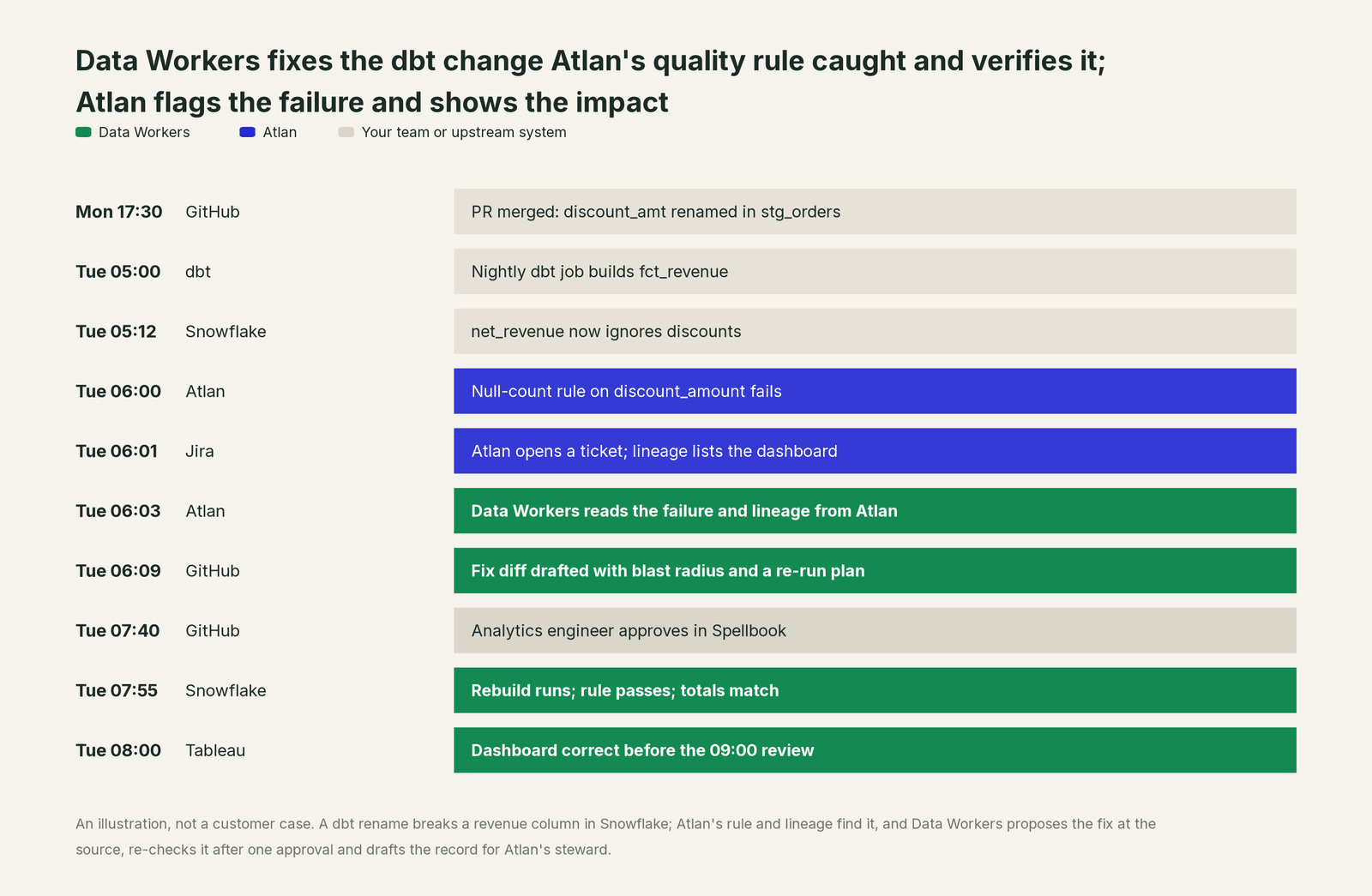
Atlan did its job on every step it owns: it caught the failure, showed the impact and told the right people. The fix lived in GitHub, dbt and Snowflake. Data Workers works there, and the map stays in Atlan.
What Atlan covers, as of October 2026
Atlan ships fast; most of what's below changed this year. Here's what its documentation and changelog say today.
| Area | What Atlan ships | Status (Oct 2026) |
|---|---|---|
| Catalog and discovery | Assets, owners, certificates, domains, data products, Data Marketplace, more than 100 connectors | GA |
| Lineage | Query lineage from SQL activity and ETL lineage from pipeline connectors; Databricks Genie Agent, AI/BI dashboard and AI model lineage | GA |
| Business glossary | Glossary terms linked to assets; Business Graph | GA |
| Context agents | Description, README and SQL Intelligence agents; never overwrite existing values; use AI credits | GA |
| Knowledge sources | GitHub, Confluence (through Atlassian's Rovo MCP server) and knowledge files read by Atlan agents | New, Sep 2026 |
| Context Engineering Studio | Assemble, simulate and deploy a context repository to Cortex Analyst, Databricks Genie, dbt MetricFlow or Claude | Enabled per tenant in Atlan Labs |
| Hosted Atlan MCP server | mcp.atlan.com/mcp, OAuth per user or API key; 39 tools across nine categories, Read, Write or Admin | Enabled for all tenants |
| MCP write safety | Write tools preview the change and wait for approval; read-only mode on request; writes gated by a Labs setting | Documented Aug 2026 |
| Data Quality Studio | Rules run natively in Snowflake, Databricks and BigQuery; AI-suggested rules; anomaly detection on Snowflake | GA |
| Alerts | Slack, Teams, Jira, ServiceNow and webhooks for rule results | GA |
| Governance workflows and inbox | Change management, new entity creation, access management and policy approval templates | Enabled in Atlan Labs |
| Access management | Grants inside Atlan, or a Jira, ServiceNow or webhook request for your team to grant at the source | GA |
| Tag and description sync | Import tags from Snowflake and Databricks; reverse sync updates existing tags and pushes descriptions as comments | GA |
| AI governance | AI models and applications registered as assets, with intake and approval workflows (Jira, ServiceNow) | Registry live; automatic intake private beta; versioning and compliance readiness beta |
| Pricing | Sold through Atlan sales; context agents use AI credits; quality rules use your warehouse compute | By quote |
That's a deep, current inventory and context layer.
One platform, not one more tool
Cataloging is one job on a data team's list. The same team also writes quality checks, finds root causes, ships fixes, cuts spend, changes pipelines, runs migrations and produces audit evidence. Each point tool adds another console, another contract and another handoff.
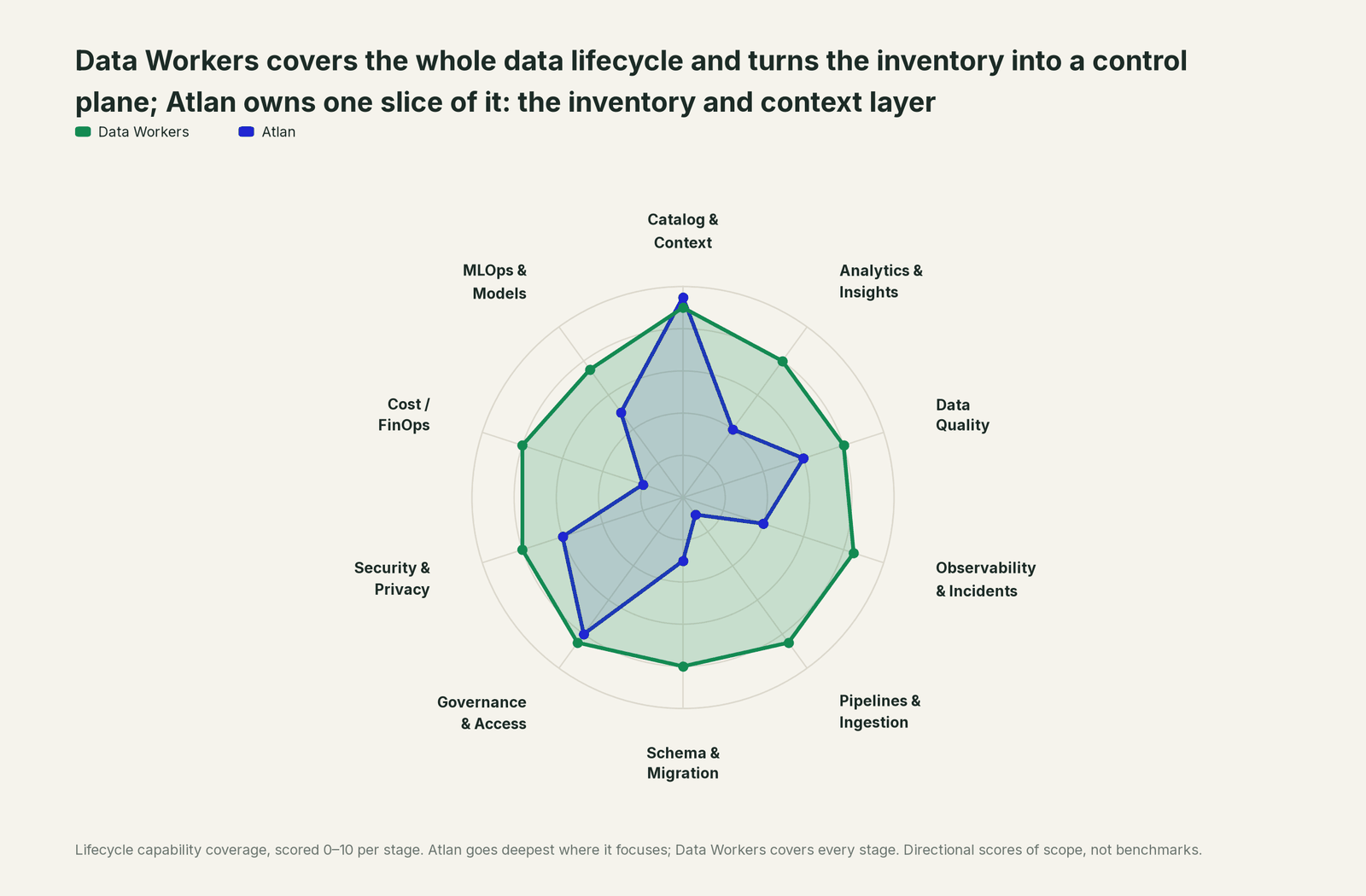
Data Workers covers the whole data lifecycle with one context graph, one approval flow and one audit trail. We score the same ten stages on every comparison page so you can compare tools across pages. Atlan leads on catalog and context, its home ground, and it's strong on governance of metadata. Data Workers leads on every stage where the work happens outside the catalog.
| Stage | Data Workers | Atlan | Why we scored it this way |
|---|---|---|---|
| Catalog & Context | 9 | 9.5 | Atlan's home stage: a catalog of assets, glossary terms, domains and lineage across 100+ connectors, enriched by context agents and served to AI over a hosted MCP server. Data Workers reads it as a first-class source. |
| Analytics & Insights | 8 | 4 | Context Engineering Studio assembles and tests semantic models and deploys them to Genie, Cortex Analyst and dbt. The questions are answered in those engines. Data Workers answers over the whole governed graph. |
| Data Quality | 8 | 6 | Data Quality Studio runs rules natively in Snowflake, Databricks and BigQuery and suggests rules with AI. It flags failures; repairing the data is outside it. Data Workers writes, runs and repairs checks. |
| Observability & Incidents | 8.5 | 4 | Rule failures alert Slack, Teams, Jira or ServiceNow, and Monte Carlo and Elementary signals show on the asset. The cause is left for a person. The Conductor traces it, proposes the fix behind approval and verifies it. |
| Pipelines & Ingestion | 8.5 | 1 | Atlan catalogs Fivetran, dbt and Airflow lineage and doesn't run pipelines. Data Workers proposes pipeline changes and reruns behind approval. |
| Schema & Migration | 8 | 3 | Lineage shows the impact of a change; Atlan doesn't plan or run schema changes or migrations. Data Workers plans them in approved waves. |
| Governance & Access | 8.5 | 8 | Personas, policies and governance workflows with an inbox govern metadata well. Access requests grant inside Atlan or raise a Jira, ServiceNow or webhook request for a person to grant at the source. Data Workers dry-runs each grant, applies approved Unity Catalog grants and proposes the rest for their owners. |
| Security & Privacy | 8 | 6 | Classifications propagate through lineage, and tag reverse sync updates existing tags in Snowflake and Databricks. Enforcement stays in the warehouse. Data Workers traces copies of classified columns through lineage and proposes the matching policy. |
| Cost / FinOps | 8 | 2 | Atlan tracks the compute its own quality rules use and shows popularity metrics. Data Workers attributes Snowflake credits per query to the dbt model behind them and drafts the fix for its owner. |
| MLOps & Models | 7.5 | 5 | AI models and applications are registered as assets with lineage and approval workflows. Data Workers keeps the data under models healthy and connects to MLflow and W&B over their APIs today. |
Atlan vs Spellbook on the outcomes you buy
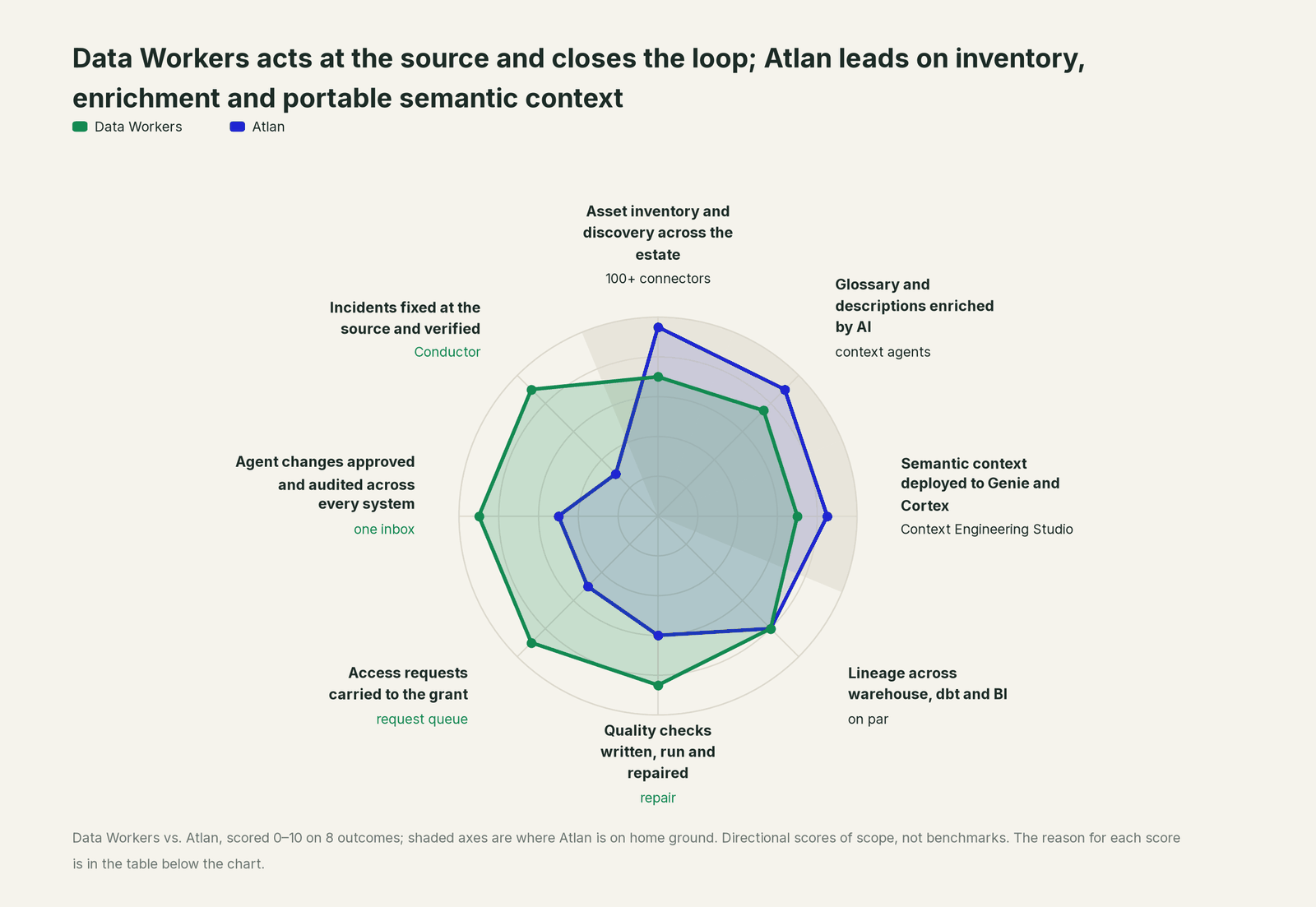
This view narrows to eight outcomes a data leader buys from an agentic data catalog. Atlan leads on three, all about knowing and describing the estate: inventory, AI enrichment and portable semantic context. We're even on lineage. Data Workers leads on every outcome where something has to change outside the catalog.
| Outcome | Data Workers | Atlan | Why we scored it this way |
|---|---|---|---|
| Asset inventory and discovery across the estate | 7 | 9.5 | Atlan's core: one searchable graph of assets, owners, domains and lineage across warehouses, BI, ETL and SaaS. Data Workers reads Atlan into its context graph instead of re-crawling it. |
| Glossary and descriptions enriched by AI | 7.5 | 9 | Context agents write descriptions, READMEs and SQL intelligence from query history, lineage and the glossary, and never overwrite existing values. Data Workers proposes descriptions with source and confidence. |
| Semantic context deployed to Genie and Cortex | 7 | 8.5 | Context Engineering Studio (a Labs opt-in) tests a context repository and deploys it as a Cortex Analyst semantic view or Genie metric views. Data Workers imports metric views as first-class definitions. |
| Lineage across warehouse, dbt and BI | 8 | 8 | Even. Atlan builds query and ETL lineage, including Genie Agents and AI/BI dashboards. Data Workers reads lineage from every platform and resolves it to the jobs behind it. |
| Quality checks written, run and repaired | 8.5 | 6 | Data Quality Studio creates, schedules and runs rules in the warehouse and suggests rules with AI. It flags the failure. Data Workers also repairs the cause and re-runs the check. |
| Access requests carried to the grant | 9 | 5 | Access management workflows grant inside Atlan, or open a Jira, ServiceNow or webhook request for your team to grant at the source. Data Workers dry-runs a least-privilege grant, applies it on Unity Catalog after approval, proposes it elsewhere and keeps a receipt. |
| Agent changes approved and audited across every system | 9 | 5 | Atlan's MCP write tools preview each change and wait for approval, and governance workflows route metadata changes. Both cover Atlan's own metadata. Spellbook covers agent changes in the warehouse, dbt, pipelines and the catalog. |
| Incidents fixed at the source and verified | 9 | 3 | Atlan surfaces failed rules and observability incidents on the asset and routes the alert. The Conductor traces the cause, proposes the fix behind approval, queues the rerun and checks the result. |
The scores measure scope, not answer quality. They're directional judgments, not benchmarks, and the reasoning is on every line so you can argue with any of it.
Where Atlan stops
Each limit below comes from Atlan's own documentation. None is a flaw. Atlan built a catalog and context layer, and a catalog should be careful about what it changes in systems it describes.
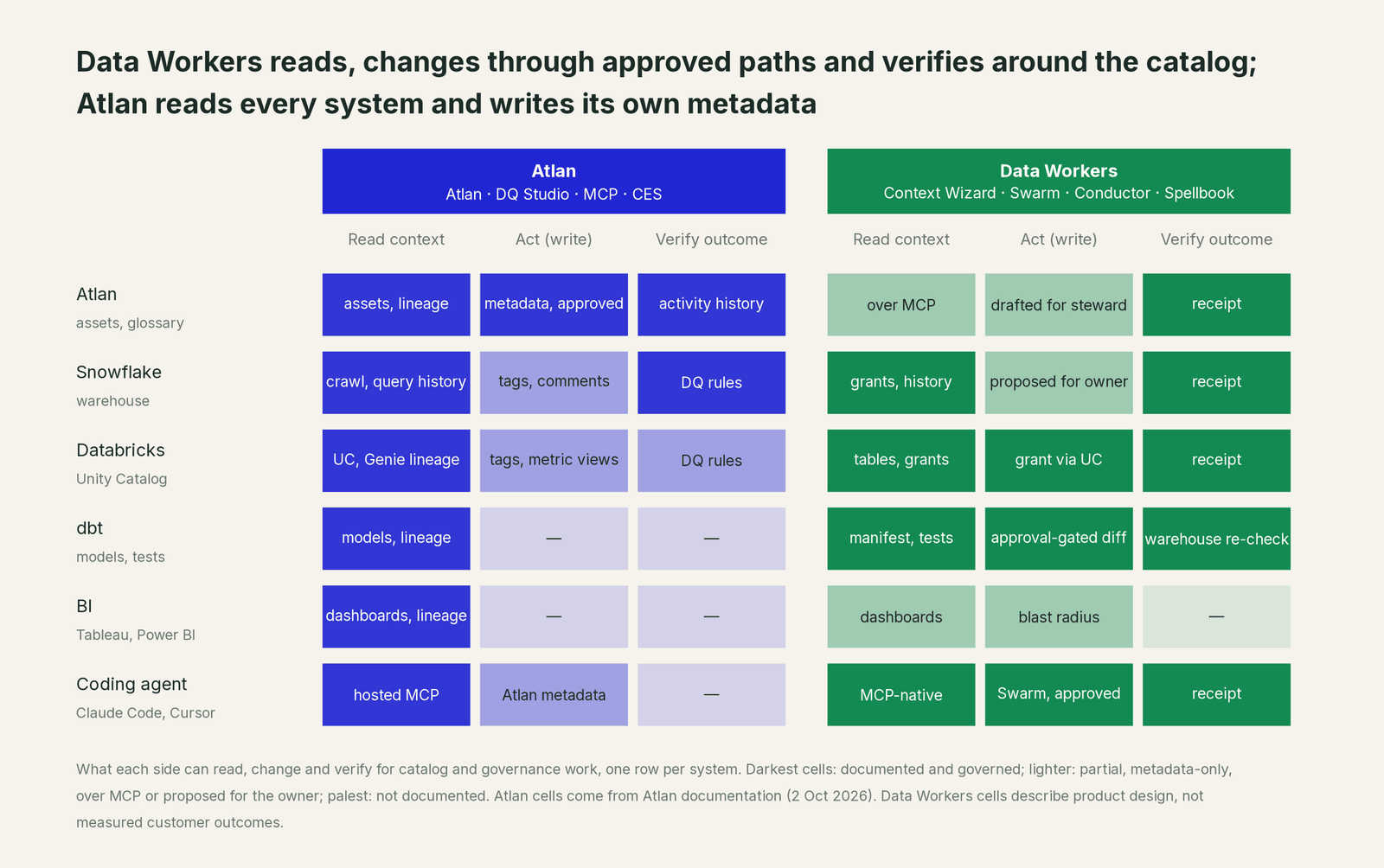
Writes stay inside Atlan. The MCP server's write tools change Atlan metadata: descriptions, certificates, glossary terms, tags, custom metadata, domains and quality rules. For SQL through MCP, "statements that modify data are rejected". An agent connected to Atlan can learn that a model is broken. Fixing the model happens somewhere else.
Access requests end as tickets. The access management workflow grants access inside Atlan, for querying in Data Exploration and previewing samples, or creates a Jira ticket, a ServiceNow request or a webhook "for your team to grant or revoke data access" at the source.
Tag sync updates; it doesn't create. Reverse sync to Snowflake and Databricks "only updates existing tags", and "neither creates nor deletes any tags". The masking policy that acts on the tag lives in the warehouse.
Signals stop before the fix. Data Quality Studio runs rules and routes failures to Slack, Teams, Jira or ServiceNow. Monte Carlo, Elementary and other observability signals show up on the asset. Finding and fixing the cause is a person's job.
Approvals cover Atlan's own changes. Governance workflows route metadata changes to owners, and the MCP server previews each write and waits for approval. Both are well designed, and both stop at the edge of the catalog. An agent change in dbt or Snowflake never reaches that inbox.
Why doesn't Atlan just do this itself?
Because a catalog earns trust by describing every system neutrally, and changing those systems is a different promise. Atlan connects to more than 100 sources with crawl permissions, and its MCP server blocks DML and DDL on purpose. That keeps its security review simple and makes it safe to connect everywhere. Turning access requests into Jira and ServiceNow tickets respects the fact that the platform team owns grants in Snowflake and Databricks, and Atlan doesn't.
Writing to production systems across a stack is a separate product category. It needs blast-radius scoping across systems, an approval flow per domain, rollback, receipts, context about every other system, and accountability for changes in tools Atlan doesn't own. That's the product Data Workers is. It doesn't compete with the map. It acts on what the map shows, with your approval, and hands the result to your steward to record on it.
Where the two overlap
"Both" means Data Workers builds on the Atlan capability.
| Job to be done | Atlan | Data Workers | What we recommend |
|---|---|---|---|
| Inventory and discovery | Assets across 100+ connectors | Reads Atlan into the context graph | Atlan |
| Glossary and descriptions | Context agents, governance workflows | Proposals with source and confidence; a named human approves | Both: Atlan keeps the glossary, Data Workers drafts approved notes for the steward |
| Semantic context for Genie and Cortex | Context Engineering Studio | Imports metric views as definitions | Atlan |
| Lineage | Query and ETL lineage | Reads it and joins the dbt manifest, grants and quality checks | Both |
| Quality rules | Data Quality Studio runs and alerts | Repairs the cause and re-runs the check | Both: Atlan detects, Data Workers fixes |
| Access requests | Workflow, then grant in Atlan or a ticket | Grant dry run; applied on Unity Catalog after approval, proposed for the owner elsewhere, with a receipt | Data Workers, started from Atlan's request |
| Agent changes outside the catalog | Not in scope | One inbox, blast radius, rollback | Data Workers |
| Audit | Activity history on each asset | Receipt on every change, every system | Both |
Atlan vs Spellbook: keep it or replace it
Keep Atlan if it's working as your inventory. Your stewards know it, your glossary lives there, your context agents keep descriptions current, and your AI tools already read it over MCP. Data Workers reads all of that and makes it the starting point for action.
Add Spellbook to govern the work. It reads what Atlan knows, turns failed rules and requests into scoped proposals, lands approved changes through the owners of each system and drafts the outcome for the steward to record on the Atlan asset.
Consolidate if you'd rather run one agentic catalog. Spellbook's asset pages are written by the agents as they work: what an asset is, who owns it, what broke and how it was fixed. Some teams start with Atlan as a source and later let Spellbook carry the catalog too. Either way there's no migration day: Data Workers reads Atlan from the start, so nothing is lost while you decide.
What it costs
Atlan is sold through its sales team and priced by quote. Context agents consume AI credits, and Data Quality Studio rules run on your own warehouse compute, which Atlan helps you track.
Data Workers is a flat platform fee. The Apache 2.0 core is free. A pilot is $7,500 one-time. Scale starts at $1,000 a month and Enterprise at $3,000 a month (billed annually). Seats are unlimited, there's no usage meter, and there's no markup on model spend because you bring your own model. See pricing.
The fastest first win: failed rules on one domain
Start with signals Atlan already produces. Pick one domain, finance or revenue, where Data Quality Studio rules already run. Connect Data Workers to Atlan's MCP server with a service token scoped to that domain's persona, and run the Conductor in propose mode. Each failed rule arrives in Spellbook as an incident with the likely cause, a drafted fix and its blast radius from Atlan's lineage. An analytics engineer approves and merges, and the Conductor queues the rerun and confirms the rule passes.
In the same first weeks, have requests from Atlan's access management workflow for the same domain reach Data Workers over Atlan's API today. Each request gets a dry run of effective privileges and sensitive columns; approved Unity Catalog grants are applied and recorded, and Snowflake grants are drafted for the platform owner to run. When your team has approved the proposals as-is for a few weeks, move that domain up to reversible actions.
What Spellbook and Data Context Wizard add
Spellbook Data Catalog. The control plane for agent work, and the idea behind our whitepaper From the Traditional Data Catalog to the Agentic Data Catalog. A traditional catalog records what exists, what it means and who can use it. Once agents do the work, the catalog also has to be where that work is proposed, approved, rolled back and audited.
- •One inbox for all agent work: approve, steer, send back or roll back.
- •Asset pages written by the agents as they work, with what broke, who fixed it and how.
- •An authority guard enforced in code. No agent can promote its own work.
- •Provenance and blast radius on every proposed change.
- •Approval requests reach stewards in Slack or email, and the decision is made in Spellbook with the diff in view.
Data Context Wizard. The cross-platform context graph Spellbook reads from, with 50+ connectors. It treats Atlan as a first-class source: assets, owners, glossary terms, classifications and lineage come in with their provenance and stay yours. It joins them to query history, grants, the dbt manifest and quality-check results, which Atlan's lineage points to but doesn't hold.
The Data-Agents Swarm brings the specialists: Incident Debugging, Quality Monitoring, Data Change Review, Pipeline Building, Data Access & Governance, Data Security and more. The Autonomous Data-Conductor runs each loop: detect, diagnose, fix, review, verify, remember.
Guardrails
Atlan decides what your estate looks like and who may change its metadata. Data Workers decides, with your approval, which changes get made in the systems themselves.
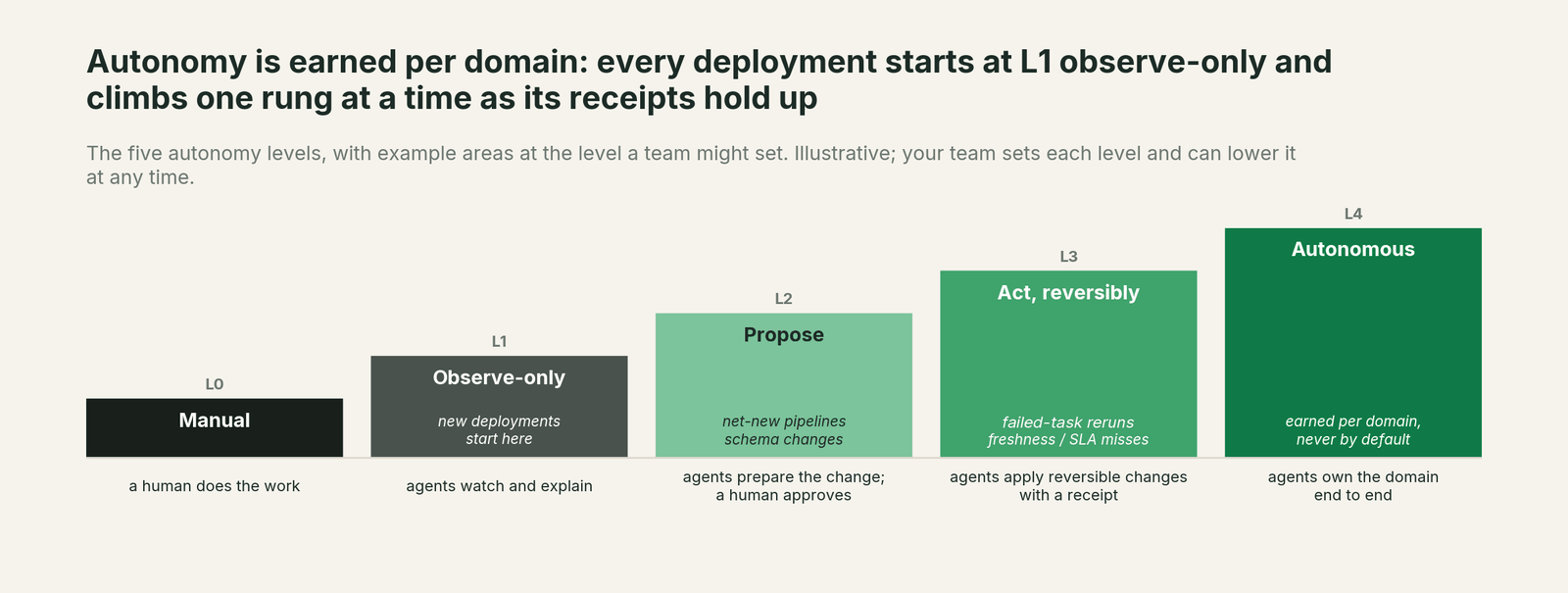
- •New deployments start observe-only, and you extend autonomy one domain at a time.
- •Autonomy is set per domain. Quality fixes in a sandbox domain can run at L3 (act, reversibly) while finance grants stay at L2 (propose).
- •Anything irreversible needs a named human to approve it.
- •Every write is scoped before it runs, with blast radius computed from lineage across systems.
- •Every action is approved or reversible, with a tamper-evident receipt covering the diff, approver, timestamp and rollback path.
- •No agent can promote its own work, and an unanswered approval expires and escalates; it never auto-grants.
- •Least privilege. Data Workers reads Atlan with the persona you give its token, and acts in each warehouse with the privileges you grant there.
"Atlan's MCP server already asks for approval. Isn't that enough?"
For changes to Atlan's metadata, it's a good design. Write tools return a preview and wait for approval, read-only mode is a support request away, a Labs setting decides who may write from conversational AI, service tokens carry exactly one persona, and every change shows in the asset's activity history.
That approval answers "may this agent update this asset's description?". The questions a data team gets are wider. Can the agent fix the dbt model, and what else does that change touch? Who approved the grant in Snowflake, and how do we undo it? What did every agent change this quarter, in every system? Spellbook answers those. Every Data Workers agent is itself an MCP server, and each one runs behind the approval flow, the authority guard and the receipts. When an approved change belongs in Atlan, Data Workers drafts it for the steward, who makes it in Atlan or through your team's Atlan MCP client, so Atlan's own preview and approval apply too.
How it fits together
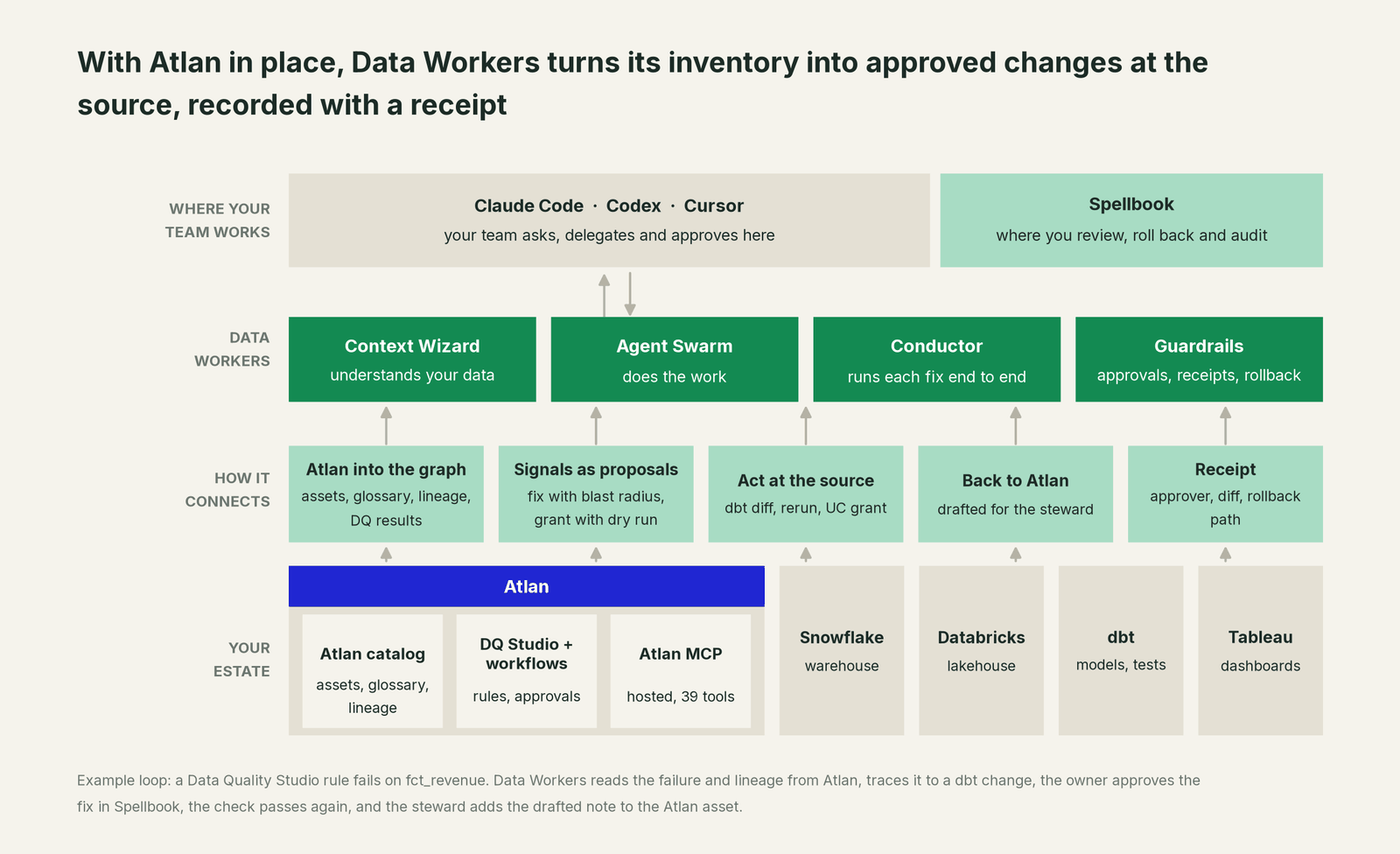
Getting started takes no migration. Connect Data Workers to Atlan's MCP server with a service token and one persona, add read access to your warehouses, your dbt project and your BI tools, and let the Context Wizard build the graph. Every agent starts observe-only. The first things you see are open quality failures with their likely causes, access requests with a dry run of what each grant would reach, and new sensitive columns with masking proposed for their owners.
When Atlan alone is enough
Atlan can be enough if your goal is discovery and documentation: people finding the right table, stewards curating the glossary, AI tools reading governed context. If people, not agents, make every change in your warehouse and dbt, and your incident and access queues are small, Atlan covers that world well.
Everyone else, which is most teams with agents starting to write and a quality or access queue that never empties, adds Data Workers, because they need the loop that turns what Atlan knows into fixes that are approved, applied and recorded.
The case for your CFO
The outcome in business terms: data problems Atlan already detects get fixed the same morning instead of waiting in a ticket queue, access requests finish with the right grant instead of a whole schema, and the people who rely on the revenue dashboard see correct numbers. Every change is approved once, landed in the system that owns it, and recorded, so audit evidence comes out of the work.
The risk story is plain. Agents start observe-only and move up one domain at a time. Anything irreversible needs a named person to approve it, no agent can promote its own work, and every change leaves a receipt with the diff, the approver and a rollback path. Data Workers acts only with the privileges you grant it.
Why now: your catalog already hands context to AI agents over MCP, and those agents are starting to write. The record of what they changed is the next thing auditors and security teams will ask for, and it's cheaper to put the approval flow in place before that queue grows.
The first win is failed quality rules on one domain, closed at the source and verified. What stays the same: Atlan stays your inventory, your glossary, personas and governance workflows don't change, and nothing migrates.
The path is a pilot on that one domain. The pilot is credited in full against the first year; see pricing.
The sentence to repeat upstairs: "Atlan tells us what we have and what it means; Spellbook is where every agent change across our stack gets approved, landed in the system that owns it and recorded."
FAQ
Atlan vs Spellbook: which should I choose? Most teams use both, for different jobs. Atlan is the inventory and context layer. Spellbook is the control plane where agent changes across the warehouse, dbt, pipelines and the catalog are approved, applied and audited.
Does Data Workers replace Atlan? It doesn't have to. Data Workers reads Atlan as a first-class source and drafts approved notes for your steward to add to it. Teams that want one agentic catalog can consolidate on Spellbook over time.
How does Data Workers connect to Atlan? Over Atlan's hosted MCP server and API today, with a service token or OAuth. Atlan's personas and policies apply to everything Data Workers reads there.
Can Atlan's MCP server change data in Snowflake or Databricks? Its SQL tools are read-only by design, and its write tools change Atlan metadata. Tag and description reverse sync update existing tags and comments. Data Workers proposes changes to models, grants and policies for their owners, applies approved Unity Catalog grants, and works within each platform's own permissions.
What happens when a Data Quality Studio rule fails? Atlan alerts your team and opens a ticket. Data Workers reads the failure and lineage, traces the cause, proposes a fix with its blast radius for the owner to approve and merge, queues the rerun and confirms the rule passes.
How are access requests from Atlan handled? Atlan's workflow collects the request and the approvals. Data Workers dry-runs a least-privilege, optionally time-boxed grant, applies it on Unity Catalog after approval, drafts it for the platform owner on Snowflake and BigQuery, and keeps a receipt.
Is Spellbook generally available? Spellbook Data Catalog is in preview. The Data Workers core is Apache 2.0 and free to run, and the paid plans add governed writes, hosted components and support.
How much does Data Workers cost? The core is free. A pilot is $7,500 one-time, Scale starts at $1,000 a month and Enterprise at $3,000 a month, billed annually, with unlimited seats and no usage meter. See pricing.
Sources
Sources for Atlan capabilities and statuses: Atlan documentation, changelog and product pages current as of October 2, 2026, including the Atlan homepage, the Atlan MCP overview (updated September 4, 2026), Atlan MCP tools (updated August 12, 2026), Atlan MCP security (updated August 31, 2026), the Atlan agent toolkit repository, the product changelog, Context Engineering Studio (updated August 26, 2026), deploying to Databricks Genie (updated August 25, 2026), context agents (updated September 24, 2026), Data Quality Studio, governance workflows (updated August 4, 2026), Snowflake tags (updated August 12, 2026), Databricks tags (updated August 21, 2026) and description reverse sync to Databricks (updated August 25, 2026). Product names and statuses change quickly; if we've got something wrong, tell us and we'll fix it.