Your Governance Office Runs on Collibra. Now Let Data Workers Keep the Estate True to It: A Guide for Data Leaders
A guide for CDOs and governance offices standardized on Collibra: what Collibra covers, and how Data Workers keeps the governed estate true to it, with changes proposed to stewards and owners.
Collibra is where your enterprise decides what its data means, who answers for it and what each use may touch. Data Workers keeps the running estate true to those decisions. This guide is for the CDO and governance office of a regulated enterprise standardized on Collibra.
Your governance office already lives in Collibra. Assets sit in domains inside communities, every business term has a steward, and workflows route each change to the person who answers for it. Data classes mark which columns hold personal data. Collibra Data Quality & Observability scores the tables behind your critical data elements. AI Command Center, launched on May 6, 2026, keeps the registry of every AI use case, model and agent, with assessments built on EU AI Act, NIST AI RMF and AIUC-1 templates. Collibra Data Access turns classifications into masking and filtering in Snowflake, Databricks and BigQuery.
Then a decision leaves Collibra. A steward approves a revised definition, and someone has to find every dbt model and dashboard that computes the old one. A quality rule breaks on a critical data element, and the issue travels from team to team. An auditor asks which systems implement a policy, and the answer is a week of screenshots.
Your governance program has a control-plane problem, and the control plane is your team. Collibra made the decision explicit and auditable. The expensive part is everything after it: finding where the decision lives in the estate, changing it there, checking that it held and keeping the record.
What Collibra solved, and what it didn't
Collibra solved the record. One platform holds the glossary, the stewards, the policies, the quality scores and the AI registry, and the people who decide work in it every day. Its AI goes further. Collibra Maestro, announced September 23, 2026 with Maestro Studio and Maestro Assistant in public preview, lets governance teams configure and manage their own agents and work through a chat interface. Guardian agents and agent contracts, announced for October 2026 through AI Command Center, are designed to supervise how AI agents behave against defined boundaries. The Collibra MCP Server, which Collibra calls production-ready, serves assets, glossary terms, lineage and classifications to Claude, ChatGPT, Databricks, Cursor and other clients, and can create and edit assets, classification matches and proposed terms. In Collibra's words, "every action uses Collibra's existing permission model."
What Collibra doesn't do is change the systems that carry the data. Every write it offers lands on a Collibra object. Nothing in Collibra rewrites the dbt model that still computes last quarter's definition, queues the rerun in Airflow or checks the numbers downstream. That is the right line for the platform an enterprise trusts to decide.
Collibra is the governance office of record. Data Workers is the agentic data platform that keeps the governed estate true to it, and runs the rest of your data back office.
Or, in one sentence for your team: Collibra records what we decided; Data Workers finds every place the estate disagrees, takes each fix to its owner and proves it held.
What goes on autopilot
Each of these is a queue your governance office chases by hand today, after the decision is already made in Collibra.
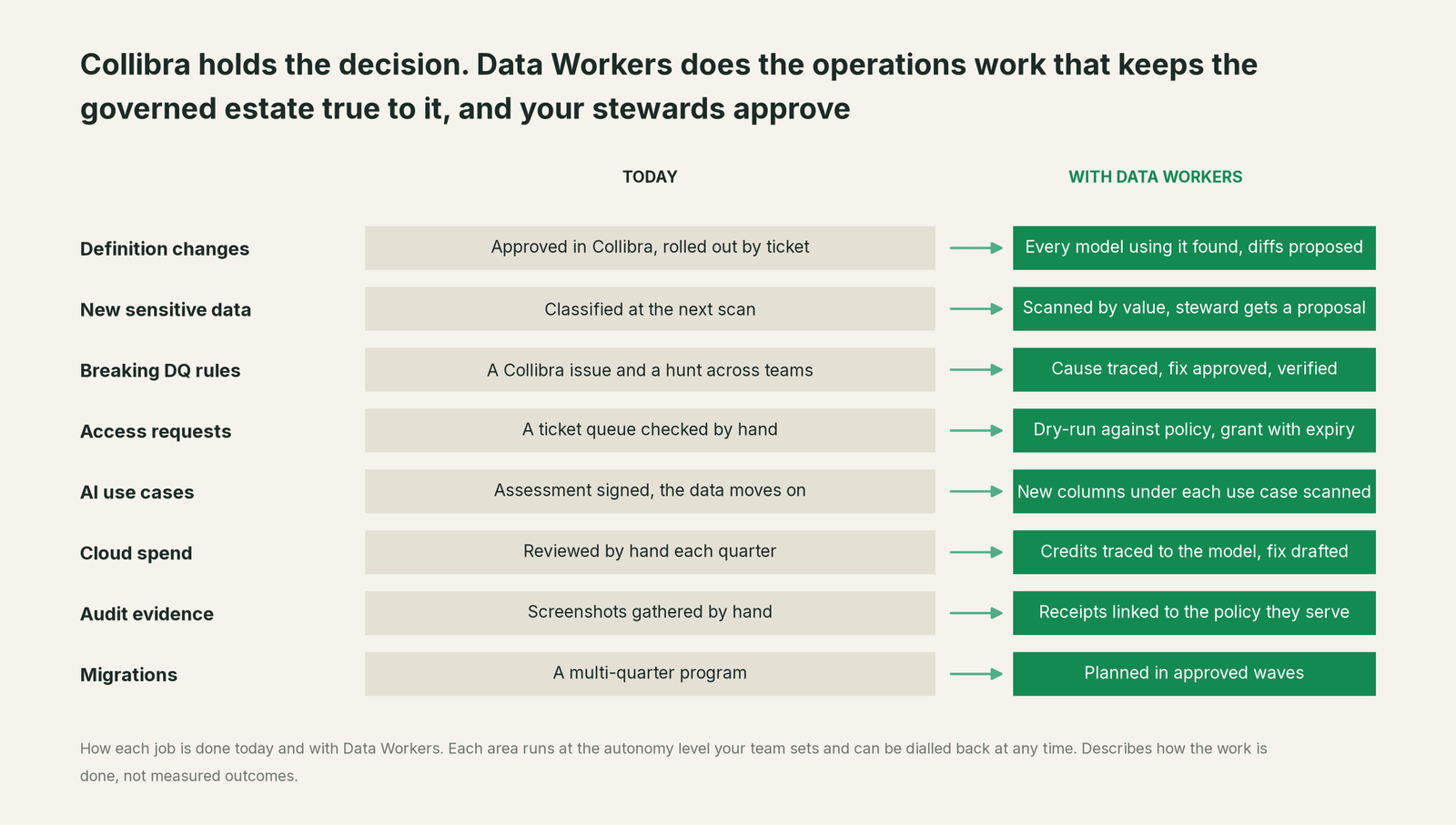
Nothing gets replaced. Collibra connects over its MCP server or REST API today, used by your team's assistant side by side with Data Workers, which works inside the warehouse, dbt and orchestrator you already run, and hands every Collibra-side change to the steward who owns it.
What changes for your organization
Here's a normal week.
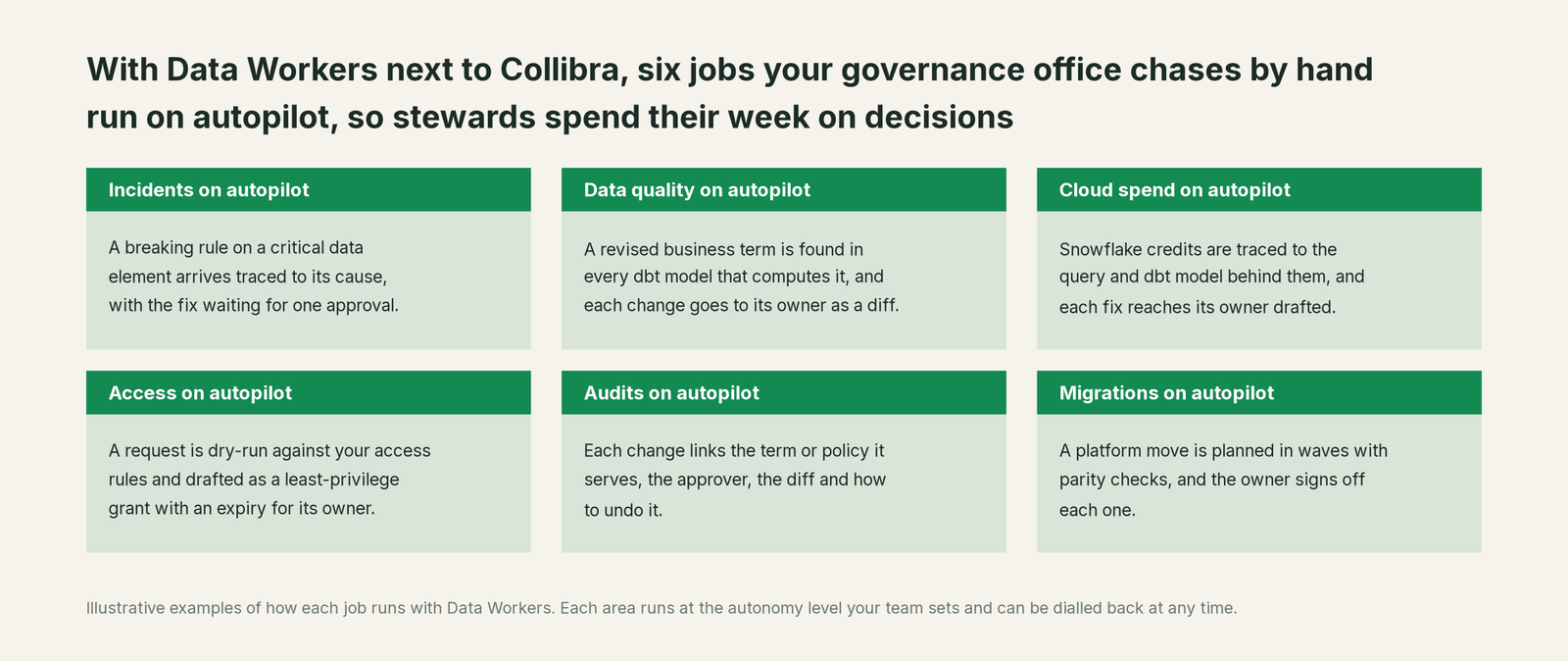
- •Decisions reach the estate the week they are made. A revised term or policy arrives at every model and dashboard that implements it as proposed changes, each with its owner named.
- •Stewards stop chasing. Classifications, notes and status changes arrive drafted with the evidence attached.
- •Breaking rules arrive diagnosed. A falling score on a critical data element comes with the cause traced upstream, the blast radius and a fix waiting for one approval.
- •Audits get easier. Collibra records the decision and the steward's work. Data Workers records what changed in the estate to honour it, who approved it and how to undo it.
One decision, start to finish
This is an illustration, not a customer case.
- •On Tuesday, a bank's credit risk governance council approves a revised definition of "Delinquent account" in Collibra: days past due now count from the contractual due date instead of the statement date, effective November 1. The steward publishes the term.
- •The term is linked to the delinquency table in Snowflake, but the dbt model that builds it and two models that reuse its logic still compute the old rule, and the Tableau "Credit risk monthly" data source reads their output. The rollout is a ticket in someone's queue.
- •Three weeks later, the monthly risk pack goes to the regulator on the old definition, and internal audit asks why the governed term and the reported number disagree.
With Data Workers, the steward's assistant hands the approved term from Collibra to Context Wizard the day the steward publishes it. Lineage runs from the linked Snowflake table through the dbt models, and the blast radius names every model and snapshot that computes delinquency, with its owner, plus the Tableau data source that reads them. Data Workers proposes one diff per model for the credit risk analytics owner to merge, citing the approved term. The owner merges, Data Workers queues the dbt run through Airflow, then checks load lag against its baseline and the quality score on every table the change touched. Tableau is read only, so the data source is flagged for its owner's next refresh. Data Workers drafts a note for the steward linking the term to the receipt, and the steward applies it in Collibra. The November risk pack runs on the definition the council approved, and audit gets the trail from decision to deployed change.
You choose how far and how fast
You choose the altitude, one domain at a time.
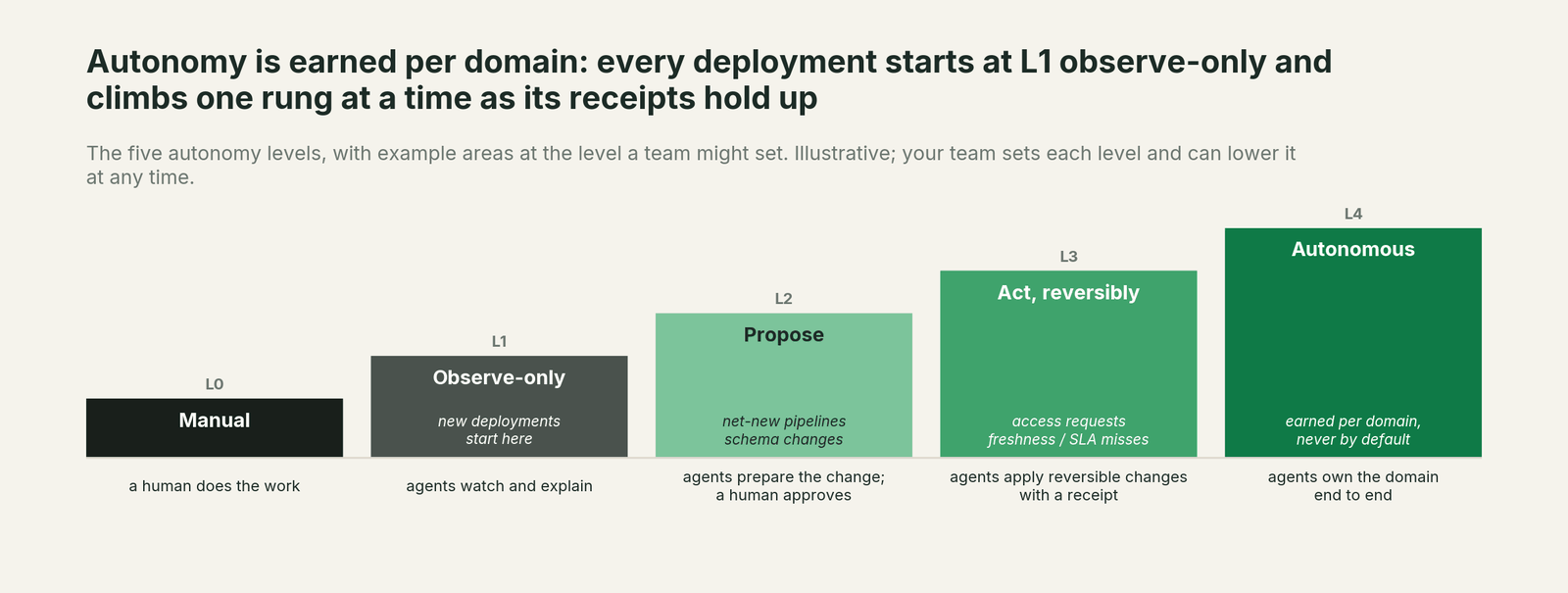
L0 manual is the work your team does by hand today. Every domain starts at L1 observe: Data Workers reports each gap between what Collibra holds and what the estate does, with lineage and owners, and nothing changes. At L2 propose, agents draft the fix and a named owner or steward approves it. At L3 act reversibly, change classes with a proven record, such as queuing the rerun after an approved fix and re-checking the tables, run on their own with a receipt left behind. At L4 autonomous, a domain that has earned it runs end to end, and any domain can be dialled back at any time. Collibra-side changes always go to the steward. No agent can promote its own work.
A common path: one domain at L1 for a few weeks, moved to L2 once the reports match what your stewards would have found, then the first L3 class when the receipts show a clean record, then the next domain. The ladder in detail is in autonomy levels L0 to L4 explained, and how approvals work covers who signs off on what.
Why doesn't Collibra just do this itself?
Focus and risk. Collibra is trusted because it is the neutral record for every system around it, and its write surface follows from that job: assets, classifications, assessments, data contracts and quality jobs, under its own permission model, with the open-source server's data quality tools off until you opt in. Maestro serves the governance team, and guardian agents are designed to supervise other agents. Rewriting a dbt model, rerunning a pipeline or changing a warehouse object is a different product with a different liability: blast radius across systems Collibra doesn't own, scoped credentials in each, the owner's approval, a rollback path and proof downstream. A governance platform that edited those systems would be grading its own homework. Data Workers is the product on the other side of that line, and it hands every Collibra change back to the steward.
The operating model
The governance office keeps every decision. Data Workers takes the legwork between the decision and the estate.
| Who | Keeps | Gets from Data Workers |
|---|---|---|
| CDO and governance council | Policy, definitions, risk appetite, autonomy per domain | A report of every gap between Collibra and the estate, and receipts for each change |
| Data stewards | Classifications, terms, notes and status in Collibra | Proposals drafted with evidence, ready to apply |
| Data and model owners | Merges, grants and changes in their systems | Diffs with blast radius, dry-run grants, one approval each |
| Platform team | Warehouse roles, orchestration, change control | Reruns queued through the orchestrator, checks after every change |
| Audit and risk | The evidence standard | The trail from decision to deployed change, with the approver and how to undo it |
- •Changes to Collibra are proposals. The account Data Workers uses can stay read-only; stewards apply classifications, notes and status, and approved facts land in Data Workers' own context graph.
- •Grants follow your access rules. Each request is dry-run against policy for effective privileges and the sensitive columns it would reach, then drafted as a least-privilege grant with an expiry. Approved Unity Catalog grants are applied; elsewhere the owner applies the drafted grant. Masking stays with Collibra Data Access, by design.
- •Approvals go to a named person. An unanswered request expires and escalates; it never auto-grants.
- •Your data stays in your systems. The agents run in your infrastructure and hold the warehouse credentials; the hosted service sees workflow metadata only. The security and deployment guide has the detail, and who owns the agents covers accountability.
When you don't need Data Workers
- •Your estate changes slowly, and stewards keep it in line with Collibra by hand without a backlog.
- •Policy and definition changes are rare, and each rollout is small enough for one engineer.
- •Your auditors accept the governance record alone, without evidence of what changed in the systems.
If all three are true, keep your budget. If any of them isn't, the rest of this guide is about you.
The case for your CFO
The outcome. The company already pays Collibra to make governance decisions explicit. Data Workers makes the estate follow them: each approved term, policy and assessment reaches the models, tables and grants that implement it, with proof. Regulatory reports run on the definitions the council approved, and stewards' hours go to decisions instead of chasing.
The risk story. Autonomy is set per domain on the ladder above, and nothing changes at L2 until a named person approves. Every Collibra change goes to its steward. Every change in the estate carries a receipt: the trigger, the diff, the blast radius, who approved it, how it was verified and how to undo it. An org-wide stop halts all autonomous dispatch. Our safety guide goes deeper, and SOX, HIPAA, GDPR and the EU AI Act covers the regulatory side.
Why now. The Collibra MCP Server puts governed context in every AI client your people use, and AI agents read whatever the estate holds the moment it lands. A decision that reaches the estate next quarter arrives after the agents did. The choice is one approval flow and one record, or each team's own scripts on the MCP server: the trade-off in build it ourselves with Claude Code and MCP servers.
The first win. Read-only: one governed domain gets a report of every gap between Collibra's terms, classifications and assessments and the running tables.
What stays the same. Collibra, your stewards, workflows, policies, Data Access and change control. The path is a pilot on your own data before you commit; the ROI guide shows how to size it.
The sentence to repeat upstairs: Collibra is where we decide the rules; Data Workers makes every system follow them, with an approval and a receipt for each change.
Where to start
Pick one domain your governance office answers for directly: the data behind a regulatory report, a registered AI use case or the critical data elements on the finance close. Start with a pilot. A forward-deployed engineer connects Data Workers to Collibra, your warehouse, dbt and your orchestrator, and runs the first domain alongside your stewards. See pricing for how the pilot works.
For the detail, send your architects you're on Collibra, the practitioner version of this guide, and you're on Collibra Data Quality. To compare catalogs, read Collibra, Alation, DataHub and OpenMetadata vs Spellbook or our earlier Data Workers vs Collibra; leader siblings are the Atlan and Alation guides, and the role views are Data Workers for CDOs and for data governance leads. They cover the four products: the Autonomous Data-Conductor runs each fix from detection to a verified result, the Data-Agents Swarm does the work, Data Context Wizard keeps one governed graph of definitions, lineage and owners that brings in what Collibra holds, and Spellbook Data Catalog (in preview) is where your team approves, audits and rolls back. The thinking behind them is in our thesis.
Sources
- •Collibra, Collibra MCP Server product page ("production-ready", supported clients, read and write tools, permission-model quote), checked Oct 3, 2026: https://www.collibra.com/products/mcp-server
- •Collibra, press release, Collibra launches new capabilities to reduce the hallucination tax on enterprise AI (Sep 23, 2026: Maestro public preview; agent contracts and guardian agents through AI Command Center in October), checked Oct 3, 2026: https://www.collibra.com/company/newsroom/press-releases/collibra-launches-new-capabilities-to-reduce-the-hallucination-tax-on-enterprise-ai
- •Collibra, press release, AI Command Center launch (May 6, 2026), checked Oct 3, 2026: https://www.collibra.com/company/newsroom/press-releases/collibra-launches-ai-command-center-to-scale-agentic-ai
- •Collibra, AI Command Center (AI governance) product page (registry, guardian agents, EU AI Act, NIST AI RMF and AIUC-1 templates), checked Oct 3, 2026: https://www.collibra.com/products/ai-governance
- •Collibra, Collibra Data Access product page (masking and filtering in Snowflake, Databricks and BigQuery), checked Oct 3, 2026: https://www.collibra.com/products/protect
- •Collibra, Data Quality & Observability product page (scores, critical data elements, issue workflows), checked Oct 3, 2026: https://www.collibra.com/products/data-quality-and-observability
- •Collibra, open-source MCP server collibra/chip README (data quality tools opt-in,
confirm=truecheckpoints; release v0.0.47, Aug 7, 2026), checked Oct 3, 2026: https://github.com/collibra/chip