Data Workers for chief data officers
What Data Workers changes for a CDO: one governed layer of AI data agents across every engine, autonomy set per domain with a receipt on every change, team capacity returned, fewer point tools, and audit evidence on demand.
For a chief data officer, Data Workers turns AI from a set of pilots into one governed operating layer: its agents do the data operations work across every engine you run, at the autonomy level you set per domain, and every change they make leaves a receipt with the diff, the approver, the blast radius and the way back. Your week shifts from chasing evidence, definitions and tickets to deciding policy: which domains go first, what bar each one has to clear, and who owns what.
Key takeaways
- •One governed layer across engines. The same agents, context graph, approval flow and audit trail run across Snowflake, Databricks, BigQuery, Postgres and the catalogs, orchestrators and BI tools around them.
- •You set the autonomy, per domain. Each domain runs at a level from L0 manual to L4 autonomous. Data Workers ships observe-only, and a named owner approves changes at L2.
- •Evidence is a by-product. Every applied change carries a receipt (diff, approver, blast radius, way back), and every agent action lands in a SHA-256 hash-chained audit log that your team can verify and export for any period.
- •Capacity comes back to the roadmap. Tickets, incidents and access requests close behind approvals, so your teams spend more of the week on data products. Hours returned are a planning assumption you test in the pilot.
- •Fewer contracts, one audit trail. One platform covers the whole data lifecycle, so slice tools become a choice rather than a necessity.
A CDO's week today
The work is strategy, governance and money. A board or executive committee wants to know whether the company's data is ready for AI. The governance council meets on definitions, quality and access. Internal audit and regulators ask how a reported number was built and who changed it. Budget season asks why warehouse spend grows faster than the team, and the vendor list keeps getting longer.
The tools are mostly not yours to touch. Catalogs and governance suites (Collibra, Alation, Atlan, Microsoft Purview, Unity Catalog), BI scorecards, Jira or ServiceNow queues and the board deck.
The industry data says the pressure is real. dbt Labs' 2026 State of Analytics Engineering report surveyed 363 data practitioners and leaders (27% of them managers or executives), not CDOs alone. Across all respondents, 71% are concerned about hallucinated or incorrect data reaching stakeholders, 41% cite ambiguous data ownership as an ongoing challenge, and 57% report increased warehouse and compute spend against 36% reporting increased team budgets. Among the leaders, more than 77% emphasize AI for productivity gains, and leaders are more likely than practitioners to frame the challenges as compliance, documentation and governance preparedness.
The same week with Data Workers
The agents take the legwork: tracing lineage, checking quality, catching schema changes, diagnosing incidents, drafting access grants, attributing cost and writing the receipts. You and your leaders keep the decisions.
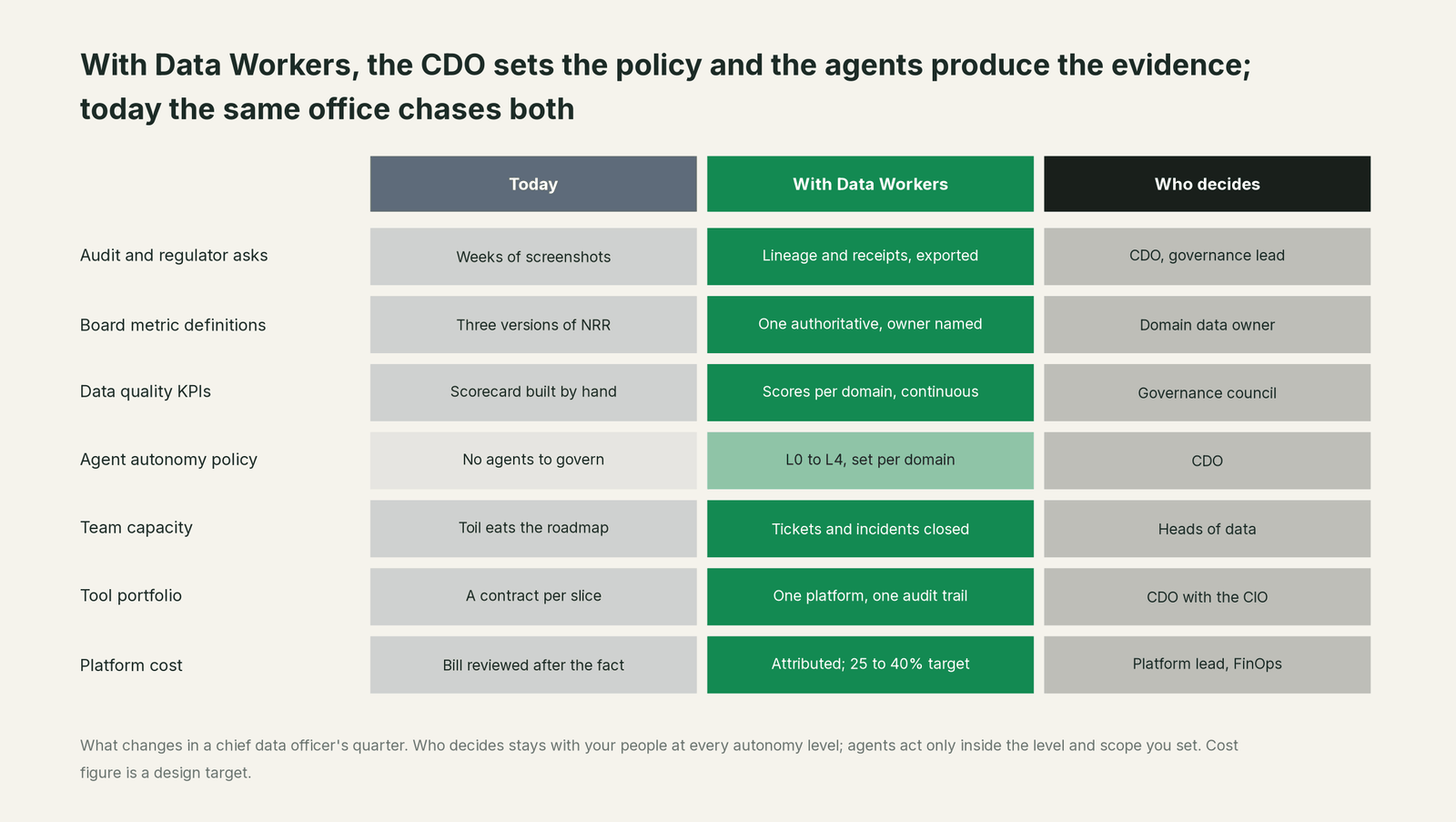
What the agents take off. The incident agent runs diagnose_incident and get_root_cause across systems, and remediate proposes or applies a fix at the level the domain has earned. The governance agent's provision_access drafts least-privilege, column-level grants that expire after 90 days by default and grants nothing when the verdict is review. The quality agent's get_quality_score gives each domain a current score, and the context catalog's trace_cross_platform_lineage follows a number from the board pack to its source tables.
What you still own and decide.
- •Which domains, in what order. Most CDOs start where the pain and the evidence burden are highest: incidents and freshness, then access, then the regulatory and finance domains.
- •What bar each domain has to clear. Each domain runs at L0 manual, L1 observe, L2 propose, L3 act reversibly or L4 autonomous. The team reviews the agents' records and receipts against the bar you set, and moves a domain up the ladder when it clears it. Autonomy levels L0 to L4 explains each rung.
- •Who owns what. Approvals go to a named person. An unanswered request expires and escalates; it never auto-grants. No agent can promote its own work to authoritative, and the org-wide stop halts all autonomous dispatch at once. Who owns the agents and how approvals work set out the split.
When the audit committee asks who changed a production table, the answer is a name, a time and a diff.
How Data Workers fits the tools you already run
Spellbook (in preview) is where leaders look: one inbox to approve, steer, send back or roll back the fleet's work, with the receipts behind every item. Your teams' coding agents and assistants reach the same agents over MCP, so engineers stay in Claude Code or Cursor and analysts in Claude or ChatGPT Enterprise. For remote access, sign-in runs through your own identity provider (Okta or Entra ID), and Data Workers verifies those tokens via JWKS.
Your governance stack stays. Microsoft Purview, Unity Catalog, DataHub and OpenMetadata connect natively; Data Workers connects to Collibra, Alation and Atlan over their APIs or MCP servers today. The Data Context Wizard holds approved definitions and owners for the agents to work from, and routes a conflicting definition to a person instead of picking a winner. Work that needs a ticket lands in your queue through create_servicenow_ticket or create_jira_sm_ticket. The integrations page lists the 50+ connectors.
Where the data lives matters to every CDO. The agents run in your infrastructure on every tier, holding your warehouse credentials and model key. Your data stays in your systems; the hosted Autonomous Data-Conductor sees workflow metadata only, never rows, credentials or model keys. Where does our data go? covers it in full.
The metrics you are judged on
CDOs are measured on business value from data and AI, trust and quality, regulatory findings closed, time-to-data for the business, and cost. Data Workers moves each one with a number you can read from the platform's own records.
| Metric | How Data Workers moves it | Where the number comes from |
|---|---|---|
| Trust and quality | Quality checks and anomaly detection per domain, with fixes behind approval | get_quality_score per domain, incident history |
| Audit and regulatory findings | Lineage, approvals and receipts ready before the request arrives | Hash-chained log, generate_audit_report |
| Time-to-data | Access requests arrive as scoped, expiring grants to approve | Request-to-grant time in the receipts |
| Team capacity | Tickets and incidents closed behind approvals | Hours returned; the ROI calculator's default planning assumption is 30% to 60% of ticket and incident work |
| Platform cost | Snowflake spend attributed to the query and dbt model; fixes drafted for the owner | Design target of 25 to 40% lower warehouse spend, measured in your pilot |
The hours line is a planning assumption and the cost line a design target, not results; your pilot measures your own. How to measure AI data agents sets out the scorecard, the ROI calculator runs your numbers, and the ROI of agentic data operations shows the arithmetic in the open.
A worked example: internal audit asks about a board metric
This is an illustration, not a customer case. Internal audit asks the CDO's office to trace net revenue retention in the quarterly board pack back to source and list every change to it this quarter, with approvers. The company runs Snowflake, dbt and Tableau, with Salesforce and Stripe data loaded into the warehouse. The finance domain runs at L2 propose.
| Time | Who | What happened |
|---|---|---|
| Mon 09:00 | Internal audit | Asks for the NRR lineage and this quarter's changes |
| Mon 09:20 | Data Workers | trace_cross_platform_lineage traces fct_nrr_quarterly back to the Salesforce and Stripe tables |
| Mon 09:40 | Data Workers | get_audit_trail pulls the finance agents' hash-chained entries: 14 changes to those models this quarter, each with its receipt and approver |
| Mon 09:45 | Data Workers | verify_global_hash_chain confirms the log is intact end to end |
| Mon 10:10 | Tableau | A marketing workbook computes NRR without downgrades |
| Mon 10:15 | Data Workers | Routes the conflicting definition to the finance data owner |
| Tue 11:00 | Finance data owner | Confirms the definition and marks fct_nrr_quarterly authoritative with mark_authoritative |
| Tue 11:30 | Snowflake, dbt | The marketing model's owner merges the diff Data Workers proposed, pointing it at fct_nrr_quarterly |
| Tue 14:00 | Data Workers | generate_audit_report exports the quarter: agent actions, policy checks, and access grants |
| Wed 09:00 | CDO | Reviews the evidence pack in Spellbook and sends it to internal audit |
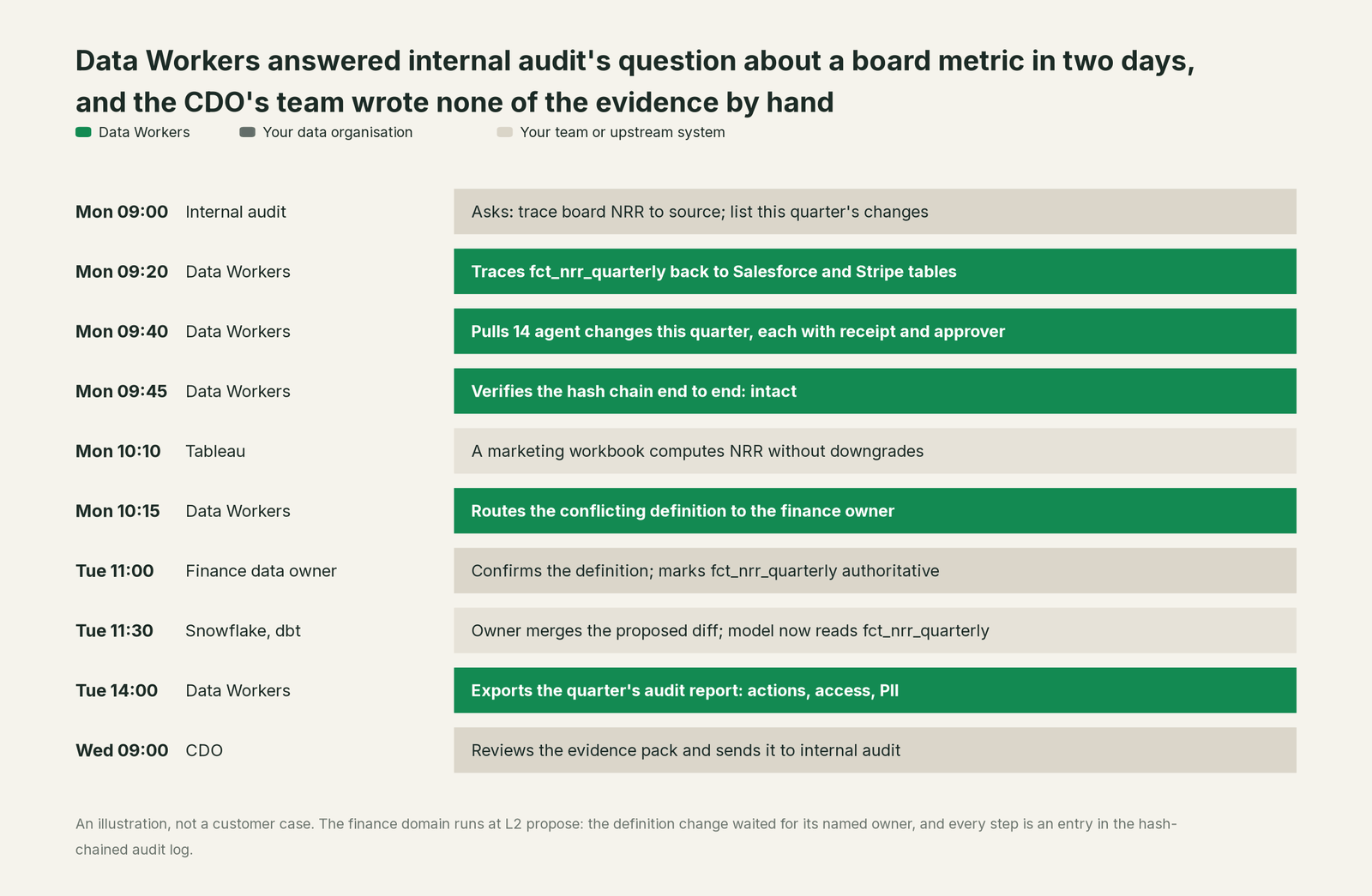
Nobody built a spreadsheet of screenshots, and the second NRR definition was caught before it reached the board. SOX, HIPAA, GDPR and the EU AI Act maps these controls to the rules' own text; your auditors and counsel decide what satisfies them. This is not legal advice.
The case for your CFO
The outcome is data the business can trust at a cost that grows slower than the estate. Today the CDO's organisation spends its capacity on tickets, incidents and evidence-gathering, while warehouse spend rises faster than budgets. Data Workers closes that operating work behind approvals and attributes the spend, so the same team delivers more of the roadmap.
The risk story: autonomy is set per domain, starting observe-only, with finance and regulated domains held at L2 propose for as long as you choose. Every change has a named approver and a receipt in a tamper-evident log. Nothing migrates: your warehouses, catalogs, orchestrators and BI tools stay, and the open-source core is Apache 2.0 (what if Data Workers goes away?).
Why now: your teams already write data code with AI, and the operating load around it grows with every model and pipeline. The first win is one domain, typically incidents and freshness, at L2 or L3 for a quarter, with the receipts as the scorecard.
Start with a pilot ($7,500 one-time, credited in full against the first year). Scale is from $1,000 a month and Enterprise from $3,000 a month, billed annually, with unlimited seats, no usage meter, no markup on model spend and your own model. See pricing. The sentence for upstairs: "Agents do our data operations work under rules we set per domain, and every change they make has a named approver and a receipt."
FAQ
Who is accountable when an agent changes production data? The named owner of that domain. Approvals route to a person, every change is recorded with its approver, and no agent can promote its own work. Is it safe to let AI agents change production data? walks through the controls.
Does Data Workers replace our catalog or governance suite? No. Purview, Unity Catalog, DataHub and OpenMetadata connect natively, and Collibra, Alation and Atlan over their APIs or MCP servers. Data Workers does the operational work around them.
Will it replace people on my data team? It takes the toil, not the jobs: tickets, incidents and evidence-gathering. Will Data Workers replace my data team? answers the question your team will ask.
Could we build this ourselves with Claude Code and MCP servers? You could build the agents. The operating layer (approvals, blast radius, rollback, receipts, autonomy per domain) is the larger job. Build it ourselves prices that path.
How do we show ROI to the board? Use the platform's own records: incidents closed, requests granted, hours returned and spend attributed, read against the targets you set. Start from the ROI calculator.
How does this differ from the platform-native agents on Snowflake or Databricks? Keep them. Data Workers works across every engine you run with one context graph, one approval flow and one audit trail. What is an agentic data platform? gives the test, and the data leaders' guides for Snowflake and Databricks go deeper.
For your peers, see Data Workers for VPs and heads of data and for CIOs and CTOs, and the broader data leaders' guide to data engineering agents.
Sources
- •dbt Labs, 2026 State of Analytics Engineering Report: https://www.getdbt.com/resources/state-of-analytics-engineering-2026 (checked Oct 2, 2026)
- •Data Workers public repository tools (
diagnose_incident,get_root_cause,remediate,provision_access,get_quality_score,trace_cross_platform_lineage,get_audit_trail,verify_global_hash_chain,generate_audit_report,mark_authoritative,create_servicenow_ticket,create_jira_sm_ticket): https://github.com/DataWorkersProject/dataworkers-claw-community (checked Oct 2, 2026) - •Data Workers product repository,
data-workers-agent-swarmmain @ 0c2491e3: core/enterprise approvals, promotion guard, audit log; dw-cost Snowflake per-query attribution with dbt query tags (checked Oct 2, 2026) - •Data Workers product pages: https://dataworkers.io/product/autonomous-data-conductor/ , https://dataworkers.io/product/spellbook-data-catalog/ , https://dataworkers.io/product/data-context-wizard/ (checked Oct 2, 2026)
- •Data Workers security page: https://dataworkers.io/security/ (checked Oct 2, 2026)
- •Data Workers pricing and ROI calculator: https://dataworkers.io/pricing/ , https://dataworkers.io/roi-calculator/ (checked Oct 2, 2026)