You're on Mistral Le Chat Enterprise, now Mistral Vibe: Vibe is where your people ask, and Data Workers makes the answers right
Your company runs Le Chat Enterprise, now Mistral Vibe. Add Data Workers as a custom MCP connector, and people get answers from governed data and approved fixes with a receipt.
Your company rolled out Le Chat Enterprise, and Mistral has since renamed it: the product is now Mistral Vibe (formerly Le Chat), and the work assistant your people used is Vibe Work, with the same URL, the same login and every conversation carried over. IT chose where it runs (Mistral Cloud, your private cloud or on-premises), connected Gmail, SharePoint, Slack and Atlassian, built Libraries from the policy handbook and the board packs, and set which connectors each Workspace may use. Finance asks Vibe to summarise the month-end close. Sales ops runs a Skill that drafts the Monday pipeline note. Then the question lands on the data team: "Vibe answers from our documents now. Can it answer from our data, tell us when a number is wrong, and fix it?"
It can, once Vibe has a connector that knows your data estate and is allowed to change it safely. Mistral Vibe is where your people ask. Data Workers is the data team that makes the answers right and acts on them. It answers from one governed context graph and does the data work behind approvals, with a receipt on every change. You keep Vibe, its Admin settings, its connectors and the deployment you chose.
Key takeaways
- •The role swap. Your company bought Le Chat Enterprise seats and people ask. With Data Workers added as a Custom MCP Connector, the same assistant answers from governed context and does real data work through approvals and receipts.
- •One connector, every Workspace. An admin adds Data Workers once by URL over Streamable HTTP, then sets it to Allowed, Restricted or Blocked per Workspace.
- •Two locks on every write. Vibe stops and asks before any write function runs, and Data Workers' per-domain guardrail, set from L0 manual to L4 autonomous, sits behind it.
- •Your model, your infrastructure. Bring your own model, including Mistral open-weight models served through Ollama or vLLM, and turn on sovereign mode to block every external model call.
- •One number, nothing moved. Every seat asks the same governed definitions, and your warehouse, dbt, Airflow and BI stay where they are. Zero migration.
Mistral Vibe is where your people ask. Data Workers is the data team that makes the answers right.
Here is a Monday morning a European finance team will recognise. It's an illustration, not a customer case.
| Time | System | What happens |
|---|---|---|
| Sun 22:00 | Fivetran | A historical re-sync of the Stripe connector re-delivers three days of refunds. Nothing fails. |
| Sun 22:40 | Snowflake | The refund rows land a second time with new sync IDs in stripe.refunds. |
| Mon 04:00 | Airflow + dbt | The DAG run builds fct_net_revenue, an incremental model with no unique key on refund_id. Refunds count twice. Every test passes. |
| 07:30 | Tableau | The weekly revenue dashboard shows DACH net revenue down 11% week on week. |
| 08:52 | Mistral Vibe | The DACH finance controller asks: "Why did DACH net revenue fall 11% last week? I need it for the 10:00 review." |
| 08:53 | Snowflake, via Data Workers | Vibe calls a Data Workers read function. Data Workers traces the tile to fct_net_revenue, then to 2,140 refund rows that appear twice. |
| 08:55 | Mistral Vibe | The answer: sales held, refunds were counted twice after the weekend re-sync. Six dashboard views and one finance Library export read the same model. |
| 09:05 | Airflow + dbt | Data Workers proposes a change that dedupes on refund_id, adds a uniqueness test and rebuilds the three affected days, with its blast radius: two models, six views. |
| 09:20 | Spellbook | The on-call analytics engineer reviews the diff and approves. |
| 09:40 | Tableau, Mistral Vibe | The rebuild runs, refunds match the raw Stripe rows, the tile reads up 1.2%, and the receipt lands in the controller's conversation. |
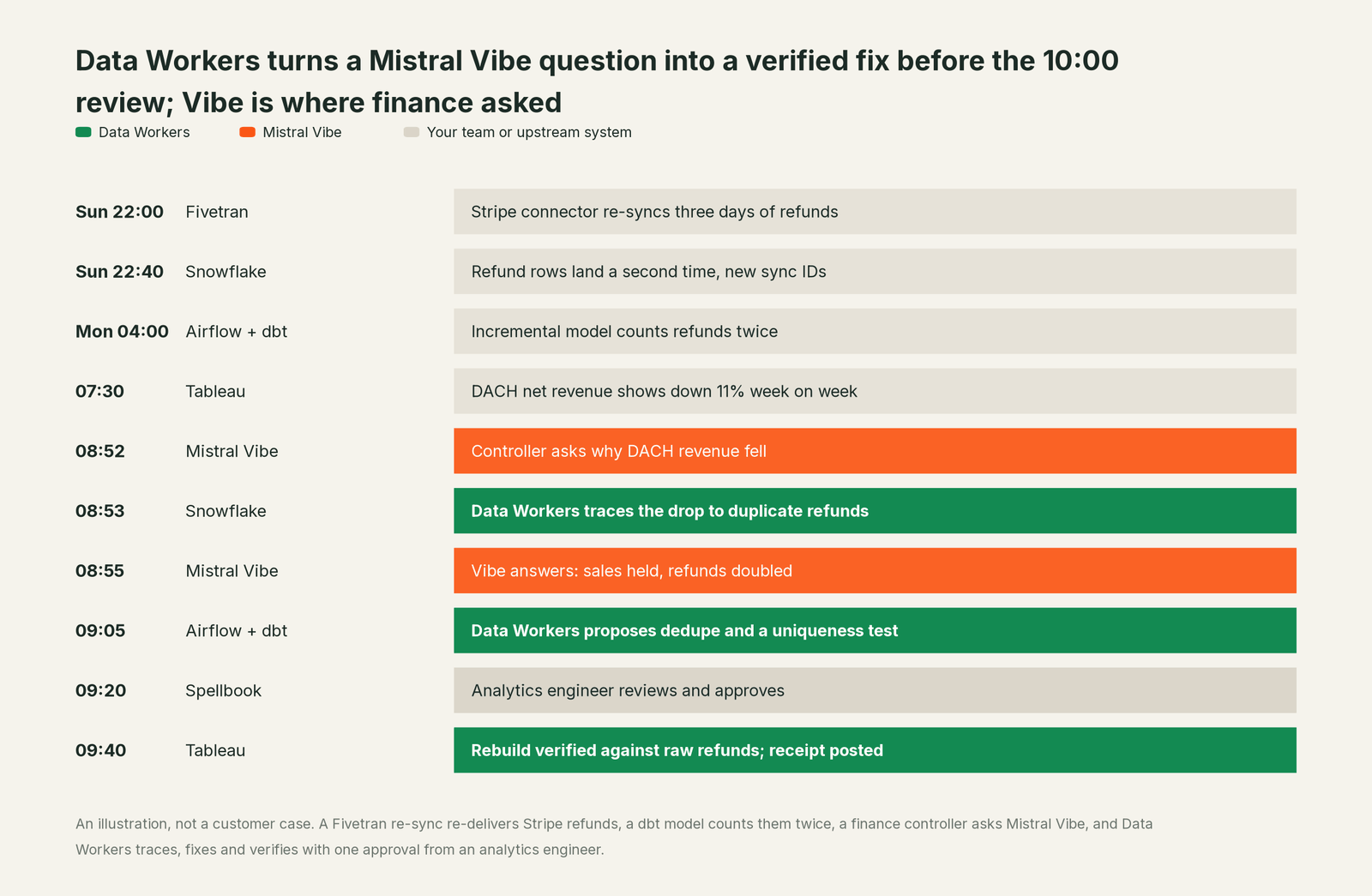
Vibe did what it's built for: it understood a plain-language question, picked the right connector function, showed each tool call and gave an answer the controller could take into the review. Data Workers did the parts that need to know your estate and change it safely: lineage across five systems, a scoped fix, a verified rebuild and a receipt. The data team spent one review on it.
| Step | What Mistral Vibe does | What Data Workers does |
|---|---|---|
| The question | Understands the controller's question and calls the Data Workers function | Supplies the governed net revenue definition and lineage from the Tableau view back to Stripe |
| The cause | Explains the cause in the conversation, with the tool call visible | Finds the duplicate refunds by comparing the raw sync, the model and the dashboard |
| The decision | Tells the controller sales held and the number is wrong | Lists every view and export that reads the bad model, so nobody acts on it |
| The fix | Stops and asks the user before any write function runs | Writes the dbt change with its blast radius and holds it for approval |
| Verification | Reports what Data Workers returns | Rebuilds, compares refunds with the raw rows, re-checks the views |
| The record | Keeps the conversation under your Vibe deployment and policies | Writes a tamper-evident receipt: who asked, why, what changed, how to undo it |
Why doesn't Mistral Vibe just do this itself?
Because Vibe is a work agent for the whole company, and Mistral made sensible choices about focus and risk.
Vibe reaches more than a hundred tools, from email and calendar to Slack, GitHub, SharePoint, Stripe and any remote MCP server an admin adds. Mistral built the client and the gate around all of it. Adding an MCP connector is administrator-only. Admins set each connector to Allowed, Restricted or Blocked per Workspace. Every user sees each tool call with its inputs and outputs, and Vibe "stops and asks for your approval" before anything that creates, modifies, sends, posts or deletes. Mistral's documentation also says MCP connectors aren't Mistral products and that it doesn't control third-party servers. That's the right line for a general assistant: the user approves the call, and the system behind the call owns what the change does.
Changing production data is a different product. It needs to know which models, dashboards and exports a change touches before it runs, approvals that differ by domain, rollback, verification against the source and a receipt an auditor can read. It also carries responsibility for changes in systems Vibe doesn't run: your dbt repo, Airflow, Snowflake and Tableau. Data Workers is built for that job, and it plugs into the gate Mistral already built.
Every tool owns a slice. Data Workers covers the whole lifecycle
A data team's work runs across ten stages, from context and quality to access, cost and models. Each point tool adds another console, another contract and another handoff. Data Workers covers the whole lifecycle with one context, one approval flow and one audit trail. We score the same ten stages on every Build On page. Mistral Vibe leads on Analytics & Insights, its home stage, where research, spreadsheets, Canvas and multi-step Work tasks are the core product.
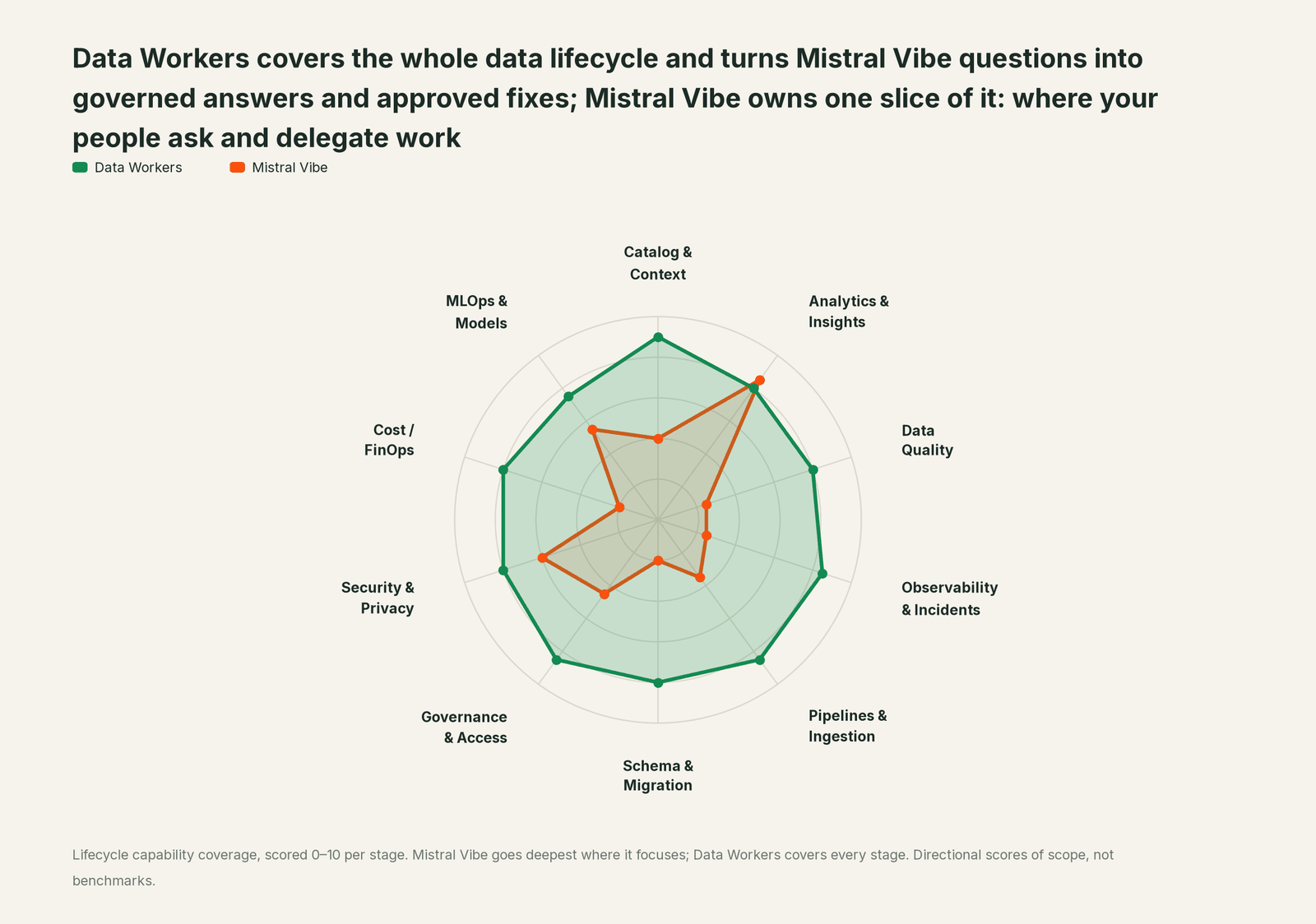
| Stage | Data Workers | Mistral Vibe | Why we scored it this way |
|---|---|---|---|
| Catalog & Context | 9 | 4 | Vibe searches Libraries, the Knowledge Base and 100+ connected tools. Data Workers keeps one governed context graph of tables, models, lineage, owners and metric definitions. |
| Analytics & Insights | 8 | 8.5 | Vibe's home stage: research, spreadsheets, Canvas and multi-step Work tasks over company knowledge. Data Workers answers from governed definitions with lineage behind every number. |
| Data Quality | 8 | 2.5 | Vibe reads what connectors return; checks live in the data platform. Data Workers writes, runs and repairs checks and dbt tests across the estate. |
| Observability & Incidents | 8.5 | 2.5 | Vibe explains an anomaly clearly when someone asks. Data Workers detects, traces, fixes and verifies, and closes the incident with a receipt. |
| Pipelines & Ingestion | 8.5 | 3.5 | Workflows from Mistral Studio and scheduled tasks automate business processes. Data Workers changes the data pipeline behind approval and confirms the rerun. |
| Schema & Migration | 8 | 2 | Schema changes sit outside a work assistant by design. Data Workers assesses blast radius and plans platform moves in parity-checked waves. |
| Governance & Access | 8.5 | 4.5 | Admins set each connector to Allowed, Restricted or Blocked per Workspace, with SAML SSO. Data Workers proposes least-privilege grants on your data platforms. |
| Security & Privacy | 8 | 6 | Vibe secures its own surface: EU hosting by default, self-hosted and private cloud options, approvals before writes, audit logs. Data Workers leaves a tamper-evident receipt on every data change. |
| Cost / FinOps | 8 | 2 | Admins manage Vibe seats and usage. Data Workers traces Snowflake credits to the dbt model behind them and drafts the fix for its owner. |
| MLOps & Models | 7.5 | 5.5 | Mistral builds the models and fine-tunes them for enterprises through Forge. Data Workers keeps the data under your models healthy and connects to MLflow and W&B. |
How Mistral Vibe and Data Workers work together
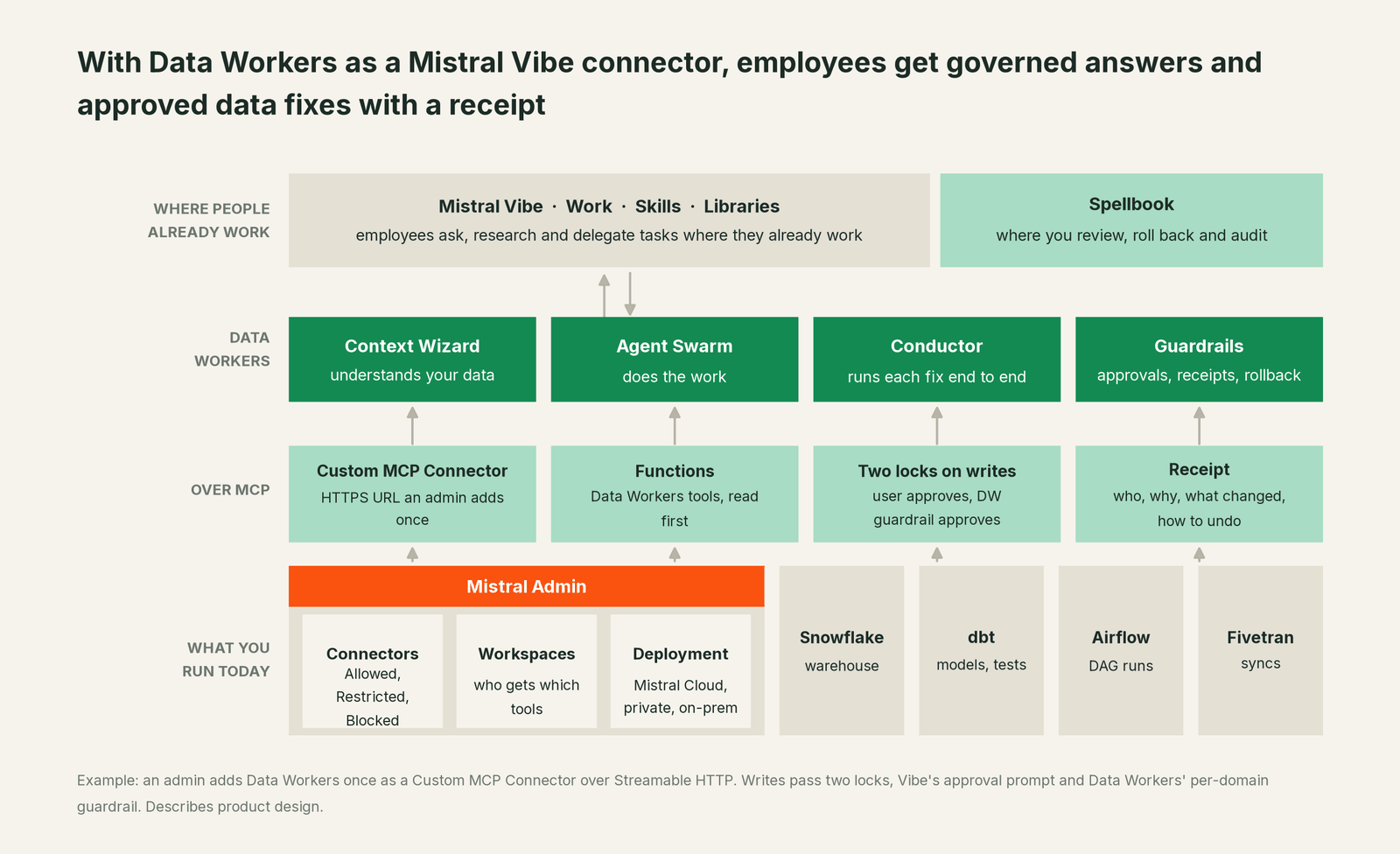
Vibe stays where employees ask and delegate. Spellbook Data Catalog (in preview) is where your data team reviews proposals, rolls changes back and reads the audit trail. Underneath, Data Context Wizard builds one governed graph across Snowflake, dbt, Airflow, Fivetran and the rest of your estate. The Data-Agents Swarm does the work, and the Autonomous Data-Conductor runs each fix end to end: detect, diagnose, fix, review, verify, remember. Every Data Workers agent is an MCP server, and the same tools are served over Streamable HTTP, which Mistral's documentation names as the current standard for custom connectors.
Setup in Mistral Vibe. Custom MCP connectors are in beta on Mistral's pricing page, and adding one takes an administrator. Vibe detects the server's authentication on its own. The simplest path is Data Workers' API-key mode: Vibe sends the key as an HTTP Bearer token, and each key maps server-side to a named user and tenant, so every call is tied to who made it. If your identity provider runs sign-in instead, your provider is the authorization server and Data Workers' remote endpoint runs in OAuth mode, verifying every access token's signature, issuer and audience against your provider's published keys.
# Example: add Data Workers as a Custom MCP Connector in Mistral Vibe
1. Connectors > + Add Connector > Custom MCP Connector tab
2. Connector name: dataworkers   (no spaces or special characters)
3. Server URL:     https://<your-data-workers-host>/mcp   (Streamable HTTP, valid TLS)
4. Description:    Governed answers and approved fixes for our data estate
5. Connect. Vibe detects HTTP Bearer Token auth; paste the Data Workers API key
6. Mistral Admin > Connectors > dataworkers > Permissions:
   Restricted for the pilot Workspace, read tools only; Blocked elsewhere
7. Per function: Always allow trace_cross_platform_lineage, search_across_platforms,
   get_quality_score; keep diagnose_incident and remediate on manual approval
Those five are tools the Data Workers agents register today, as are blast_radius_analysis, monitor_metrics and detect_schema_change. If you deploy Vibe on-premises or in your private cloud, run Data Workers in the same network: your data stays in your systems, and the hosted Conductor sees workflow metadata only.
For your Mistral admin. Give the connector to the pilot Workspace first, with Restricted permissions exposing read tools before write tools. Always allow choices are per user, so a data engineer can pre-authorize lookups while every write still asks. A Skill can package finance's standard questions ("explain this number, show its lineage, list what reads it") so anyone runs them with @. Agents are now a legacy Chat feature, and Enterprise organizations keep them during a six-month migration window while Mistral moves that work to Skills; build new data requests as Skills.
Model choice. Data Workers is model-agnostic by design: bring your own model, with no markup on model spend, including Mistral open-weight models served through Ollama or vLLM inside your environment. In sovereign mode every call to an external model API is blocked, the agents route to your local endpoint, and audit logging is enhanced for EU AI Act record-keeping. Teams that chose Mistral for sovereignty keep the whole loop on infrastructure they pick.
One request, L0 to L4. Take "Why did DACH net revenue fall, and fix it." Here is how it runs at each autonomy level, set per domain.
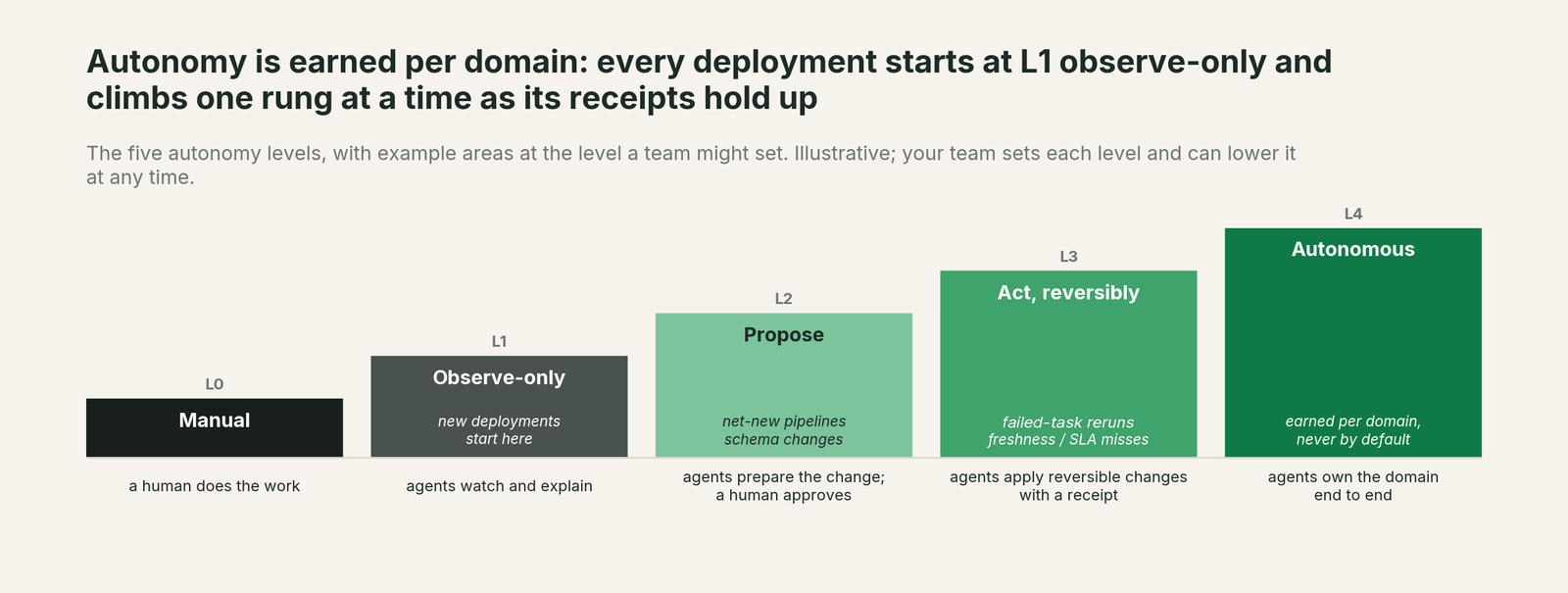
- •L0 manual. Data Workers is connected but not acting. Your analyst investigates.
- •L1 observe. Vibe answers from Data Workers: the cause, the lineage and every view affected. Nothing changes.
- •L2 propose. Data Workers drafts the dbt change with its blast radius. Vibe shows the write function, the user selects Continue, and an engineer approves in Spellbook.
- •L3 act reversibly. Data Workers applies changes it can undo, such as rebuilding the affected days, then verifies and records the receipt.
- •L4 autonomous. For a trusted, scoped class like duplicate rows after a connector re-sync in finance, Data Workers fixes and verifies on its own and posts the receipt for review.
Vibe's approval decides whether the user's call goes ahead; Data Workers' guardrail decides whether the change may run in that domain, and no agent approves its own work. The safety guide covers what each level allows.
What changes for your team
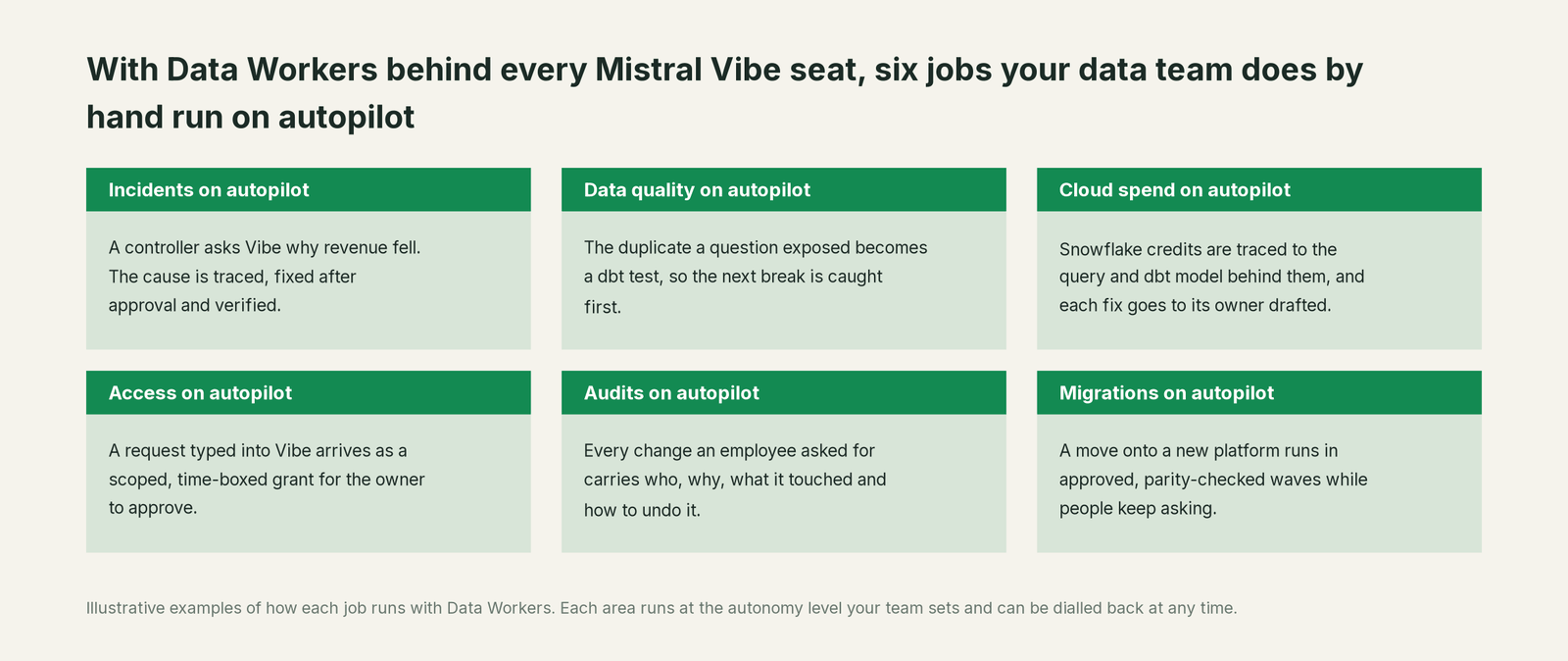
For the business, the habit stays the same and the answer gets better. The controller still asks Vibe, and the answer now comes from governed definitions, says where the number came from and says when it's wrong. Finance, sales and marketing ask the same connector, so they get one net revenue and one pipeline number. Libraries keep the handbook and board packs; Data Workers covers the live data underneath.
For the data team, the change is where questions end. Today a strange number ends in a Slack message and a ticket. With Data Workers behind the connector, it ends in a governed answer or a proposed fix that one person approves. The team spends its time modeling the business, setting guardrails per domain and deciding which domains move up the ladder.
For security and IT, nothing new sits outside the tools they already govern: the connector is admin-only and scoped per Workspace, every tool call is visible, and every write has a receipt with a named person on it.
Keep Mistral Vibe, or consolidate?
Keep Mistral Vibe if you love it; Data Workers works with it from day one. Many teams consolidate once Data Workers runs that slice too.
For Vibe, keeping it is the natural answer. It's your company's assistant, often chosen for where it runs and who controls it, and Data Workers is built to sit behind it. What teams consolidate is the sprawl around it: the separate catalog, quality tool, incident runbooks and access queue that Vibe would otherwise need a connector for, one by one. If parts of the company run another assistant, the same Data Workers server sits behind each; see the guides for ChatGPT Enterprise, Microsoft 365 Copilot and Gemini Enterprise, and the section overview, Your company just rolled out AI assistants. Now what?
The case for your CFO
The outcome. The company already pays for Mistral Vibe (Le Chat Enterprise) seats. Today, when a number behind an answer breaks upstream, it lands on the data team as a ticket. With Data Workers as a connector, the same seats give governed answers and approved fixes, so revenue and pipeline figures are right before anyone takes them into a review.
The risk story. Data Workers starts at observe. At propose, every change is a draft a person approves. At act reversibly, it runs only changes it can undo, and only in domains you've moved up. Autonomous is a per-domain choice, never a default. Vibe asks the user before every write function, and no agent approves its own work. Every receipt records who or what acted, why, what it touched and how to undo it. Zero migration: your data stays in Snowflake and your other platforms, and Data Workers runs where you choose, with the model you choose. The security and deployment guide goes deeper.
Why now. Vibe takes any remote MCP server as a custom connector, with admin-only setup, per-Workspace permissions and approvals before writes built in, and employees already ask it about company numbers. Data Workers puts governed definitions and a fix path behind those answers.
The first win. "Where does this number come from?" questions from finance, answered at observe in one Workspace, then one domain at propose.
What stays the same. Vibe, its deployment, Admin settings, connectors and Libraries, your warehouse permissions, dbt, Airflow and Tableau.
The path. Start with a pilot. See pricing; the pilot is credited in full against the first year. The ROI guide shows how to size it, and the build-vs-buy guide answers the question your engineers will raise.
The sentence to repeat upstairs: "We already run Mistral for our people; Data Workers makes sure the numbers it gives them are right, and fixes them behind an approval with a receipt, on infrastructure we choose."
Getting started
Start with a pilot. Your Mistral admin adds Data Workers as a Custom MCP Connector with read tools for one Workspace, so people first see Vibe answering from governed context. Pick one domain, usually revenue or marketing spend, move it to propose, and watch the receipts. See pricing; the pilot is credited in full against the first year.
FAQ
Is Le Chat Enterprise now Mistral Vibe? Yes. Le Chat is now Mistral Vibe, with Vibe Work (the productivity mode from Le Chat), Vibe Code and Vibe Chat. Accounts, plans and conversations carried over, and chat.mistral.ai is still the entry point. Chat and Work became one experience on September 22; Enterprise organizations have a six-month migration window and their admins pick the date.
Does Vibe's approval replace Data Workers' approval? No. Vibe's approval means the person asking agrees to make the call. Data Workers' guardrail decides whether the change may run in that domain and who must approve it, then verifies the result and writes the receipt.
We self-host Vibe. Can Data Workers stay inside our network too? Yes. Data Workers runs in your environment, and Vibe's custom connector only needs an HTTPS URL it can reach. Sovereign mode keeps model calls local too.
Can Data Workers use Mistral models? Yes. Mistral open-weight models run through Data Workers' Ollama and vLLM providers, and the air-gapped deployment guide builds its bundle around Mistral Small.
We already have Libraries with our metric definitions. Why add Data Workers? Libraries answer from documents you upload, the right home for policies and board packs. Data Workers adds governed metric definitions tied to the models that compute them, lineage to dashboards, quality checks and the approved fix when a number is wrong.
Does our data train Mistral's models? Mistral states that data accessed through connectors is never used to train or fine-tune its models, regardless of plan. Data Workers runs in the environment you choose, with the model you choose.
Sources
Mistral Vibe capabilities are current as of October 2, 2026, from Mistral's own pages, all checked October 2, 2026: Mistral Vibe (formerly Le Chat) (rename, 100+ tools, MCP, on-premises, private cloud or Mistral Cloud deployment), Mistral pricing (Enterprise plan, Connectors and Custom MCP connectors in beta, Workflows, audit logs, SAML SSO), Le Chat is now Vibe (Vibe Work, Vibe Code, Vibe Chat), Vibe Work get started, Where do you store my data (EU hosting by default), Vibe overview (Chat and Work merged September 22; Enterprise migration window), MCP Connectors, Safety and approvals, Admin Connectors, Libraries, Agents (legacy Chat feature, six-month Enterprise window, Skills), Connectors and the Le Chat Enterprise launch post (May 7, 2025). Data Workers' remote Streamable HTTP transport (API-key and JWKS-verified OAuth modes), Ollama and vLLM model providers, sovereign mode, air-gap guide and tool names are from the Data Workers repositories, checked October 2, 2026. Product names and settings change quickly; if we've got something wrong, tell us and we'll fix it.