You're on Jira Service Management: Keep the Queue, Let Data Workers Resolve the Data Incident Behind the Ticket
Jira Service Management tracks requests and incidents. Data Workers diagnoses, fixes and verifies the data incident behind the ticket and writes the receipt into it.
Your service team lives in Jira Service Management. Employees raise requests from the help center, agents work them from queues with SLAs, alerts group into incidents, the on-call is paged, and change requests wait for approvers. Assets holds your services and their owners, and it is now in every Standard plan. Jira Service Management is part of Atlassian's Service Collection, with an AI-powered virtual service agent on the front line and AIOps, powered by Rovo, for incidents. Since Opsgenie's end of sale, Atlassian's alerting and on-call live there too. Jira Service Management is where requests and incidents are tracked. Data Workers diagnoses, fixes and verifies the data incident behind the ticket, and writes the receipt into it.
Your data platform team probably runs a service desk on it already: "can I get access to the bookings schema", "this number looks wrong". Jira Service Management routes each one to the right queue. Then an engineer traces the cause across Okta, Snowflake, dbt and the BI tool, types "should be fixed now" into a comment, and resolves the ticket without proof. Data Workers takes that part, from cause to receipt.
Key takeaways
- •Jira Service Management stays the record. Request types, queues, SLAs, workflows, on-call, change requests and Assets stay exactly where they are.
- •Data incidents arrive diagnosed. Data Workers reads open incidents for the services you choose and comments the cause and blast radius before a person picks them up.
- •It files the ticket when it sees the break first.
create_jira_sm_ticketopens it with a summary, the cause in the description and a priority. - •Resolved means verified. The resolution comment says what changed, who approved it, how it was checked and how to undo it.
- •Data access requests get a real decision. Data Workers checks each request against policy and classification and proposes least-privilege, time-bound access for the data owner.
- •A native connector, today, over the Jira REST API, with autonomy per domain from L0 manual to L4 autonomous.
Jira Service Management is the record. Data Workers is the resolver.
Jira Service Management makes service work visible and accountable: who owns a ticket, which SLA is running, who approved a change. A data incident needs exactly that around it, while the diagnosis and the repair happen in the systems the data team runs. Here is a Tuesday with both in place. This is an illustration, not a customer case.
| Time | System | What happens |
|---|---|---|
| Mon 17:40 | Okta | In a reorg, IT renames the data-eng-svc group to platform-data-svc; group push updates Snowflake |
| 17:41 | Snowflake | The dbt service user SVC_TRANSFORM drops out of the TRANSFORMER role, which holds write access to ANALYTICS.FINANCE |
| Tue 02:00 | Prefect | The nightly_dbt flow run starts dbt build against Snowflake |
| 02:07 | dbt Core | fct_bookings fails with "insufficient privileges"; 14 downstream models are skipped; Prefect marks the run Failed |
| 02:09 | Data Workers | Catches the failed run, reads the Snowflake error and the service user's Okta groups, maps the blast radius (fct_bookings, 14 models, the Sigma "Daily bookings" workbook) and opens JSM-412 in Jira Service Management with create_jira_sm_ticket, priority High, cause in the description |
| 02:15 | Spellbook | Data Workers proposes the fix to the named approver, the Snowflake platform owner: restore TRANSFORMER to the service user, map the role to a dedicated service group so a reorg can't move it again, then rerun the flow. Nobody is woken: bookings are read at 08:00 |
| 08:05 | Sigma | The sales ops lead opens "Daily bookings": Monday is missing |
| 08:11 | Jira Service Management | Two requests ("bookings dashboard is stale") arrive through the help center; the service agent sees JSM-412 already open with the cause and links them |
| 08:20 | Spellbook | The platform owner approves and applies the grant in Snowflake; the identity admin applies the Okta mapping |
| 08:24 | Prefect | Data Workers queues the rerun of nightly_dbt and comments on JSM-412: "Fix approved and applied; rerun queued" |
| 08:52 | Snowflake + dbt Core | The build completes; the analytics engineer reports the dbt tests passing, and Data Workers verifies Monday's bookings totals against the raw orders loaded that day |
| 08:55 | Jira Service Management | Data Workers posts the receipt as the resolution comment on JSM-412; the service agent resolves it and the linked requests |
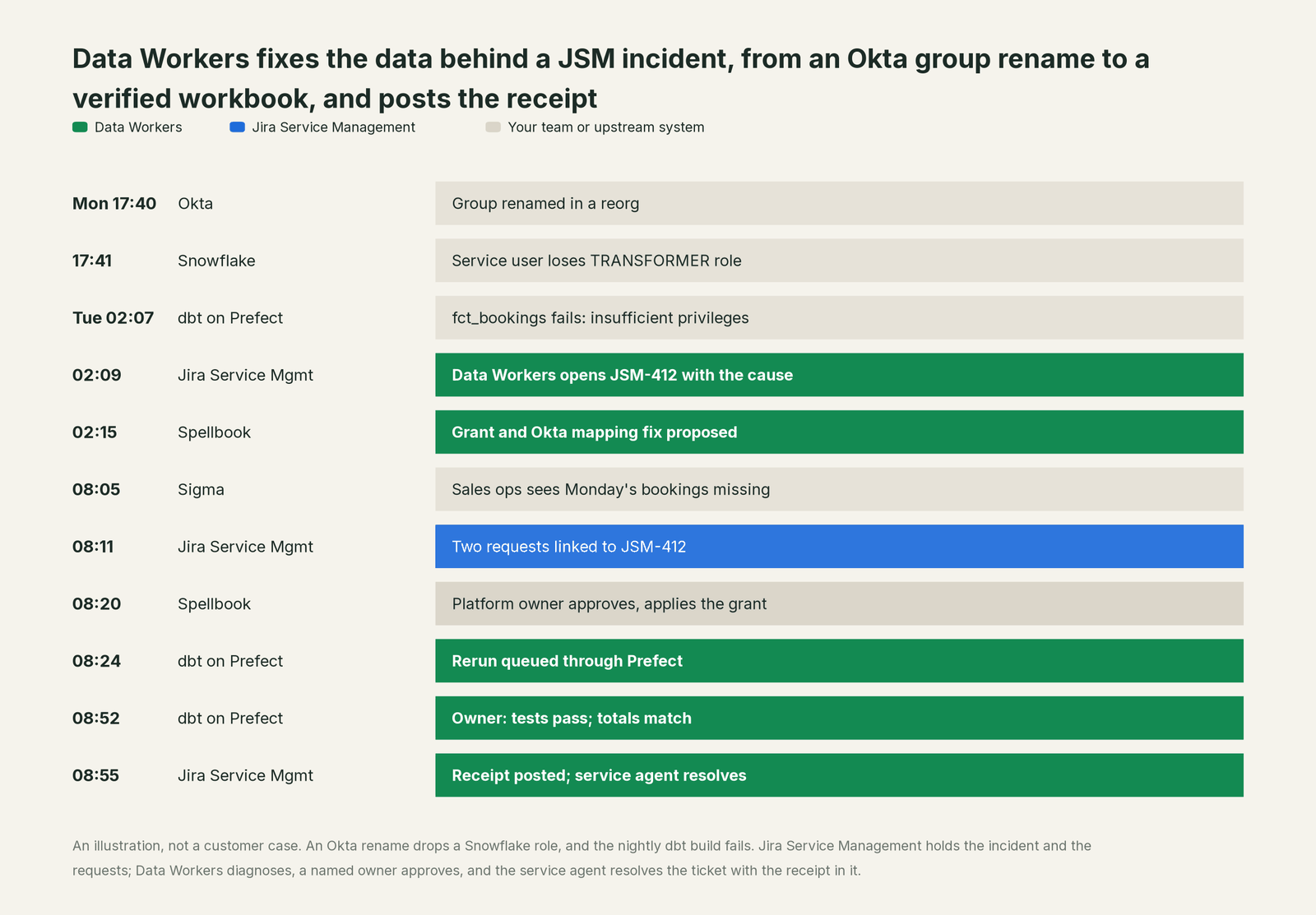
Every system did its job: Okta pushed the change, Snowflake enforced the role, dbt refused to write, Prefect reported the failure, and Jira Service Management put the requests next to the incident. The gap was between them: an identity change in one system broke a data job in another, three tools away from the ticket. With Data Workers, the ticket existed before the first request, the cause was in its description, the fix waited for one approval from the person who owns Snowflake roles, and the ticket closed with proof.
| Job | What Jira Service Management does | What Data Workers does |
|---|---|---|
| The intake | Requests from the help center, email, chat and the virtual service agent, with request types and SLAs | Opens a ticket itself when it catches the break first, with the cause attached |
| The context | Assets maps services, owners and their links; the Teamwork Graph connects people and work | Keeps one governed context graph of tables, models, flows, roles, owners and lineage |
| The diagnosis | AIOps groups related alerts and recommends mitigation steps from change and deployment history | Traces the break across Okta, Snowflake, dbt, Prefect and Sigma and names the cause |
| The approval | Approvals on request types and change requests | Routes the data fix to the named data owner in Spellbook, with blast radius and rollback |
| The fix | Records who approved what and when | Queues the rerun through Prefect once the approved grant is applied, and verifies the result |
| The close | Resolves the ticket, stops the SLA clock and summarizes the post-incident review with AI | Writes the receipt as the resolution comment and remembers the incident for next time |
Why doesn't Jira Service Management just do this itself?
Because Jira Service Management is built to run service work for the whole company, IT, HR, facilities and engineering alike, and that focus is right. Atlassian keeps adding the right things for that job: AI alert grouping, AI-recommended mitigation steps drawn from change intelligence and deployment history, AI-generated post-incident reviews, Ops Expert in early access to bring third-party observability data into the incident, and, rolling out since late September, central management of Rovo agents in Atlassian Administration.
Those features work from the record: the alerts, the ticket, the change history. They group, recommend and summarize. The cause of a data incident sits in the warehouse, the identity provider, the transformation code and the orchestrator: which role a service user lost, which models were skipped, which workbooks read them, how to rerun without double-loading. Fixing it means changing systems Atlassian does not run and carrying the liability for those changes, with blast-radius scoping across lineage, a named data approver, rollback and a receipt. That is a different product. It is the product Data Workers is, and it reports back into the ticket.
Every tool owns a slice. Data Workers covers the whole lifecycle
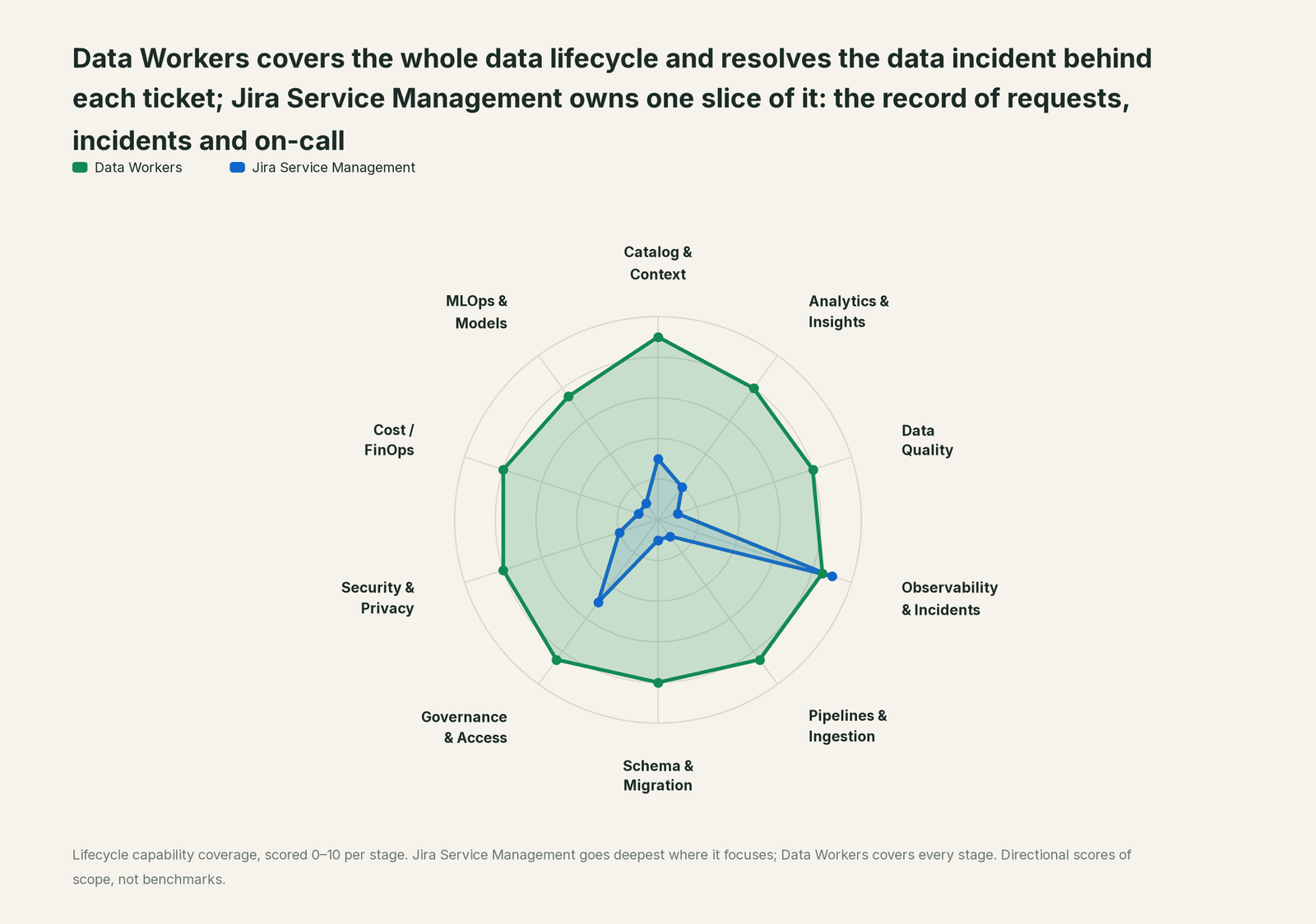
Jira Service Management owns one slice deeply: the record of requests, incidents and on-call, with approvals around it. Each point tool adds another console, contract and handoff. Data Workers covers the whole lifecycle with one context, one approval flow and one audit trail, and builds on Jira Service Management where your service process lives.
| Stage | Data Workers | Jira Service Management | Why we scored it this way |
|---|---|---|---|
| Catalog & Context | 9 | 3 | Assets models services, owners and their links, and is now in every Standard plan. Data Workers keeps one governed context graph of tables, models, pipelines, owners and lineage. |
| Analytics & Insights | 8 | 2 | Reports and dashboards cover queues, SLAs and incident trends. Data Workers answers data questions from governed definitions with lineage behind every number. |
| Data Quality | 8 | 1 | Not a service desk job: a failed check arrives as an alert or a request. Data Workers writes, runs and repairs quality checks after every incident. |
| Observability & Incidents | 8.5 | 9 | JSM's home stage: requests, queues, SLAs, alerts and on-call from Opsgenie, major incidents, AI alert grouping and AI post-incident reviews. Data Workers fixes the data behind the data tickets. |
| Pipelines & Ingestion | 8.5 | 1 | Not a service desk job: pipelines run in Prefect, Airflow or dbt; JSM hears when they fail. Data Workers queues reruns through the orchestrator and backfills with approvals. |
| Schema & Migration | 8 | 1 | Not a service desk job: table schemas and models sit with the data team. Data Workers catches schema changes and plans migrations with rollback. |
| Governance & Access | 8.5 | 5 | Approvals on request types and change requests, with a named approver on each. Data Workers adds data-level blast radius for changes and dry-run, least-privilege access proposals. |
| Security & Privacy | 8 | 2 | Service desk permissions and Atlassian's data security policies protect the tickets. Data Workers leaves a receipt on every data change and proposes masking for the owner to apply. |
| Cost / FinOps | 8 | 1 | Not a service desk job. Data Workers traces Snowflake credits to the dbt model behind them and drafts the fix for its owner. |
| MLOps & Models | 7.5 | 1 | Not a service desk job. Data Workers keeps the data under your models healthy. |
How Jira Service Management and Data Workers work together
Jira Service Management stays on top, where requests, incidents and on-call are tracked. Spellbook Data Catalog (in preview) is where the data team looks: each proposed change, who approved it, what it touched and how to roll it back. Between them, Data Context Wizard keeps one governed context graph across Okta, Snowflake, dbt, Prefect and the workbooks, the Data-Agents Swarm does the work with more than 20 specialist agents, and the Autonomous Data-Conductor runs each incident end to end: detect, diagnose, fix, review, verify, remember.
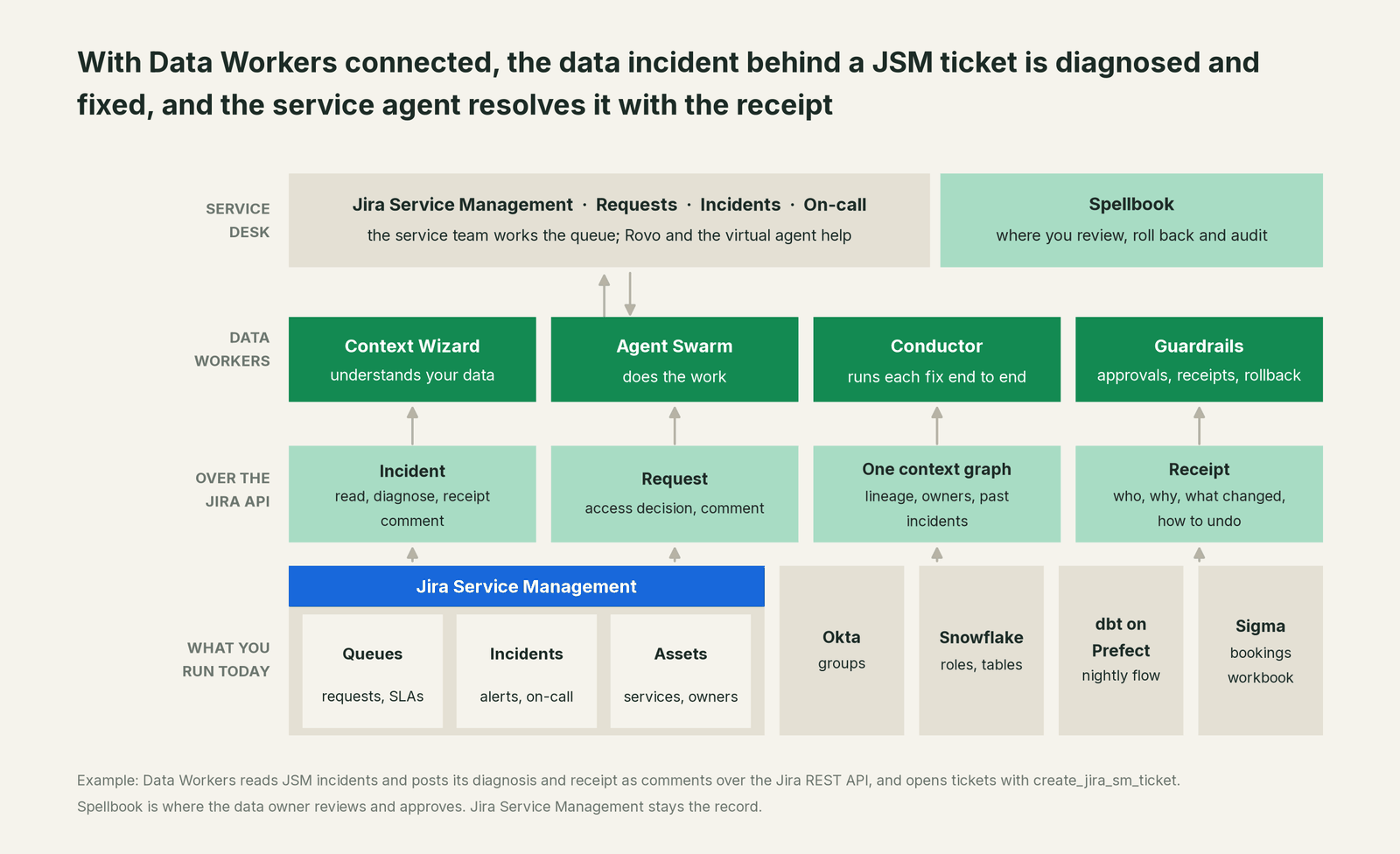
Native, over the Jira REST API. Data Workers reads open incidents for the affected services you choose and posts its acknowledgement, diagnosis, progress notes and receipt as comments on them. When it catches a break first, create_jira_sm_ticket opens a ticket with a summary, the cause in the description and a priority, and update_jira_sm_ticket keeps its summary current. Status transitions stay with your service agents and your workflow, so queues, SLAs and automation rules run exactly as they do today. Okta is read only: identity changes go to your identity admin. Prefect is native, so reruns are queued through it; Sigma connects over its API today.
Data access requests. A data service desk is mostly access requests. provision_access (dw-governance) evaluates each one with least privilege and column-level scope, 90 days by default, and grants nothing when the verdict is review; request_governance_review then opens a trackable review. Data Workers proposes the grant for the data owner to apply in Snowflake or BigQuery and comments the decision on the request. Your approval step on the request type stays where it is.
The Atlassian MCP server. Atlassian runs a hosted MCP server at https://mcp.atlassian.com/v2/mcp (also called the Atlassian Rovo MCP Server) for Jira, Jira Service Management, Confluence, Bitbucket, Projects, Goals and Loom. It reads and writes work items, with OAuth 2.1 or an optional API token, acting with the user's existing permissions, and each call consumes Rovo credits. Since late September, a Rovo MCP server control in Data Security Policy (rolling out) lets admins govern how external AI tools read and write Jira and Confluence data, by app, space and classification level. Keep assistant write scope narrow. Data Workers' connector runs with its own service account, so the always-on responder doesn't depend on a person's assistant session.
Setup. Every Data Workers agent is an MCP server; the client setup guide documents the path (clone the repo, one start-agent.sh entry per agent). In Claude Code, an analyst can run both side by side:
# Example: Atlassian's MCP server plus Data Workers agents in Claude Code
# Atlassian (OAuth 2.1 in the browser; admins govern MCP reads and writes in Data Security Policy)
claude mcp add --transport http atlassian https://mcp.atlassian.com/v2/mcp

# Data Workers agents, from a clone of the open-source repo
claude mcp add --scope user dw-incidents -- "$(pwd)/start-agent.sh" dw-incidents
claude mcp add --scope user dw-catalog -- "$(pwd)/start-agent.sh" dw-context-catalog
claude mcp add --scope user dw-quality -- "$(pwd)/start-agent.sh" dw-quality
claude mcp add --scope user dw-governance -- "$(pwd)/start-agent.sh" dw-governance
In production the remote endpoint serves /mcp and takes an API key (bearer) or OAuth tokens from your identity provider, verified through JWKS. The agents run in your infrastructure and hold the warehouse credentials; your data stays in your systems, and the hosted Conductor sees workflow metadata only. In the loop: diagnose_incident and get_root_cause find the cause, blast_radius_analysis maps what it touches, run_quality_check verifies the fix, get_audit_trail keeps the record, and get_incident_history means the next role break starts from this one. dbt changes go to the owner as a diff to merge.
One incident, L0 to L4, set per domain. The ticket: "Daily bookings dashboard is stale."
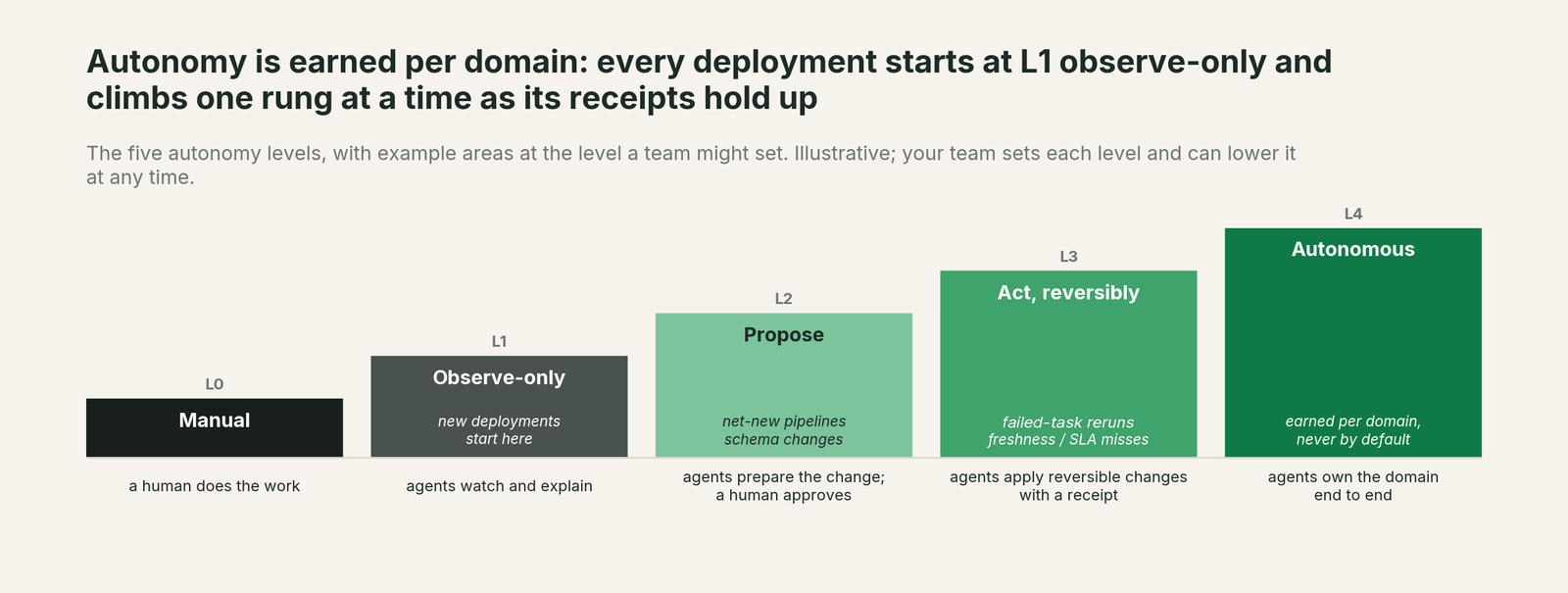
- •L0 manual. An engineer opens Prefect, reads the dbt log, asks IT about Okta and finds the rename after an hour.
- •L1 observe. Data Workers comments the cause and blast radius on the ticket. Nothing changes; the engineer starts from the answer.
- •L2 propose. Data Workers proposes the grant, the group mapping and the rerun. Nothing changes until the named approver says yes; a request nobody answers expires and escalates, and never grants itself.
- •L3 act reversibly. For change classes with a clean record, such as rerunning a failed flow after an approved access fix, Data Workers queues the rerun, verifies it and posts the receipt, with rollback ready.
- •L4 autonomous. For a scoped domain such as the finance models, Data Workers runs that change class end to end, from rerun to verified receipt, and the team reviews the receipts after the fact. Grants still go to the Snowflake owner.
More: who owns the agents, how approvals work, is it safe to let AI agents change production data, data agents with write access, where does our data go, and the sibling guides you're on ServiceNow and you're on PagerDuty.
Still on Opsgenie? Opsgenie reached end of sale on June 4, 2025 and shuts down on April 5, 2027, when data that hasn't moved is deleted; its alerting and on-call features are now available in Jira Service Management, with 120 days of parallel access after you migrate. Data Workers connects natively to both, so your data runbooks don't change when the pager does. You're on Opsgenie covers the move.
What changes for your team
Data tickets arrive diagnosed and leave with proof.
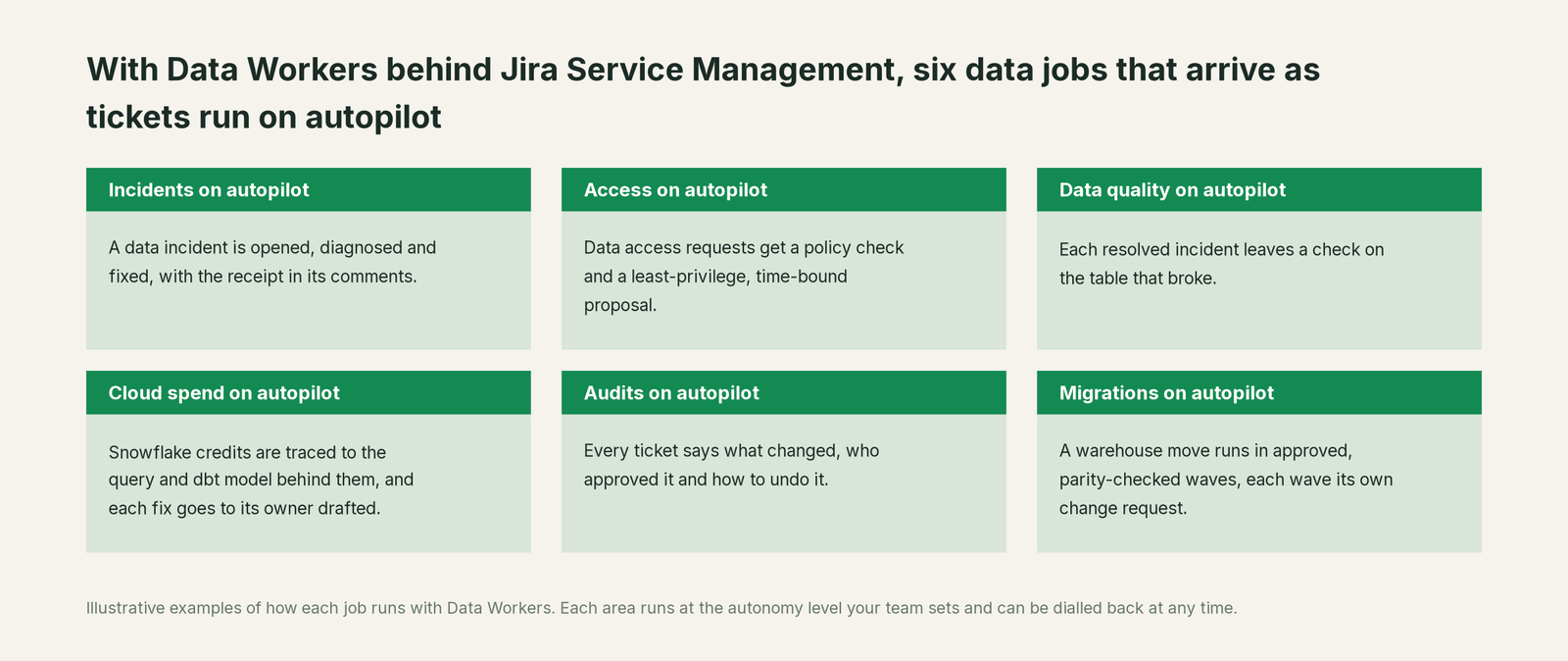
The service team keeps its queues and SLAs. The data team stops doing archaeology on every ticket and reviews proposals instead, and every ticket says what changed, who approved it and how to undo it.
Keep Jira Service Management, or consolidate?
Keep Jira Service Management if you love it; Data Workers works with it from day one. Many teams consolidate once Data Workers runs that slice too.
For almost every team, the answer is keep it: it is where the whole company asks for help, and the data team's tickets belong next to everyone else's. What teams consolidate is the stack around the warehouse: a separate data observability tool, a quality tool, a stale catalog and homegrown table watchers. See Data Workers vs data observability and Data Workers integrations. Tempted to build this with Jira automation and an assistant on the Atlassian MCP server? Read build it ourselves with Claude Code and MCP servers first: the API call is the easy part; the context graph, approvals and rollback are the work. MCP for incident response agents covers it from the agent side.
The case for your CFO
The outcome: data tickets stop being the slowest tickets in the queue. A stale dashboard is diagnosed before anyone reports it and corrected the same morning, under the approvals you already run, with a record of why. Sales and finance stop working from numbers nobody can vouch for.
The risk story is plain. Jira Service Management keeps governing the work: requests, queues, SLAs, change approvals. Data Workers governs changes to the data: autonomy per domain from L0 manual to L4 autonomous, every change routed to a named approver, applied reversibly, verified and recorded in a receipt with who approved it, what it touched and how to undo it. No agent can promote its own work. Your data stays in your systems; the hosted Conductor sees workflow metadata only. Zero migration: Jira Service Management, Okta, Snowflake, dbt, Prefect and Sigma stay where they are.
Why now: Atlassian is putting AI and on-call into Jira Service Management and opening it to every agent over MCP, so the open question is which agent may change production data, under whose approval, with what receipt. The first win is L1 on one affected service: every data incident gets a diagnosis comment. For the numbers, see the ROI of agentic data operations.
The sentence to repeat upstairs: "Jira Service Management keeps the queue; Data Workers fixes the data behind our tickets, with an approval and a receipt on every one."
Getting started
Start with a pilot. Pick one affected service, such as Daily bookings, connect Data Workers to Jira Service Management with a service account, and let every data incident on that service get a diagnosis comment at L1. Then move that domain to L2 propose, so fixes arrive with blast radius and rollback for the owner to approve, and add your data access request type. Plans are on the pricing page, and the pilot is credited in full against the first year.
FAQ
Does Data Workers have a Jira Service Management connector? Yes, natively over the Jira REST API. It reads open incidents for the services you choose, posts its diagnosis, notes and receipt as comments, opens tickets with create_jira_sm_ticket and keeps their summaries current with update_jira_sm_ticket. The repair happens where the data breaks: Snowflake, Databricks, BigQuery, dbt, Prefect, Airflow and the other native connectors.
Does Data Workers move tickets through our workflow? No. Status transitions stay with your service agents and your workflow, so SLAs and automation rules behave as they do today. Data Workers writes the diagnosis and the receipt; your agent resolves the ticket with the proof in front of them.
We have Rovo and AIOps. Why add Data Workers? AIOps groups alerts, recommends mitigation steps and summarizes the post-incident review from the record, and does it well. Data Workers works in the data systems: it traces the cause, proposes the fix with its blast radius, routes it for approval, verifies it and writes the receipt into the ticket.
Can we give an assistant the Atlassian MCP server and let it fix data tickets? It lets an assistant read and update tickets, which is useful. Fixing the data needs context across every other system, a named data approver, rollback and a receipt. Pair the assistant with Data Workers over MCP, and use the Data Security Policy control to keep its write scope narrow.
Does Data Workers grant access when a request comes in? It evaluates the request against policy and column classification and proposes least-privilege, time-bound access. When the verdict is review, it grants nothing and opens a review. The data owner approves and applies the grant in Snowflake or BigQuery.
Sources
- •Atlassian, Jira Service Management product page (Service Collection, Assets for Standard, virtual service agent, AI for incidents), https://www.atlassian.com/software/jira/service-management (checked Oct 2, 2026)
- •Atlassian, Elevate service resilience with AIOps (AI alert grouping, AI-recommended mitigation steps, Ops Expert early access, AI PIR generation), https://www.atlassian.com/software/jira/service-management/aiops (checked Oct 2, 2026)
- •Atlassian, Atlassian Cloud changes Sep 21 to Sep 28, 2026 (Rovo MCP server control in Data Security Policy; Rovo agents managed from Atlassian Administration; both rolling out), https://confluence.atlassian.com/cloud/blog/2026/09/atlassian-cloud-changes-sep-21-to-sep-28-2026 (checked Oct 2, 2026)
- •Atlassian Support, Get started with the Atlassian MCP server (v2 endpoint, OAuth 2.1 or API token, read and write, Rovo credit usage), https://support.atlassian.com/atlassian-rovo-mcp-server/docs/getting-started-with-the-atlassian-remote-mcp-server/ (checked Oct 2, 2026)
- •Atlassian, Opsgenie migration (end of sale June 4, 2025; end of support April 5, 2027; 120 days of parallel access), https://www.atlassian.com/software/opsgenie/migration (checked Oct 2, 2026)
- •Atlassian, The evolution of IT operations (Mar 3, 2025), https://www.atlassian.com/blog/announcements/evolution-of-it-operations (checked Oct 2, 2026)
- •Data Workers open-source repository (Jira Service Management tools in dw-connectors; incident, context, quality, governance and audit tools), https://github.com/DataWorkersProject/dataworkers-claw-community (checked Oct 2, 2026)
- •Data Workers client setup guide, https://dataworkers.io/opensource-docs/client-setup/ (checked Oct 2, 2026)