You're on Fabric IQ: Bring Your Ontology Into Data Workers So Every Agent Reads One Owned Meaning
Your business meaning lives in the Fabric IQ ontology. Data Context Wizard brings it in with provenance, reconciles it with dbt and Snowflake definitions, and fixes drift with approvals.
Your team has started modeling the business in Fabric IQ. The ontology (preview) holds entity types like Customer and Subscription, their relationships, plain-language rules, and metrics that carry source-owned DAX measures from the Power BI semantic models you trust. A modeler ran Generate Ontology on the Subscription Analytics model; a colleague imported an industry vocabulary from a Turtle file. Data bindings point each entity at the lakehouse, warehouse or eventhouse that owns the rows. Fabric data agents and operations agents read that context, and since September 28, 2026 Fabric IQ in Copilot Chat and Cowork is generally available. Fabric IQ is where your business meaning lives. Data Context Wizard is where every agent reads it, next to lineage, quality and usage, with a named owner on every fact, and Data Workers, the agentic data platform, acts when that meaning drifts.
Most estates hold meaning in more than one place: finance keeps metrics as code in dbt on Databricks, a regional team runs Snowflake views, the CRM has its own idea of an account. Bring your own context means your Fabric IQ ontology becomes a first-class source in one governed view, stays yours, and is reconciled with the rest before an agent repeats the wrong number.
Key takeaways
- •Fabric IQ keeps its job. The ontology, its bindings, rules, graph and agents stay in Fabric. Your team's assistant reads them over Microsoft's Ontology MCP server and the Power BI remote MCP server today, side by side with Data Workers.
- •Every fact arrives with provenance. Each entity, rule and metric enters Data Context Wizard with its source item, owner and observation time, and stays your data.
- •Conflicts go to people. When the Fabric IQ metric and the dbt metric disagree, Data Workers shows both with the blast radius and routes the decision to a named owner in Spellbook.
- •Drift gets fixed at the source. Approved changes go back where they belong: a semantic model diff, a dbt change, or rule text the ontology owner applies with the ontology agent.
- •Fabric's guardrails stay on. Workspace permissions, OneLake security and the ontology agent's Plan and Act modes govern Fabric. Data Workers adds approvals, rollback and receipts across every other system.
- •Start with a pilot. Read-only on one domain, then one change class, on the ladder from L0 manual to L4 autonomous.
Fabric IQ is where your meaning lives. Data Workers is where it stays true across every engine.
Fabric IQ solved a real problem: tables are built for machines, and agents need business concepts. Microsoft describes the ontology as "a shared, machine-understandable representation of your business" that "isn't itself a general-purpose data-query engine"; the consuming experience queries the bound source. That keeps your data where it lives, and it means the ontology's meaning is only as current as the definitions it points at.
Here is a Tuesday and Wednesday with Data Workers connected. This is an illustration, not a customer case.
| Time | System | What happens |
|---|---|---|
| Tue 14:00 | dbt + Databricks | Finance merges a change: active_customers now excludes trial plans, ahead of the board pack |
| Tue 14:20 | Fabric IQ | Data Workers sees the new dbt definition; the analytics engineer's assistant reads the Customer entity's Active Customers metric over the Ontology MCP server and its source measure over the Power BI MCP server, and hands both to Data Workers, which finds the measure still counts trials |
| Tue 14:25 | Spellbook | Data Workers opens a contradiction with both definitions side by side and the blast radius: the ontology metric, two Fabric data agents, an operations agent rule on churn risk and three Power BI reports. It routes to the finance controller and the semantic model owner |
| Wed 08:30 | Fabric data agent (Teams) | A sales VP asks the data agent built on the Subscription Analytics model how many active customers there are and gets 48,200; the finance board draft says 44,900 |
| Wed 08:35 | Spellbook | The analyst the VP pings finds the conflict already open, with both definitions, their owners and what each number feeds |
| Wed 08:50 | Spellbook | The controller marks the dbt definition authoritative for revenue reporting, with her name and reason on the record |
| Wed 08:55 | Power BI | Data Workers proposes a diff on the semantic model's definition in the Git-connected workspace repo, adding the trial filter to the Active Customers measure |
| Wed 09:30 | Power BI | The model owner reviews and merges; the workspace syncs and the model refreshes |
| Wed 09:40 | Fabric IQ | The ontology metric still points at the same source measure. Data Workers drafted the rule "Trial plans are not active customers"; the ontology owner applies it with the ontology agent in Act mode |
| Wed 09:50 | Fabric data agent | Data Workers re-queries both engines: dbt and the semantic model return 44,900, and the data agent's answer matches. The receipt records who approved what, what changed and how to undo it |
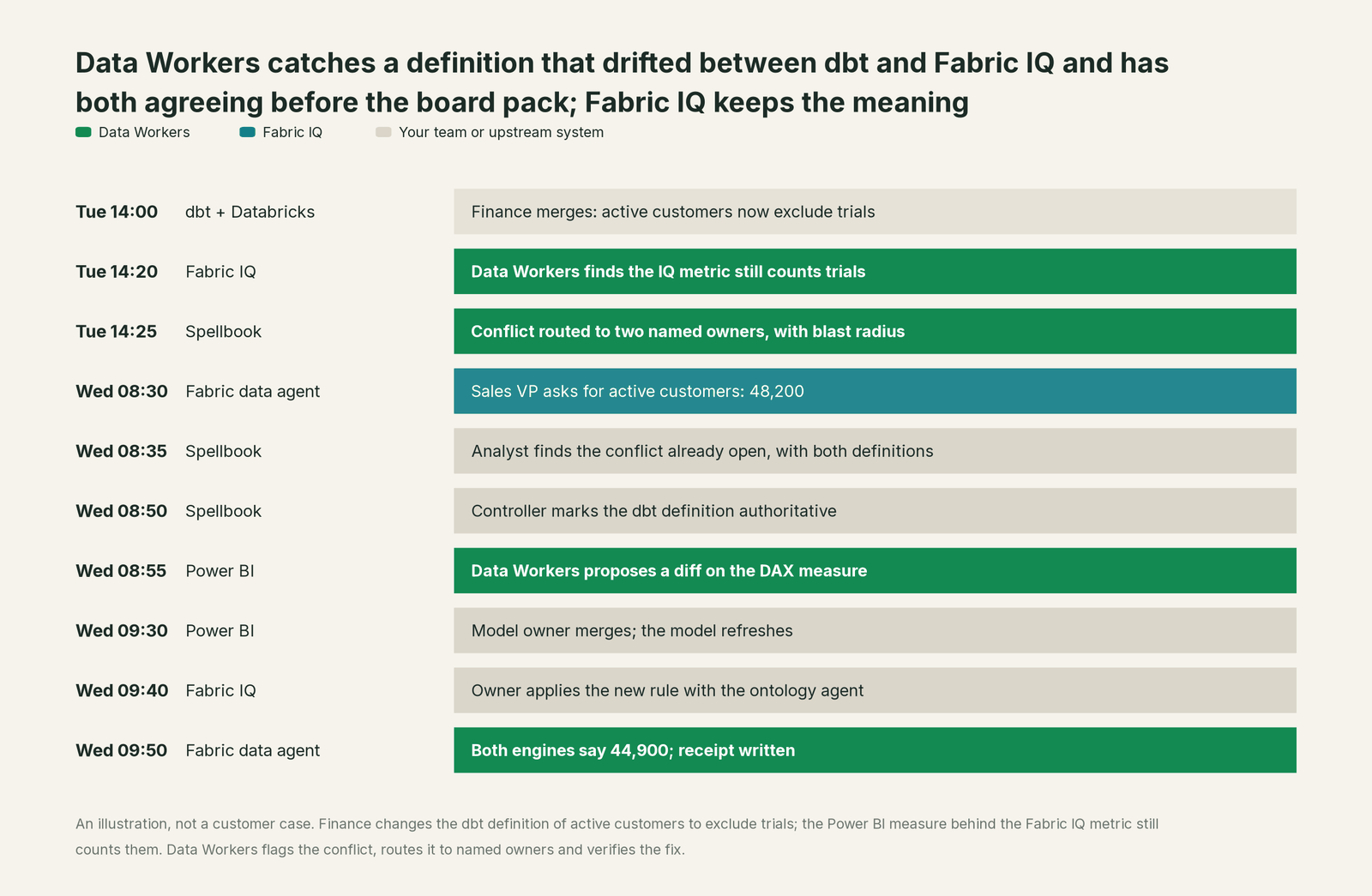
Nothing in Fabric failed here. The ontology and the data agent served the measure they were given. The meaning changed somewhere Fabric IQ doesn't own, and Data Workers was watching that seam from 14:20 on Tuesday.
| Job | What Fabric IQ does | What Data Workers does |
|---|---|---|
| The model | Defines entity types, relationships, rules, metrics and bindings on OneLake data | Brings that model into one governed graph with every other engine's definitions |
| The source of a metric | Carries source-owned DAX measures from semantic models as metrics | Joins each metric to its lineage, quality score, usage and owner across platforms |
| Interchange | Imports RDF, Turtle and OWL; exports RDF and Turtle | Keeps the provenance of every imported or generated fact, whichever route it took |
| Drift inside Fabric | The ontology agent proposes patches as sources change, with stable IDs | Catches drift between Fabric and dbt, Snowflake or Databricks definitions and routes it to owners |
| The decision | Lets ontology authors decide what goes into the item | Records a named human as the approver of every authoritative definition |
| The fix | Applies ontology changes in Act mode, with your identity | Proposes the change where it starts, applies it after approval, verifies it and keeps a receipt |
| Answers | Grounds data agents, operations agents, Copilot Chat and Cowork | Gives every other agent and assistant the same reconciled meaning over MCP |
Why doesn't Fabric IQ just do this itself?
Because Microsoft built Fabric IQ to model and serve meaning for the Fabric estate, and its design is right for that job. The ontology binds to Fabric sources. The ontology agent works on one ontology in one workspace per conversation, acts with your identity, and follows a proposal-first model: Plan mode by default, Act mode only when you switch, and a draft preview before anything changes. That is a careful boundary for a product that sits under Copilot across a tenant.
Reconciling that meaning with definitions in dbt, Snowflake, Databricks and a CRM is a different product. It needs a graph across vendors, live quality and usage behind each definition, a named owner for each fact, and the ability to change production data and code in systems Microsoft doesn't run, with rollback, receipts and the liability that comes with them. Inside Fabric, applying ontology changes "adds or updates items in place", and named versions let you restore a known state. Data Workers adds the cross-system layer: what changed everywhere a definition is used, who approved it and how to undo it.
Focus matters too: your modelers should spend their time on the business model, not on tracing a dbt merge in another platform. Data Workers carries that watch.
Every tool owns a slice. Data Workers covers the whole lifecycle
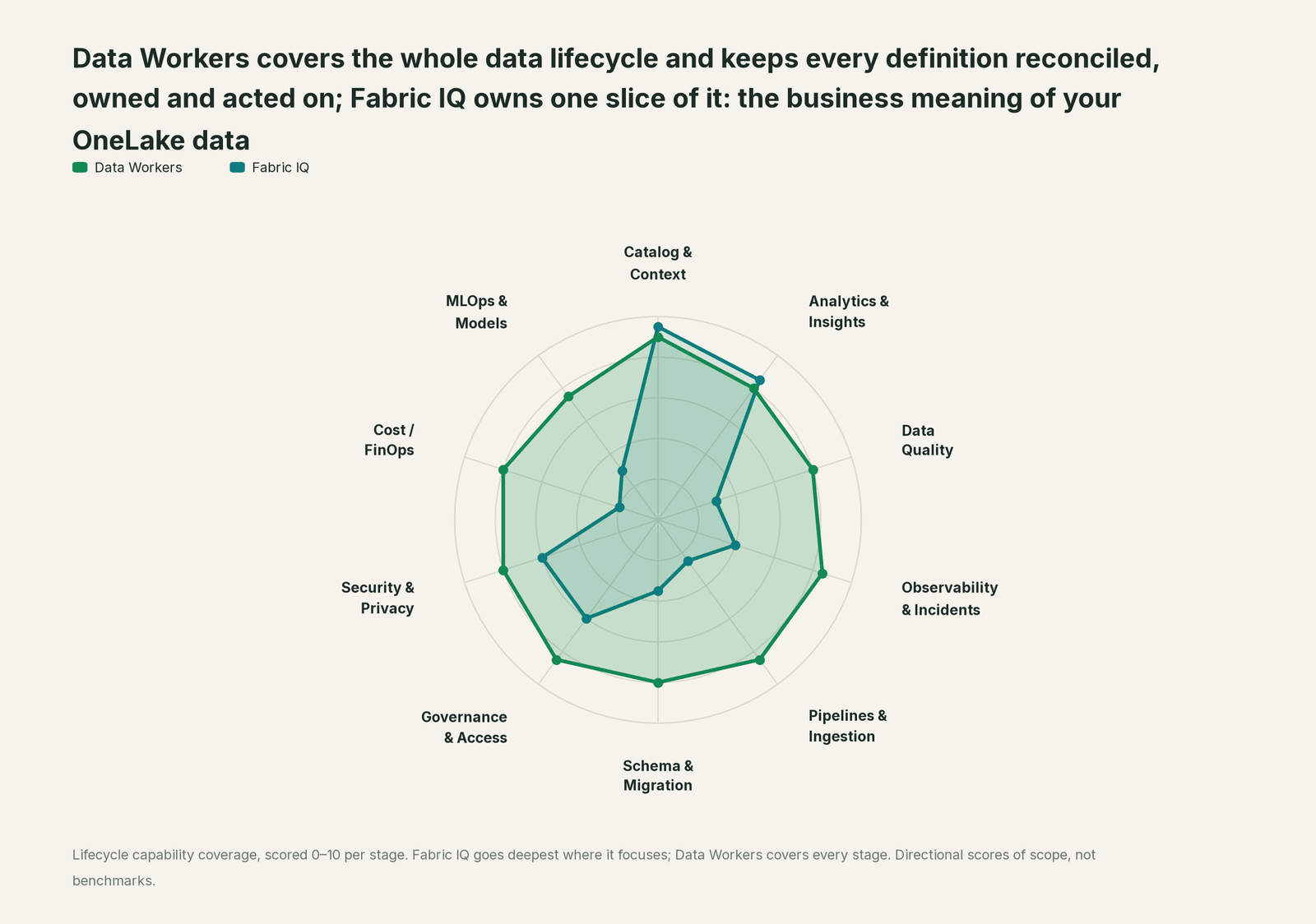
Fabric IQ owns one slice of the lifecycle, and owns it well: the business meaning of your OneLake data, served to Microsoft's agents. Each point tool adds another console, contract and handoff. Data Workers covers the whole lifecycle with one context, one approval flow and one audit trail, and builds on Fabric IQ where your modelers already work.
| Stage | Data Workers | Fabric IQ | Why we scored it this way |
|---|---|---|---|
| Catalog & Context | 9 | 9.5 | Fabric IQ's home stage: the ontology (preview) models entity types, properties, relationships, rules and metrics, binds them to OneLake data and imports RDF, Turtle and OWL. Data Workers brings that meaning into one graph with every other engine's definitions. |
| Analytics & Insights | 8 | 8.5 | A second home stage: Fabric IQ grounds data agents, operations agents and Copilot Chat and Cowork (GA Sep 28, 2026), and DAX measures carry over as metrics. Data Workers answers across platforms from the same governed definitions. |
| Data Quality | 8 | 3 | Constraints in the ontology help keep data consistent, and rules state business logic in plain language. Data Workers writes, runs and repairs checks and dbt tests across the estate. |
| Observability & Incidents | 8.5 | 4 | Operations agents watch live data through the ontology and recommend actions in Teams; root-cause analysis and pre-approved actions are in preview. Data Workers traces a break across systems, fixes it and verifies it. |
| Pipelines & Ingestion | 8.5 | 2.5 | Data bindings point at lakehouses, warehouses, eventhouses and semantic models without copying data. Data Workers builds, reruns and backfills the pipelines that fill those sources. |
| Schema & Migration | 8 | 3.5 | The ontology agent proposes patches when sources drift, keeps stable IDs and offers named versions. Data Workers catches upstream schema changes in the dbt manifest and in review and plans migrations in parity-checked waves. |
| Governance & Access | 8.5 | 6 | Fabric workspace and item permissions govern the ontology, and queries respect OneLake security with row, object and column rules. Data Workers proposes least-privilege grants across platforms and routes each to its owner. |
| Security & Privacy | 8 | 6 | The ontology agent acts with your own Entra identity, and Microsoft does not use conversation data to train foundation models. Data Workers leaves a receipt on every data change. |
| Cost / FinOps | 8 | 2 | Graph and ontology work draw on Fabric capacity units you can watch in the Capacity Metrics app. Data Workers traces Snowflake credits to the dbt model behind them and drafts the fix for its owner. |
| MLOps & Models | 7.5 | 3 | Ontology context grounds the agents Fabric runs. Data Workers keeps the data under your own models healthy and connects to MLflow and W&B. |
How Fabric IQ and Data Workers work together
People keep asking in Copilot Chat and Cowork, Fabric data agents in Teams, and your engineers' coding agent. Spellbook Data Catalog (in preview) is where the data team looks: every conflict, who owns each side, who approved the winner and how to roll it back. Underneath, Data Context Wizard holds one governed context graph, the Data-Agents Swarm does the work with 20+ specialist agents, and the Autonomous Data-Conductor runs each fix end to end (detect, diagnose, fix, review, verify, remember).
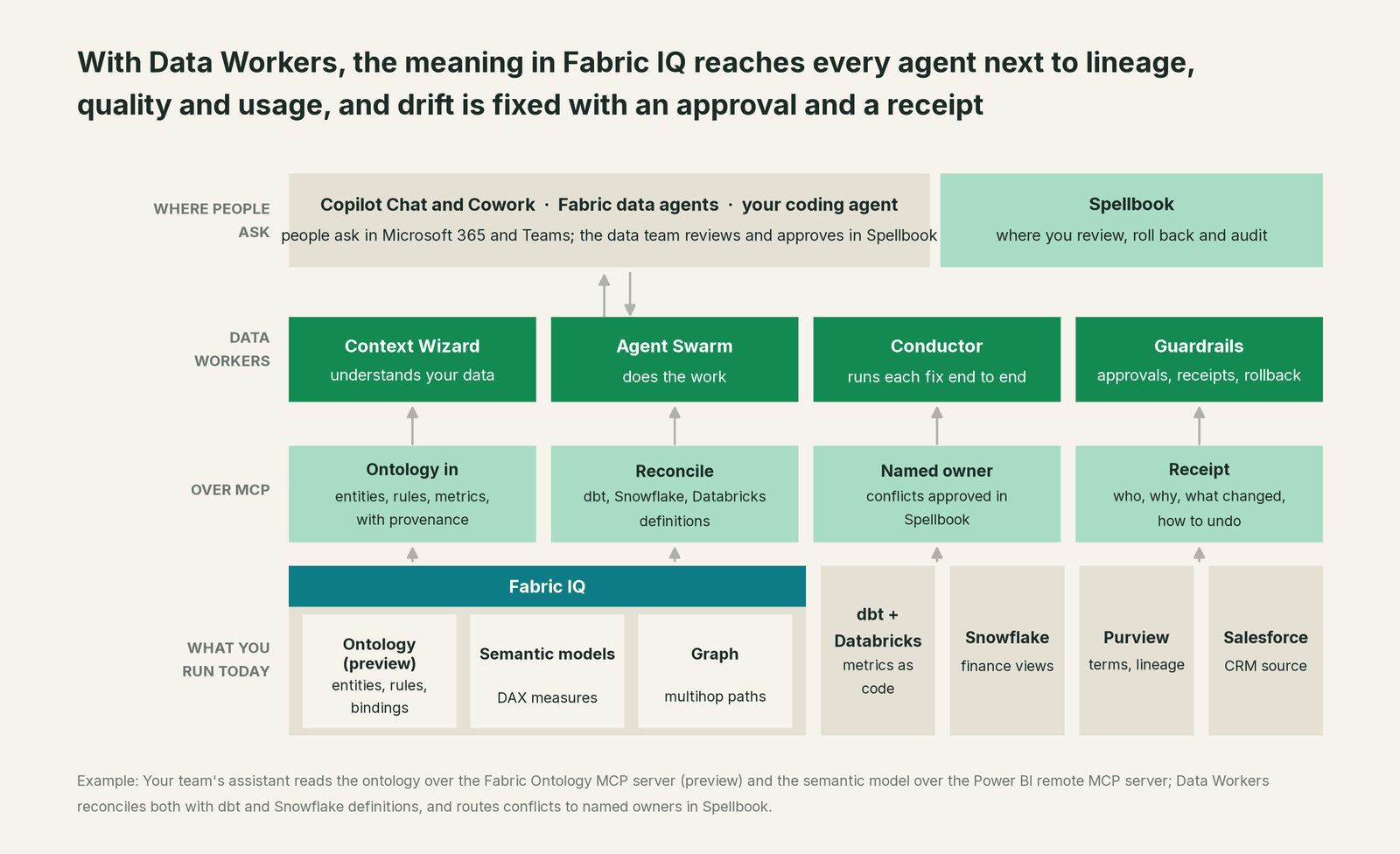
How the ontology comes in. Your team's assistant reads Fabric IQ over Microsoft's Ontology MCP server (preview), which gives an agent "business entities, relationships, and definitions from an ontology", and the semantic models behind its metrics over the Power BI remote MCP server, then hands the definitions to Context Wizard as proposals. Data Workers' agents never call those servers. Each entity, rule and metric lands in Data Context Wizard with provenance: its ontology item, the semantic model that owns the DAX expression, when it was observed and who owns it. Only a named person can make a definition authoritative. dbt metrics come in through the MetricFlow importer, so the Fabric IQ definition sits next to every other version of the same idea. Changes go back as proposals the owner applies, which keeps Fabric the system of record for its own definitions.
What Data Workers does with it. resolve_metric returns every candidate definition for an ambiguous metric name; mark_authoritative and get_authoritative_source record the one a named owner signed off. trace_cross_platform_lineage and blast_radius_analysis show what each definition feeds, down to the data agent. The dbt manifest diff and pull-request review catch a renamed column before it breaks a binding, and get_quality_score tells an agent how far to trust the table under an entity.
Setup today. Follow the client setup docs: clone the open-source repository, then add Data Workers agents to your MCP client next to the Fabric Ontology MCP server, using Microsoft's endpoint format. Example for VS Code's .vscode/mcp.json:
{
  "servers": {
    "fabric-ontology": {
      "type": "http",
      "url": "https://api.fabric.microsoft.com/v1/mcp/dataPlane/workspaces/<workspace-ID>/items/<ontology-item-ID>/ontologyEndpoint"
    },
    "dw-context-catalog": { "type": "stdio", "command": "/path/to/dataworkers-claw-community/start-agent.sh", "args": ["dw-context-catalog"] },
    "dw-schema": { "type": "stdio", "command": "/path/to/dataworkers-claw-community/start-agent.sh", "args": ["dw-schema"] },
    "dw-quality": { "type": "stdio", "command": "/path/to/dataworkers-claw-community/start-agent.sh", "args": ["dw-quality"] }
  }
}
Sign in to the Fabric server with your own account when VS Code prompts you; queries respect your access to the bound data. List each server's tools with your client's own MCP view.
The climb, L0 to L4. Autonomy is set per domain, and it sits on top of Fabric's own controls.
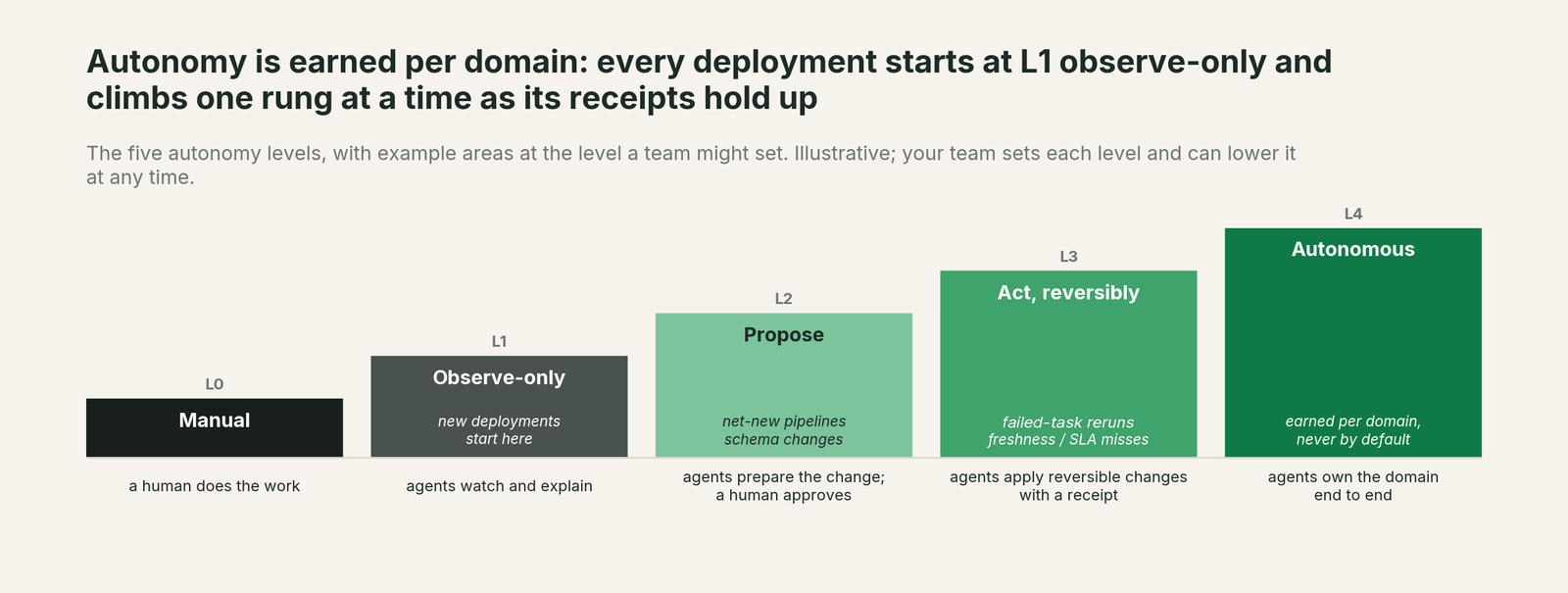
- •L0 manual. Modelers maintain the ontology and dbt metrics separately; a mismatch surfaces when two numbers meet in a meeting.
- •L1 observe. Data Workers reports every definition that disagrees, with owners and blast radius.
- •L2 propose. Data Workers drafts the change: a semantic model diff, a dbt change, or rule text for the ontology owner to apply in Act mode.
- •L3 act reversibly. For change classes with a clean record, such as refreshing a model after an approved definition change, Data Workers applies the change, verifies both numbers and can roll it back.
- •L4 autonomous. For a scoped domain like descriptions and synonyms that mirror an approved glossary, Data Workers keeps definitions in step on its own, with a receipt for each change.
You can step back at any time. For the safety model, read is it safe to let AI agents change production data; for where data lives, where does our data go.
For the operations loop across Fabric, read Data Workers on Microsoft Fabric; for the answering side, Fabric data agents vs Data Workers. The same pattern on other context layers: you're on Palantir Ontology, you're on Databricks Genie Ontology, you're on Snowflake Horizon Context and the hub, bring your own context.
What changes for your team
Fabric IQ gives your modelers a place to say what the business means. Data Workers gives the data team a crew that keeps that meaning true everywhere else it lives, so "which number is right?" stops being a Slack thread.
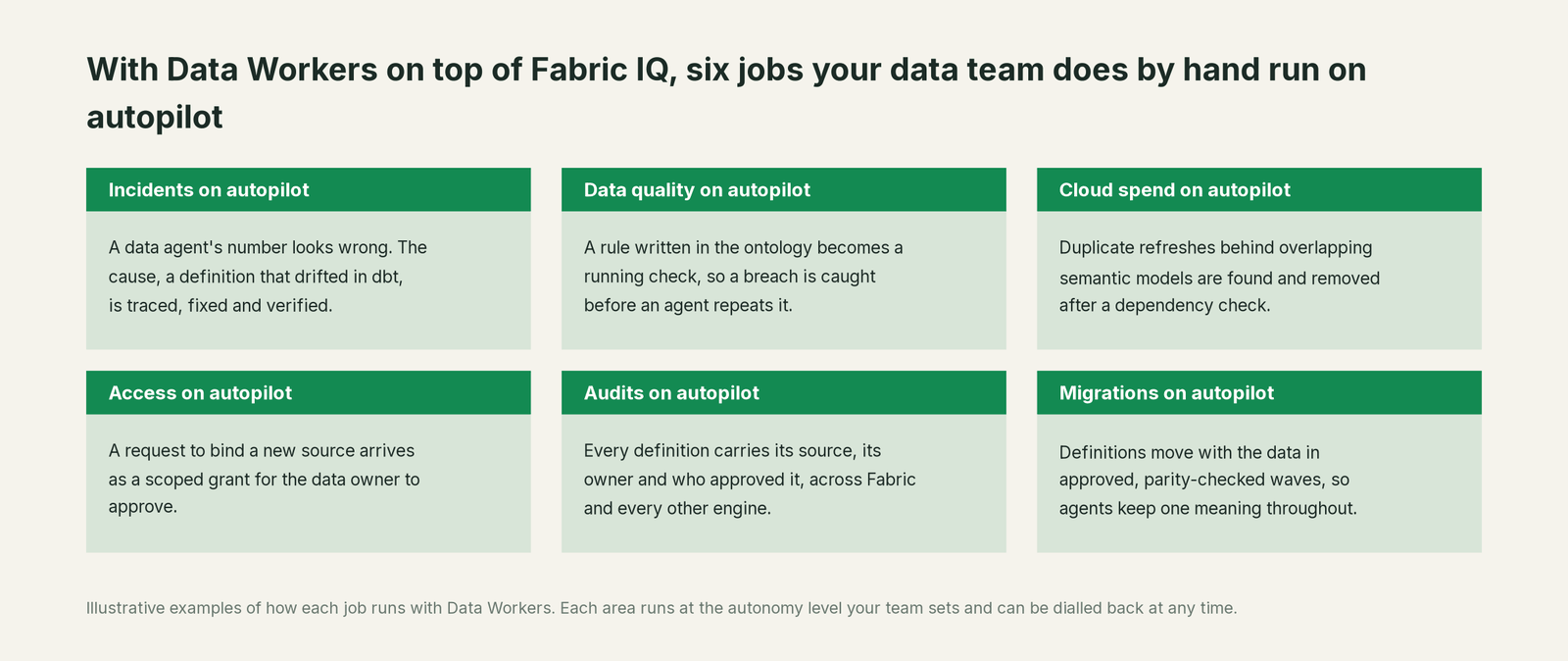
- •Incidents. A data agent's wrong number is traced to the definition that moved upstream, fixed at the source and verified in both engines.
- •Data quality. An ontology rule such as "a shipment always has a carrier" becomes a running check.
- •Cloud spend. Overlapping semantic models that refresh the same data are retired after a dependency check.
- •Access. A request to bind a new source arrives as a scoped grant for the data owner.
- •Audits. "Where does this KPI come from?" has a one-page answer: source, owner and approver, in Fabric and every other engine.
- •Migrations. Definitions move with the data in approved, parity-checked waves, including the copy Microsoft asks you to make before the old ontology experience retires on January 31, 2027, where Data Workers lists every agent and dashboard to reconnect.
Keep Fabric IQ, or consolidate?
Keep Fabric IQ if you love it; Data Workers works with it from day one. Many teams consolidate once Data Workers runs that slice too.
For most Microsoft shops the answer is keep it: it is where Fabric's agents and Copilot read business meaning, and Turtle and RDF export keep that meaning portable. Teams consolidate what sits around it: the spreadsheet mapping dbt metrics to Power BI measures, the duplicate glossary, the hand-built checks, often a separate observability tool. Weighing a homegrown layer on the Ontology MCP server? Read build it ourselves with Claude Code and MCP servers: reading an ontology over MCP is the easy part; reconciliation, approvals and rollback are where the work is.
The case for your CFO
The outcome: you are investing in Fabric IQ so Copilot and Fabric's agents speak the language of the business. Data Workers makes that language agree with every other place you define your numbers, so the active-customer count in Teams matches the board pack, signed off by a named person.
The risk story: Fabric's permissions, OneLake security and the ontology agent's Plan and Act modes stay exactly as they are. Data Workers sets autonomy per domain from L0 manual to L4 autonomous, routes every change to a named approver, applies it reversibly, verifies it in each engine and writes a receipt with who approved it, what it touched and how to undo it. Zero migration: Fabric, Power BI, dbt, Databricks and Snowflake stay where they are.
Why now: Fabric IQ in Copilot Chat and Cowork went generally available on September 28, 2026, so a drifted definition now misleads every Microsoft 365 user who asks. The first win is one domain, read-only: every definition that disagrees across Fabric IQ and dbt, with owners and blast radius. What stays the same: your ontology, semantic models, Git workflow and review process. For the numbers, see the ROI of agentic data operations. Start with a pilot (pricing); the pilot is credited in full against the first year.
The sentence to repeat upstairs: "Fabric IQ holds what our numbers mean; Data Workers makes sure that meaning matches everywhere else we define it, and fixes the gaps with an approval and a receipt."
Getting started
Start with a pilot. Pick one domain your ontology already models, such as customers, connect Data Workers read-only next to the Ontology MCP server and your dbt project, and let it list every definition that disagrees before you turn on the first change class. Plans are on the pricing page, and the pilot is credited in full against the first year.
FAQ
Does Data Workers replace the Fabric IQ ontology? No. The ontology stays the source of business meaning for Fabric, and its agents keep reading it. Data Workers reads it as a first-class source, joins it to lineage, quality and usage across your other platforms, and routes disagreements to named owners.
How does Data Workers read our ontology? Over Microsoft's Ontology MCP server (preview) and the Power BI remote MCP server today, with your permissions. Each entity, relationship, rule and metric lands with its source item, owner and observation time. An exported Turtle file in Git serves as a versioned snapshot alongside.
Can Data Workers write to the ontology? Data Workers writes its proposals back to the people who own each definition, by design. Rule text and definition changes are drafted for the ontology owner to apply with the ontology agent in Act mode, which matches Fabric's proposal-first model. Changes that start in a semantic model go to the owner as a diff to merge through Fabric's Git integration, and dbt changes as a dbt diff.
We generated our ontology from Power BI semantic models. What happens when a measure changes? The semantic model owns the DAX expression, and the ontology metric keeps pointing at it. Data Workers watches the measure and the definitions it should agree with in dbt or Snowflake, and flags a change in either before an agent answers from it.
We imported an industry ontology from OWL. Does that provenance survive? Fabric's import summary marks each item Preserved, Auto-fixed or skipped (with the reason), and the summary can't be reopened, so download the log. Data Workers records the import as the source of those definitions, so you can always see which entities came from the external vocabulary and which your team added.
Is this safe to run while Fabric IQ is in preview? Yes. Start at L1, where Data Workers reads and reports, so preview changes on the Fabric side don't put data at risk. Each higher level is a per-domain decision backed by receipts.
Sources
- •Microsoft Learn, What is Fabric IQ? (updated Sep 29, 2026), https://learn.microsoft.com/en-us/fabric/iq/overview (checked Oct 2, 2026)
- •Microsoft Learn, What is ontology (preview)? (updated Oct 1, 2026; old experience retires Jan 31, 2027), https://learn.microsoft.com/en-us/fabric/iq/ontology/overview (checked Oct 2, 2026)
- •Microsoft Learn, Generate ontology (preview) from semantic models (updated Oct 1, 2026), https://learn.microsoft.com/en-us/fabric/iq/ontology/how-to-generate-from-semantic-models (checked Oct 2, 2026)
- •Microsoft Learn, Import and export ontologies (preview) (updated Sep 29, 2026), https://learn.microsoft.com/en-us/fabric/iq/ontology/how-to-import-export (checked Oct 2, 2026)
- •Microsoft Learn, Use the ontology agent (preview) (updated Sep 29, 2026), https://learn.microsoft.com/en-us/fabric/iq/ontology/how-to-use-ontology-agent (checked Oct 2, 2026)
- •Microsoft Learn, Use Ontology MCP Server (preview) (updated Oct 1, 2026), https://learn.microsoft.com/en-us/fabric/iq/ontology/how-to-use-ontology-mcp-server (checked Oct 2, 2026)
- •Microsoft Learn, Choose a Microsoft Fabric MCP server (updated Sep 23, 2026), https://learn.microsoft.com/en-us/rest/api/fabric/articles/mcp-servers/fabric-mcp-servers-list (checked Oct 2, 2026)
- •Microsoft Learn, What is graph in Microsoft Fabric? (updated Jun 26, 2026), https://learn.microsoft.com/en-us/fabric/graph/overview (checked Oct 2, 2026)
- •Microsoft Learn, What's new in Microsoft Fabric (updated Oct 1, 2026), https://learn.microsoft.com/en-us/fabric/fundamentals/whats-new (checked Oct 2, 2026)
- •Microsoft Azure Blog, FabCon and SQLCon 2026 (Sep 28, 2026; Fabric IQ in Copilot Chat and Cowork generally available), https://azure.microsoft.com/en-us/blog/fabcon-and-sqlcon-2026-in-barcelona-building-the-data-foundation-for-microsoft-copilot-and-agents/ (checked Oct 2, 2026)
- •Data Workers client setup docs, https://dataworkers.io/opensource-docs/client-setup/, and the open-source repository https://github.com/DataWorkersProject/dataworkers-claw-community (
start-agent.sh; tool definitions forresolve_metric,mark_authoritative,get_authoritative_source,trace_cross_platform_lineage,blast_radius_analysis,get_quality_score) (checked Oct 2, 2026)