You're on Informatica Data Quality: It Runs the Rules Inside IDMC. Data Workers Fixes What Fails Them Across the Estate
Informatica Data Quality defines and runs quality rules inside IDMC. Data Workers diagnoses, fixes and verifies the data incident across your estate, with approval.
Your data management team runs quality inside Informatica's Intelligent Data Management Cloud (IDMC). Cloud Data Quality profiles sources, runs rule specifications on your critical data elements, cleanses, verifies addresses and deduplicates; scorecards track each rule against its target; Cloud Data Governance and Catalog (CDGC) shows the data quality score next to the glossary term; MDM Customer 360 merges the golden record. Many estates still run on-premises Informatica Data Quality beside it. Since Salesforce closed its acquisition on Nov 18, 2025, the product is "Informatica from Salesforce", and the Data Quality Agent, generally available since Spring 2026, turns a rule written in plain language into deployed logic. Informatica Data Quality writes the rulebook and runs it inside IDMC, and does that job well. Data Workers is the repair team across the estate: it diagnoses, fixes and verifies the incident behind approvals, from the CRM that changed to the downstream process about to use the data, with a receipt for every change.
Key takeaways
- •Informatica keeps its job. Rules, scorecards, cleansing, address verification, MDM match and merge and your stewards' work stay in IDMC.
- •A failed rule is where Data Workers starts. The failed rule reaches Data Workers through the on-call, whose assistant can use Informatica's MCP servers side by side with Data Workers; Data Workers traces the cause past IDMC and maps the blast radius.
- •One plan, one approval, one receipt. A named owner approves the repair in Spellbook; each system's owner applies their step, and Data Workers queues reruns, verifies and records how to undo it.
- •Stewards get evidence. The cause, the fix, the verification and the restored score sit in one record.
- •Autonomy is set per domain, from L0 manual to L4 autonomous, and an unanswered approval expires and escalates, never auto-grants.
Informatica Data Quality is the rulebook. Data Workers is the repair team across the estate.
If Informatica's scorecards are the smoke alarm on your customer master, Data Workers is the crew that puts out the fire. A Thursday at an industrial distributor: Microsoft Dynamics 365 Sales holds accounts, an IDMC Cloud Data Integration taskflow loads them into BigQuery, Cloud Data Quality scores them, MDM Customer 360 builds golden records, Prefect runs dbt Core, DataHub holds lineage, and a Zuora bill run reads bill-to addresses at 10:00. An illustration, not a customer case.
| Time | System | What happens |
|---|---|---|
| Wed 16:30 | Dynamics 365 Sales | A solution update adds a new address form for EU accounts; on every account edited after it, the postal code is saved in address1_line3 and address1_postalcode is left blank |
| Thu 01:00 | IDMC Cloud Data Integration | The tf_crm_accounts_nightly taskflow runs its mapping task; 18,420 changed accounts land in crm_raw.accounts in BigQuery with a null postal_code |
| 01:40 | Informatica Cloud Data Quality | Address verification fails on those accounts; the "Customer address valid" scorecard falls to 91.4% against a 98% target and the data quality score on the CDE drops in CDGC |
| 02:30 | MDM Customer 360 | Match and merge cannot match the accounts without a postal code; 1,206 existing golden records split into duplicates |
| 03:00 | Prefect and dbt | The customer_marts flow builds dim_customer and dim_bill_to in BigQuery on the split records |
| 06:30 | Data Workers | Reads the scorecard result and the CDGC score over Informatica's API, checks crm_raw.accounts in BigQuery and finds every null on accounts edited after Wed 16:30, each with the postal code sitting in address line 3; raises an Opsgenie alert to the customer data on-call |
| 06:34 | Data Workers | Traces lineage through dbt: dim_bill_to feeds the 10:00 Zuora bill run sync, where 3,880 invoices would go to split accounts with incomplete bill-to addresses. get_incident_history finds no earlier fix to reuse |
| 06:50 | Data Workers | Proposes one plan in Spellbook: a note to the Dynamics admin on the form, a mapping change that reads the postal code from line 3 when the field is blank, a reload of the changed accounts, a match and merge run for the 1,206 records, a Prefect rerun, and a hold on the bill run sync until verification passes |
| 07:20 | Spellbook | The customer data owner reviews the diagnosis, the blast radius and the plan, and approves |
| 07:30 | Zuora | The billing operations owner pauses the 10:00 sync |
| 07:40 | IDMC | The integration owner applies the mapping change and reruns the taskflow for accounts edited since Wednesday; postal codes load for all 18,420 |
| 08:05 | Informatica Cloud Data Quality | The scorecard reruns at 98.3% |
| 08:20 | MDM Customer 360 | The MDM steward reviews the merge candidates and merges the 1,206 split records back |
| 08:45 | Prefect | Data Workers queues the customer_marts flow run; the dbt tests pass |
| 09:05 | BigQuery | Data Workers verifies: null rate on postal_code back to baseline, one dim_bill_to row per customer, and the golden record count against Wednesday plus new accounts |
| 09:30 | Opsgenie and Zuora | Data Workers closes the Opsgenie alert with the receipt link; billing operations resumes the sync before the 10:00 bill run |
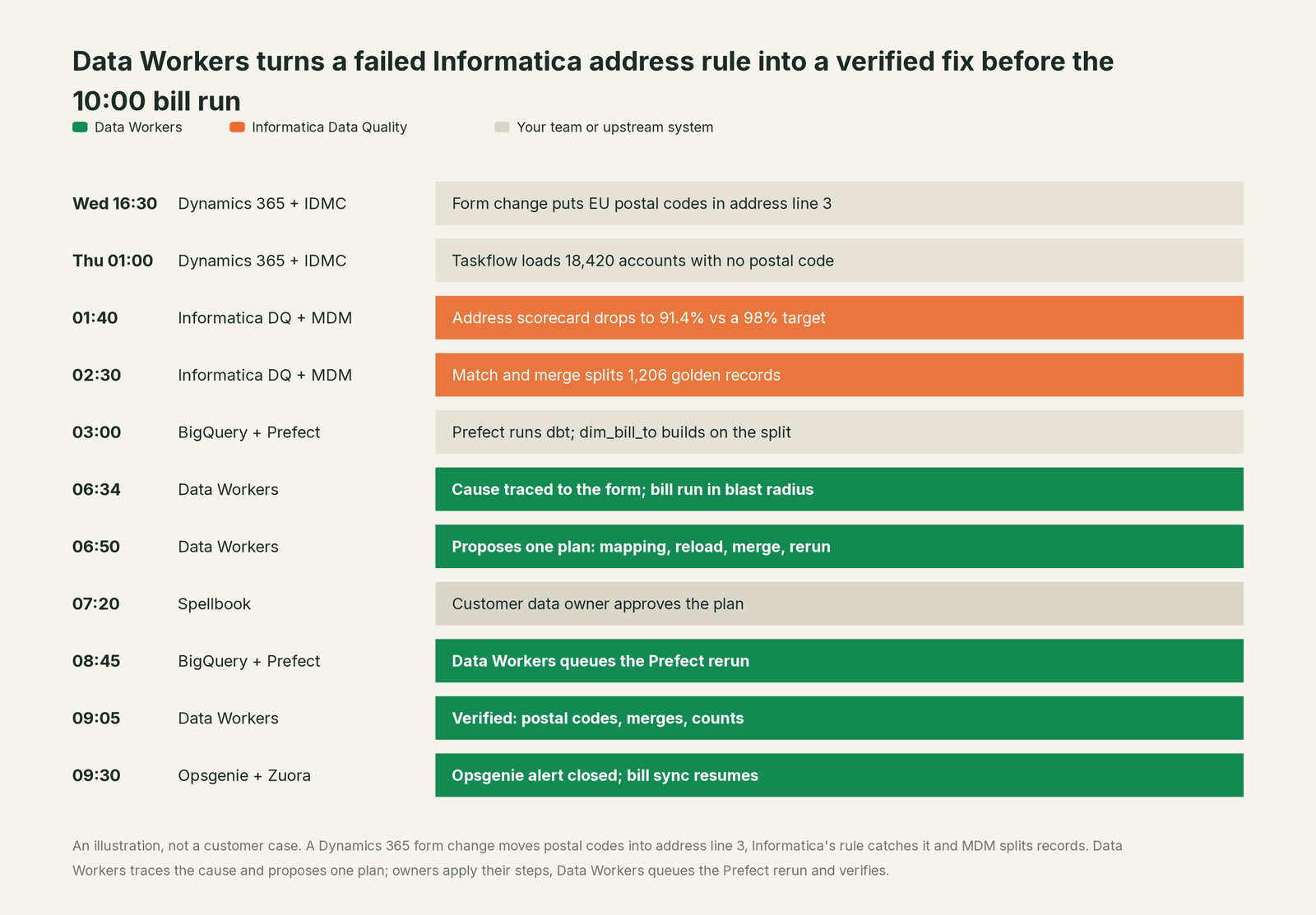
Informatica did its job: the scorecard caught the bad addresses at 01:40 and showed the steward. Data Workers added everything around that rule. The cause sat in a Dynamics form, the damage had spread into MDM and two dbt models, and the deadline was a bill run Informatica never sees. One owner approved one plan, each team did its step, and the invoices went out right.
| Job | What Informatica Data Quality does | What Data Workers does |
|---|---|---|
| Detection | Profiles sources, runs rules on CDEs, verifies addresses, tracks schema changes and anomalies in IDMC | Watches freshness and volume in the warehouse and schema changes in the dbt manifest, and takes Informatica's failed rule as a starting signal |
| Rules | CLAIRE recommends rules; the Data Quality Agent turns plain-language specs into deployed logic | Proposes a guard check where the break happened, in the system that broke |
| Root cause | Shows which records fail which rule, with lineage inside IDMC and CDGC | Traces past IDMC into the source system and downstream through dbt, the orchestrator and every consumer |
| The fix | Cleanses, standardizes and deduplicates inside IDMC; stewards merge in MDM | Proposes the complete repair across systems with blast radius: source note, mapping change, reloads, reruns and holds, each routed to its owner |
| Running it | Your teams run jobs and steward the records | A named owner approves in Spellbook; Data Workers queues the orchestrator rerun and tracks each owner's step |
| Verification | The scorecard reruns and the score recovers | Checks volume and quality on every table the fix touched, beyond the rule's own scope |
| The record | Scores, rule results and the steward's history in IDMC | A receipt: the cause, the changes, who approved them, what they touched, how they were verified and how to undo them |
Why doesn't Informatica Data Quality just do this itself?
Because Informatica built a data management suite, and it acts where it is in charge. Inside IDMC its reach is wide: Cloud Data Quality cleanses and deduplicates in its own mappings, MDM merges golden records, and CLAIRE agents generate and deploy rules. Informatica describes CLAIRE agents as agents that "discover data, build pipelines and proactively fix data quality issues", and on May 20, 2026 it announced a Data Steward Agent for resolving quality issues and matching records in MDM, planned for Q4 2026. Even there, people stay in the loop: users accept or ignore CLAIRE's recommended rules. We concede that surface happily: inside IDMC, Informatica is deep.
The Thursday fix needed more than IDMC. The cause was a Dynamics form owned by the CRM team; the damage reached a dbt project run by Prefect and a Zuora sync owned by billing operations. A suite that changed those on its own would take on liability for systems it does not run. Acting across them takes blast-radius scoping, an owner's approval, an undo written first, verification beyond one rule and a record an auditor can read. That is a different product, and it is the product Data Workers is.
There is also focus. Informatica's 2026 direction is trusted data for AI agents across Salesforce's Data 360 and Agentforce, delivered through headless services and MCP: a sensible bet for a suite its size. Running the whole data lifecycle across every other vendor's tools is the job we chose.
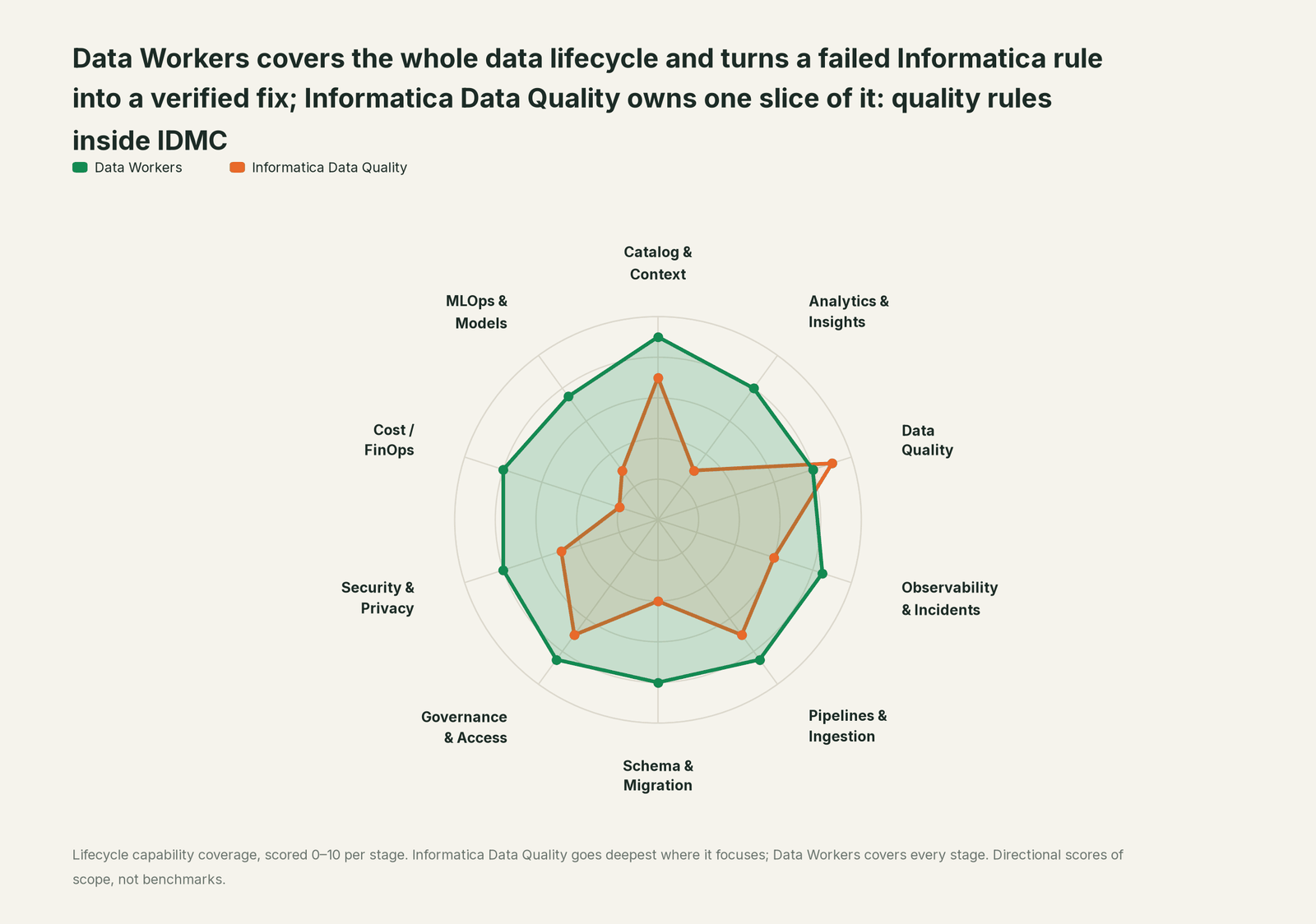
Every tool owns a slice. Data Workers covers the whole lifecycle
Informatica Data Quality goes deep on quality, and the suite around it reaches into integration, catalog and MDM. Each point tool adds another console, contract and handoff. Data Workers covers the whole lifecycle with one context, one approval flow and one audit trail.
| Stage | Data Workers | Informatica Data Quality | Why we scored it this way |
|---|---|---|---|
| Catalog & Context | 9 | 7 | Cloud Data Governance and Catalog (CDGC) carries glossary terms, lineage and data quality scores next to the rules. Data Workers keeps one governed context graph of definitions, owners, lineage, quality and usage across every platform. |
| Analytics & Insights | 8 | 3 | CLAIRE GPT answers questions about assets and recommends rules. Data Workers answers data questions from governed definitions with lineage behind every number. |
| Data Quality | 8 | 9 | Informatica's home stage: profiling, prebuilt and AI-generated rules, cleansing, standardization, address verification and deduplication, with the Data Quality Agent GA since Spring 2026. Data Workers runs checks too and fixes the cause when a rule fails. |
| Observability & Incidents | 8.5 | 6 | Data Observability watches data health and anomalies inside IDMC. Data Workers diagnoses across systems, fixes with approval and verifies the fix. |
| Pipelines & Ingestion | 8.5 | 7 | As a suite, IDMC also runs Cloud Data Integration mappings and taskflows. Data Workers queues reruns through your orchestrator and proposes ingestion changes for their owner, with approvals. |
| Schema & Migration | 8 | 4 | Schema change tracking flags changes on profiled sources. Data Workers scores a schema change's blast radius, drafts the migration with rollback SQL and plans moves in waves. |
| Governance & Access | 8.5 | 7 | CDGC policies, stewardship and MDM golden records are suite strengths. Data Workers dry-runs each warehouse access request and proposes a time-bound grant for the owner to approve. |
| Security & Privacy | 8 | 5 | Classification and data privacy services sit elsewhere in the suite. Data Workers' pull request review flags new columns whose names or annotations look sensitive, and leaves a receipt on every data change. |
| Cost / FinOps | 8 | 2 | Data quality is not a cost tool. Data Workers reads warehouse spend next to each incident and drafts setting changes for their owner. |
| MLOps & Models | 7.5 | 3 | Trusted data for AI agents is the 2026 theme. Data Workers keeps the data under your models fresh and correct. |
Informatica leads on its home stage, and we scored the suite's integration, catalog and MDM breadth where it shows. For the category, see how Data Workers differs from data observability, autonomous resolution and data quality for AI agents.
How Informatica Data Quality and Data Workers work together
Spellbook Data Catalog (in preview) is where the data team looks: each proposed change, who approved it and how to roll it back. Behind it, Data Context Wizard keeps one governed context graph across the estate, the Data-Agents Swarm does the work with 20+ specialist agents, the Autonomous Data-Conductor runs each fix end to end, and per-domain guardrails hold approvals, receipts and rollback.
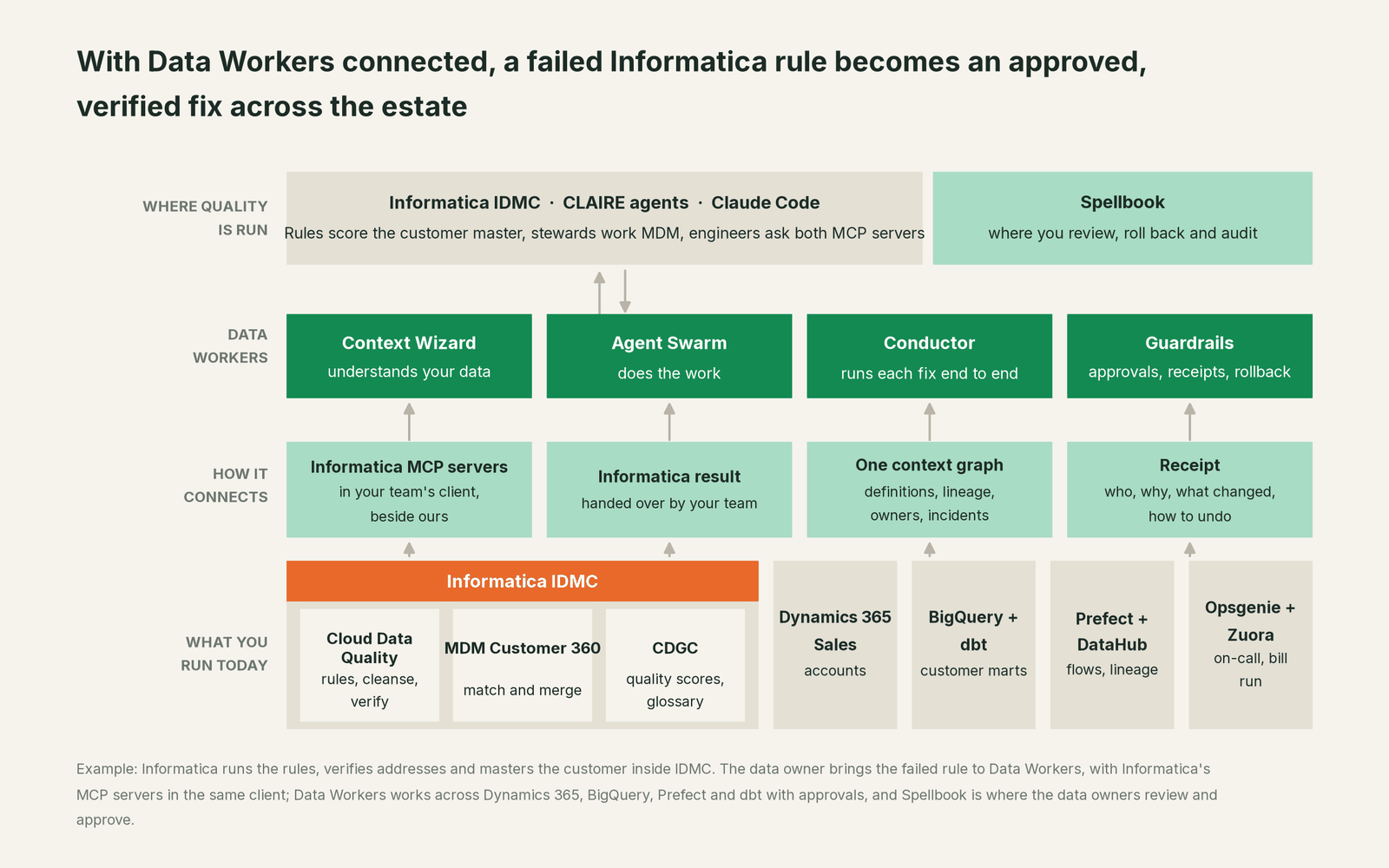
Informatica to Data Workers. Informatica connects over its API or MCP servers today: your team's assistant reads scorecard results, data quality scores, job runs and CDGC metadata side by side with Data Workers, whose own checks rest on BigQuery, Prefect and dbt. Dynamics 365, IDMC Cloud Data Integration, Zuora and DataHub connect over their APIs or MCP servers today, and Data Workers reads BigQuery, Prefect, dbt and Opsgenie natively. A failed rule starts a diagnosis: diagnose_incident and get_root_cause work the evidence, trace_cross_platform_lineage follows the failure past IDMC to the source and every consumer, blast_radius_analysis maps what is at risk, explain_table pulls each table's definition, lineage and documentation, and get_incident_history checks for repeats. The repair runs through remediate: code changes go to the owner as a diff to merge, reruns are queued through the orchestrator, and IDMC taskflow reruns and ingestion syncs stay with their owner. Catalog updates are proposed for the DataHub owner; approved facts land in the Context Wizard graph. Verification uses run_quality_check and get_quality_score, and every step lands in get_audit_trail.
Data Workers back to Informatica. Informatica keeps the rule, the scorecard and the steward's history. The receipt lives in Spellbook and the audit trail, linked from the Opsgenie alert or your ticket. Rule changes Data Workers suggests go to the rule owner, who applies them in IDMC or asks the Data Quality Agent to write them.
Side by side in one client. Informatica's Headless Data Management, GA since Spring 2026, exposes its data management services through native MCP support to clients such as Claude and Cursor; its MCP servers reach cloud address verification, CDGC search and MDM. Add Informatica's MCP server as your IDMC administrator publishes it, then add Data Workers beside it, one start-agent.sh entry per agent, as the client setup guide documents. Example for Claude Code's .mcp.json, Data Workers entries only:
{
  "mcpServers": {
    "dw-context-catalog": { "command": "/path/to/dataworkers-claw-community/start-agent.sh", "args": ["dw-context-catalog"] },
    "dw-incidents": { "command": "/path/to/dataworkers-claw-community/start-agent.sh", "args": ["dw-incidents"] },
    "dw-quality": { "command": "/path/to/dataworkers-claw-community/start-agent.sh", "args": ["dw-quality"] }
  }
}
Ask "why did the customer address scorecard drop, and what does the fix touch?" and the client calls both: Informatica returns the rule result and the CDGC score; Data Workers returns the Dynamics cause, the bill run in the blast radius and a proposed plan. Informatica's access controls govern IDMC; Data Workers' guardrail decides whether a data change may run in that domain, with a named approver. A shared Data Workers endpoint takes an API key or OAuth tokens from your identity provider, such as Okta or Entra ID, verified through JWKS.
One failed Informatica rule, L0 to L4. The same incident at each level, set per domain.
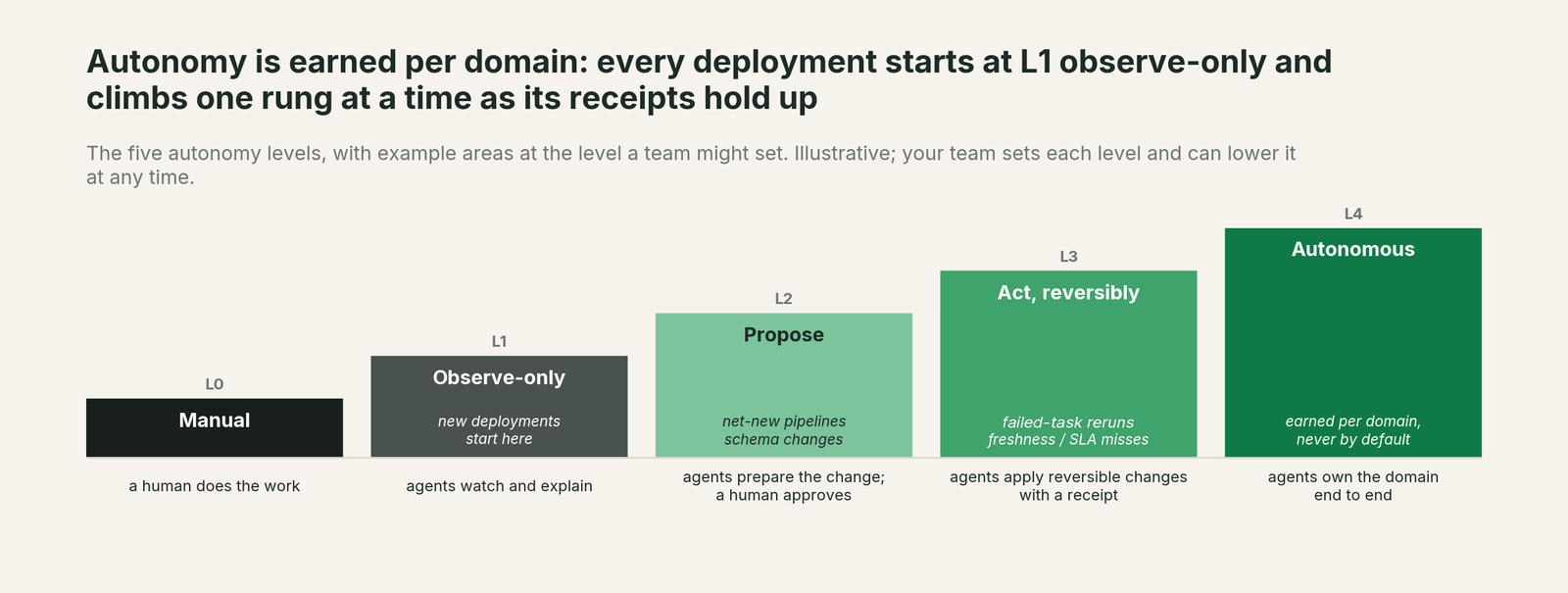
- •L0 manual. The steward sees the score drop and emails the CRM, integration and analytics teams.
- •L1 observe. Data Workers posts the diagnosis and the bill run at risk. Nothing changes.
- •L2 propose. Data Workers proposes the full plan; nothing runs until the customer data owner approves in Spellbook.
- •L3 act reversibly. For proven change classes, such as rerunning the customer marts flow after a verified reload, Data Workers queues the step, verifies it and records the receipt.
- •L4 autonomous. In a scoped domain with a long clean record, Data Workers runs the repeatable steps end to end; IDMC mappings, MDM merges and source changes stay with their owners.
On safety, see is it safe to let AI agents change production data, how approvals work, autonomy levels and rollback. On where data lives: the agents run in your infrastructure, your data stays in your systems, and the hosted Conductor sees workflow metadata only.
What changes for your team
Informatica gave your stewards scorecards. Data Workers gives them a crew.
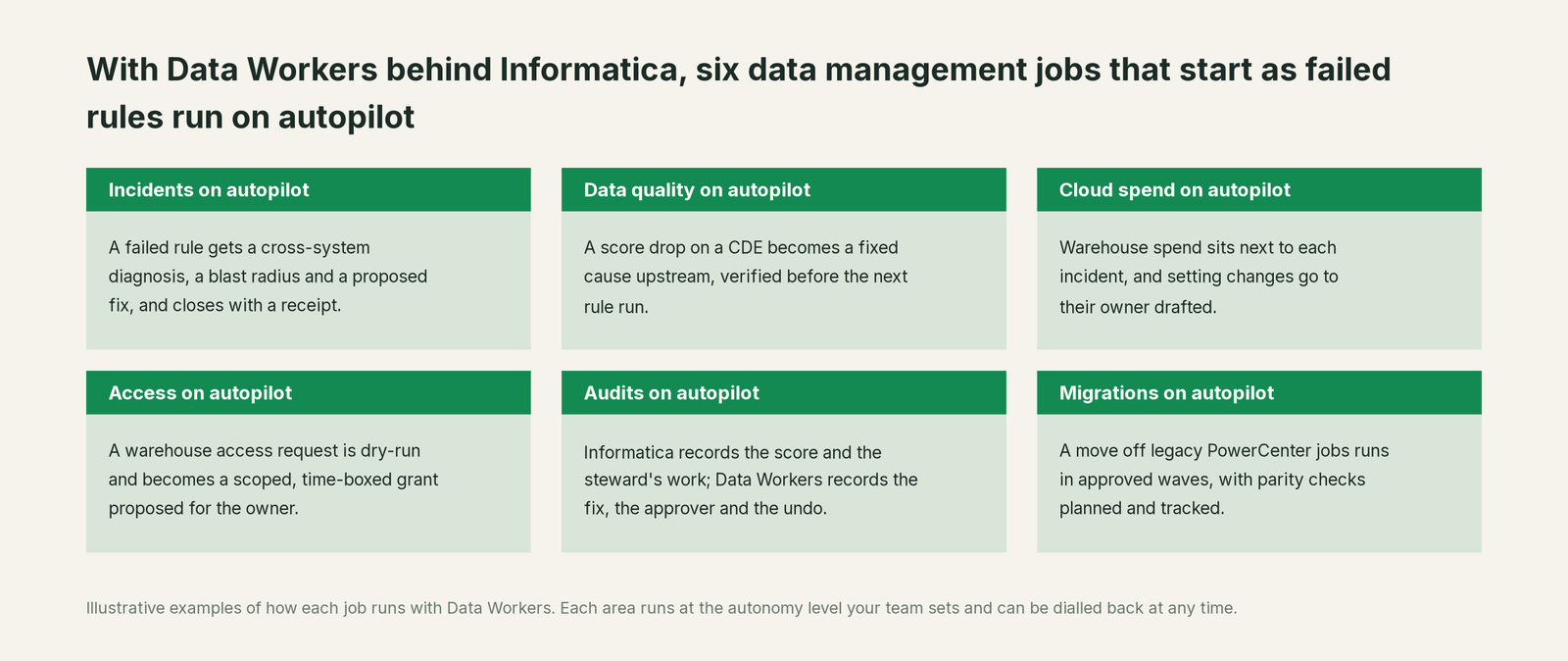
- •Incidents. A failed rule gets a cross-system diagnosis, a blast radius and a proposed fix, and closes with a receipt.
- •Data quality. A score drop on a CDE becomes a fixed cause upstream, verified before the next rule run.
- •Cloud spend. Warehouse spend sits next to each incident, and setting changes go to their owner drafted.
- •Access. A warehouse access request is dry-run and becomes a scoped, time-boxed grant proposed for the data owner to approve.
- •Audits. Informatica records the score and the steward's work; Data Workers records what changed, who approved it and how to undo it.
- •Migrations. A move off legacy PowerCenter jobs runs in approved waves, with parity checks planned and tracked and the completion gate held for the owner's sign-off.
The steward changes most: one plan to review instead of chasing four teams, and evidence the CDE stayed fixed. See the data incident response playbook and who owns the agents.
Keep Informatica Data Quality, or consolidate?
Keep Informatica Data Quality if you love it; Data Workers works with it from day one. Many teams consolidate once Data Workers runs that slice too.
Most Informatica estates keep it: the rules map to the governance program, the stewards know IDMC and MDM depends on it. What teams consolidate is the work around it: a second monitoring tool on the same tables, scripts that patch records after a failed rule, and the email thread that is the only record of last quarter's fix. Building that layer yourself on Informatica's MCP servers? Read build it ourselves with Claude Code and MCP servers: the calls are easy; the context graph, approvals and rollback are the work.
For the rest of this stack, see you're on Informatica, you're on Informatica PowerCenter, you're on Ataccama, you're on Collibra Data Quality, you're on Salesforce Data 360, you're on Prefect and what is an agentic data platform. Planning a move off legacy Informatica jobs? See automating Teradata and Informatica migrations.
The case for your CFO
The outcome: your customer master feeds billing, tax and service, and Informatica already tells your team the moment a rule fails. Data Workers turns each failure from a morning of cross-team tracing into a diagnosis on arrival and one plan with one approval, so the run that matters, a bill run or a regulatory file, goes out on correct data.
The risk story: autonomy is set per domain. At L1 Data Workers only reads; at L2 it changes nothing until a named person approves; at L3 it applies changes it can undo. IDMC, MDM and source changes stay with their owners. An unanswered approval request expires and escalates, never auto-grants. No agent can promote its own work. Every change carries a receipt: cause, change, approver, verification and undo. An org-wide stop halts all autonomous dispatch. Zero migration: Informatica, Dynamics 365, BigQuery, Prefect and Zuora stay where they are.
Why now: with the Data Quality Agent writing rules from plain language, teams catch more problems sooner, and the queue of failed rules that need a cross-system fix grows with it. The first win is read-only: every failed rule on the customer master gets a cross-system diagnosis and a blast radius. What stays the same: your rules, scores, stewards, MDM processes, change control and schedules. For the numbers, see the ROI of agentic data operations.
The sentence to repeat upstairs: "Informatica tells us which rule failed; Data Workers fixes the cause across our systems, with an approval, and proves it held."
Getting started
Start with a pilot. Pick one domain, such as the customer master, connect Data Workers to Informatica, your warehouse, orchestrator and lineage, and run at L1 so every failed rule gets a diagnosis and a blast radius. Then turn on a first write class at L2, such as orchestrator reruns after a verified reload. The pilot path and plans are on the pricing page, and the pilot is credited in full against the first year.
FAQ
Is Informatica now part of Salesforce? Yes. Salesforce completed its acquisition of Informatica on Nov 18, 2025, and the site now reads "Informatica from Salesforce". Informatica strengthens Salesforce's Data 360 and Agentforce, and IDMC, Cloud Data Quality and MDM continue as products.
How does Data Workers connect to Informatica Data Quality? Over Informatica's API or MCP servers today, reading scorecard results, data quality scores, job runs and CDGC metadata. BigQuery, Snowflake, Databricks, Prefect, Airflow, dbt and Opsgenie are native; DataHub connects over its API or MCP server today. You can also run both MCP servers in one client.
The Data Quality Agent already writes rules. Why add Data Workers? It makes rules fast to define and deploy. A failed rule still needs someone to find the cause, often outside IDMC, fix it in every system it reached and prove the fix held. That is the job Data Workers does, under one approval.
Does Data Workers change our IDMC mappings or MDM records? No. It proposes the mapping change and the merge run with the evidence attached; your integration owner and MDM steward apply them under your change process. Data Workers queues orchestrator reruns and verifies the result.
Does it work with on-premises Informatica Data Quality? Yes. Data Workers works from the results and the warehouse data those jobs produce, with the same diagnosis, plan and verification. Moving them off? Data Workers plans the move in approved waves.
Where does our data go? The agents run in your infrastructure and hold the warehouse credentials and model key. Your data stays in your systems; the hosted Conductor sees workflow metadata only, such as table names, proposals and approval records.
Sources
- •Salesforce, "Salesforce Completes Acquisition of Informatica" (Nov 18, 2025), https://www.salesforce.com/news/press-releases/2025/11/18/salesforce-completes-acquisition-of-informatica/ (checked Oct 3, 2026)
- •Informatica homepage ("Informatica from Salesforce", ©Salesforce, Inc.), https://www.informatica.com/ (checked Oct 3, 2026)
- •Informatica, Data Quality and Observability product page, https://www.informatica.com/products/data-quality.html (checked Oct 3, 2026)
- •Informatica, Cloud Data Quality product page, https://www.informatica.com/products/data-quality/informatica-data-quality.html (checked Oct 3, 2026)
- •Informatica, Data Observability product page, https://www.informatica.com/products/data-quality/data-observability.html (checked Oct 3, 2026)
- •Informatica, CLAIRE AI (CLAIRE Agents, CLAIRE GPT, CLAIRE Copilot), https://www.informatica.com/platform/claire-ai.html (checked Oct 3, 2026)
- •Informatica, "Informatica Announces Fall 2025 Release" (Oct 29, 2025: CLAIRE Data Quality Agents public preview, MCP servers), https://www.informatica.com/about-us/news/news-releases/2025/10/20251029-informatica-announces-fall-2025-release-with-latest-innovations-to-intelligent-data-management-cloud.html (checked Oct 3, 2026)
- •Informatica, "Informatica from Salesforce Delivers the Trusted Data Foundation Every AI Agent Needs" (May 20, 2026: headless data management and Data Quality Agent GA Spring 2026; Data Steward Agent Q4 2026), https://www.informatica.com/about-us/news/news-releases/2026/05/20260520-informatica-from-salesforce-delivers-the-trusted-data-foundation-every-ai-agent-needs-now-across-every-surface-every-platform-everywhere.html (checked Oct 3, 2026)
- •Informatica, "CLAIRE GPT for data quality" (recommended rules accepted or ignored by the user), https://www.informatica.com/resources/articles/claire-gpt-data-quality.html (checked Oct 3, 2026)
- •Data Workers open-source repository, https://github.com/DataWorkersProject/dataworkers-claw-community (checked Oct 3, 2026)
- •Data Workers client setup guide, https://dataworkers.io/opensource-docs/client-setup/ (checked Oct 3, 2026)