You're on Strategy (MicroStrategy): Mosaic Serves the Governed Metric. Data Workers Owns Whether the Data Under It Is Right
Already on Strategy (MicroStrategy)? Data Workers checks the tables under every Mosaic model, traces a wrong governed metric to its cause, proposes the fix behind a named approval and verifies it, with a receipt.
Your enterprise has run on MicroStrategy for years, and the company now goes by Strategy. Its BI suite, Strategy BI (renamed from Strategy One on June 29, 2026; since the July release the notes call the whole platform Strategy), carries the dashboards, reports and Library subscriptions your managers open every morning, and its Universal Semantic Layer, Strategy Mosaic, defines attributes, metrics and security filters once and serves them to Strategy dashboards, to Power BI, to certified Agents in Microsoft Teams, to the new Explorer, and to Claude, Copilot or ChatGPT through the Mosaic MCP server. Strategy serves one governed answer to every user and tool. Data Workers owns whether the data under those metrics is right: it checks the warehouse tables every Mosaic model reads, traces a moved number to the source, pipeline or dbt model that caused it, proposes the fix behind a named approval and verifies it with a receipt.
Key takeaways
- •Strategy keeps its job. Mosaic models, dashboards, subscriptions, Agents and Explorer stay with their owners.
- •One governed definition means one shared failure. When a table under a certified Mosaic model goes wrong, every dashboard, Power BI report, agent and MCP client that reads the model shows the same wrong number, consistently. Data Workers checks those tables after every run.
- •The fix lands where the cause is. A wrong Strategy number usually starts in an ERP, a pipeline or a dbt model. Data Workers proposes the fix there as a diff for its owner, behind a named approval, and queues the rerun in your orchestrator.
- •Nothing in Strategy changes. Data Workers connects to Strategy over its REST API or MCP server today and never edits a Mosaic model, metric or dashboard. Your team's client holds the read-only Mosaic MCP server next to Data Workers'.
- •Start with one certified model. Pick the Mosaic model behind a number people act on, check every table it reads, and climb from L0 manual to L4 autonomous per domain.
Strategy is the source of governed metrics. Data Workers is the keeper of the data under them.
A Mosaic metric is a promise about meaning: "Cases Shipped" says what a case is and which table counts it. Mosaic keeps that promise identical everywhere, so a quiet change in the data underneath leaves the definition intact, passes every type check and changes the answer for everyone at once.
Here is a Thursday night with Data Workers next to a Strategy estate on Snowflake at a beverage distributor. This is an illustrative example.
| Time | System | What happens |
|---|---|---|
| Thu 15:10 | Dynamics 365 Supply Chain Management | The master data team finishes a unit-of-measure cleanup: 312 beverage SKUs change their sales unit from CS (a case of 12) to EA. From now on, order lines for those items carry quantity in eaches. A valid change, approved in the master data change log. |
| 23:30 | Azure Data Factory, Snowflake | The pipeline pl_d365_sales_copy copies the day's exported sales lines into raw_d365.salesline. It succeeds. |
| Fri 00:20 | Azure Data Factory, dbt Core, Snowflake | pl_dbt_commercial runs dbt. fct_shipments sums qty as cases, as it always has; it never reads salesunit. The run is green; every test passes. |
| 00:52 | Data Workers | The post-run run_quality_check on fct_shipments passes: shipment_line_id unique, no null keys, rows above the minimum. The values the team records with monitor_metrics after each run tell a different story: Beverages cases shipped for Thursday at 182,400 against a weekday baseline near 118,000 (+55%), Beverages net revenue at $2.57M, right on its baseline, and average price per case at $14.09 against roughly $21.80. Every other category sits on baseline. Data Workers opens an incident. |
| 00:55 | Data Workers | diagnose_incident: volume up 55% with revenue flat and price per case down 35% points to a change in what is being counted, not a change in demand. The dbt manifest, read natively, shows no model change since Sept 24. trace_cross_platform_lineage follows fct_shipments through stg_d365__salesline to raw_d365.salesline; a context-graph note the team recorded says the model assumes every line is in cases. get_incident_history finds no earlier case. Data Workers drafts a check query for the owner: distinct sales units per item for Thursday's lines. |
| 00:58 | Data Workers, Slack | blast_radius_analysis lists three dbt models (agg_volume_daily, fct_price_realization, fct_route_load). Context-graph notes the BI team recorded add the Strategy Mosaic model "Commercial Volume" that reads fct_shipments: in-memory, refreshed at 05:30, feeding the Weekly Volume & Price dashboard with a 07:00 burst subscription to 140 sales managers, and certified for the Revenue Management agent in Teams and the Mosaic MCP server. send_slack_alert posts the incident, the evidence and the check query to #data-incidents. |
| 01:06 | Data Workers, Spellbook | Proposes the fix as a diff for the owner to merge: stg_d365__salesline joins the item unit-conversion table already landed in raw_d365 and converts every line to cases, and dbt tests guard it (accepted values on salesunit, not-null on the conversion factor). With it: the blast radius, the rerun plan, the undo (revert the commit, rerun) and a note for the Strategy model owner: refresh Commercial Volume after the rerun, before 07:00. The approval request reaches the analytics engineering on-call by Slack and email. Unanswered by 05:00, it escalates to the head of analytics engineering. |
| 05:12 | Snowflake, Spellbook, GitHub | The on-call runs the check query: 312 items switched to EA on Thursday afternoon. The master data lead confirms the cleanup stays. The on-call approves in Spellbook and merges the diff. |
| 05:15 | Azure Data Factory | Data Workers queues the approved pl_dbt_commercial run with trigger_adf_pipeline. |
| 05:44 | Snowflake, Data Workers | The run finishes. run_quality_check passes; monitor_metrics reads Beverages cases at 117,950 and price per case at $21.79, inside the baseline. Data Workers records the values in the incident. |
| 05:52 | Strategy | The BI owner refreshes the Commercial Volume Mosaic model in Strategy instead of waiting for the next schedule. |
| 07:00 | Strategy Library, Teams | The burst subscription goes out with 117,950 cases. A regional VP asks the Revenue Management agent in Teams how beverage volume moved; it answers from the corrected model. The BI lead checks the dashboard's Beverages tile against the value Data Workers recorded and closes the incident. Data Workers writes the receipt (cause, diff, approver, rerun, checks) and a graph note that fct_shipments depends on the sales unit. |
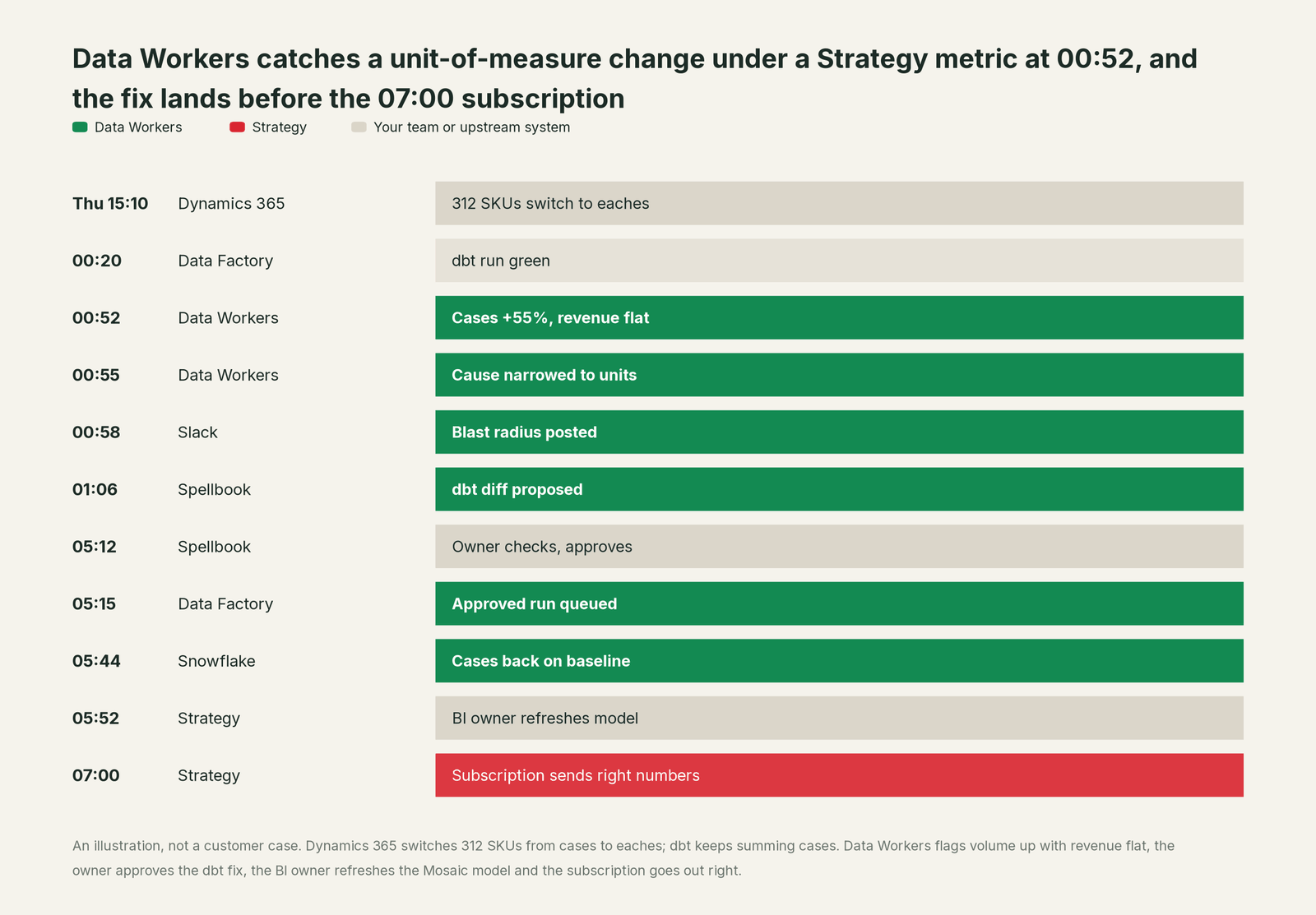
Every tool did its job; the problem lived between them: a unit change that kept the column's type and broke its meaning. Without the 00:52 check, 140 managers would have read a 55% volume surge at 07:00, and the Teams agent would have explained it.
| Job | What Strategy does | What Data Workers does |
|---|---|---|
| The definition | Defines attributes, metrics and security filters once in Mosaic models and Mosaic Schema | Records the definitions your team brings in as governed context, tied to the tables and dbt models they read |
| The answer | Serves one governed answer to dashboards, Power BI, Agents, Explorer and MCP clients | Makes sure the tables under each certified model are right before anyone asks |
| The watch | Mosaic Sentinel shows who queried what; Test Center compares reports and dashboards against a baseline | Flags the table or headline value that moved after each run and traces it to the change that caused it |
| The fix | Owners edit Mosaic models and refresh in-memory models | Proposes the upstream fix as a diff for its owner, routes it to a named approver and queues the approved rerun |
| The proof | Serves the refreshed model everywhere at once | Re-checks the tables, records the corrected value and writes a receipt with cause, diff, approver and undo |
Why doesn't Strategy just do this itself?
Strategy made a clear bet: govern the meaning of every metric once and serve it to every tool and every agent. Its guardrails fit that job well. Mosaic Schema mapping makes models inherit ACLs and security filters across dashboards, Agents, subscriptions and caches. The Mosaic MCP server accepts read-only SQL and rejects writes, and since September 2026 it needs its own privilege, off by default. Test Center runs baseline and comparison tests on reports and dashboards. Mosaic Sentinel adds usage, risk and cost views, and schema updates warn when a column's data type changes.
All of that protects the definition and the access around it. Thursday's change never touched the definition, and the column kept its type. It came through an ERP setting, a pipeline and a dbt model in systems Strategy doesn't run, and fixing it meant a dbt change, an approval, a Data Factory rerun and a warehouse check. Cross-system context, blast-radius scoping, approvals, rollback and receipts across vendors is a different product with different liability. That is Data Workers, built on the Strategy estate your business already trusts.
Every tool owns a slice. Data Workers covers the whole lifecycle
Strategy owns one slice outright: serving governed enterprise metrics through the Mosaic semantic layer to every person, tool and agent that asks. Each point tool adds another console, contract and handoff. Data Workers covers the whole lifecycle with one context, one approval flow and one audit trail.
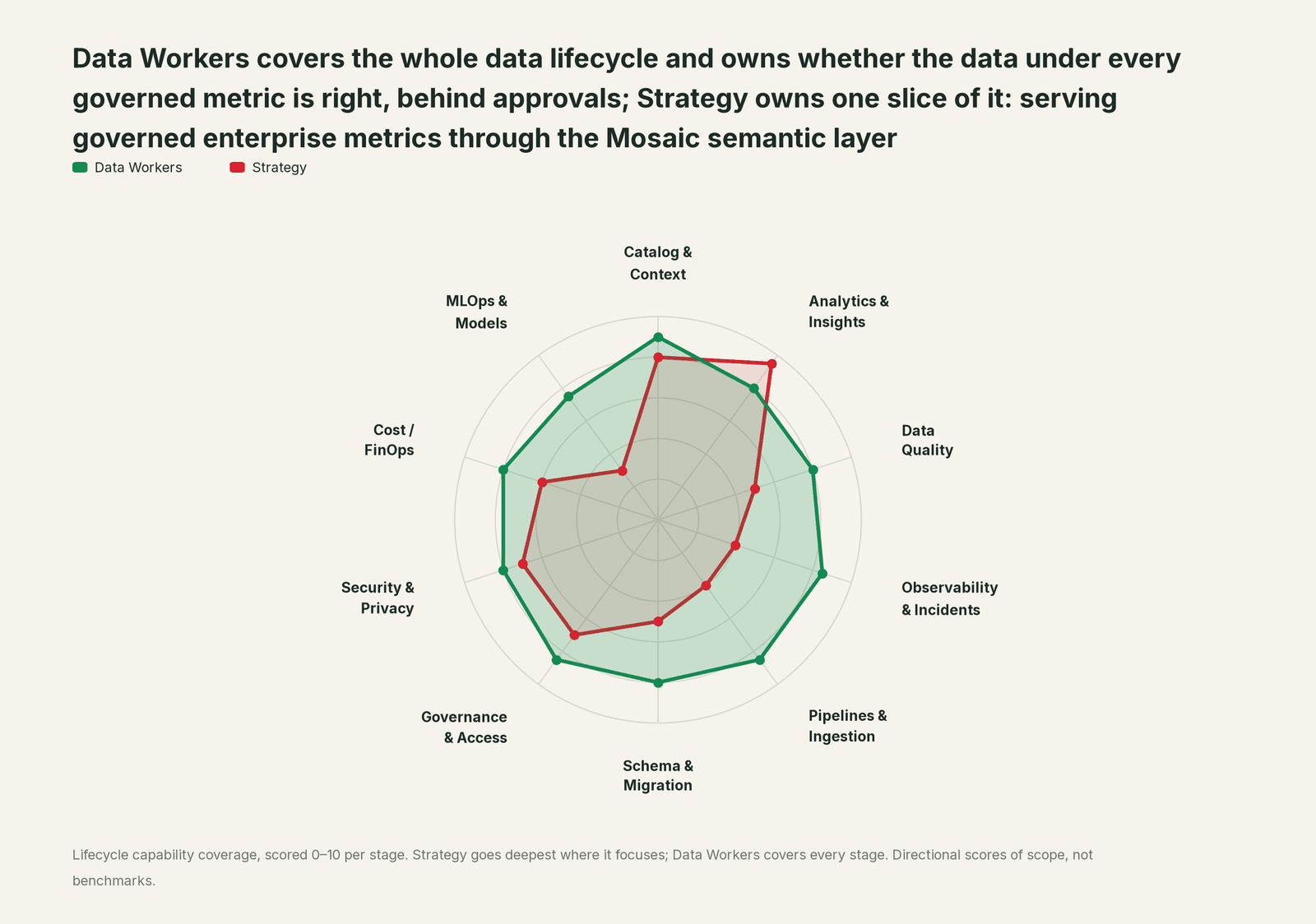
| Stage | Data Workers | Strategy | Why we scored it this way |
|---|---|---|---|
| Catalog & Context | 9 | 8 | Mosaic models and Mosaic Schema hold attributes, metrics and security filters for Strategy BI, Power BI and AI clients, with OSI YAML import and export. Data Workers keeps one governed context graph across the source, warehouse, dbt and every consumer. |
| Analytics & Insights | 8 | 9.5 | Strategy's home stage: dashboards, reports, Library subscriptions, Agents, Auto Dashboard and Explorer (Sep 2026), all served from Mosaic. Data Workers makes sure the tables under each metric are right. |
| Data Quality | 8 | 5 | Test Center baseline and comparison tests check that reports and dashboards still match after a change. Data Workers checks the warehouse tables under them after every run and holds headline values to a baseline. |
| Observability & Incidents | 8.5 | 4 | Mosaic Sentinel shows who queried what, with usage and risk views. Data Workers traces a moved number back to the source, pipeline or dbt model that caused it, proposes the fix and verifies it. |
| Pipelines & Ingestion | 8.5 | 4 | Mosaic Studio builds models and schedules in-memory model refreshes. Data Workers queues approved orchestrator reruns of the pipelines and dbt jobs that feed the warehouse. |
| Schema & Migration | 8 | 5 | Schema updates warn when a column's data type changes. Data Workers reviews dbt changes and their manifest diff and scopes the blast radius before merge. |
| Governance & Access | 8.5 | 7 | ACLs and security filters, inherited by mapped Mosaic models, govern every dashboard, agent and subscription. Data Workers routes every data change to a named approver. |
| Security & Privacy | 8 | 7 | Mosaic MCP is read-only and needs its own privilege, off by default. Data Workers leaves a receipt on every data change and proposes masking for the owner to apply. |
| Cost / FinOps | 8 | 6 | Sentinel Cost Intelligence attributes Snowflake and Databricks spend to Mosaic models. Data Workers reads Snowflake spend per query and per dbt model through query tags, and BigQuery spend from the Jobs API. |
| MLOps & Models | 7.5 | 3 | Agents and Explorer answer questions on governed data. Data Workers keeps the data under models and agents healthy. |
How Strategy and Data Workers work together
Your people stay where they are: Library dashboards and subscriptions for managers, Agents in Teams and Explorer for business questions, Claude or Copilot with the Mosaic MCP server for analysts and engineers, Slack for alerts and approval requests. Spellbook Data Catalog (in preview) is where the data team reviews each fix, its blast radius, approver and rollback. Underneath, Data Context Wizard keeps one governed context graph, the Data-Agents Swarm's 20+ specialist agents do the work, and the Autonomous Data-Conductor runs each fix end to end.
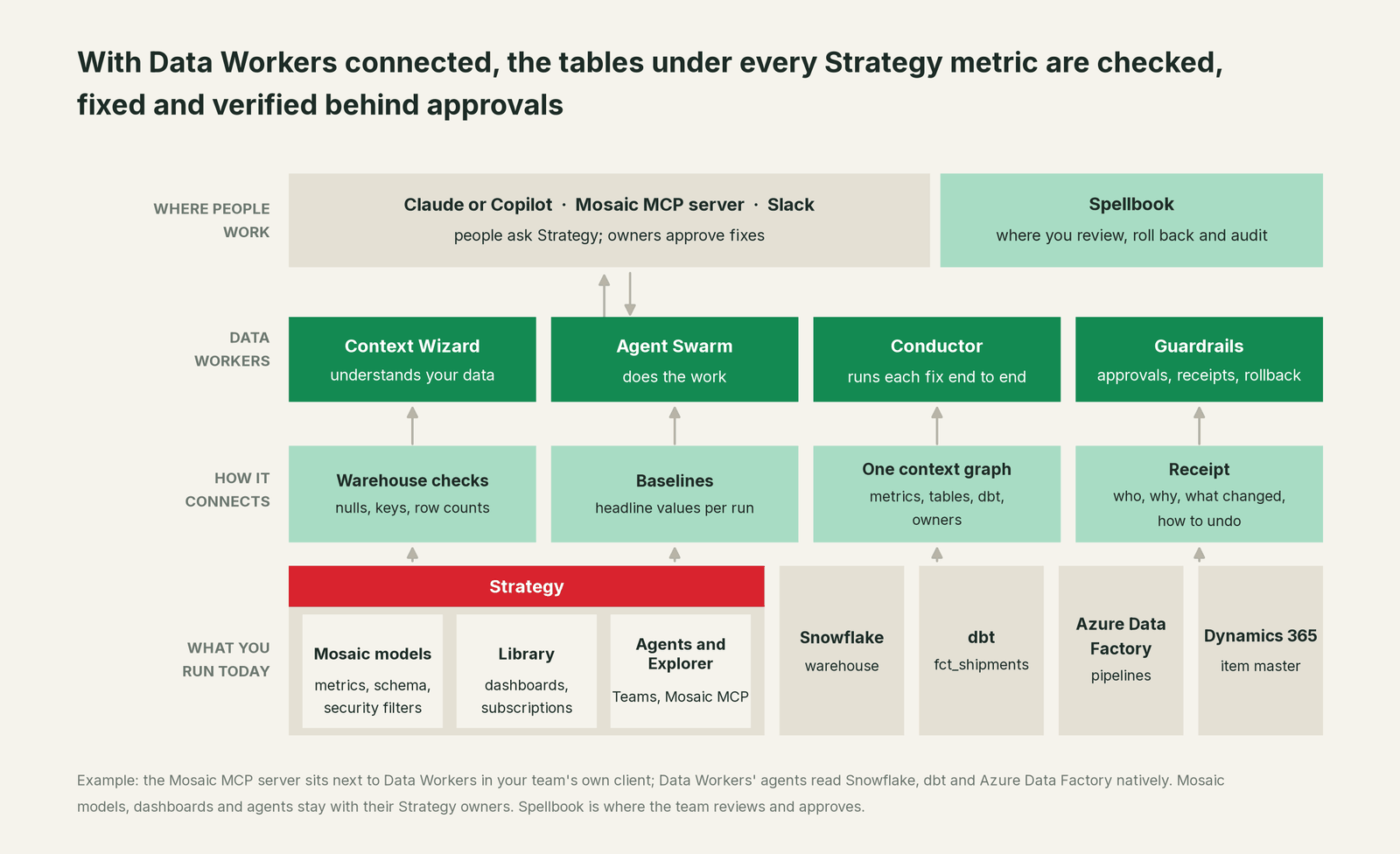
What Data Workers works from. Data Workers connects to Strategy over its REST API or MCP server today, and does its own checking on the systems under it. run_quality_check runs nulls, uniqueness on id columns and a minimum row count on Snowflake and Postgres, and on BigQuery with a service-account key; get_quality_score rolls them up. monitor_metrics holds the values your team records after each run, such as a certified metric's source query, a category's volume or a price per unit, against their baseline: that is where Thursday's 55% showed. trace_cross_platform_lineage and blast_radius_analysis follow a table back to its source and forward to every dbt model; the Mosaic models, dashboards and agents beyond them come from context-graph notes your team records (or from pull-request review's lineage diff when the fix goes through a PR). explain_table returns a table's definition, lineage, documentation and trust score. diagnose_incident, remediate and get_incident_history run and record the incident. Data Workers reads Azure Data Factory pipeline runs and the dbt manifest natively; Dynamics 365 and Strategy connect over their APIs today. Your data stays in your systems; the hosted Conductor sees workflow metadata only.
How Mosaic definitions come in. Your coding agent reads a certified model's definition (through get_semantics on the Mosaic MCP server, or an OSI YAML export) and hands its metrics and the tables behind them to Context Wizard as governed definitions, the path LookML to Data Context Wizard walks through for Looker; You're on OSI Semantics covers the YAML route. Data Workers never edits a Mosaic model, metric, security filter or dashboard; their owners do.
Setup over MCP today. Clone the open-source repository and add start-agent.sh entries to your client's MCP config, per the client setup docs. Strategy documents two MCP endpoints in Strategy Library: Agents MCP (list_agents, ask_agent) and Mosaic MCP (get_projects, get_models, get_semantics and a query tool that runs read-only SQL and rejects writes). Both sign in through Strategy Library with OAuth, and models must be published and certified to appear. The Mosaic server sits next to Data Workers for your own questions; Data Workers' agents never call it.
// Example: .mcp.json for Claude Code. The Strategy entry is your team's
// own Mosaic MCP connection (sign in through Strategy Library when
// prompted); Data Workers does not call it.
{
  "mcpServers": {
    "strategy-mosaic": {
      "type": "http",
      "url": "https://<your-strategy-environment>/collaboration/mcp/mosaic"
    },
    "dw-context-catalog": {
      "command": "/path/to/dataworkers-claw-community/start-agent.sh",
      "args": ["dw-context-catalog"]
    },
    "dw-quality": {
      "command": "/path/to/dataworkers-claw-community/start-agent.sh",
      "args": ["dw-quality"]
    },
    "dw-incidents": {
      "command": "/path/to/dataworkers-claw-community/start-agent.sh",
      "args": ["dw-incidents"]
    }
  }
}
List the tools with your client's own command (for example /mcp). An analyst can then ask "is everything under Commercial Volume healthy?" and get Mosaic's answer and Data Workers' checks side by side.
Where fixes go. Data Workers proposes the change as a diff for the owner to merge, usually a dbt model or source mapping, with its blast radius and undo step; it opens the pull request itself only when your team turns on the dbt GitHub pull-request target. After approval it queues the rerun through your orchestrator. In-memory Mosaic models and cubes refresh on their Strategy schedule or when the BI owner refreshes them; live models read the fixed table on the next query.
One request, L0 to L4. The autonomy ladder is set per domain.
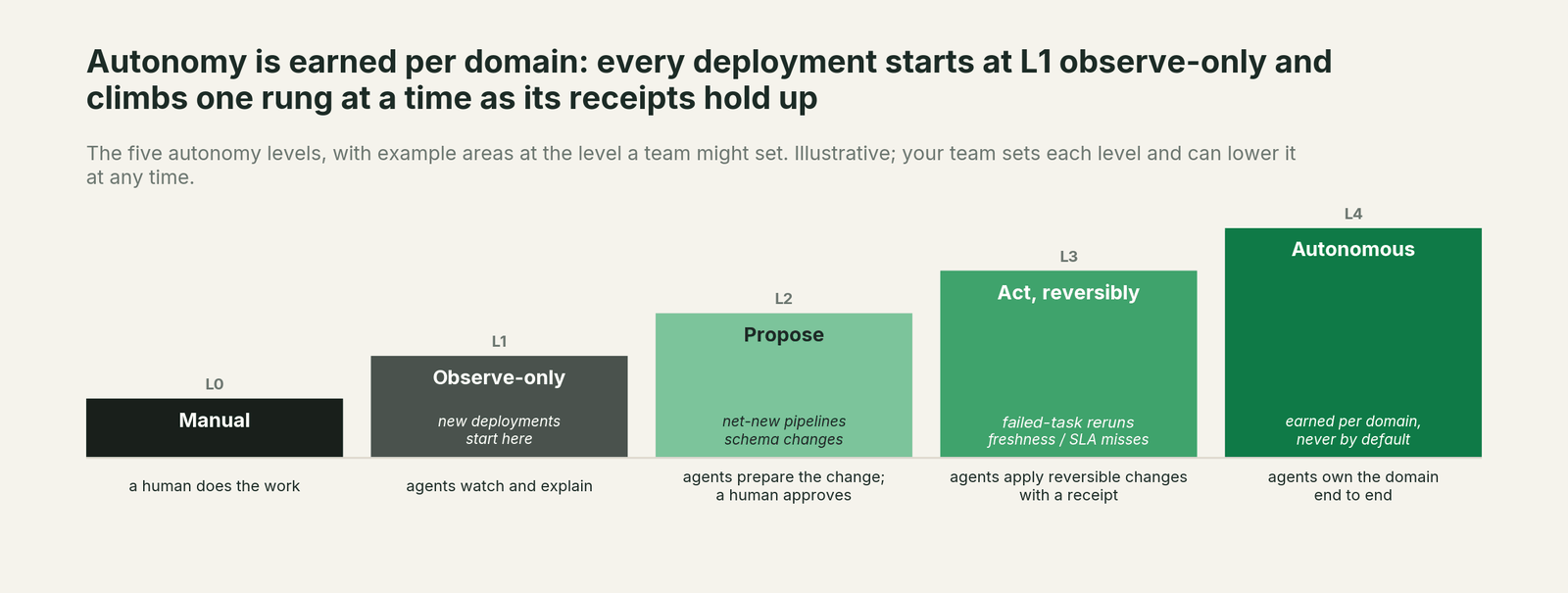
- •L0 manual. A sales manager questions a strange volume number and the BI team chases it by hand.
- •L1 observe. Data Workers checks every table under your certified Mosaic models and logs what it would do.
- •L2 propose. It drafts the upstream fix with its blast radius; a named owner approves in Spellbook first.
- •L3 act reversibly. For proven classes, such as queuing the orchestrator rerun after an approved dbt fix, it acts, verifies and can roll back.
- •L4 autonomous. For a narrow class in one domain, it fixes and verifies on its own and posts the receipt.
Approvals go to a named person; an unanswered request expires and escalates, never grants itself. No agent can promote its own work. Read is it safe to let AI agents change production data, how approvals work in practice, what the autonomy levels mean, who owns the agents and where does our data go for the full safety model.
Related: You're on Azure Data Factory, You're on AtScale, You're on Power BI and You're on Looker. On semantic layers: what is a semantic layer, semantic layer tools compared and the context and semantic layer market landscape.
What changes for your team
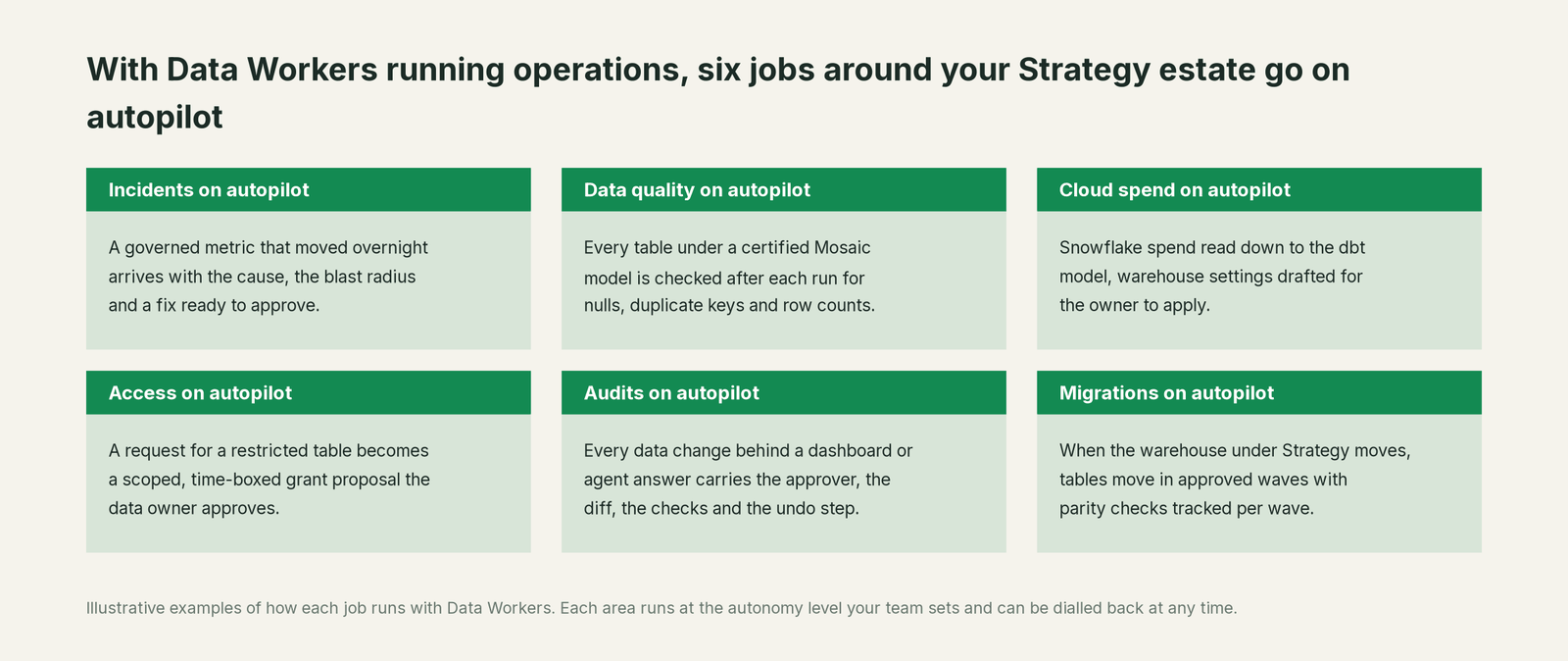
Strategy teams lose much of the week to one question: is a strange number the metric, the security filter or the data? With Data Workers, these jobs run on autopilot at the level you set.
- •Incidents. A governed metric that moved overnight arrives with its cause, blast radius and a fix ready to approve.
- •Data quality. Every table under a certified Mosaic model is checked after each run for nulls, duplicate keys and row counts, with headline values held to a baseline.
- •Cloud spend. Snowflake spend is read per query and per dbt model through query tags, with warehouse settings drafted for the owner to apply.
- •Access. A request for a restricted table becomes a scoped, time-boxed grant proposal the data owner approves.
- •Audits. Every data change behind a dashboard, subscription or agent answer carries its approver, diff, checks and undo step.
- •Migrations. When the warehouse under Strategy moves, tables move in approved waves, parity checks tracked per wave.
Keep Strategy, or consolidate?
Keep Strategy if you love it; Data Workers works with it from day one. Many teams consolidate once Data Workers runs that slice too.
Most Strategy estates keep Strategy: years of reports, Mosaic models and security filters belong there. What they consolidate is the tooling around it: a separate data-quality tool, scripts that compare dashboard numbers with warehouse queries, a spreadsheet of who owns which table. Weighing a build on the Mosaic MCP server? Read build it ourselves with Claude Code and MCP servers: connecting servers is easy; cross-system context, approvals and rollback are the work.
The case for your CFO
The outcome: the governed numbers Strategy serves to managers, to Power BI and to every agent stay right, and when something upstream breaks, the fix arrives before the morning subscription, with a named approver.
The risk story: Data Workers changes nothing in Strategy. It checks the warehouse tables under each certified model and proposes upstream fixes as diffs; nothing runs until the named owner approves. Every change is verified and leaves a receipt: what broke, what changed, who approved it, how to undo it. Autonomy is set per domain from L0 manual to L4 autonomous, and an org-wide stop halts all autonomous dispatch. There is zero migration.
Why now: Mosaic now feeds agents in Teams, Explorer and MCP clients. A broken table reaches executives as a confident sentence, with no analyst in between.
The first win: one certified Mosaic model that feeds a weekly decision, every table under it checked after each run. What stays the same: your Mosaic models, security filters, dashboards and subscriptions, your ERP, Data Factory, dbt and review process. For the numbers, see the ROI of agentic data operations.
The sentence to repeat upstairs: "Strategy keeps serving one governed number to everyone; Data Workers makes sure the data under that number is right, with a named approver and a receipt on every fix."
Getting started
Start with a pilot. Pick the certified Mosaic model behind a number people act on, connect Data Workers read-only to the warehouse, dbt and your orchestrator, record its headline values as baselines, and let it check every table the model reads for a few weeks before turning on the first fix class. The pilot path and plans are on the pricing page, and the pilot is credited in full against the first year.
FAQ
Does Data Workers change our Mosaic models, metrics or dashboards? No. They stay with their Strategy owners. Data Workers proposes fixes in the systems underneath, such as a dbt model, and a named owner approves them.
We already use Test Center and Mosaic Sentinel. Why add this? Keep them. Test Center checks that a report still matches its baseline after a Strategy change; Sentinel shows who queried what. Data Workers watches the warehouse tables under the model after every run, tells you why a number moved, and carries the fix through approval, rerun and verification.
A Strategy agent gave a wrong answer. Was it the agent, the metric or the data? Check the tables first. Often the agent answered faithfully from the Mosaic model and the data underneath had moved. Data Workers shows whether a table under the model failed a check or left its baseline, and traces it to the source, pipeline or dbt model that changed.
Do Data Workers' agents use the Mosaic MCP server? No. Your team runs it side by side in the same client, where it is read-only by Strategy's design. Data Workers relies on its own warehouse, dbt and orchestrator connections.
Does Data Workers refresh our in-memory Mosaic models or cubes after a fix? No. They refresh on their Strategy schedule or when the BI owner refreshes them. Data Workers puts the refresh in the fix plan, re-checks the tables and records the corrected value.
Which warehouses does this cover? The table checks run natively on Snowflake, Postgres and BigQuery (with a service-account key). Across 50+ connectors Data Workers also works natively with dbt, Airflow, Dagster, Prefect and Azure Data Factory; what integrations Data Workers supports lists each one.
Sources
- •Strategy, What's New with Strategy (Sep 18 2026 entries: Explorer, Test Center, Dynamic Parameterized Metrics in Mosaic Models, Sentinel Query Performance Analytics, Gemini 3.x; spotlights on Mosaic Schema mapping, Apache Ossie YAML and Sentinel Cost Intelligence), https://software.strategy.com/whats-new (checked Oct 3, 2026)
- •Strategy, What's New in Strategy readme (September, August, July and June 2026 releases: Explorer, filtered Mosaic model refreshes, Mosaic MCP certification, Agents in Teams, Test Center, rename), https://www2.strategy.com/producthelp/Current/Readme/en-us/content/whats_new.htm (checked Oct 3, 2026)
- •Strategy, Interact with Agents, Mosaic Models, and Cubes Using an MCP Server (Agents MCP and Mosaic MCP tools, read-only query, OAuth, privileges split in Sep 2026), https://www2.strategy.com/producthelp/Current/NextGenAI/en-us/Content/agent_MCPServerIntegration.htm (checked Oct 3, 2026)
- •Strategy, Use Explorer as an MCP Client to Interact with Other MCP Servers, https://www2.strategy.com/producthelp/Current/NextGenAI/en-us/Content/Explorer_MCP.htm (checked Oct 3, 2026)
- •Strategy blog, Strategy One is now Strategy BI (Jun 29, 2026), https://software.strategy.com/blog/strategy-one-is-now-strategy-bi (checked Oct 3, 2026)
- •Strategy, press release: Mosaic Sentinel and cloud cost arbitrage (Mar 9, 2026), https://www.strategy.com/press/strategy-announces-mosaic-sentinel-and-cloud-cost-arbitrage-at-the-gartner-data-analytics-summit-2026_03-09-2026 (checked Oct 3, 2026)
- •Data Workers, Client setup (open-source docs), https://dataworkers.io/opensource-docs/client-setup/ (checked Oct 3, 2026)
- •Data Workers open-source repository, agent tools and start-agent.sh, https://github.com/DataWorkersProject/dataworkers-claw-community (checked Oct 3, 2026)