You're on Promethium: Keep Every Federated Answer Right, From the Source System to the Mantra Reply
Already on Promethium? Data Workers reads its context as one governed source and keeps the pipelines under every Mantra answer right, with approvals and receipts.
Your company asks its data questions through Promethium. The Mantra AI Insights Fabric, which Promethium introduced in May 2026, sits across Snowflake, Databricks, Oracle, SQL Server, Postgres, S3 and Salesforce, and the Universal Query Engine, built on Trino, queries them live where the data sits, with no copies to keep in sync. The 360° Context Hub pulls meaning from Alation, Collibra or Atlan, Tableau, Power BI and Looker, dbt and AtScale, plus the business rules your stewards keep in Mantra, into the Insights Context Graph. People ask Mantra in plain language, from Promethium or from Claude, ChatGPT and Copilot through Promethium's MCP interface and open APIs, and every Data Answer arrives with its SQL, its lineage and a Trust Score. Experts endorse, correct or flag answers, and the good ones go to the Answer Marketplace for everyone to reuse.
Promethium is where your people get answers. Data Workers is the agentic data platform that keeps the data under those answers right. Data Context Wizard reads Promethium's context as one source with provenance, and when an upstream change breaks a model, the Data-Agents Swarm traces it, proposes the fix, routes it to a named owner and leaves a receipt. That seam is what this guide covers.
Key takeaways
- •Promethium keeps its job. Mantra, the Insights Context Graph, the 360° Context Hub, the Trust Harness and your Datamaps stay as they are. Data Workers works next to them from day one.
- •Promethium's context becomes one governed source. Your team's assistant brings it in from Promethium's MCP interface, with provenance, and Data Context Wizard joins it to lineage, quality and owners.
- •Breaks are fixed upstream, before the question. Data Workers catches a break in the jobs under your federated sources overnight and lands the fix in the tool that owns it, such as a SQLMesh diff for the owner to merge or a Dagster backfill.
- •Writes go through one approval flow. Every change carries its blast radius, a named approver in Spellbook, a rollback path and a receipt.
- •Start with a pilot. One domain, read-only, then one fix class, on the ladder from L0 manual to L4 autonomous.
Promethium is the answer fabric. Data Workers is the crew that keeps it true.
Promethium answers questions across systems without moving data, carefully. Its Trust Harness validates every answer "against the Insights Context Graph before delivery", packages the SQL, sources and definitions applied, and flags lower-confidence answers "for manual review by a domain expert before reaching the business." The Trust Score checks the definitions, joins, business rules and filter values an answer rests on, and rates it Confident, Needs Attention or Review Required.
All of that happens at question time, over the data as it is. The syncs, models and jobs that produce that data sit in other tools, run by other teams, and change every week. Data Workers covers that side.
Here is a renewal week with Data Workers next to Promethium. This is an illustration, not a customer case.
| Time | System | What happens |
|---|---|---|
| 17:20 | Zendesk | Support ops renames the option tags on the custom "escalation level" field, from esc_t2 and esc_t3 to escalation_tier_2 and escalation_tier_3 |
| 02:00 | Airbyte | The nightly Zendesk sync lands tickets in Databricks with the new tag values |
| 02:40 | SQLMesh + Dagster | Dagster runs the SQLMesh plan; fct_escalations still filters on the old tags, so new escalations drop out; the run succeeds |
| 02:55 | Data Workers | The volume check on fct_escalations fails against its baseline; Data Workers spots the new values in the source column, traces Zendesk to Airbyte to Databricks to SQLMesh, and opens an incident with the model's owner |
| 08:05 | Claude | The VP of Customer Success asks Mantra, through Promethium's MCP interface, which accounts renewing this month had more than three tier-2 escalations last quarter |
| 08:06 | Promethium | Mantra joins Salesforce renewal dates with escalations in Databricks, live, and returns the answer with its SQL, lineage and Trust Score |
| 08:07 | Data Workers | In the same chat, get_incident_history reports the open incident on fct_escalations: tickets since 17:20 yesterday are missing, so the count is low |
| 08:20 | SQLMesh | Data Workers proposes a diff that maps the new tags, with its blast radius: three models, one Promethium Datamap and one Power BI report |
| 09:05 | Spellbook | The support analytics owner reviews the diff and approves; SQLMesh CI passes |
| 09:10 | Dagster | Data Workers triggers the backfill for the affected days |
| 09:30 | Databricks | Escalation counts are back on their monitor_metrics baseline and the support lead confirms them against Zendesk; Data Workers writes the receipt |
| 09:35 | Promethium | The VP asks again; Mantra's answer now includes the accounts that were missing, and she endorses it for the Marketplace |
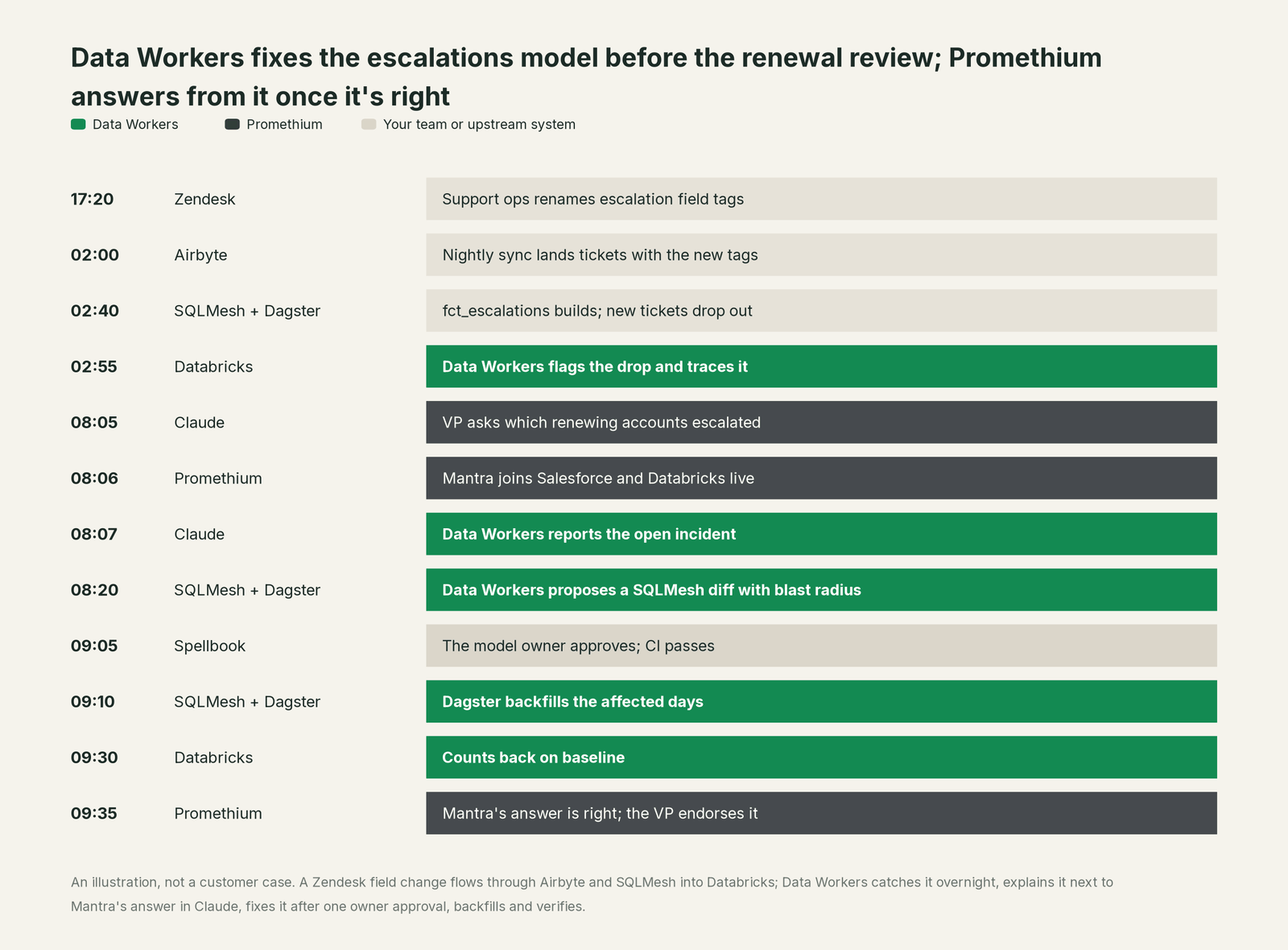
Promethium did what it promises: a live, governed, explained answer across two systems. The cause sat three hops upstream, in a tag rename that left the data internally consistent. Data Workers was on it at 02:55 and fixed it in SQLMesh, the tool that owns the logic, after one owner approval.
| Job | What Promethium does | What Data Workers does |
|---|---|---|
| The question | Takes it in plain language in Mantra, or from Claude, ChatGPT and Copilot over MCP and APIs | Adds the operational facts behind the number: open incidents, freshness, quality and the owner |
| The query | Federates live across Snowflake, Databricks, Oracle, Salesforce and more, with pushdown and no copies | Keeps the tables those queries read correct and current |
| The context | Builds the Insights Context Graph from catalogs, BI tools, semantic layers and business rules | Reads that graph as one source with provenance and joins it to lineage, quality and usage across the estate |
| The trust check | Validates each answer and scores it Confident, Needs Attention or Review Required | Finds why an answer would be wrong upstream and fixes the cause |
| The fix | Lets experts correct a definition, join or metric in the graph | Proposes code fixes in SQLMesh, dbt or the load job with a blast radius, routes them to a named owner, applies them reversibly |
| The proof | Ships SQL, lineage and reasoning with every answer; logs actions in audit logs | Verifies with checks and baselines on the changed tables and writes a receipt: cause, diff, approver, rollback |
Why doesn't Promethium just do this itself?
Because Promethium built an answer fabric and made sensible choices for that job. Its docs say it "needs read-only access at a minimum" to each source, "enabling metadata crawling and safe query execution without altering your source systems." Its Universal Query Engine is zero-copy by design: "no ETL pipelines to build, no replication jobs to monitor." It can materialize a Datamap as a table on a refresh schedule, and its trust model checks answers at question time and sends doubtful ones to a domain expert. That is exactly right for a product whose promise is a fast, governed answer from any system.
Changing the systems underneath is a different product. Fixing a Zendesk tag change means editing a SQLMesh model the support analytics team owns, rerunning a Dagster job the platform team owns and checking every Datamap, report and model that reads the table. That takes lineage across tools Promethium doesn't run, blast-radius scoping, approvals, rollback for every change class and liability for changes in other vendors' systems. Promethium keeps its sources read-only, which keeps every source system safe. Data Workers is the product on the other side of that line.
Every tool owns a slice. Data Workers covers the whole lifecycle
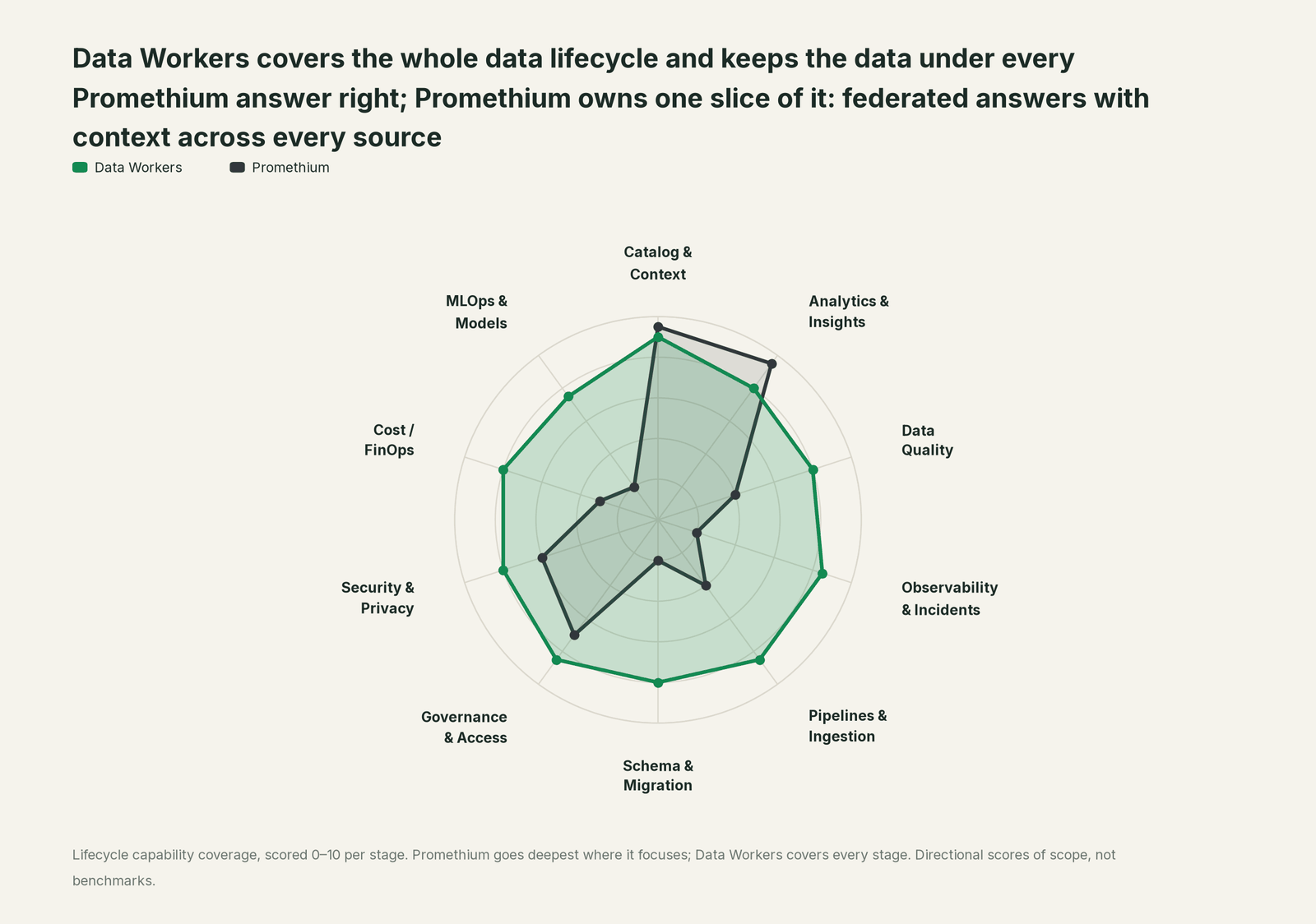
Promethium owns one slice of the data lifecycle outright: federated answers with context across every source. Each point tool adds another console, contract and handoff. Data Workers covers the whole lifecycle with one context, one approval flow and one audit trail, and builds on Promethium where your people already ask.
| Stage | Data Workers | Promethium | Why we scored it this way |
|---|---|---|---|
| Catalog & Context | 9 | 9.5 | Promethium's home stage: the 360° Context Hub pulls context from Alation, Collibra, Atlan, Tableau, Power BI, Looker, dbt, AtScale and your documents into the Insights Context Graph. Data Workers reads that context as one source with provenance, next to lineage, quality and usage. |
| Analytics & Insights | 8 | 9.5 | Promethium's other home stage: Mantra answers in plain language over live data across Snowflake, Databricks, Oracle, Salesforce and more, with SQL, lineage and a Trust Score on every answer. Data Workers answers metric questions through governed definitions. |
| Data Quality | 8 | 4 | The Trust Score checks an answer's definitions, joins and filter values against your context and data. Data Workers runs and repairs the quality checks on the tables under those answers. |
| Observability & Incidents | 8.5 | 2 | Promethium tells you when an answer can't be fully verified. Data Workers detects the break in the pipeline, traces it across systems, fixes it and verifies the result. |
| Pipelines & Ingestion | 8.5 | 4 | Datamaps can be materialized as tables with scheduled refresh pipelines, and federation avoids copies. Data Workers builds, reruns and backfills the ingestion and transformation pipelines upstream, with approvals. |
| Schema & Migration | 8 | 2 | Source schemas are crawled as metadata. Data Workers catches upstream schema changes in the dbt manifest and in review, assesses their impact and drafts each migration with rollback SQL for the owner to apply. |
| Governance & Access | 8.5 | 7 | Strong over its own surface: permission sets, object-level access by domain, and a modified Open Policy Agent applying row, column and policy security at query time. Data Workers proposes and applies grants on your data platforms by policy. |
| Security & Privacy | 8 | 6 | Strong for its own estate: a data plane in your cloud, no data sent to the control plane by default, SSO and audit logs. Data Workers flags sensitive column names in pull request review and proposes masking for the owner. |
| Cost / FinOps | 8 | 3 | Zero-copy federation avoids replication jobs. Data Workers traces Snowflake credits to the dbt model behind them and drafts the fix for its owner. |
| MLOps & Models | 7.5 | 2 | Model training and monitoring sit outside an answer fabric's job. Data Workers keeps the data under your models healthy and connects to MLflow and W&B. |
How Promethium and Data Workers work together
Your people stay where they ask: Mantra, or Claude, ChatGPT and Copilot connected to Promethium. Spellbook Data Catalog (in preview) is where the data team looks: each proposed change, its blast radius, its approver and how to roll it back. Underneath, Data Context Wizard keeps one governed context graph, the Data-Agents Swarm does the work with more than 20 specialist agents, and the Autonomous Data-Conductor runs each fix end to end: detect, diagnose, fix, review, verify, remember.
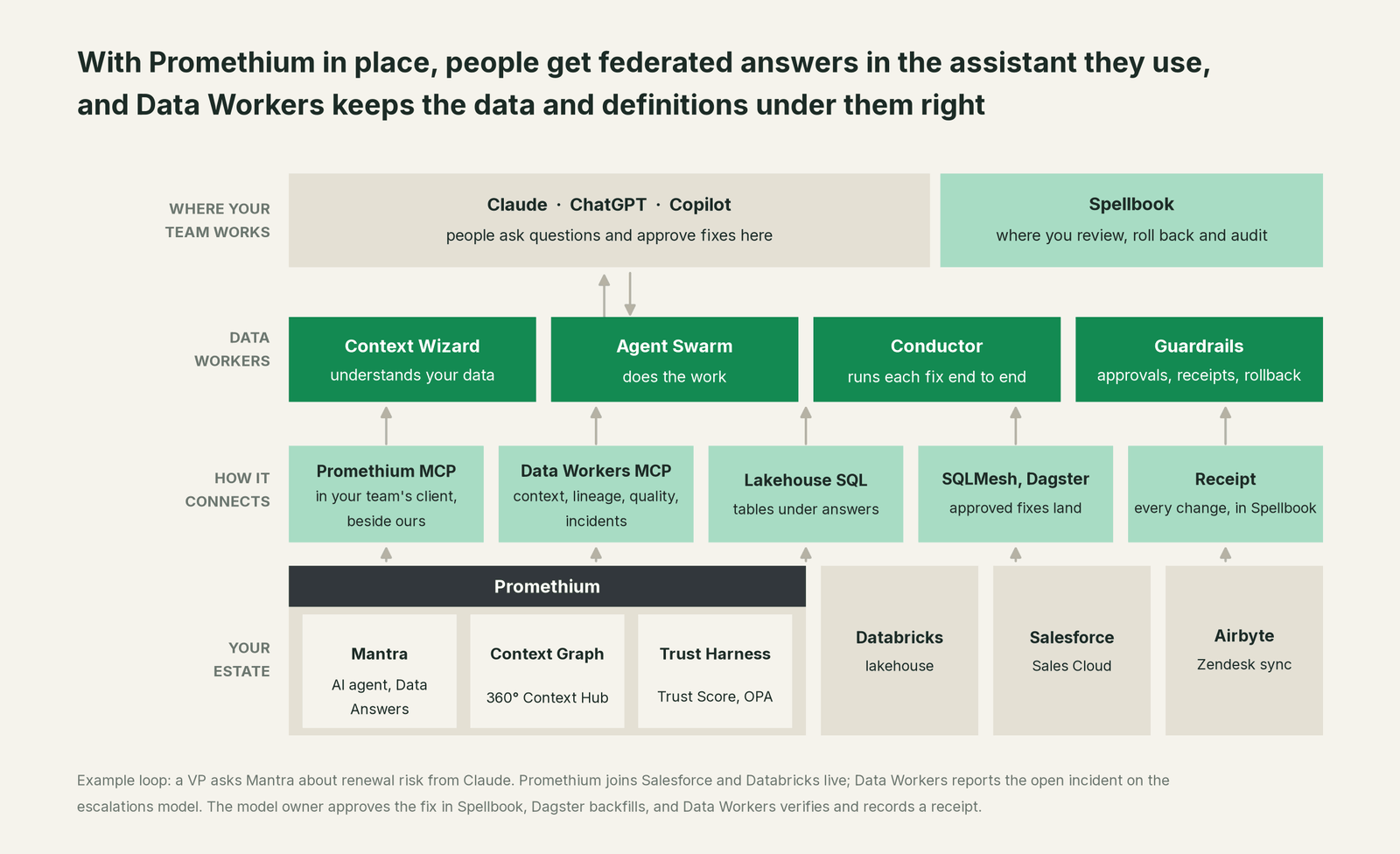
Bring your own context. Promethium has already gathered business rules, glossary terms, endorsed joins and metric logic. Data Context Wizard treats that as a first-class source, never a copy to replace. Your team's assistant hands Promethium's context to it from Promethium's MCP interface, and it records each fact with where it came from and who owns it. To bring in the business rules your stewards keep as Promethium YAML, map each rule to the asset it governs and pass the list to import_tribal_knowledge, which stores each entry as a structured rule with its author and assets. An owner can mark the canonical table for a metric with mark_authoritative.
From then on, Context Wizard joins Promethium's "tier-2 escalation" to the SQLMesh model that computes it, the Airbyte sync that feeds it, its quality score and its freshness. When Promethium's rule and a dbt or BI definition disagree, the conflict goes to a named owner. The context stays yours, in Promethium: Data Workers sends definition changes to the owner there as proposals, and code fixes land in the tool that owns the logic. For the pattern across semantic layers, ontologies and context engines, see the hub, bring your own context.
Setup over MCP today. Data Workers connects to Promethium over its MCP interface or API today, and runs next to it in the same assistant. Your Promethium team provides the MCP endpoint and authentication for your tenant. Data Workers' agents come from the open-source repository: clone it and add start-agent.sh entries to the client config, as the client setup docs show.
// Example: .mcp.json for Claude Code with Promethium and Data Workers side by side
{
  "mcpServers": {
    "promethium": {
      "type": "http",
      "url": "<your Promethium MCP endpoint, from your Promethium team>"
    },
    "dw-context-catalog": {
      "command": "/path/to/dataworkers-claw-community/start-agent.sh",
      "args": ["dw-context-catalog"]
    },
    "dw-incidents": {
      "command": "/path/to/dataworkers-claw-community/start-agent.sh",
      "args": ["dw-incidents"]
    },
    "dw-quality": {
      "command": "/path/to/dataworkers-claw-community/start-agent.sh",
      "args": ["dw-quality"]
    },
    "dw-schema": {
      "command": "/path/to/dataworkers-claw-community/start-agent.sh",
      "args": ["dw-schema"]
    }
  }
}
List the tools with the client's own command (for example /mcp). The ones this guide uses are explain_table (definition, lineage and documentation), resolve_metric, trace_cross_platform_lineage and blast_radius_analysis on dw-context-catalog, get_quality_score on dw-quality, and get_incident_history, diagnose_incident and remediate on dw-incidents. The product's remote endpoint, running in your VPC next to Promethium's data plane, takes an API key or OAuth through your identity provider; you're on ChatGPT Enterprise shows ChatGPT reaching the same tools.
One question end to end, L0 to L4. Autonomy is set per domain on the ladder.
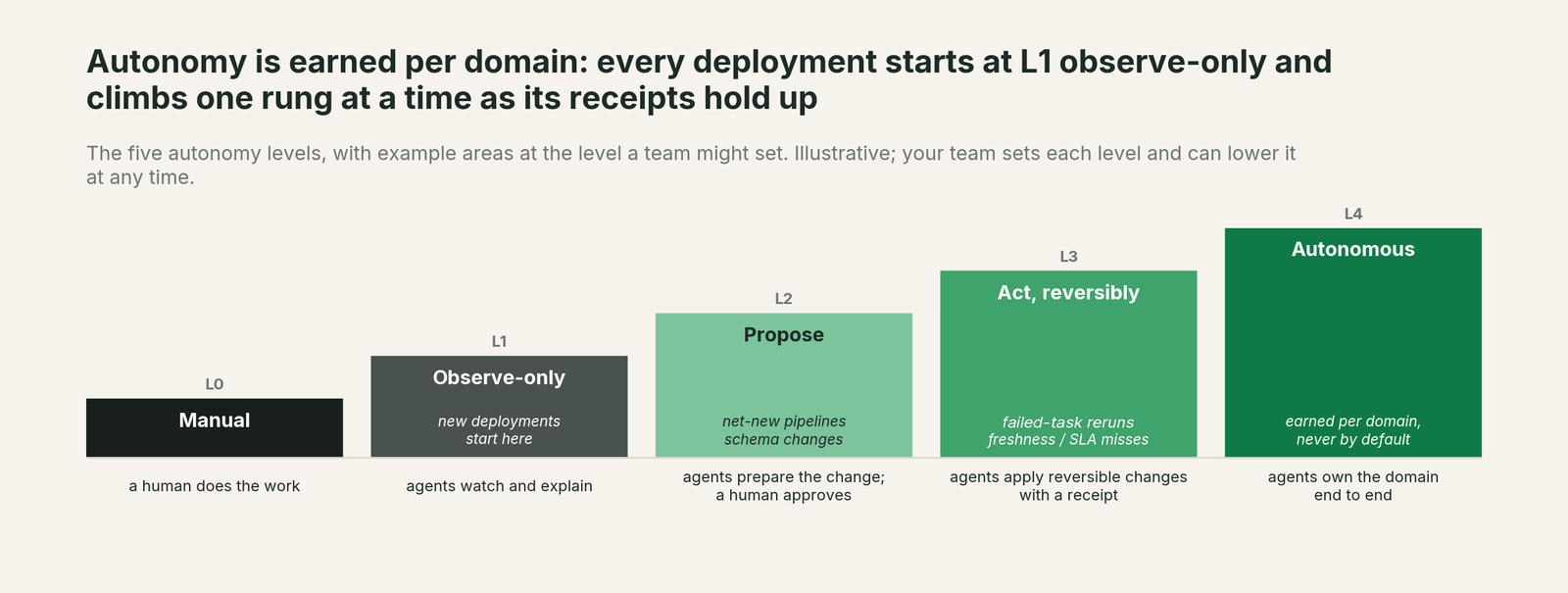
- •L0 manual. Mantra answers; when a number looks off, your team digs through the pipelines by hand.
- •L1 observe. Read tools only. Next to Mantra's answer, Data Workers reports lineage, load lag against its baseline, the quality score and any open incident on the tables it used.
- •L2 propose. Data Workers drafts the SQLMesh or dbt diff with its blast radius; nothing ships until the owner approves in Spellbook and CI passes.
- •L3 act reversibly. For change classes with a proven record, such as backfills of failed partitions, Data Workers applies the change, re-runs the checks on the changed tables, with the undo recorded before it runs.
- •L4 autonomous. For a scoped domain like freshness breaks on the support marts, Data Workers fixes overnight, with a receipt waiting in Spellbook.
Each step up is a per-domain decision backed by receipts, and you can step back down any time. For the safety model, read is it safe to let AI agents change production data; for where data and credentials live, where does our data go. Teams on other context layers can compare you're on Jedify and you're on Kaelio.
What changes for your team
Promethium gave the business a way to ask across every system. Data Workers gives the data team a crew, so more questions don't mean more "is this number right?" tickets.
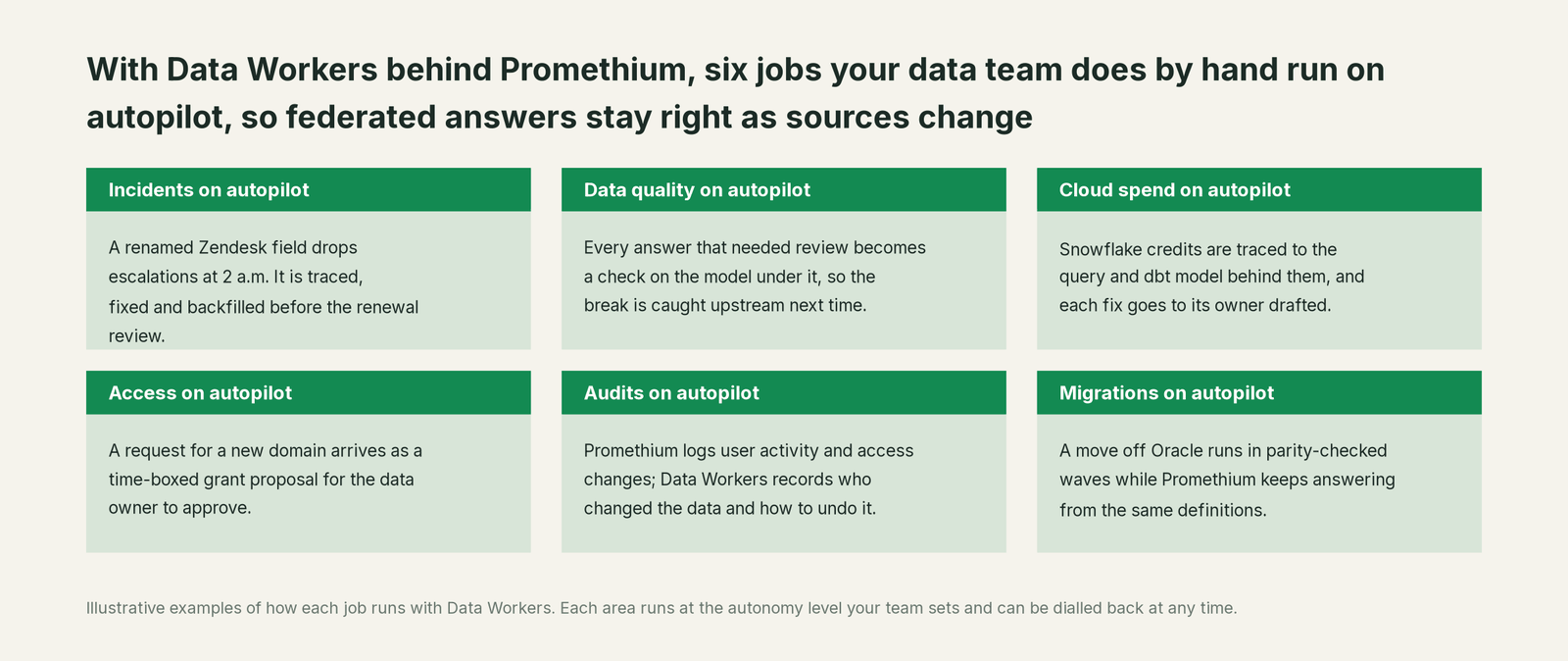
- •Incidents. A source change that breaks a model at 2 a.m. is fixed and backfilled before anyone asks Mantra.
- •Data quality. An answer flagged for review because of bad data becomes a check on the model under it.
- •Cloud spend. Snowflake credits are traced to the query and dbt model behind them, and each fix goes to its owner drafted.
- •Access. A request for a new domain arrives as a time-boxed grant proposal for the data owner, with its policy.
- •Audits. Promethium's audit logs cover user activity, access changes and data operations in Promethium. Data Workers' receipts show who changed the data, why and how to undo it.
- •Migrations. A move off Oracle or SQL Server runs in approved, parity-checked waves while Promethium keeps answering.
Domain experts keep endorsing, correcting and flagging answers. Analytics engineers stop chasing upstream causes by hand.
Keep Promethium, or consolidate?
Keep Promethium if you love it; Data Workers works with it from day one. Many teams consolidate once Data Workers runs that slice too.
For most teams the answer is to keep Promethium. Its federated access, Context Hub and answers inside the assistants people already use are why the business asks data questions at all. Data Workers adds the slice an answer fabric leaves to the systems underneath: incident repair, quality, schema change, access, cost and change control. Where teams consolidate, it is usually a standalone observability tool or a second glossary only the data team reads. If you are weighing a homegrown repair layer, build it ourselves with Claude Code and MCP servers walks through what it takes to write safely across tools you don't own.
The case for your CFO
The outcome: the company bought Promethium so leaders could ask any question across every system and trust the answer. Data Workers protects that trust in the pipelines under the answer and fixes them when they break. A renewal call or board metric built on a quietly broken model costs far more than the fix.
The risk story: autonomy is set per domain from L0 manual to L4 autonomous. At L1 Data Workers only reads. At L2 it proposes, and a named owner approves in Spellbook before anything changes. At L3 it acts only on approved change classes and can roll every change back. Every change leaves a receipt: cause, diff, approver, verification and rollback path. There is zero migration: Promethium, your lakehouse, Airbyte, SQLMesh, Dagster and BI stay where they are.
Why now: federated answers inside Claude, ChatGPT and Copilot have made the data team's pipelines part of every executive's morning, so a quiet break upstream now shows up in a renewal decision, not a dashboard nobody opened. The first win: one domain read-only, with incidents and freshness next to Mantra's answers, then one fix class behind approvals. What stays the same: Promethium's context, endorsements, permissions and Marketplace, and your code review. For the numbers, see the ROI of agentic data operations.
The sentence to repeat upstairs: "Promethium gives us the answer from every system; Data Workers makes sure the data behind it is right, and fixes it with an approval and a receipt when it isn't."
Getting started
Start with a pilot. Pick one domain where Promethium answers already drive decisions, such as renewals, connect Data Workers next to Promethium with read tools only, bring that domain's business rules into Context Wizard with their owners, and run it for a few weeks before enabling the first fix class. The pilot path and plans are on the pricing page, and the pilot is credited in full against the first year.
FAQ
Doesn't Promethium's Trust Harness already catch bad answers? It catches a lot: it validates each answer against the Insights Context Graph, checks definitions, joins and filter values, and sends doubtful answers to an expert. A break upstream can still produce data that is consistent and wrong, like tickets silently dropping out of a model. Data Workers catches that kind of break at its source and fixes it.
Does Data Workers replace the Insights Context Graph? No. Promethium's graph stays the context behind Mantra's answers. Data Context Wizard reads it as one source with provenance and joins it to lineage, quality, usage and owners, so agents outside Promethium read the same meaning.
Will Data Workers change definitions inside Promethium? No. Data Workers doesn't write into Promethium's graph. When a definition there should change, it goes to the owner as a proposal, and your experts make the change in Promethium. Code fixes land in SQLMesh, dbt or the load job, through review.
Our data plane runs in our own cloud. Where does Data Workers run? In your VPC next to Promethium's data plane, with credentials scoped per connection and per domain. Your platforms' permissions stay the system of record, by design.
What do the receipts contain? The cause, the diff, the blast radius, who approved it, how it was verified and how to roll it back. They complement Promethium's audit logs, which record user activity, access control changes and data operations in Promethium.
Sources
- •Promethium, homepage, https://www.promethium.ai/ (checked Oct 2, 2026)
- •Promethium, product overview, https://www.promethium.ai/product-overview/ (checked Oct 2, 2026)
- •Promethium, Universal Query Engine, https://www.promethium.ai/universal-query-engine/ (checked Oct 2, 2026)
- •Promethium, 360° Context Hub, https://www.promethium.ai/360-context-hub/ (checked Oct 2, 2026)
- •Promethium, Trust Harness, https://www.promethium.ai/trust-harness/ (checked Oct 2, 2026)
- •Promethium, Open Agentic Platform (MCP and APIs), https://www.promethium.ai/open-agentic-platform/ (checked Oct 2, 2026)
- •Promethium, Data Answers, https://www.promethium.ai/data-answers/ (checked Oct 2, 2026)
- •Promethium docs, Introduction (architecture, Datamaps, Mantra), https://docs.promethium.ai/docs/intro (checked Oct 2, 2026)
- •Promethium docs, Business Context Overview, https://docs.promethium.ai/docs/business-context/context-intro (checked Oct 2, 2026)
- •Promethium docs, Import Context (business rules YAML), https://docs.promethium.ai/docs/business-context/context-import (checked Oct 2, 2026)
- •Promethium docs, Data Answers, https://docs.promethium.ai/docs/data-answers/data-answers-overview (checked Oct 2, 2026)
- •Promethium docs, Trust Score, https://docs.promethium.ai/docs/data-answers/trust-score (checked Oct 2, 2026)
- •Promethium docs, Data Sources (read-only access), https://docs.promethium.ai/docs/data-sources/ (checked Oct 2, 2026)
- •Promethium docs, Schedule Pipelines, https://docs.promethium.ai/docs/create-datamap/schedule-pipelines (checked Oct 2, 2026)
- •Promethium docs, Data Authorization, https://docs.promethium.ai/docs/authorization/data-authorization (checked Oct 2, 2026)
- •Promethium docs, Audit Logs, https://docs.promethium.ai/docs/security/audit-logs (checked Oct 2, 2026)
- •Promethium blog, "Mantra: Wiring your Agentic Enterprise with AI-Ready Data for Trusted Insights" (May 5, 2026), https://promethium.ai/blog/mantra-wiring-your-agentic-enterprise-with-ai-ready-data-for-trusted-insights/ (checked Oct 2, 2026)
- •Data Workers, client setup, https://dataworkers.io/opensource-docs/client-setup/ (checked Oct 2, 2026)
- •Data Workers open-source repository, tool registrations, https://github.com/DataWorkersProject/dataworkers-claw-community (checked Oct 2, 2026)