You're on Atlan: Keep What Your Catalog Shows True, With Data Workers Doing the Operations Work
Already on Atlan? Atlan is where your team finds, understands and governs data. Data Workers does the operations work that keeps what Atlan shows true, behind approvals.
Your team lives in Atlan. Every Databricks table, dbt model and Mode report is an asset with an owner, a certificate and a README. Glossary terms tie words like "MRR" to the columns that compute them, domains group assets by team, and PII classifications flow down lineage on their own. Context agents fill in missing descriptions and never overwrite a value a person set. Data Quality Studio runs uniqueness, freshness and reconciliation rules natively in your lakehouse. Since September, Atlan agents also read GitHub and Confluence as knowledge sources. The hosted Atlan MCP server hands all of it to Claude, Cursor and the rest as 39 governed tools. Atlan calls itself "the missing context layer for enterprise AI", and it is very good at that job.
Atlan is where your team finds, understands and governs data. Data Workers does the operations work that keeps what Atlan shows true, behind approvals. A Verified certificate is a promise. When the table under it breaks at 1 a.m., someone has to find the cause, change the code, rerun the job and prove the number before the board pre-read.
Key takeaways
- •Atlan keeps its job. Assets, certificates, glossary, lineage, context agents, Data Quality Studio and the MCP server stay as they are.
- •Atlan's signals start the work. A failed Data Quality Studio rule, its owner and its lineage reach Data Context Wizard over Atlan's API and MCP server and become an incident with a traced cause.
- •The fix lands where the cause lives. Data Workers proposes the dbt diff, queues the rerun through your orchestrator and verifies the result, with a named owner approving first.
- •Atlan stays the place people look. Data Workers drafts the announcement and description update; your steward posts them in Atlan.
- •Start with a pilot. One domain with Data Quality Studio rules already running, read-only first, on the ladder from L0 manual to L4 autonomous.
Atlan is the inventory. Data Workers is the control plane.
Atlan holds what your data is, what it means and who owns it. Data Workers holds what happens next: one context across the systems Atlan describes, one approval flow and one audit trail, with Spellbook Data Catalog (in preview) as the place your team reviews it. Choosing between the two catalogs? Our Atlan vs Spellbook comparison covers that. This page is for teams keeping Atlan.
A Wednesday at a subscription software company on Databricks, dbt and Dagster, with Atlan as its catalog. This is an illustration, not a customer case.
| Time | System | What happens |
|---|---|---|
| 01:10 | Dagster | The mongo_subscriptions ingest asset times out after its write commits. Dagster's retry policy runs it again |
| 01:12 | MongoDB to Databricks | The retry appends the same export batch, so 41,200 duplicate rows land in bronze.subscriptions_raw |
| 02:00 | dbt on Databricks | The nightly build merges them into fct_mrr, an incremental model with no dedupe step. October MRR reads $8.93M instead of $8.74M |
| 03:00 | Atlan | A Data Quality Studio Duplicate Count rule on fct_mrr (subscription and month) fails. Atlan alerts the data quality channel in Slack and opens a Jira ticket. The asset still carries its Verified certificate |
| 03:04 | Data Workers | The on-call's assistant reads the failure, the owner and the lineage over Atlan's MCP server and hands them to Data Workers, which opens an incident |
| 03:15 | Data Workers | It traces the duplicates to the retried Dagster run and lists the blast radius: two dbt models, the Mode "Board MRR" report and the metric view behind a Genie Agent, which Context Engineering Studio deployed from fct_mrr |
| 03:20 | Data Workers | It proposes a dbt diff that dedupes on the MongoDB _id and export batch, adds a uniqueness test, and attaches a rerun plan for October. It drafts an idempotent write for the ingest asset as a separate change, and a short announcement for the Atlan asset |
| 07:45 | Spellbook | The analytics engineer named as owner reviews the diff, the cause and the blast radius, approves, and merges. dbt CI passes |
| 08:05 | Dagster | Data Workers queues the October rebuild of fct_mrr through Dagster |
| 08:25 | Databricks | The owner's uniqueness test passes (rows equal distinct subscriptions per month) and MRR matches the billing ledger the owner attaches; Data Workers writes the receipt |
| 08:30 | Atlan | The steward runs the rule on demand and it passes, then posts the drafted announcement on the asset |
| 09:00 | Mode | The board pre-read pulls $8.74M, the right number |
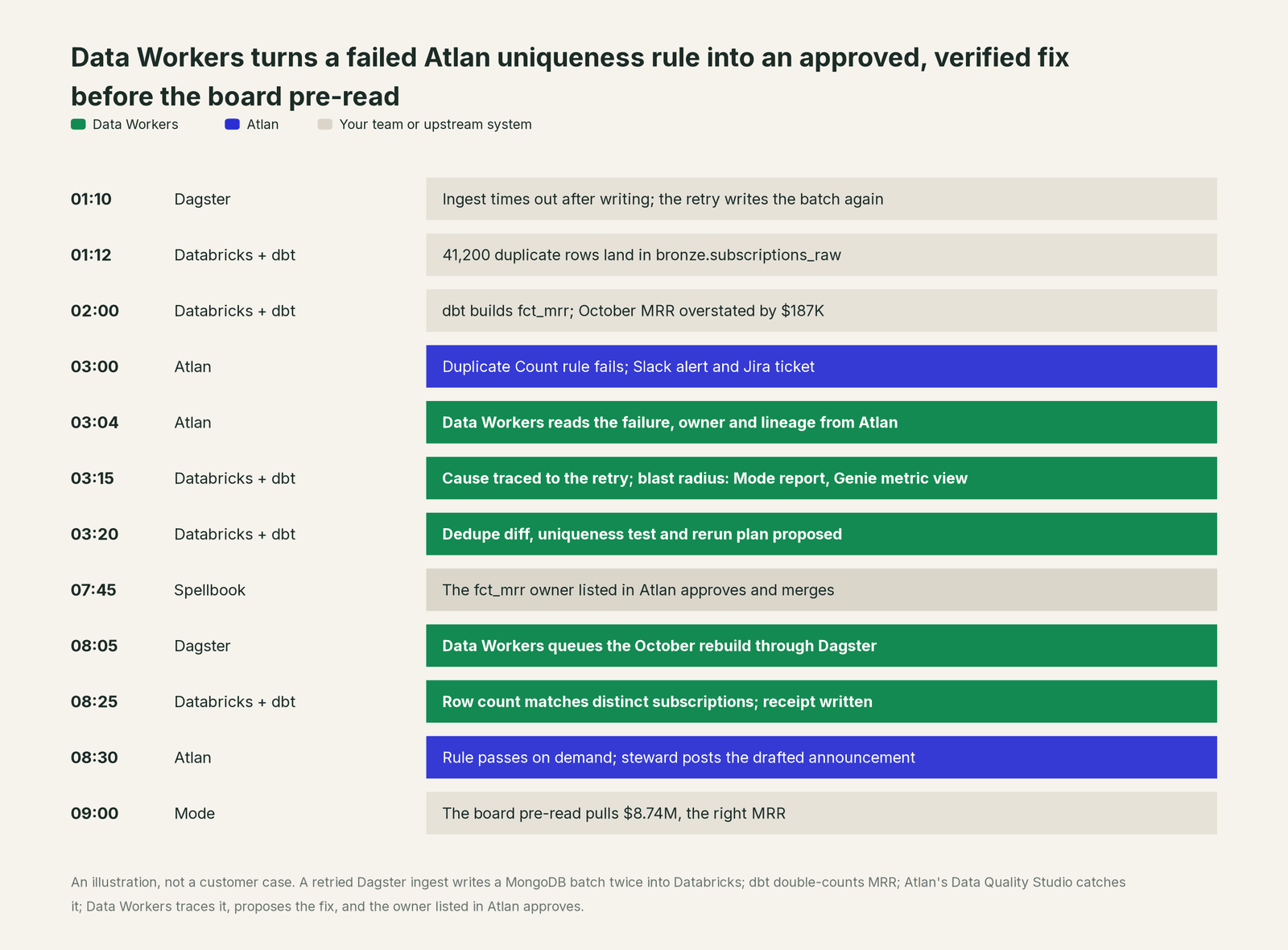
Atlan did its part exactly: the rule caught the duplicates, the alert reached the right channel, and lineage showed a board report and a Genie metric view downstream. The cause sat in a Dagster retry and a dbt merge, two systems Atlan describes and doesn't run. Without the trace, the board would have seen MRR $187,000 too high, and Genie would have repeated it to anyone who asked.
| Job | What Atlan does | What Data Workers does |
|---|---|---|
| The record | Holds the asset, its owner, certificate, README and glossary term | Brings them in as sourced context and checks models against them |
| The signal | Runs the Duplicate Count rule in Databricks, shows failed rows, alerts Slack and opens Jira | Picks up the failure with the owner attached and opens an incident |
| The reach | Shows lineage to the Mode report and the Genie metric view | Adds what lineage points to but doesn't hold: Dagster run history and dbt code |
| The cause | Leaves the cause for a person to find | Traces it across Dagster, the bronze table and dbt to the retried write |
| The fix | Records the change once the asset is rebuilt | Proposes the dbt diff with its blast radius, routes it to a named owner, queues the rerun after approval |
| The proof | Reruns the rule on demand | Verifies counts and the reconciliation, keeps a receipt with cause, diff, approver and rollback path |
Why doesn't Atlan just do this itself?
Because Atlan is built to be the trusted record of an entire estate, and it draws its write lines with care. Its MCP write tools change Atlan metadata only, and each one "returns a preview of the change and waits for your approval before writing". SQL through MCP rejects "statements that modify data". Read-only mode is a support request away, and access requests end as a grant inside Atlan or a ticket for the platform team. That design is right for a catalog connected to more than 100 systems: it keeps the catalog neutral and its security review simple.
Fixing the duplicates is a different promise: changing a dbt model and a Dagster asset the catalog doesn't own, scoping what else that touches, getting the right person to approve, rerunning the job, proving the number and owning the rollback. That needs blast radius across systems, approvals per domain, receipts and accountability for changes in tools Atlan doesn't run. That product is Data Workers.
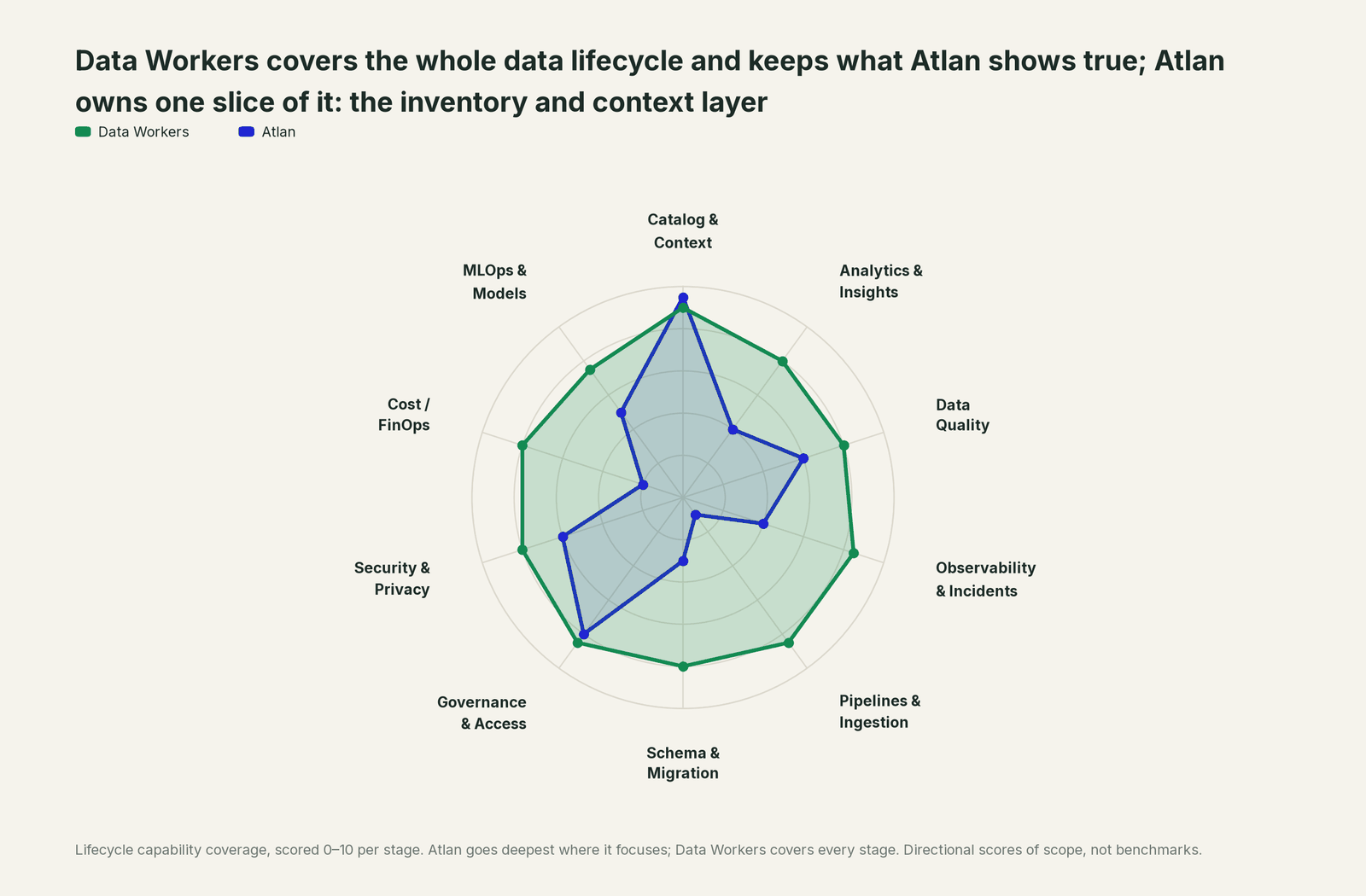
Every tool owns a slice. Data Workers covers the whole lifecycle
Atlan owns one slice outright: the inventory and context layer, with strong metadata governance beside it. Each point tool adds another console, contract and handoff. Data Workers covers the whole lifecycle with one context, one approval flow and one audit trail, and builds on the catalog you already run. We use the same Atlan scores as our Atlan vs Spellbook comparison, with the reasons written for teams building on it.
| Stage | Data Workers | Atlan | Why we scored it this way |
|---|---|---|---|
| Catalog & Context | 9 | 9.5 | Atlan's home stage: assets, owners, certificates, glossary terms, domains and lineage across 100+ connectors, enriched by context agents and served to AI over a hosted MCP server with 39 tools. Data Workers reads it as a first-class source. |
| Analytics & Insights | 8 | 4 | Context Engineering Studio tests a context repository and deploys it to Genie or Cortex Analyst; the questions are answered in those engines. Data Workers answers across platforms from approved definitions. |
| Data Quality | 8 | 6 | Data Quality Studio runs completeness, uniqueness, validity, freshness and reconciliation rules natively in Snowflake, Databricks and BigQuery, with failed-rows SQL and AI-suggested rules. Data Workers also repairs the cause and re-checks. |
| Observability & Incidents | 8.5 | 4 | Rule failures alert Slack, Teams, Jira, ServiceNow or a webhook, and lineage shows the downstream reach. Data Workers traces the cause, proposes the fix behind approval and verifies it. |
| Pipelines & Ingestion | 8.5 | 1 | Atlan catalogs pipeline and dbt lineage; running pipelines is outside its job. Data Workers proposes pipeline changes and queues reruns through your orchestrator after approval. |
| Schema & Migration | 8 | 3 | Lineage and the MCP tools show the impact of a schema change before it merges. Data Workers detects the change upstream and generates migrations with rollback SQL for the owner. |
| Governance & Access | 8.5 | 8 | Personas, policies, governance workflows and the MCP preview-and-approve step govern metadata well; access requests grant in Atlan or open a ticket. Data Workers dry-runs a proposed grant and applies approved Unity Catalog grants. |
| Security & Privacy | 8 | 6 | Classifications propagate down lineage and tag reverse sync updates existing tags in Snowflake and Databricks. Data Workers flags new sensitive column names in pull request review and proposes the masking for the owner to apply. |
| Cost / FinOps | 8 | 2 | Atlan tracks the compute its own quality rules use. Data Workers attributes Snowflake credits per query to the dbt model behind them and drafts the fix for its owner. |
| MLOps & Models | 7.5 | 5 | AI models and AI apps are registered as assets with lineage and approval workflows. Data Workers keeps the data under the models healthy. |
How Atlan and Data Workers work together
People keep working where they work: Claude Code or Cursor for SQL and dbt, Genie for plain-language questions, Atlan for search and stewardship. Spellbook is where the data team reviews proposed changes with the asset, blast radius, approver and rollback path; approval requests reach the named approver in Slack or email. Underneath, Data Context Wizard keeps one governed context graph, the Data-Agents Swarm does the work with 20+ specialist agents, and the Autonomous Data-Conductor runs each fix: detect, diagnose, fix, review, verify, remember.
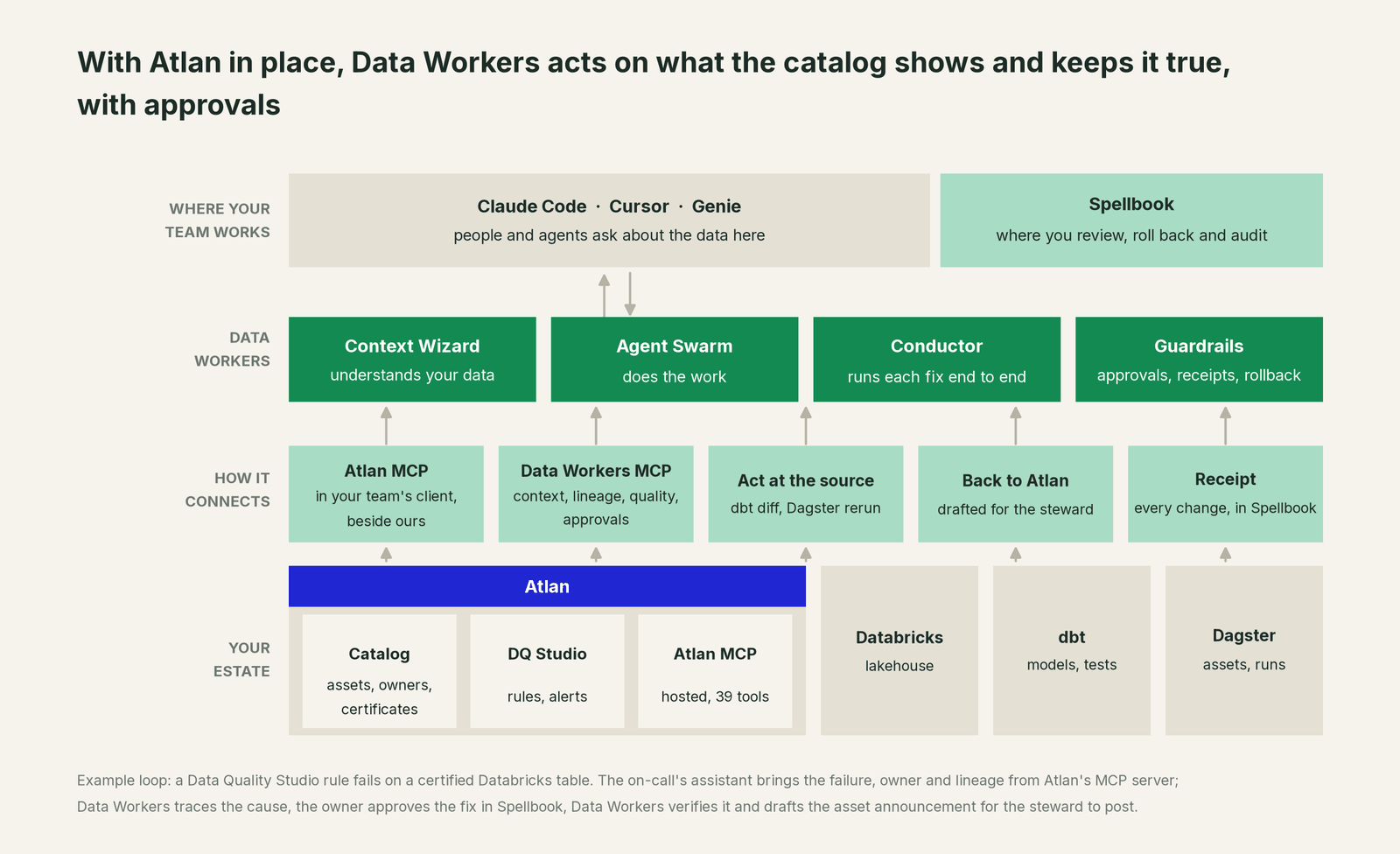
What comes in from Atlan. Data Workers connects to Atlan over Atlan's hosted MCP server and API today: read tools such as search_assets, get_assets and traverse_lineage over MCP, and rule results over the API. Owners, certificates, glossary terms, classifications and lineage arrive with their source and the time they were seen, and stay yours. Context Wizard joins them to what Atlan's lineage points to but doesn't hold: Dagster runs and dbt manifests, read through Data Workers' native dbt and Dagster connectors. MongoDB and Mode connect over their APIs today. Your agent can then call explain_table for definition, lineage and trust score, blast_radius_analysis for what a change touches, get_quality_score for quality and get_incident_history for open incidents.
Setup over MCP today. Use a service token with exactly one persona, scoped to your pilot domain (Atlan rejects tokens with more). Ask Atlan support for read-only mode if your security review prefers it: Data Workers only needs Atlan's read tools. For Data Workers, clone the open-source repository and add start-agent.sh entries, as the client setup docs show.
// Example: .mcp.json for Claude Code
{
  "mcpServers": {
    "atlan": {
      "type": "http",
      "url": "https://mcp.atlan.com/mcp",
      "headers": { "Authorization": "Bearer ${ATLAN_API_KEY}" }
    },
    "dw-context-catalog": {
      "command": "/path/to/dataworkers-claw-community/start-agent.sh",
      "args": ["dw-context-catalog"]
    },
    "dw-quality": {
      "command": "/path/to/dataworkers-claw-community/start-agent.sh",
      "args": ["dw-quality"]
    },
    "dw-incidents": {
      "command": "/path/to/dataworkers-claw-community/start-agent.sh",
      "args": ["dw-incidents"]
    }
  }
}
People can sign in with OAuth instead (claude mcp add --transport http atlan https://mcp.atlan.com/mcp), so each call runs with their own Atlan permissions. List the tools with /mcp. Then "why did the MRR duplicate rule fail?" gets the owner and lineage from Atlan, lineage beyond the catalog from trace_cross_platform_lineage, the cause from get_root_cause and the table's state from the monitor_metrics baseline, in one answer.
Where writes go. Data Workers proposes the dbt change as a diff for the owner to merge and queues reruns through Dagster or Airflow after approval. Data cleanups, such as removing the duplicate bronze rows, are proposed for the owner to approve and apply. Catalog updates (the announcement, a clearer description, a certificate change) are proposed for the steward, who makes them in Atlan or through the team's own Atlan MCP client, under Atlan's preview and approval. Approved facts land in the Context Wizard graph. Atlan stays the system of record for its metadata, by design.
One request, L0 to L4. The autonomy ladder is set per domain.
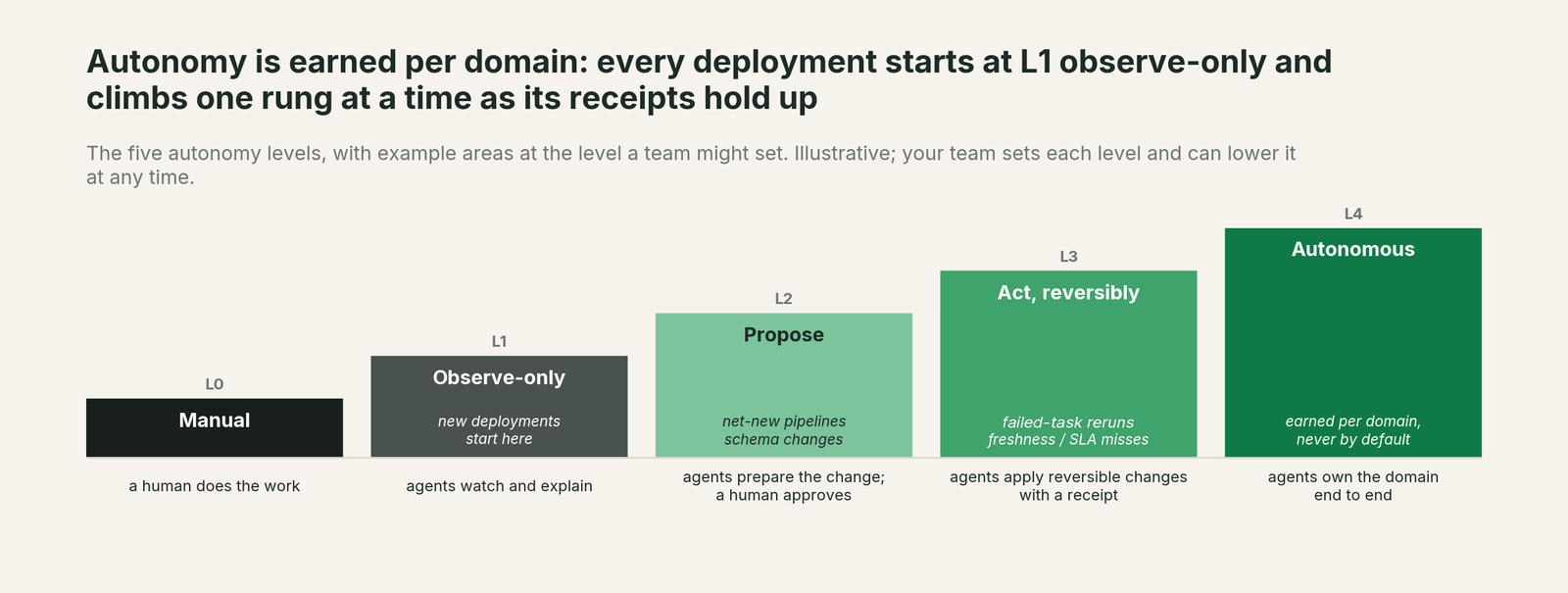
- •L0 manual. Connected, not acting. Your engineer works the Jira ticket by hand.
- •L1 observe. Each failed rule arrives explained with cause, owner and blast radius; nothing changes, and the log shows what each action would have needed.
- •L2 propose. Data Workers drafts the dbt diff, rerun plan and announcement; a named owner approves in Spellbook first.
- •L3 act reversibly. For proven classes, such as rerunning a partition after an approved upstream fix, Data Workers acts, verifies and keeps the undo path.
- •L4 autonomous. For a scoped, trusted class in one domain, it fixes and verifies on its own and posts the receipt.
An unanswered approval request expires and escalates; it never auto-grants. No agent can promote its own work, and an org-wide stop halts all autonomous dispatch. The safety model is in is it safe to let AI agents change production data and sign-off in how approvals work for AI data agents. The agents run in your infrastructure and hold your warehouse credentials and model key; your data stays in your systems, and the hosted Conductor sees workflow metadata only (where does our data go).
The same pattern runs across the catalog section: see the guides for teams on Collibra, Alation and DataHub, the category answer in how Data Workers is different from a data catalog, Data Workers on Databricks, Atlan alternatives and our notes on the Atlan MCP server.
What changes for your team
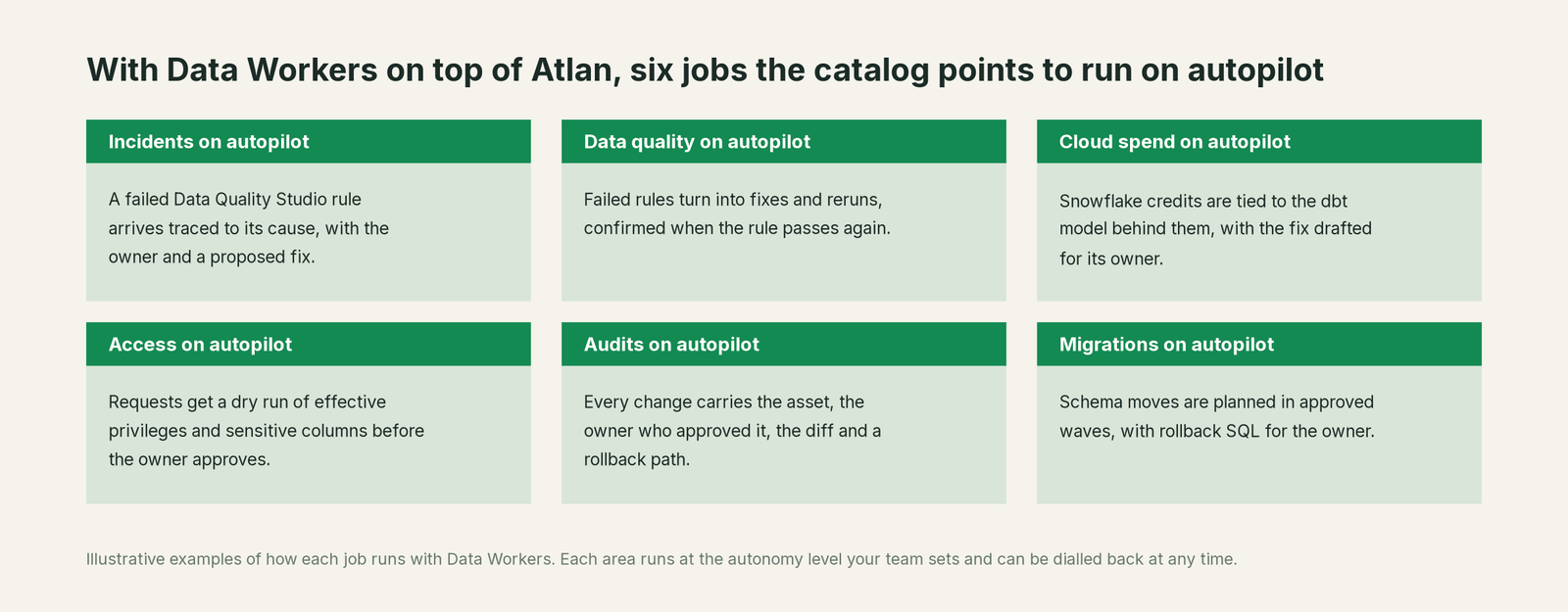
Teams on Atlan spend much of the week turning signals into tickets: forwarding a rule failure, finding who owns the dbt model, chasing a grant, reminding a steward to fix a certificate. With Data Workers on top, those jobs run on autopilot at the level you set.
- •Incidents. A failed Data Quality Studio rule arrives traced to its cause, with the owner and a proposed fix attached.
- •Data quality. Failed rules turn into fixes and reruns, confirmed when the rule passes again.
- •Cloud spend. Snowflake credits are tied to the dbt model behind them, with the fix drafted for its owner.
- •Access. Requests get a dry run of effective privileges and sensitive columns before the owner approves.
- •Audits. Every change carries the asset, the owner who approved it, the diff and a rollback path.
- •Migrations. Schema moves are planned in approved waves, with rollback SQL for the owner to apply.
Stewards get their week back for curation, and Atlan's certificates keep meaning what they say.
Keep Atlan, or consolidate?
Keep Atlan if you love it; Data Workers works with it from day one. Many teams consolidate once Data Workers runs that slice too.
For most Atlan teams the answer is to keep it: your stewards, glossary and certificates live there, and your AI tools already read it over MCP. What teams consolidate is the tooling around it: the script that turns rule failures into tickets, the rerun runbook, the spreadsheet mapping glossary terms to dbt models, a separate observability console. Teams that later want one agentic catalog can move to Spellbook with no migration day, because Data Workers reads Atlan from the start. Weighing building this layer yourself on Atlan's MCP server? Read build it ourselves with Claude Code and MCP servers: the connection is the easy part; cross-system context, approvals and rollback are the work.
The case for your CFO
The outcome: the catalog the company already pays for starts paying back in correct numbers. Breaks Atlan detects get fixed at the source the same morning instead of waiting in a ticket queue, so every Verified certificate stays backed by a table that's right. Above, that is the difference between the right MRR in the board pre-read and one $187,000 high.
The risk story is plain. Data Workers reads Atlan with one persona. Every change shows its blast radius, goes to a named owner, lands through your existing dbt and orchestrator workflows, is verified and leaves a receipt: trigger, diff, before and after checks, approver and undo path. Autonomy is set per domain from L0 manual to L4 autonomous. Zero migration: Atlan, Databricks, dbt and Dagster stay where they are.
Why now: Atlan already hands your context to AI agents over MCP, and agents across the stack are starting to change things; the record of who approved what is cheaper to build before that queue grows. The first win is one domain where every failed rule arrives explained and owned. What stays the same: your glossary, certificates, personas, governance workflows and review process. For the numbers, see the ROI of agentic data operations. Start with a pilot (pricing); the pilot is credited in full against the first year.
The sentence to repeat upstairs: "Atlan tells us what our data is and who owns it; Data Workers keeps it true, with the owner approving every fix and a receipt for each one."
Getting started
Start with a pilot. Pick one domain where Data Quality Studio rules already run, such as revenue, connect Atlan with a single-persona service token next to Data Workers, and let Data Workers explain every failed rule before you turn on the first fix class. Plans are on the pricing page, and the pilot is credited in full against the first year.
FAQ
Does Data Workers write to Atlan? Catalog changes are proposed for your steward. Data Workers drafts the announcement, description or certificate change; the steward makes it in Atlan, or your team's Atlan MCP client adds it, under Atlan's preview and approval. Data Workers only needs Atlan's read tools, so read-only mode works.
How does Data Workers connect to Atlan? Over Atlan's hosted MCP server and API today, with a one-persona service token or OAuth per person. Atlan's policies apply to everything Data Workers reads there.
Do Atlan's context agents and Data Workers overlap? They do different jobs. Context agents fill in missing descriptions, READMEs and SQL patterns inside Atlan. Data Workers works on the tables, models and pipelines those descriptions are about.
What about the Genie and Cortex context we deploy from Context Engineering Studio? Keep deploying it. Data Workers treats the Genie metric views and Cortex semantic views as downstream assets: when a table under them breaks, they show up in the blast radius, and the fix is verified before the next question hits them.
Can Data Workers finish Atlan access requests? It dry-runs the requested grant (effective privileges, sensitive columns reached, policy conflicts, an expiry recommendation), applies approved Unity Catalog grants and records them, and drafts Snowflake and BigQuery grants for the platform owner to run.
What does Data Workers store? Metadata and scrubbed facts (definitions, lineage, owners, incident history, receipts) in your infrastructure, not copies of your tables. The hosted Conductor sees workflow metadata only.
Sources
- •Atlan, homepage ("The missing context layer for enterprise AI"), https://atlan.com/ (checked Oct 3, 2026)
- •Atlan, Set up Atlan MCP (hosted at mcp.atlan.com/mcp, enabled for all tenants, OAuth or API key; last modified Sep 4, 2026), https://docs.atlan.com/product/capabilities/atlan-ai/how-tos/remote-mcp-overview (checked Oct 3, 2026)
- •Atlan, Atlan MCP tools (39 tools in nine categories; writes preview and wait for approval; SQL rejects data-modifying statements; last modified Aug 12, 2026), https://docs.atlan.com/product/capabilities/atlan-ai/references/mcp-tools (checked Oct 3, 2026)
- •Atlan, Atlan MCP security (read-only mode, Labs write setting, one persona per service token; last modified Aug 31, 2026), https://docs.atlan.com/product/capabilities/atlan-ai/references/mcp-security (checked Oct 3, 2026)
- •Atlan, Understand context agents (Description, README, SQL Intelligence; existing values never overwritten; last modified Sep 24, 2026), https://docs.atlan.com/product/capabilities/governance/context-agents-studio/concepts/agents (checked Oct 3, 2026)
- •Atlan, What is Atlan AI (last modified Aug 12, 2026), https://docs.atlan.com/product/capabilities/atlan-ai/concepts/what-is-atlan-ai (checked Oct 3, 2026)
- •Atlan, Product changelog (knowledge sources Sep 7; GitHub Sep 15; Confluence Sep 29; docs over MCP Sep 28, 2026), https://docs.atlan.com/product/changelog (checked Oct 3, 2026)
- •Atlan, Data Quality Studio rule types and failed rows (last modified Aug 12, 2026), https://docs.atlan.com/product/capabilities/governance/data-quality/references/rule-types-and-failed-rows (checked Oct 3, 2026)
- •Atlan, Run rules on demand (Snowflake and Databricks; last modified Aug 4, 2026), https://docs.atlan.com/product/capabilities/governance/data-quality/how-tos/run-rules-on-demand (checked Oct 3, 2026)
- •Atlan, Deploy to Databricks Genie from Context Engineering Studio (last modified Aug 25, 2026), https://docs.atlan.com/product/capabilities/governance/context-engineering-studio/how-tos/deploy-databricks (checked Oct 3, 2026)
- •Atlan, AI governance (AI asset registry and approval workflows; automatic intake private beta, versioning and compliance readiness beta), https://atlan.com/ai-governance/ (checked Oct 3, 2026)
- •Atlan, Data Quality Studio configure alerts and webhooks (Slack, Teams, Jira, ServiceNow; result events by webhook), https://docs.atlan.com/llms/governance/data-quality/llms.txt (checked Oct 3, 2026)
- •Databricks, Metric views (queried from dashboards, Genie Agents and alerts), https://docs.databricks.com/aws/en/metric-views/ (checked Oct 3, 2026)
- •Data Workers, Client setup (open-source docs), https://dataworkers.io/opensource-docs/client-setup/ (checked Oct 3, 2026)
- •Data Workers open-source repository, https://github.com/DataWorkersProject/dataworkers-claw-community (checked Oct 3, 2026)