You're on Alteryx: Your Analysts Build the Workflows. Data Workers Owns Whether the Data They Read and Write Is Right
Already on Alteryx? Data Workers checks the warehouse tables your Designer workflows write, traces a wrong close number to its cause, routes the fix to a named approver and verifies it, with a receipt.
Your analysts run a good part of the business in Alteryx. FP&A builds the rebate accrual in Designer, operations blends supplier files with warehouse tables, and the month-end close leans on scheduled workflows that read a CSV, join it to Snowflake, apply rules only finance knows and write the result back to a table. Alteryx One schedules them, Live Query pushes the heavy ones down into Snowflake or Databricks, Auto Insights runs directly on Alteryx One datasets, and since the Summer 2026 Release finance can ask an Agent Studio agent why margin moved. Alteryx is where analysts prepare and blend the data. Data Workers owns whether what those workflows read and write is right: it checks every table a workflow writes, traces a wrong close number to its cause, routes the fix to a named approver and verifies it with a receipt.
Key takeaways
- •Alteryx keeps its job. Designer workflows, schedules, Auto Insights, Ask Alteryx and Agent Studio stay with the analysts and CoE leads who own them.
- •A workflow can succeed and still write the wrong table. A join that drops rows or an input file that changed shape both finish green. Data Workers checks the table after every write against its baseline.
- •The fix lands where the cause is. A workflow's owner fixes it in Designer with the evidence in hand. For a dbt model or a missing guard, Data Workers proposes the diff behind a named approval and queues the rerun.
- •Workflows stay with their owners, by design. Data Workers connects to Alteryx over its API or MCP server today, never edits or runs a workflow, and works from the warehouse, dbt and orchestrator it reads natively.
- •Start with the close. Check the workflow outputs that feed accruals and reconciliations after every run, then climb from L0 manual to L4 autonomous per domain.
Alteryx is where analysts prepare and blend the data. Data Workers owns whether what those workflows read and write is right.
Analyst workflows sit in a seam most data teams never see. They read files the data team doesn't land, write tables that dbt models and BI reports then read, and are owned by people outside data engineering. When a workflow writes a short table, nothing fails. The number is simply wrong, and finance finds out at close.
A Tuesday in close week, with Data Workers next to Alteryx One on Snowflake (an illustrative example):
| Time | System | What happens |
|---|---|---|
| Mon 16:40 | Distributor SFTP | The largest distributor changes its weekly sell-through file: beverage items now carry 14-digit GTINs instead of the 8-digit item codes. Every other product line is unchanged. |
| Tue 02:00 | Alteryx One | The scheduled Designer workflow rebate_accruals_weekly, built and owned by an FP&A analyst, reads the file and joins it to Snowflake dim_product on item code. The 16,200 beverage rows match nothing and leave through the Join tool's L anchor, which isn't connected to anything. |
| 02:04 | Snowflake | The Output Data tool writes the 35,880 joined rows to FINANCE.REBATE_ACCRUALS with Delete Data and Append. The run succeeds. |
| 03:00 | Prefect, dbt | The finance_nightly flow runs dbt. fct_gross_to_net and fct_margin_by_customer build from the accrual table. Every model is green. |
| 03:20 | Data Workers | The post-run run_quality_check on FINANCE.REBATE_ACCRUALS passes: no null or duplicate keys, and the table is well above the minimum row-count floor, which catches empty tables, not short ones. The row-count baseline the team records with monitor_metrics flags the drop: 35,880 rows against a typical 52,000, 16,200 short, with beverage rows at zero and the week's accrued rebates at $1.94M against a $2.80M baseline. |
| 03:22 | Data Workers, Slack | blast_radius_analysis finds the two dbt models and, from a context-graph note the team recorded, the Power BI Gross-to-net report. The context graph holds the team's note that rebate_accruals_weekly writes this table, with its owner, and that the controller's accrual journal reads it. Data Workers opens an incident and posts to #finance-data with send_slack_alert. |
| 07:30 | Alteryx Agent Studio | A finance manager asks the margin agent (Alteryx Agents, public preview) why beverage margin jumped. It answers faithfully from the data: rebates fell. The on-call replies in the thread with the incident link. |
| 07:45 | Alteryx Designer | The analyst opens the workflow with the incident beside it, runs it in Designer and finds 16,200 records sitting at the L anchor, every one a GTIN-14 beverage code. |
| 08:05 | Data Workers | Writes up the fix in two parts. For the workflow owner: map GTIN-14 through dim_product.gtin before the join, and route the L anchor into a Test tool that stops the run before the Output Data tool when any record fails to join. For the dbt owner, proposed as a diff to merge: a singular dbt test that fails finance_nightly when a week's accrual rows fall below 45,000, with the rerun plan and the undo. The approval request reaches the analytics engineering lead in Slack. |
| 08:40 | Alteryx One | The analyst saves the new workflow version and runs it. Delete Data and Append replaces the table with 52,080 rows. |
| 08:50 | Spellbook | The lead approves in Spellbook; the dbt owner merges the diff. |
| 08:55 | Prefect | Data Workers queues the approved finance_nightly rerun with trigger_prefect_flow. |
| 09:20 | Snowflake | The run finishes. run_quality_check passes, and the monitor_metrics baselines hold: 52,080 rows, beverage rows back at 16,200, accrued rebates at $2.80M. |
| 09:30 | Power BI | The report owner refreshes the Gross-to-net semantic model. The controller posts the accrual. Data Workers writes the receipt (cause, fix, approver, rerun, checks) and a graph note that this table depends on distributor item codes matching dim_product. |
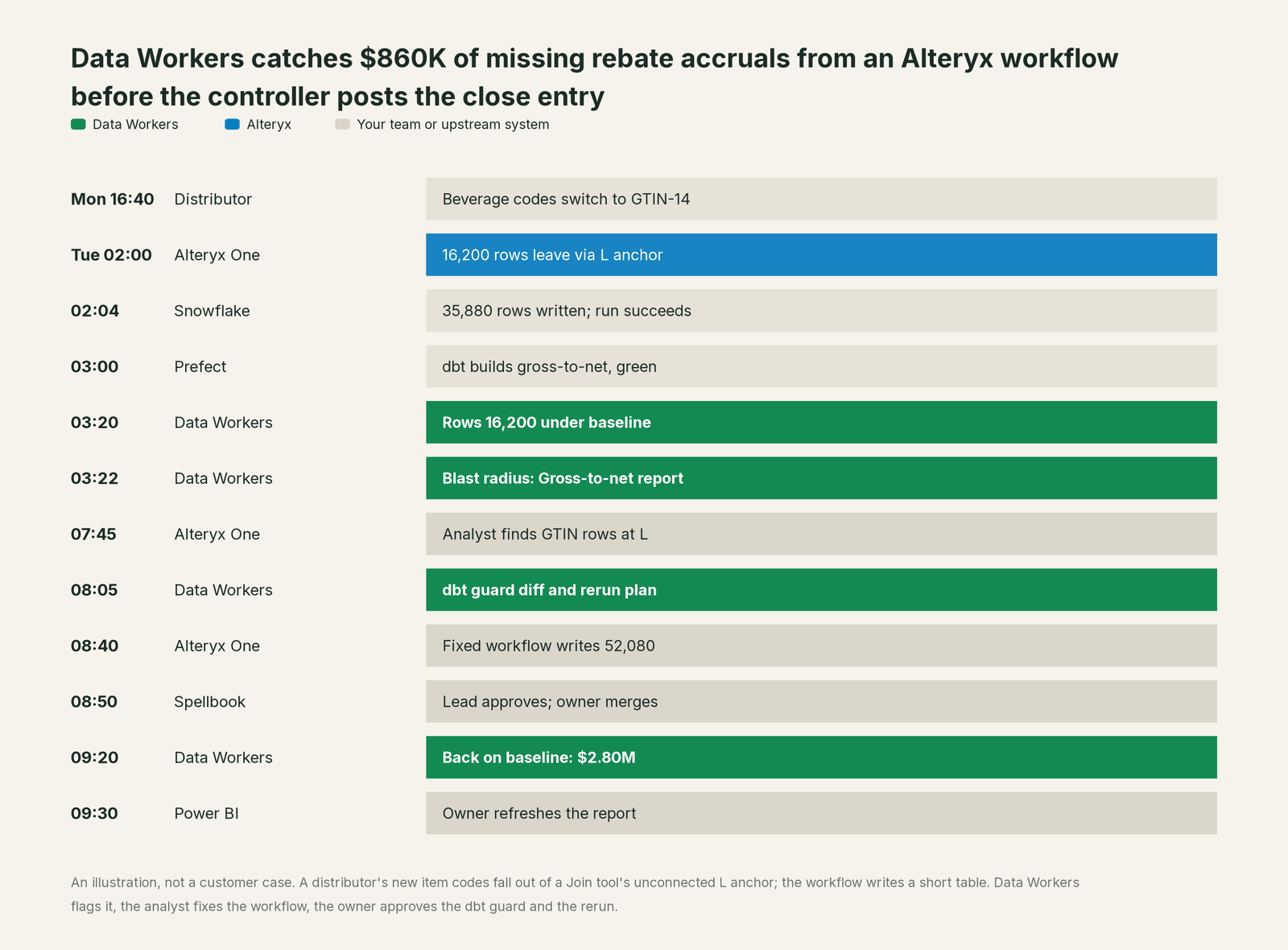
Every tool did its job: a valid file, a workflow run as configured, dbt models built as written, a report showing what the tables held. The problem lived between them: $860K of rebates that never reached the table, which would have overstated September gross margin by the same amount. Data Workers caught it hours before the entry was posted, the analyst fixed her own workflow, and a named person approved every change around it.
| Job | What Alteryx does | What Data Workers does |
|---|---|---|
| The logic | Holds the business rules analysts build in Designer workflows, versioned and governed in Alteryx One | Records which workflow writes which table, who owns it and what reads it, in one governed context graph |
| The run | Runs workflows on schedule, pushes work down to the warehouse and writes outputs as configured | Checks every table a workflow writes after each run for nulls and duplicate keys, and holds row counts and headline values to a baseline |
| The break | Reports a successful run; the Test tool checks what the author thought to test | Catches the short or broken table, traces it to the run and lists every model and report it reaches |
| The fix | The workflow owner changes the workflow in Designer and reruns it | Routes the evidence to that owner, proposes the dbt or orchestrator change as a diff behind a named approval and queues the rerun |
| The proof | The next run writes the new output | Re-checks the table, compares the recorded values and writes a receipt with cause, change, approver and undo |
Why doesn't Alteryx just do this itself?
Alteryx made a deliberate, sensible bet: put business logic in the hands of the people who know it, such as the FP&A analyst who knows which revenue excludes intercompany transfers. Its guardrails fit that job. Workflows are visible and repeatable, the Test tool is there "to verify data before writing results to a database", Alteryx One permissions decide who can run what, and the Alteryx MCP Server (seven toolsets since Sep 8, 2026, including one that creates, updates and runs Designer workflows) acts on behalf of a signed-in user, with a readOnly option that exposes only toolsets that don't update data.
All of that protects the workflow. Tuesday's break came from a file the distributor changed and landed in tables that dbt and Power BI read, in tools Alteryx doesn't run. Seeing it meant checking the table after the write against its baseline and knowing what sat downstream. Fixing it meant a workflow change by its owner, an approved dbt change, a Prefect rerun and a check afterwards. That is a different product with different liability: cross-system context, blast-radius scoping, approvals, rollback and receipts across vendors. It is the product Data Workers is.
Every tool owns a slice. Data Workers covers the whole lifecycle
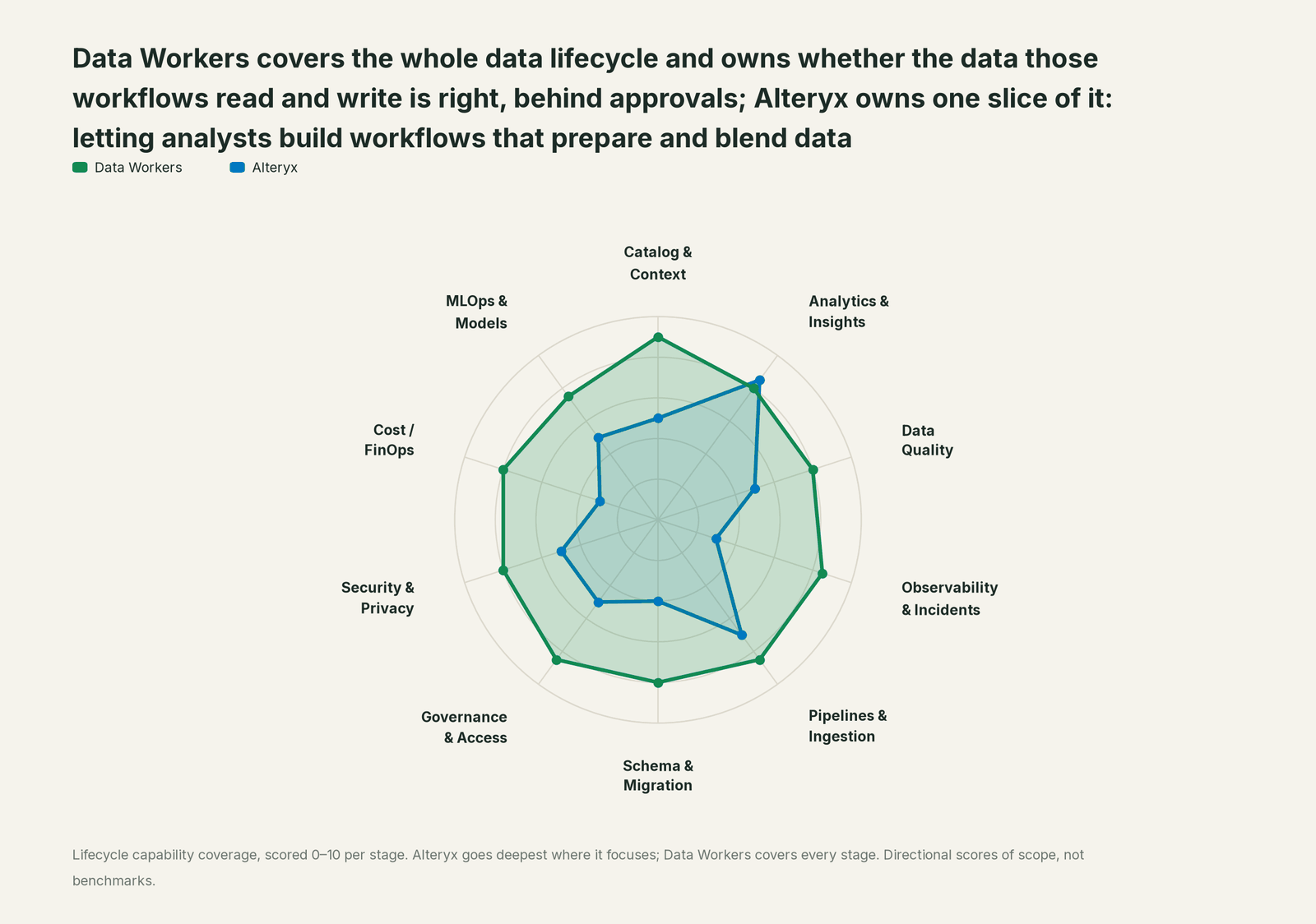
Alteryx owns one slice outright: letting analysts build workflows that prepare, blend and analyze data, now with agents on top. Each point tool adds another console, contract and handoff. Data Workers covers the whole lifecycle with one context, one approval flow and one audit trail, and builds on the Alteryx One estate you run.
| Stage | Data Workers | Alteryx | Why we scored it this way |
|---|---|---|---|
| Catalog & Context | 9 | 5 | Alteryx One catalogs workflows, datasets, macros and connections, and AI-enriched asset metadata starts Oct 15, 2026. Data Workers keeps one governed context graph across every platform, including which workflow writes which table and who owns it. |
| Analytics & Insights | 8 | 8.5 | Alteryx's home stage: Designer workflows, Auto Insights on Alteryx One datasets, Ask Alteryx and Agent Studio (GA) put analysis in analysts' and business users' hands. Data Workers answers through governed definitions and checks the tables under them. |
| Data Quality | 8 | 5 | The Test tool checks what a workflow author thought to test before a database write. Data Workers checks the tables workflows write after every run for nulls and duplicate keys, and holds row counts and headline values to a baseline. |
| Observability & Incidents | 8.5 | 3 | A scheduled workflow that finishes reports success. Data Workers traces a wrong number back across the workflow's output, the dbt models and the report, proposes the fix and verifies it. |
| Pipelines & Ingestion | 8.5 | 7 | Visual prep and blend, push-down through Live Query and scheduled runs move a lot of analyst data. Data Workers queues approved dbt and orchestrator reruns for the pipelines around them. |
| Schema & Migration | 8 | 4 | Workflows change through Designer versions and their owners. Data Workers reviews dbt changes and their manifest diff and scopes the blast radius before merge. |
| Governance & Access | 8.5 | 5 | Alteryx One roles, asset permissions and MCP toolset limits govern Alteryx itself. Data Workers routes every data change to a named approver. |
| Security & Privacy | 8 | 5 | OAuth with PKCE and per-user permissions protect what Alteryx runs. Data Workers leaves a receipt on every data change and proposes masking for the owner to apply. |
| Cost / FinOps | 8 | 3 | Automation Credits meter Alteryx's own runs. Data Workers reads Snowflake spend per query and per dbt model through query tags, and BigQuery spend as an account total. |
| MLOps & Models | 7.5 | 5 | Predictive tools and machine learning apps build models inside Alteryx. Data Workers keeps the data under models and agents healthy. |
How Alteryx and Data Workers work together
Your people stay where they are: analysts in Designer and Alteryx One, finance in Agent Studio and Power BI, engineers in Claude Code, Slack for alerts and approval requests. Spellbook Data Catalog (in preview) is where the data team looks: each proposed fix with its blast radius, approver and rollback. Underneath, Data Context Wizard keeps one governed context graph, the Data-Agents Swarm's 20+ specialist agents do the work, and the Autonomous Data-Conductor runs each fix end to end (detect, diagnose, fix, review, verify, remember).
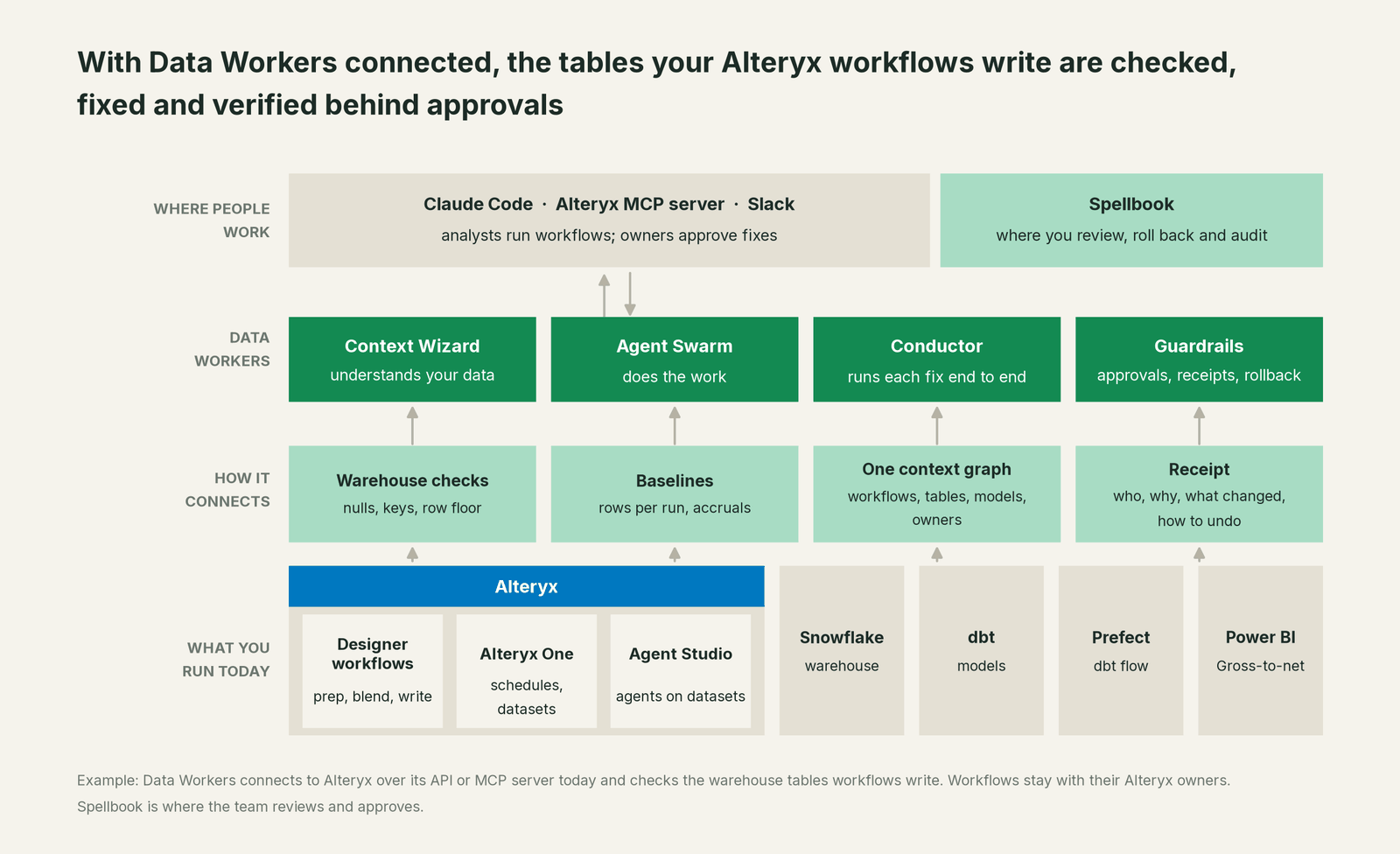
What Data Workers reads around Alteryx. Data Workers connects to Alteryx over its API or MCP server today; its checks rest on what it reads natively: the warehouse tables your workflows write, the dbt manifest and the orchestrator. run_quality_check checks nulls, uniqueness on id columns and a minimum row-count floor on Snowflake (and Postgres, or BigQuery with a service-account key). monitor_metrics holds what your team records, such as rows per run or a week's accrued rebates, against a baseline, and that is what catches a short table. blast_radius_analysis and trace_cross_platform_lineage follow a table to every dbt model and declared report; diagnose_incident, remediate and get_incident_history run and record the incident. The context graph records which workflow writes which table, and its owner. Your data stays in your systems: the agents, warehouse credentials and model key run in your infrastructure, and the hosted Conductor sees workflow metadata only.
Setup over MCP today. Clone the open-source repository and add start-agent.sh entries to your client's MCP config, as the client setup docs show. The Alteryx MCP Server can sit beside it for your own work, with readOnly=true on its URL; Data Workers' agents never call it.
// Example: .mcp.json for Claude Code. "alteryx" is your team's own
// Alteryx MCP Server connection (US region); Data Workers does not call it.
{
  "mcpServers": {
    "alteryx": {
      "type": "http",
      "url": "https://us1.alteryxcloud.com/mcp/v1?readOnly=true"
    },
    "dw-context-catalog": {
      "command": "/path/to/dataworkers-claw-community/start-agent.sh",
      "args": ["dw-context-catalog"]
    },
    "dw-quality": {
      "command": "/path/to/dataworkers-claw-community/start-agent.sh",
      "args": ["dw-quality"]
    },
    "dw-incidents": {
      "command": "/path/to/dataworkers-claw-community/start-agent.sh",
      "args": ["dw-incidents"]
    }
  }
}
List the tools with your client's own command (/mcp in Claude Code). Ask "did last night's rebate workflow write a healthy table?" and you get the workflow from Alteryx's server and the checks, lineage and open incidents from Data Workers in one answer.
Where fixes go. Data Workers never edits, schedules or runs an Alteryx workflow, and it doesn't refresh Power BI: workflow evidence goes to the workflow's owner (see Data Workers for data analysts). A fix in dbt or the orchestrator is proposed as a diff for the owner to merge, with its blast radius and undo step; Data Workers opens the pull request itself only when your team turns on the dbt GitHub pull-request target. After approval it queues the rerun through Prefect, Dagster, ADF or Airflow 2. Data Workers never deletes warehouse rows; a cleanup is proposed for the owner to apply.
One request, L0 to L4. The autonomy ladder is set per domain.
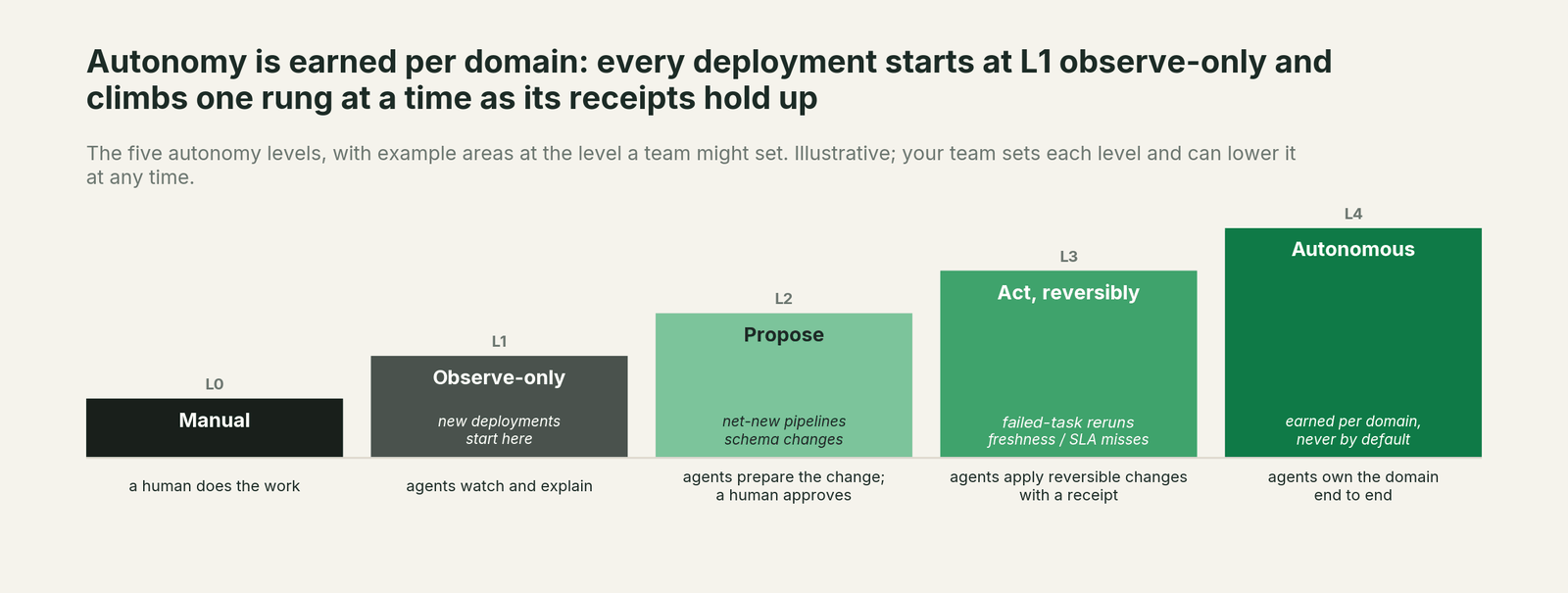
- •L0 manual. Finance finds short tables at close.
- •L1 observe. Every table your workflows write is checked; Data Workers logs what it would do.
- •L2 propose. Data Workers drafts the fix; a named owner approves in Spellbook.
- •L3 act reversibly. For proven classes, such as the finance dbt rerun after an approved workflow fix, Data Workers acts, verifies and records the undo.
- •L4 autonomous. For a narrow class in one domain, Data Workers fixes, verifies and posts the receipt.
Approvals go to a named person; an unanswered request expires and escalates, never grants itself. No agent can promote its own work. Read is it safe to let AI agents change production data, how approvals work in practice, what the autonomy levels mean and where does our data go for the full safety model.
More on the systems around Alteryx: Data Workers + Tableau, Power BI and Looker, You're on Power BI, You're on Tableau, You're on Prefect and You're on dbt.
What changes for your team
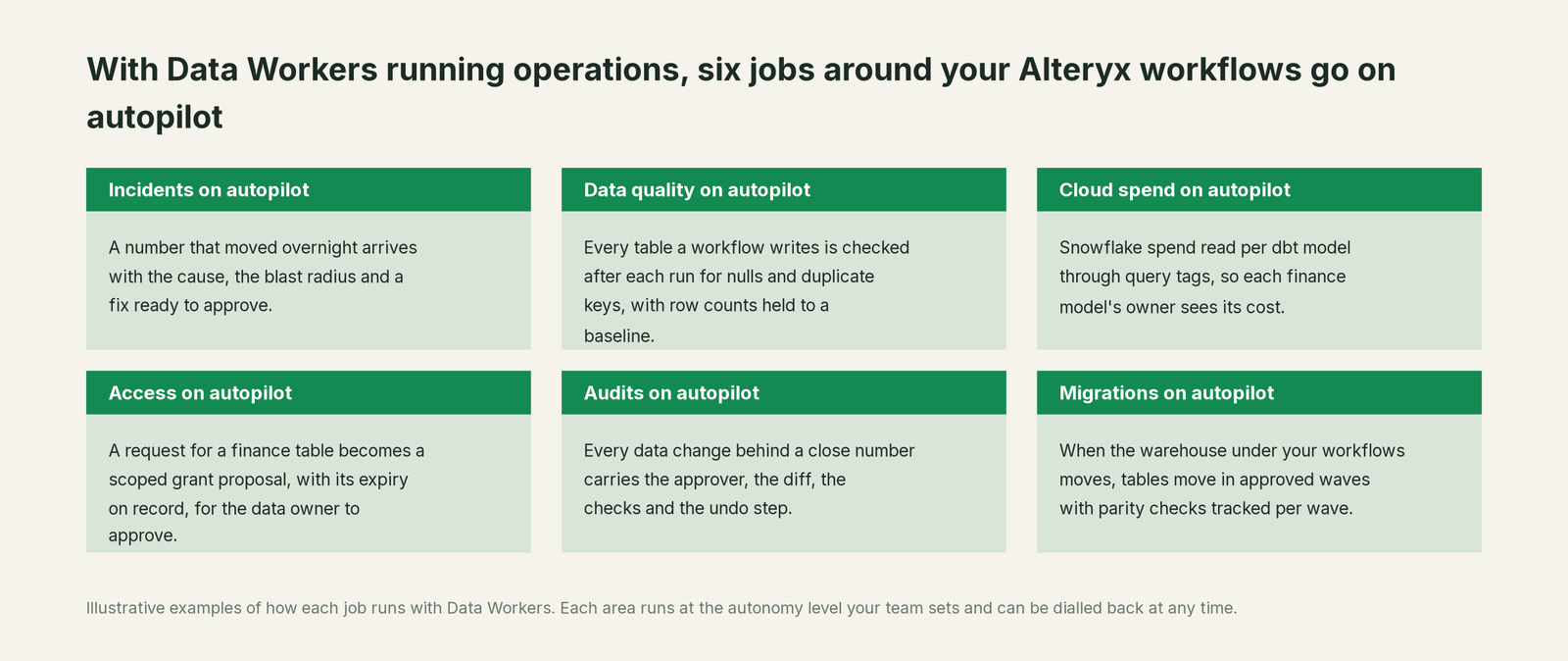
Close week goes to asking whether a number is wrong because of the file, the workflow, the model or the report. With Data Workers next to Alteryx, these jobs run on autopilot at the level you set.
- •Incidents. A number that moved overnight arrives with the cause, the blast radius and a fix ready to approve.
- •Data quality. Every table a workflow writes is checked after each run for nulls and duplicate keys, with row counts held to a baseline.
- •Cloud spend. Snowflake spend is read per dbt model through query tags, so each finance model's owner sees its cost.
- •Access. A request for a finance table becomes a scoped grant proposal, with its expiry on record, for the data owner to approve.
- •Audits. Every data change behind a close number carries the approver, the diff, the checks and the undo step.
- •Migrations. When the warehouse under your workflows moves, tables move in approved waves with parity checks tracked per wave.
Keep Alteryx, or consolidate?
Keep Alteryx if you love it; Data Workers works with it from day one. Many teams consolidate once Data Workers runs that slice too.
Most teams keep Alteryx: the business rules your analysts encoded and the workflows the close depends on belong there. What teams consolidate is the tooling around it: a separate data-quality tool, a spreadsheet of which workflow writes which table, and manual tie-outs before every journal. If you are weighing building this yourself on the Alteryx MCP Server, read build it ourselves with Claude Code and MCP servers: connecting servers is the easy part; cross-system context, approvals and rollback are the work.
The case for your CFO
The outcome: the numbers your analysts' workflows feed into the close, the margin report and the agents finance asks stay right, and when an input changes overnight, the fix arrives before the journal is posted.
The risk story: Data Workers changes nothing in Alteryx. It checks the tables workflows write, routes workflow fixes to their owners and proposes upstream changes as diffs; nothing runs until the named owner approves. Every change is verified and leaves a receipt: what broke, what changed, who approved it and how to undo it. Autonomy is set per domain from L0 manual to L4 autonomous, and an org-wide stop halts all autonomous dispatch. There is zero migration.
Why now: Alteryx's Summer 2026 Release put agents on analyst logic, in Agent Studio and through its MCP Server in ChatGPT, Claude and Gemini. A short table now reaches a finance leader as a confident answer before anyone opens the report.
The first win: the workflow outputs that feed the close, such as rebate accruals and reconciliations, checked after every run. What stays the same: your workflows and their owners, your Alteryx One schedules, your dbt, Prefect and Power BI, and your close calendar. The path is a pilot on those outputs (see pricing), credited in full against the first year; for the numbers, see the ROI of agentic data operations.
The sentence to repeat upstairs: "Alteryx keeps running our analysts' workflows; Data Workers checks what they write before finance reads it, and a named owner approves every fix with a receipt."
Getting started
Start with a pilot. Pick the workflows that feed the close, connect Data Workers to the warehouse, dbt and your orchestrator, record the row counts and values finance cares about, and let it check those tables for a few weeks before turning on the first fix class. The pilot path and plans are on the pricing page, and the pilot is credited in full against the first year.
FAQ
Does Data Workers change or run our Alteryx workflows? No. Workflows stay with their owners. Data Workers checks the tables they write, sends the evidence to the workflow's owner and proposes changes elsewhere, such as dbt guards, behind a named approval.
We already use Test tools in our workflows. Why add this? Keep them. A Test tool checks what its author thought to test inside one workflow. Data Workers checks the table after the write against the row counts and values the team expects, traces a failure to every model and report it reaches, and carries the fix through approval and verification.
Our analysts' workflows aren't in dbt. Can Data Workers see what they affect? Yes, from the warehouse side. It checks the tables the workflows write, and the context graph records which workflow writes each table and who owns it. dbt models on those tables, and reports the team records in the context graph, show up in the blast radius.
An Agent Studio agent gave finance a wrong answer. Can Data Workers tell why? Usually the agent was faithful to its dataset and the data was wrong. When that dataset reads warehouse tables, Data Workers checks them, traces the moved number to its cause and records the cause and the fix in a receipt.
Which warehouses does this cover? The table checks run natively on Snowflake, Postgres and BigQuery, and Data Workers works natively with dbt, Airflow, Dagster and Prefect among 50+ connectors; what integrations Data Workers supports lists what each one reads and changes.
Sources
- •Alteryx, What's new in Alteryx One (Summer 2026 Release: Agent Studio GA, Alteryx Agents public preview, MCP Server and Skills, Copilot renamed Ask Alteryx), https://www.alteryx.com/whats-new (checked Oct 3, 2026)
- •Alteryx, Build Trusted AI with ROI in the Alteryx 2026 Summer Release (Sep 9, 2026), https://www.alteryx.com/blog/build-trusted-ai-with-roi-in-the-alteryx-2026-summer-release (checked Oct 3, 2026)
- •Alteryx, Alteryx MCP Server and Skills, https://www.alteryx.com/platform/ai-analytics/agentic-analytics/mcp-server (checked Oct 3, 2026)
- •Alteryx Help, Alteryx MCP Server (OAuth 2.0 with PKCE, Automation Credits from Oct 1, 2026), https://help.alteryx.com/aac/en/agent-studio/alteryx-mcp-server.html (checked Oct 3, 2026)
- •Alteryx Help, Alteryx MCP Server Toolsets, https://help.alteryx.com/aac/en/agent-studio/alteryx-mcp-server/alteryx-mcp-server-toolsets.html (checked Oct 3, 2026)
- •Alteryx Help, Connect an AI App to the Alteryx MCP Server (
readOnlyparameter), https://help.alteryx.com/aac/en/agent-studio/alteryx-mcp-server/connect-an-ai-app-to-the-alteryx-mcp-server.html (checked Oct 3, 2026) - •Alteryx Help, Release notes for Auto Insights (Sep 17, 2026), https://help.alteryx.com/aac/en/release-notes/release-notes-for-auto-insights.html (checked Oct 3, 2026)
- •Alteryx Help, Release notes for Agent Studio (Sep 8, 2026: 7 MCP toolsets; Sep 21, 2026: AI metadata enrichment from Oct 15), https://help.alteryx.com/aac/en/release-notes/release-notes-for-agent-studio.html (checked Oct 3, 2026)
- •Alteryx Help, Release notes for Ask Alteryx (Aug 28, 2026), https://help.alteryx.com/aac/en/release-notes/release-notes-for-ask-alteryx.html (checked Oct 3, 2026)
- •Alteryx Help, Join Tool (L, J and R anchors), https://help.alteryx.com/current/en/designer/tools/join/join-tool.html (checked Oct 3, 2026)
- •Alteryx Help, File Format Options (Delete Data and Append), https://help.alteryx.com/current/en/designer/file-types-support/file-format-options.html (checked Oct 3, 2026)
- •Alteryx Help, Test Tool, https://help.alteryx.com/current/en/designer/tools/developer/test-tool.html (checked Oct 3, 2026)
- •Alteryx, Clearlake Capital Group and Insight Partners Complete Acquisition of Alteryx (Mar 19, 2024), https://www.alteryx.com/about-us/newsroom/press-release/clearlake-capital-group-and-insight-partners-complete-acquisition-of-alteryx (checked Oct 3, 2026)
- •Data Workers, Client setup (open-source docs), https://dataworkers.io/opensource-docs/client-setup/ (checked Oct 3, 2026)
- •Data Workers open-source repository, https://github.com/DataWorkersProject/dataworkers-claw-community (checked Oct 3, 2026)