Your Company Rolled Out Claude. Now Make Your Data Estate Agentic & Autonomous with Data Workers
A guide for heads of data whose company bought Claude Team or Enterprise: why your data team is still the human control plane behind every Claude answer, and how to put the data back office on autopilot.
Claude is where your people ask. Data Workers is the agentic data platform that does the data work behind the answer. This guide is for the leader who owns the data estate after the Claude rollout.
The rollout went well. IT bought Team or Enterprise seats, turned on SSO, and an Owner manages connectors from the admin console. Finance asks Claude to explain a variance. Sales ops uses Cowork to pull the weekly summary together. Your analytics engineers write dbt models and debug failed DAG runs in Claude Code. Usage is up, and leadership is pleased.
Then the questions reach your team. A controller asks Claude why net revenue looks low, gets a thoughtful answer, and sends your team a Slack message anyway, because nobody can fix the number from a chat. An access request typed into Claude becomes a ticket. Two people ask about the same metric and get two answers, because each conversation found a different table. Every good Claude answer that needs something changed ends in your queue.
Your data platform has a control-plane problem, and the control plane is your team. People are the connective tissue between Claude and Snowflake, dbt, Airflow and Looker, carrying context from one to the next by hand. The expensive part isn't knowing what needs doing. It's the doing: the changing, the checking and the fixing.
What Claude solved, and what it didn't
Claude solved the assistant. Every employee now has a capable colleague that reads, reasons, writes and codes, with SSO, roles, audit logs and connector controls your IT team can trust. Its admin gate is thoughtful: only Owners (and, on Enterprise, a custom admin role) add organization connectors, members sign in with their own account, and each tool can be set to Always allow, Needs approval or Blocked. Claude Code adds managed MCP policy so your engineers use an approved set of servers.
What Claude isn't is the system that changes your production data. It doesn't keep one governed definition of revenue across your warehouse, dbt and dashboards, and it doesn't own a fix from the source change to the right number on the tile. That's a sensible line for a general assistant to draw, and Anthropic draws it on purpose.
Claude is where your people ask. Data Workers is the agentic data platform that runs your whole data estate and does the work behind every answer.
Or, in one sentence for your team: we keep Claude exactly as it is, and connect it to one crew that answers from governed numbers and fixes data behind an approval.
What goes on autopilot
Each of these is a queue your data team runs by hand today, usually starting with a question someone asked Claude.
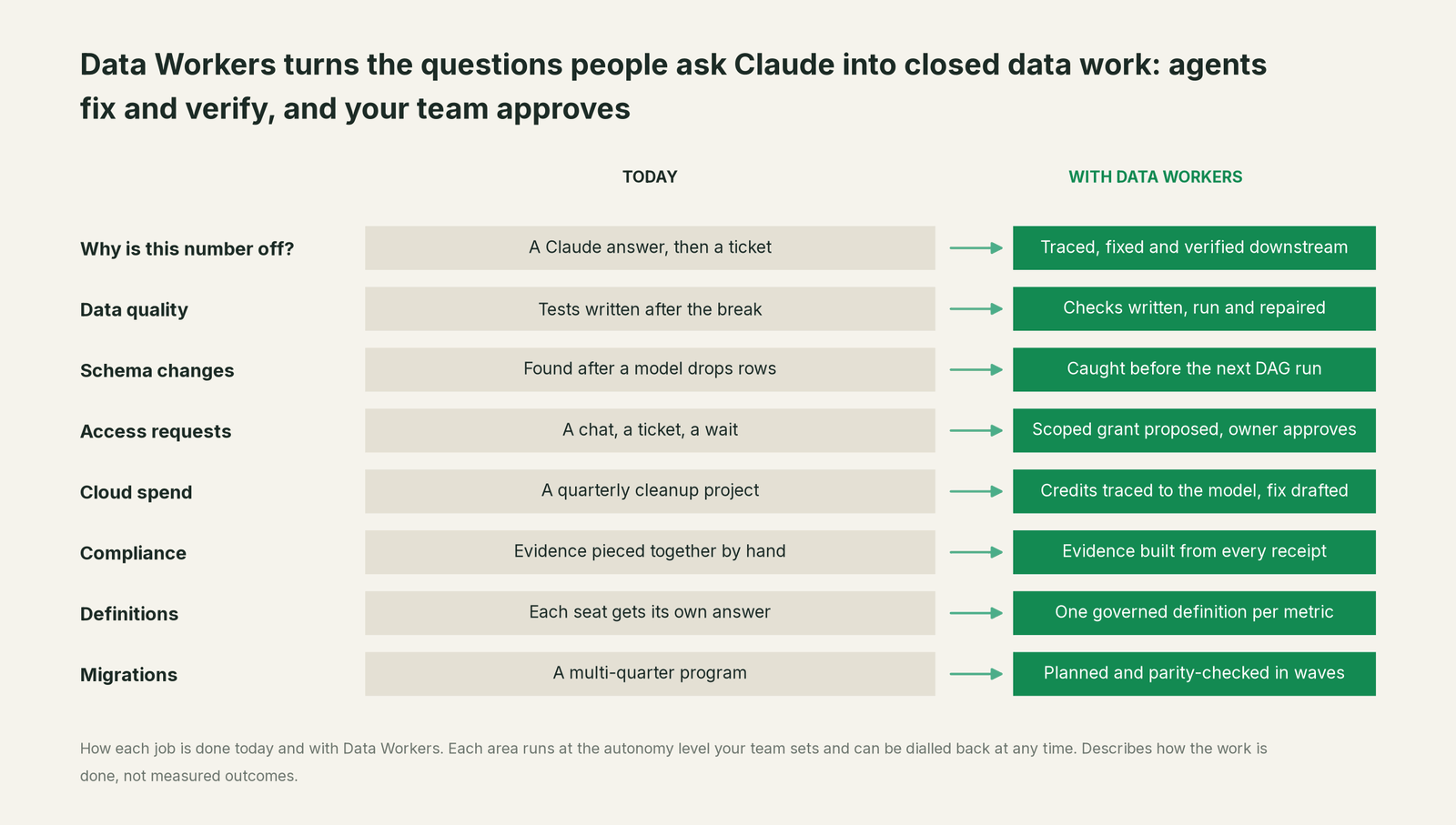
None of this requires replacing anything. Data Workers connects to Claude as one organization connector and appears in Claude Code too, works inside the tools you already run, and leaves an auditable record of every change. Your data stays in your infrastructure.
What changes for your organization
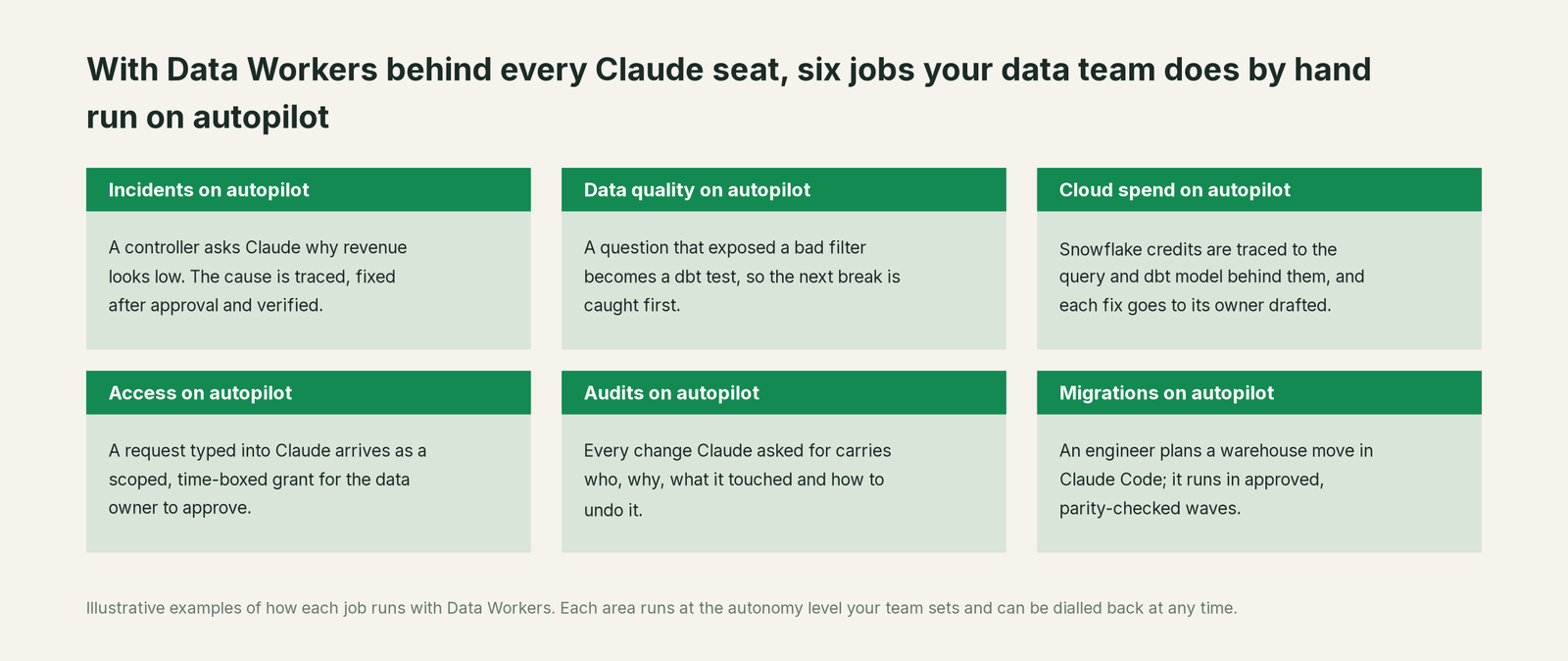
- •Your data team stops being the human control plane. The questions that used to end in a ticket end in a governed answer, or in a proposed fix one person approves.
- •Claude answers agree with each other. Every seat reads the same governed definitions and lineage, so the board deck and the controller's chat show the same number.
- •Incidents stop becoming meetings. A broken number is traced to its cause in whatever system it started in, fixed there and checked downstream.
- •Spend is managed continuously. Snowflake credits are traced to the query and dbt model behind them, and the fix goes to the owner drafted.
- •Audits get easier. Every change records who asked, why, what it touched and how to undo it.
- •Engineers keep their tools. Analytics engineers review and approve in Claude Code, the place they already work.
One incident, start to finish
This is an illustration, not a customer case.
- •Finance ops starts marking wire payments in Stripe with a new invoice status, and Fivetran syncs it into Snowflake overnight.
- •The dbt model behind revenue filters on the old status, so the wires drop out, and every test passes.
- •At 8 a.m. a controller asks Claude why net revenue in Looker is below the Stripe payout report.
- •Claude explains the gap well, but the fix lives in a dbt repo, a warehouse and a dashboard.
Today that's a morning of Slack threads. With Data Workers behind the connector, Claude answers with the cause and the affected tiles, a dbt fix arrives with its blast radius, an analytics engineer approves it in Claude Code, the rebuild is checked against Stripe, and the receipt lands in the controller's thread before the close meeting. Claude asked the right question. Data Workers fixed the cause and brought the receipt.
You choose how far and how fast
Our thesis is that data teams will climb from people working alongside an assistant, to people governing a team of agents, to a largely self-running agentic enterprise. You choose the altitude, one area at a time.
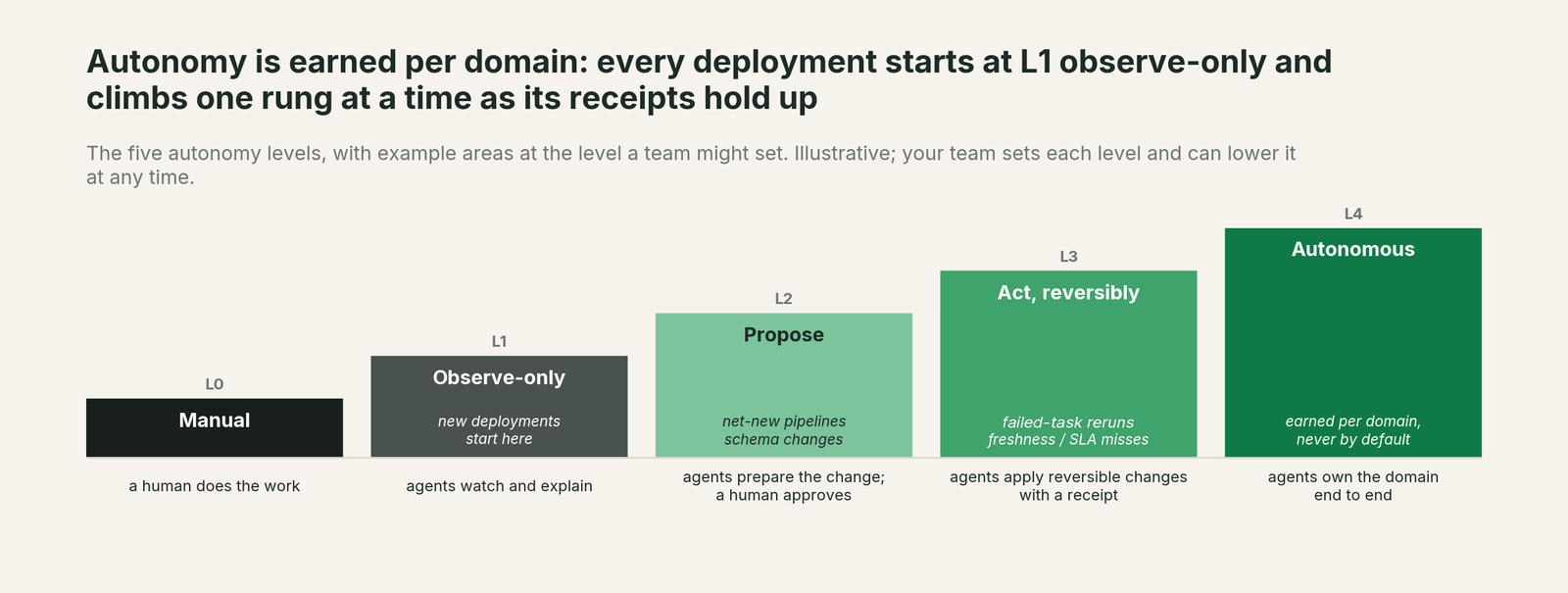
The climb has five levels: L0 manual, L1 observe, L2 propose, L3 act reversibly, L4 autonomous. Every area starts at L1, with agents watching and explaining. At L2 they propose changes your team approves. At L3 they make reversible changes on their own and leave a receipt. Only areas that have earned it reach L4, and any area can be dialled back. Two locks hold at every level: Claude's tool permission decides whether Claude may call a tool, and the per-domain guardrail decides whether the change may run. No agent approves its own work.
Why doesn't Claude do this itself?
Focus and risk. Claude is a general assistant built to reach every system a company runs, from calendars and documents to CRMs and data tools. Anthropic built the client and the admin gate around it, and says plainly that it doesn't security-audit or manage the MCP servers Claude connects to. That's the right choice for an assistant used by every department.
Changing production data across systems is a different product. It needs to know which models, dashboards and consumers a change touches before it runs, approvals that differ by domain, rollback, verification against the source and a receipt an auditor can read. It also carries responsibility for changes inside systems Anthropic doesn't run. That's the product we built, and it plugs into the gate Anthropic already ships.
How it fits with Claude
- •Claude's admin console stays the front door. An Owner adds Data Workers once; members sign in with their own account; write tools sit on Needs approval.
- •Your warehouse permissions stay the lock. Every change goes through the grants you give Data Workers. There's never a second permission system.
- •Claude Code stays where engineers work. The organization connector appears there automatically, and your managed MCP policy can make it part of the approved set.
- •Nothing is migrated. Data Workers stores metadata and scrubbed facts about your data, not your tables.
The practitioner version, with the setup screens and a request run end to end, is You're on Claude. The wider view across assistants is Your company just rolled out AI assistants. Now what?
When you don't need Data Workers
- •Your people use Claude for writing, research and code, and rarely ask it about company numbers.
- •Your estate is one warehouse with no dbt, orchestration or BI layer in the critical path.
- •Your data team isn't the bottleneck.
If all three are true, keep your budget. If any of them isn't, the rest of this guide is about you.
The case for your CFO
The outcome. The company already pays for Claude seats. Today those seats produce good answers that often end in a ticket. With Data Workers behind them, the same seats produce answers from governed numbers and approved fixes, so revenue, pipeline and cost figures are right before finance and the board read them.
The risk story. Agents start by watching. Each area earns the right to propose, then to make reversible changes, on its own record. Claude's tool permissions sit in front of every write, the per-domain guardrail sits behind, and anything irreversible needs a named person's approval. Every receipt records who or what acted, why, what it touched and how to undo it. Our safety guide and security and deployment guide go deeper.
Why now. Claude Team and Enterprise ship the admin surface for this today: Owner-managed connectors, per-tool permissions and managed MCP for Claude Code. The choice is one governed connector across the company or every engineer wiring their own, which is the trade-off in build it ourselves with Claude Code and MCP servers.
What stays the same. Claude, its admin console, SSO and SCIM, your warehouse and your dashboards. The path is a pilot, and the pilot is credited in full against the first year. The ROI guide shows how to size it.
The sentence to repeat upstairs: we already pay for Claude; Data Workers lets it answer from our governed numbers and fix data behind an approval, with a receipt on every change.
Where to start
Pick one area where Claude questions turn into tickets. Most teams start with "where does this number come from?" questions in finance, answered from governed lineage, then late-load fixes in one domain made reversibly.
Start with a pilot. A forward-deployed engineer connects your estate and runs the first areas alongside your team, so you see results on your own data before you commit. See pricing for how the pilot works.
If your architects want the detail, send them You're on Claude and our page on Claude-native data infrastructure. The four products that do the work: Data Context Wizard keeps one governed graph across your warehouse, dbt, orchestration and BI; the Data-Agents Swarm makes the changes; the Autonomous Data-Conductor runs each fix from detection to a verified result; and Spellbook Data Catalog (in preview) is where your team approves, audits and rolls back. The thinking behind them is in our thesis.
Sources
- •Anthropic, Claude plans and pricing (Team and Enterprise features), checked Oct 2, 2026: https://claude.com/pricing
- •Anthropic, Getting started with custom connectors using remote MCP, checked Oct 2, 2026: https://support.claude.com/en/articles/11175166-getting-started-with-custom-connectors-using-remote-mcp
- •Anthropic, Connectors (tool permissions, where connectors work), checked Oct 2, 2026: https://claude.com/docs/connectors
- •Anthropic, Connectors directory (Owner adds, member requests), checked Oct 2, 2026: https://claude.com/docs/connectors/directory
- •Anthropic, Claude Code MCP (organization ask and blocked tool controls), checked Oct 2, 2026: https://code.claude.com/docs/en/mcp
- •Anthropic, Claude Code managed MCP, checked Oct 2, 2026: https://code.claude.com/docs/en/managed-mcp