Agentic governance in the catalog you already use
You already pay for a catalog that holds your owners, glossary and policies, and agents now work outside it. Data Workers keeps the catalog you have, reads it, adds the context it lacks and sends every agent change to a named owner for approval.
Before and after
| Today | With Data Workers |
|---|---|
| Owners, glossary and policies sit in the catalog while agents work outside it | Agents read the catalog's owners, tags and definitions before they act |
| Metric definitions, real ownership and past fixes live in other tools and in people's heads | The missing context added by agents and confirmed by the people who hold it |
| Several catalogs, several searches | One search across every connected catalog |
| An agent change is a ticket, a chat message or nothing | Every change previewed, approved by a named owner and kept in a tamper-evident audit trail |
| A catalog replacement program before any agent value | The catalog you run stays the system of record for access and governance |
Agents and copilots now read and change the tables your catalog describes, and a catalog can only govern what it sees them do. Replacing it takes quarters, so the CDO office guide to agentic data governance starts with the catalog you have. If your catalog is a hand-run one that nobody updates, see catalog modernization instead.
How it works
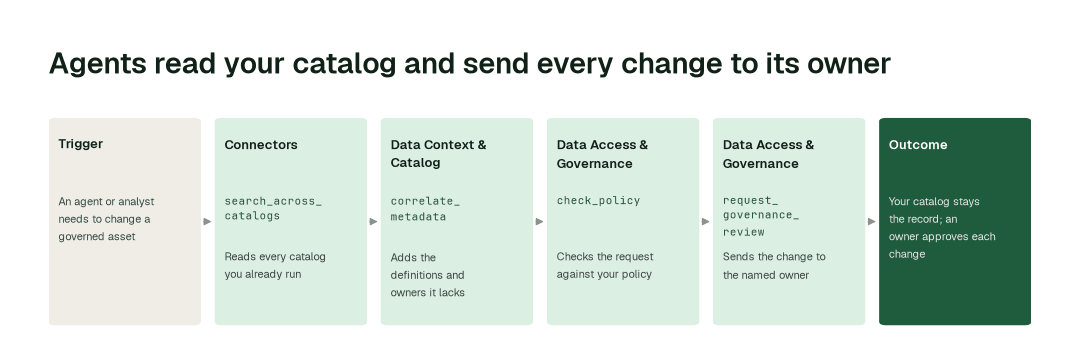
1. Read the catalogs you already run
The Connectors Agent reads DataHub, Microsoft Purview, Databricks Unity Catalog, OpenMetadata, Google Dataplex, AWS Glue and Lake Formation, Hive Metastore and Iceberg catalogs (Nessie, Polaris, Iceberg REST). list_all_catalogs shows what is connected, search_across_catalogs searches all of them at once and get_table_from_any_catalog returns one table's description, owner and tags wherever it lives. Your catalog stays the system of record for access and governance.
2. Add what the catalog does not hold
The Data Context & Catalog Agent joins what your catalogs say with what the work shows (correlate_metadata). It adds metric definitions (define_business_rule), real ownership, past fixes and lineage across platforms (get_lineage), and marks the trusted table for each concept (mark_authoritative). Analysts and agents stop using the wrong copy.
3. Put every agent change through approval
The Data Access & Governance Agent checks a request against your policy (check_policy) and sends a proposed owner, tag, definition or access change to the named owner (request_governance_review), showing what it would touch and how to undo it. Each approved change leaves a signed record in the audit trail.
The impact metrics we move
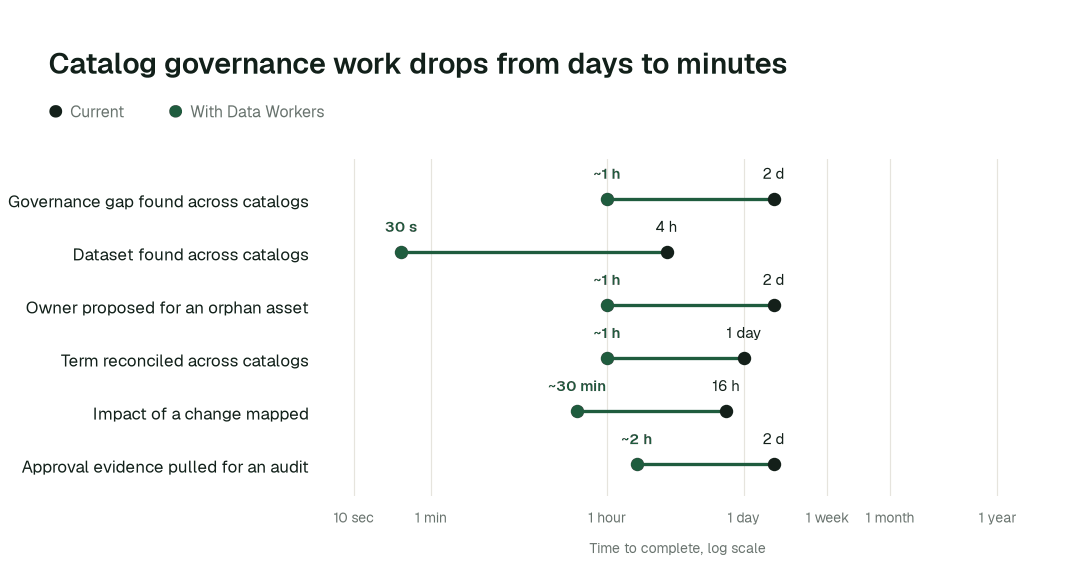
- •Governance gap found across catalogs: from about 2 days to ~1 h
- •Dataset found across catalogs: from about 4 h to 30 s
- •Owner proposed for an orphan asset: from about 2 days to ~1 h
Where teams start
- •Databricks and Unity Catalog. Agents read one domain's tags and owners and propose the definitions and owners it lacks; the Unity Catalog comparison covers where each fits.
- •DataHub or OpenMetadata. Keep the open metadata map and add the control layer; the guide for teams on DataHub shows how the two sit side by side.
- •Microsoft Purview. Use the glossary and lineage you already curated instead of rebuilding them; the guide for teams on Microsoft Purview covers the split.
- •Dataplex, Glue and Lake Formation. One search across clouds finds assets owned in one catalog and orphaned in another.
- •Choosing between catalogs. Weighing Atlan, Collibra or Alation against the ones above? Pilot the agent layer on one domain first.
What powers it
The Connectors Agent, the Data Context & Catalog Agent and the Data Access & Governance Agent do the work, and the Data Context Wizard keeps the shared picture of your estate that every agent reads: what each table means, who owns it and which source to trust. Spellbook Data Catalog (in preview) is agentic governance that works alongside the catalog you run. Autopilot Standards holds your rules, Autopilot Routines sweep for gaps on a schedule or when something changes, the Autonomous Data-Conductor routes the work, and the Data-Agents Swarm shares one approval path. This transformation shows up in:
The climb: from assisted to autonomous to agentic
Every domain climbs the same ladder from our thesis. Agents start by watching and suggesting, then act after a named owner approves, and a domain goes further only on its own review record. L0 to L2 run today; L3 and L4 are where a domain can go on evidence.
The pilot
- •Scope. One domain, read access to the catalog you run, and a named owner who approves changes.
- •First week. Agents start by watching and suggesting: the gaps, missing owners and definitions they would propose, each with a receipt, and a baseline of where governance starts.
- •By week two. Gap sweeps run on a routine, proposals reach the domain owner, and anything sensitive stays with a named approver.
- •At day 30. We review the impact metrics against your baseline:
- •Governance gap found across catalogs: from about 2 days to ~1 h
- •Dataset found across catalogs: from about 4 h to 30 s
- •Owner proposed for an orphan asset: from about 2 days to ~1 h
- •Cost. Start with a pilot ($7,500 one time, a 6 to 12 week pilot, credited in full against the first year). Scale is from $1,000 a month and Enterprise from $3,000 a month, billed annually, with unlimited seats, no usage meter and no markup on model spend. See pricing.
FAQ
Do we have to replace our catalog? No. Your catalog stays the system of record for access and governance, and Data Workers is the agent layer on top of it.
Which catalogs does it work with? DataHub, Microsoft Purview, Databricks Unity Catalog, OpenMetadata, Google Dataplex, AWS Glue and Lake Formation, Hive Metastore, and Iceberg catalogs (Nessie, Polaris, Iceberg REST).
What stays with people? Owners approve every definition, tag, owner and access change. Agents read freely, and nothing is written without a named approver.
What if an agent proposes something wrong? The proposal shows what it would touch and how to undo it, and the owner declines or reverts it.
Can we see who approved what? Yes. Every approved change carries a signed record in a tamper-evident audit trail, exportable as an evidence pack for an auditor.