Move from a catalog people update to a catalog agents keep current
Traditional catalogs are populated once and go stale. Data Workers moves your glossary, owners and policies into Spellbook, where agents keep definitions, lineage and ownership current as they work.
Before and after
| Today | With Data Workers |
|---|---|
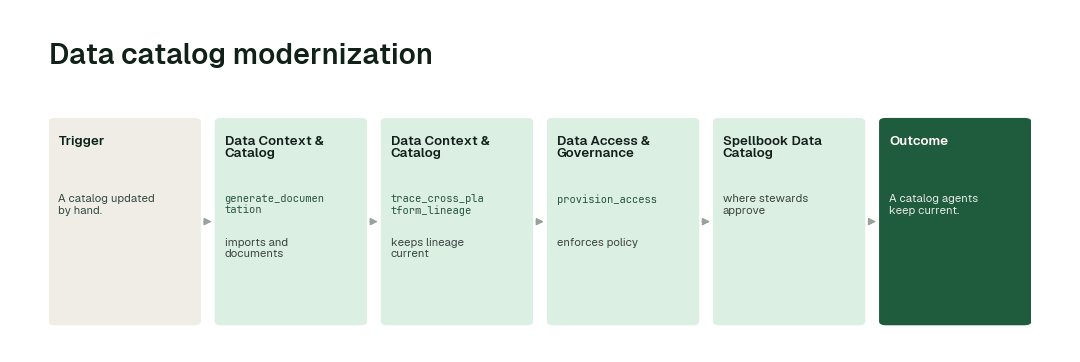
| A catalog updated by hand | A catalog agents keep current |
| Stewards chasing owners in spreadsheets | Owners proposed from usage history |
| Lineage that is weeks old | Lineage that updates with every change |
| Policy written down, not enforced | Policy enforced by agents, every grant logged |
How it works
1. Import what you have
Glossary terms, owners and policies are imported from your existing catalog.
2. Let agents keep it true
Data Context & Catalog updates lineage and documentation as pipelines change; Access & Governance enforces policy.
3. Govern from Spellbook
Stewards approve, audit and roll back in one place.
The impact metrics we move
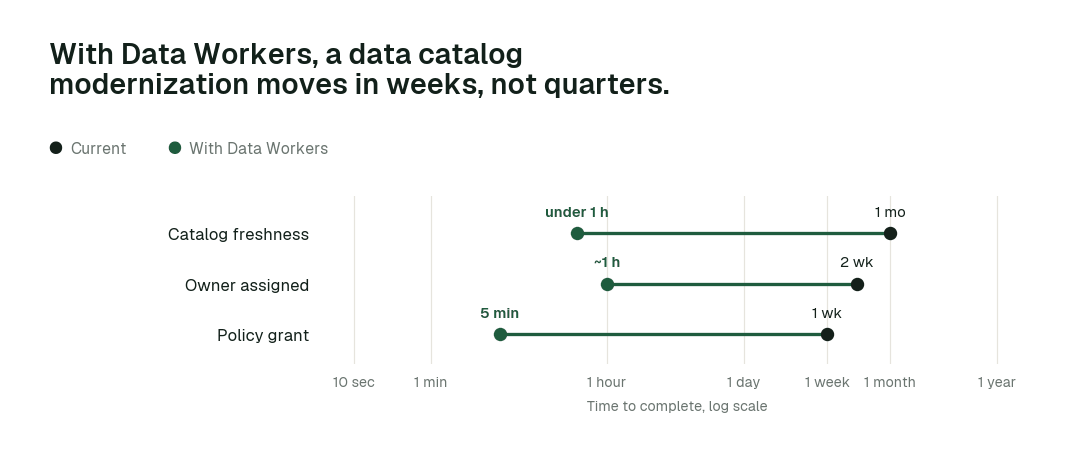
- •Catalog freshness: from about a month to under 1 h
- •Owner assigned: from about 2 weeks to ~1 h
- •Policy grant: from about a week to 5 min
Where teams start
- •Collibra and Alation modernization. Keep them or move off; agents keep the content current.
- •Unity Catalog and Purview enrichment. Agents write definitions and lineage back.
- •Glossary to governed definitions. Terms become definitions agents answer from.
- •Stewardship at scale. Owners proposed, not chased.
- •Policy as enforcement. Rules applied on every request.
The climb: from assisted to autonomous to agentic
Every transformation runs on the same ladder from our thesis: agents first inventory and propose with receipts, then move work in approved waves, and the finished platform keeps running itself once the move is done.
The pilot
- •Scope. Import one domain's glossary and keep it current for 30 days.
- •First week. Agents run at L1, observing only, and show the fixes they would have made, with receipts.
- •By week two. The routine work above runs on its own; anything sensitive stays with a named approver.
- •At day 30. We review the impact metrics against your baseline:
- •Catalog freshness: from about a month to under 1 h
- •Owner assigned: from about 2 weeks to ~1 h
- •Policy grant: from about a week to 5 min
- •Cost. Start with a pilot ($7,500 one-time, credited in full against the first year). Scale is from $1,000 a month and Enterprise from $3,000 a month, billed annually, with unlimited seats, no usage meter and no markup on model spend. See pricing.
FAQ
Do we have to replace our catalog? No; agents can keep it current where it is.
Who approves definitions? Stewards, in Spellbook.
Does lineage stay current? It updates as agents change pipelines.