Consolidate your BI estate onto one governed metric layer
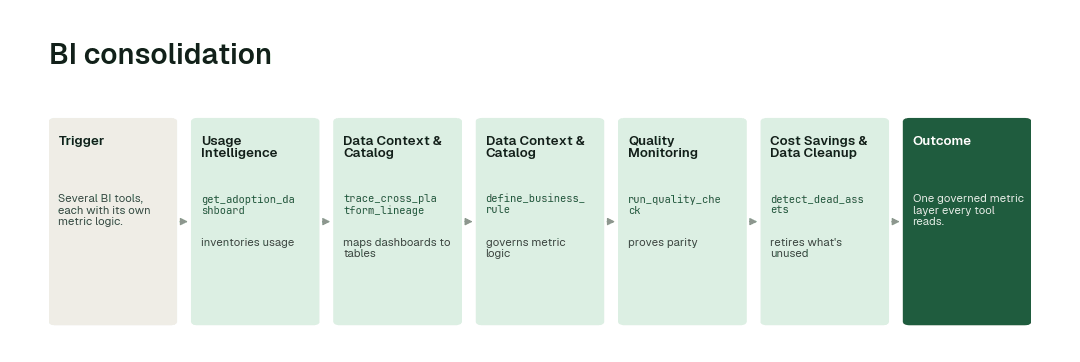
Most companies run several BI tools nobody chose on purpose, each with its own version of revenue. Data Workers inventories what people actually use, moves the metric logic into governed definitions you own, proves every number and retires the rest.
Before and after
| Today | With Data Workers |
|---|---|
| Several BI tools, each with its own metric logic | One governed metric layer every tool reads |
| Thousands of workbooks, most never opened | Only the dashboards people use, rebuilt and proven |
| Fourteen versions of net revenue | One definition per metric, with lineage |
| Migration quoted as a multi-year program | A move sized in dashboard families and weeks |
How it works
1. Find what's alive
Usage Intelligence and Data Context & Catalog inventory every dashboard, owner and open count, and trace each one to the tables behind it. Most of the estate turns out to be unused.
2. Rebuild and prove it
Metric logic from calculated fields and models moves into governed definitions in Data Context Wizard; Pipeline Building builds the models behind them, and Quality Monitoring proves every number against the values finance already trusts.
3. Switch off the rest
Unused dashboards, and the tables and compute behind them, are retired by Cost Savings & Data Cleanup once lineage proves nothing depends on them.
The impact metrics we move
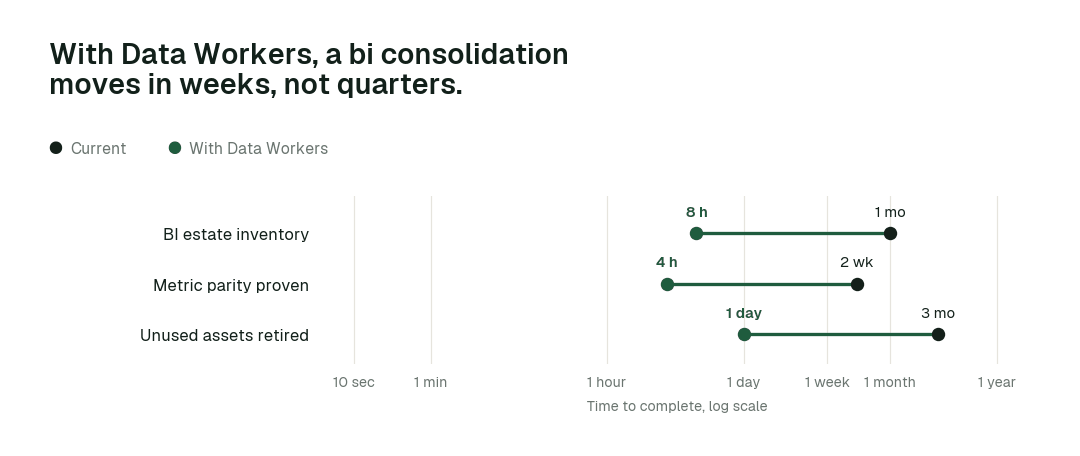
- •BI estate inventory: from about a month to 8 h
- •Metric parity proven: from about 2 weeks to 4 h
- •Unused assets retired: from about 3 months to 1 day
Where teams start
- •Tableau and Power BI rationalization. Consolidate onto the tool you keep, with metrics governed once.
- •Cognos and BusinessObjects retirement. Capture logic from decades-old universes before the people who wrote it leave.
- •Metric layer for every BI tool. One definition of each metric read by every dashboard and copilot.
- •Retire the tables behind dead dashboards. Cut warehouse spend along with seats.
- •Copilots on the same metrics. AI answers match the dashboards.
The climb: from assisted to autonomous to agentic
Every transformation runs on the same ladder from our thesis: agents first inventory and propose with receipts, then move work in approved waves, and the finished platform keeps running itself once the move is done.
The pilot
- •Scope. Inventory one dashboard family, rebuild its metrics and prove every number.
- •First week. Agents run at L1, observing only, and show the fixes they would have made, with receipts.
- •By week two. The routine work above runs on its own; anything sensitive stays with a named approver.
- •At day 30. We review the impact metrics against your baseline:
- •BI estate inventory: from about a month to 8 h
- •Metric parity proven: from about 2 weeks to 4 h
- •Unused assets retired: from about 3 months to 1 day
- •Cost. Start with a pilot ($7,500 one-time, credited in full against the first year). Scale is from $1,000 a month and Enterprise from $3,000 a month, billed annually, with unlimited seats, no usage meter and no markup on model spend. See pricing.
FAQ
Do we have to migrate everything? No. The inventory finds what people open; the rest is retired.
What if the numbers don't match? Differences are traced to the time window, definition or data, and sometimes the migration finds a number that was always wrong.
Which BI tool do we end on? The one you choose; Data Workers governs the metrics under it.