Make federated data products real, domain by domain
Data mesh programs define the operating model and stall in execution. Data Workers gives every domain an agent workforce that builds, registers and maintains data products to the firm's standards.
Before and after
| Today | With Data Workers |
|---|---|
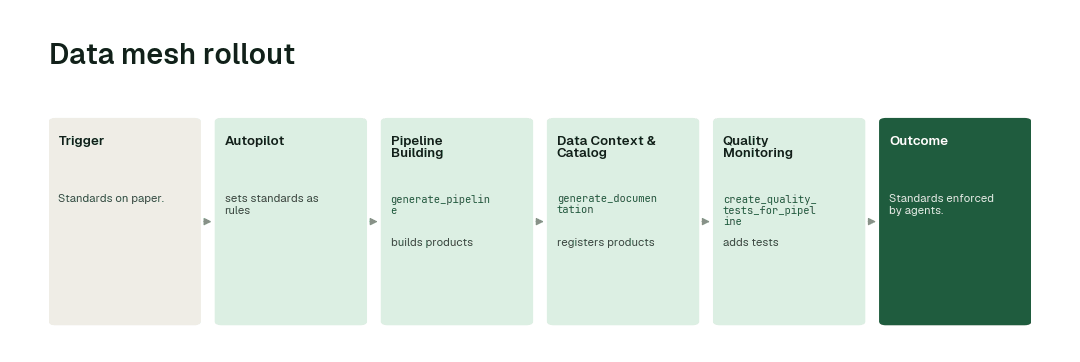
| Standards on paper | Standards enforced by agents |
| Domains that build differently | Every domain held to the same rules |
| A catalog that goes stale | Products registered and kept current |
| A central team that becomes the bottleneck | Domains that ship without waiting |
How it works
1. Set the standards
The central office writes standards as Autopilot rules.
2. Equip every domain
Agents build and register data products with owners, SLAs, tests and definitions.
3. Measure and expand
The Autopilot dashboard shows standards and autonomy per domain.
The impact metrics we move
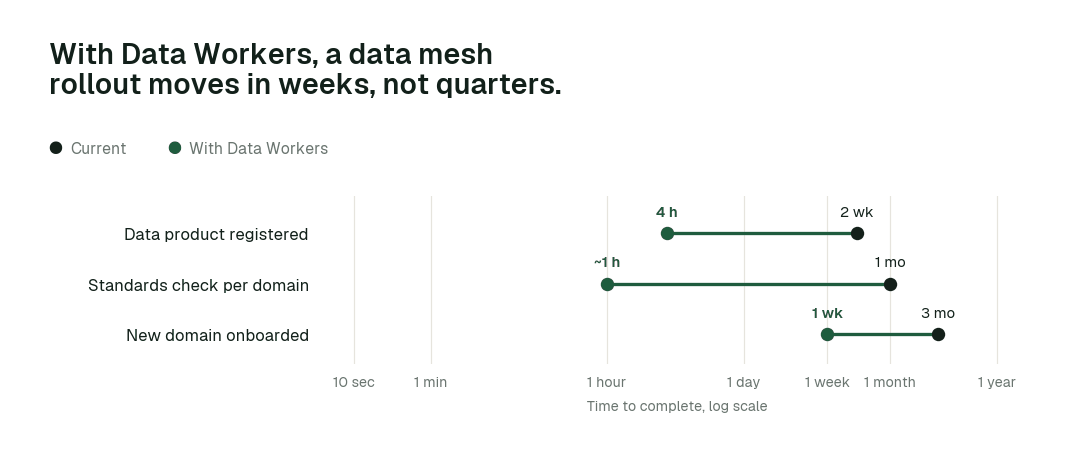
- •Data product registered: from about 2 weeks to 4 h
- •Standards check per domain: from about a month to ~1 h
- •New domain onboarded: from about 3 months to 1 wk
Where teams start
- •Firmwide data product standards. Owners, SLAs, tests and definitions.
- •Domain onboarding. Each domain equipped in a week.
- •Product marketplace. Products discoverable in Spellbook.
- •Federated governance. Policy applied in every domain.
- •Mesh metrics. Autonomy and adoption per domain.
The climb: from assisted to autonomous to agentic
Every transformation runs on the same ladder from our thesis: agents first inventory and propose with receipts, then move work in approved waves, and the finished platform keeps running itself once the move is done.
The pilot
- •Scope. Two domains with standards enforced by agents.
- •First week. Agents run at L1, observing only, and show the fixes they would have made, with receipts.
- •By week two. The routine work above runs on its own; anything sensitive stays with a named approver.
- •At day 30. We review the impact metrics against your baseline:
- •Data product registered: from about 2 weeks to 4 h
- •Standards check per domain: from about a month to ~1 h
- •New domain onboarded: from about 3 months to 1 wk
- •Cost. Start with a pilot ($7,500 one-time, credited in full against the first year). Scale is from $1,000 a month and Enterprise from $3,000 a month, billed annually, with unlimited seats, no usage meter and no markup on model spend. See pricing.
FAQ
Does this replace our central team? No; it makes them the standard-setters.
Can domains go at their own pace? Yes; autonomy is per domain.
How do we measure progress? Per domain, on the Autopilot dashboard.