Unity Catalog Alternative or Add-On? Unity Catalog vs Spellbook, the Agentic Catalog
Unity Catalog enforces the grants. Spellbook governs agent work across every platform and applies approved changes back through Unity Catalog. See the comparison.
Unity Catalog enforces the grants. Spellbook governs the agent work across your whole estate and applies approved changes back through Unity Catalog. That's the short answer for anyone searching for a Unity Catalog alternative or comparing Unity Catalog vs Data Workers.
If you run Databricks, your governance lives in Unity Catalog. Every table, view, volume, model and MCP service sits in a catalog.schema.object namespace. Grants decide who can SELECT, ABAC policies mask columns by governed tag, data classification tags sensitive columns on its own, and lineage draws itself for every job and notebook. Databricks calls it "the unified governance layer for data and AI built into Databricks", and it is very good at that job.
The seams show up in two places. The first is the rest of your estate. The finance mart lives in Snowflake, the marketing team queries BigQuery, dbt runs on more than one warehouse, and Tableau sits on top. Unity Catalog can read several of those through Lakehouse Federation, and Databricks documents that federation as read-only. The second seam is newer. Agents now change things: Genie Code edits pipelines, coding agents call MCP servers, and our own agents propose grants, tests and fixes. Someone has to decide which of those changes go through, apply them where enforcement lives, and keep the record.
Data Workers is the agentic data platform built for that. Spellbook Data Catalog (in preview) is the control plane where every agent change, on every platform, is proposed, approved, rolled back and audited. Data Context Wizard builds one governed context graph across Databricks and everything around it. On Databricks, approved access changes are applied through Unity Catalog's own permissions API, so Unity Catalog stays the lock.
For the platform-wide view, read Data Workers on Databricks. For the executive version, read the Databricks data leader's guide.
Key takeaways
- •Keep Unity Catalog as the lock. Grants, roles, ABAC row filters and column masks, data classification and lineage on Databricks are strong, mostly GA, and included with Databricks Premium and Enterprise.
- •Add Spellbook as the control plane for agent work. Every agent's proposed change, on Databricks, Snowflake, BigQuery and dbt, lands in one inbox with its blast radius, an approver and a rollback path.
- •Approved changes go back through Unity Catalog. Data Workers applies approved grants and revokes through the Unity Catalog permissions API, with the privileges you give it. It doesn't run a second permission system.
- •Unity Catalog reads the rest of the estate; Data Workers acts on it. Lakehouse Federation is read-only by design. Data Workers applies approved grants through Unity Catalog and drafts the grant or masking policy on every other platform for its owner to apply.
- •Access requests close end to end. Unity Catalog's access requests (Public Preview) route the ask; Data Workers drafts a least-privilege, time-boxed grant, applies it after approval and keeps a receipt.
- •If you're searching for a Unity Catalog alternative, the answer is an add-on. Data Workers is the better choice for governing agent work across the estate, and Unity Catalog stays where it is.
What a Unity Catalog alternative should add: six things Data Workers gives you
1. One inbox for every agent's changes. Genie, your coding agent and our 20+ specialist agents all propose work. In Spellbook each proposal arrives with the diff, the blast radius across platforms and the policy that applies. Your team approves, steers, sends back or rolls back.
2. Access requests that finish. The Access & Governance agent turns a request into a least-privilege grant: table-level instead of schema-level, the narrowest privilege that does the job, and an expiry when you want one. After approval it's applied through Unity Catalog and recorded.
3. Governance that follows the data off Databricks. When a Databricks table is copied into Snowflake or BigQuery, the Unity Catalog mask stays behind. Lineage in the context graph shows the copy of the classified column, and the Access & Governance agent proposes the matching masking policy for that platform's owner to apply.
4. One context graph across every platform. Data Context Wizard reads Unity Catalog grants, imports metric views, and joins them with your dbt manifest, Snowflake and BigQuery history and BI metadata, through 50+ connectors. Every fact carries its source, author, confidence and when it was seen.
5. A fix loop behind every signal. Unity Catalog's anomaly detection names a likely root cause. The Autonomous Data-Conductor takes the next steps: it traces the cause across systems, has the right agent fix it at the source and checks the result.
6. A receipt on every change, with who or what proposed it, who approved it, what it touched and how to undo it. Audit evidence for both platforms comes out of the same trail.
One access request, five systems
Here's how an ordinary governance week plays out in a mixed estate. It's an illustration, not a customer case.
- •Monday 09:05. A new finance analyst asks for
SELECTonmain.finance.fct_revenuefrom inside a Genie Agent. Unity Catalog's access request routes it to the#data-accessSlack channel. - •Monday 09:40. The platform engineer on rotation opens the approval dialog and, to clear the queue, grants
SELECTon the wholemain.financeschema. Nothing expires it. - •Tuesday 02:00. Data classification tags
main.finance.dim_customer.emailas PII. An ABAC column mask now hides it from anyone without the right group, on Databricks. - •Tuesday 03:00. A nightly dbt job copies
dim_customerinto the Snowflake finance mart. The column arrives in Snowflake with no masking policy, and a Tableau workbook reads it. - •Friday 16:00. An auditor asks a plain question: who can see customer email, on any platform?
| Step | What Unity Catalog sees | What Data Workers does |
|---|---|---|
| Access request from Genie | Routes the request to Slack (Public Preview). The approver grants in a dialog. | The Access & Governance agent drafts a table-level, 30-day grant with its dry run: effective privileges and the sensitive columns it reaches. After approval in Spellbook it's applied through the Unity Catalog permissions API. |
| Broad schema grant | Records the grant and enforces it. | The dry run recommends the narrower table-level grant. Data Workers proposes it with the revoke of the schema grant, and applies both through Unity Catalog after approval. |
| PII tag and ABAC mask | Classifies, tags and masks on Databricks. | Reads the grants and policies on the table and carries the sensitivity into the context graph. |
| dbt copy into Snowflake | Outside Unity Catalog; federation is read-only. | Lineage ties the copied email column in Snowflake to the masked, classified source. A Snowflake masking policy is proposed for the owner to apply, with the Tableau workbook listed in its blast radius. |
| Auditor's question | Audit logs and system tables for Databricks. | Receipts and an access map cover both platforms in one answer. |
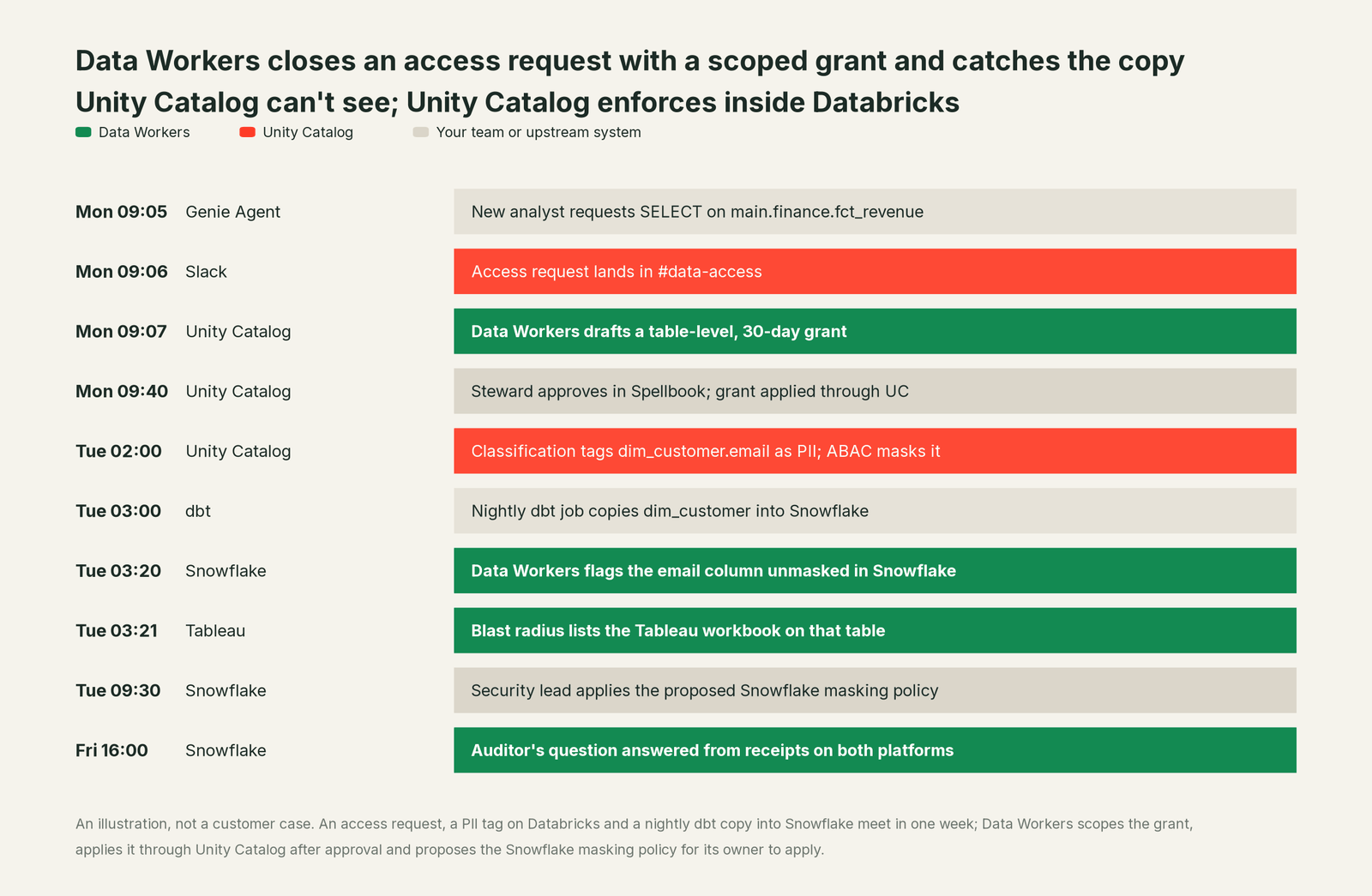
Unity Catalog did its job on every step it owns. The gaps sat between steps and between platforms. Data Workers works in those gaps, and it never takes enforcement away from Unity Catalog.
What Unity Catalog covers, as of October 2026
Databricks shipped a lot of governance this year, most of it in August and September. Here's what its documentation and release notes say ships today.
| Area | What Unity Catalog ships | Status (Oct 2026) |
|---|---|---|
| Privileges and grants | Ownership, READ METADATA (GA Aug 10), MANAGE | GA |
| Roles | Assume a role so only that role's permissions apply | GA, Aug 19 2026 |
| Fine-grained write privileges | INSERT, UPDATE, DELETE as least-privilege alternatives to MODIFY | Beta, Aug 24 2026 |
| ABAC | Row filter and column mask policies on governed tags; GRANT policies (GA Aug 31) | GA core |
| Newer ABAC | DENY policies, metastore-level policies, policies on views, identity and context attributes | Beta, Aug to Sep 2026 |
| Governed tags | Tag automations and a Tags page in Governance Hub; tags on dashboards, notebooks, apps and Genie Agents (GA Sep 25) | Beta / GA |
| Data classification | "An agentic AI system" that tags sensitive columns automatically once enabled; view scanning in Beta | GA |
| AI-generated comments | Suggested per object; a person with MODIFY accepts or edits before saving; no bulk mode | GA |
| Access requests | Destinations: email, Slack, Teams, webhook or one redirect URL; approver grants or adds to a group | Public Preview |
| Lineage | Table and column lineage, kept indefinitely in Catalog Explorer; external assets can be registered | GA |
| Anomaly detection | Freshness and completeness, with a likely root cause; no views or foreign tables | Public Preview |
| Lakehouse Federation | Query federation (Snowflake, BigQuery, Redshift, Oracle and more) and catalog federation (Hive metastore, Glue, Snowflake and more) | GA, read-only |
| Secrets | Secrets as securables in the three-level namespace | GA, Aug 3 2026 |
| AI assets | Models, model services, MCP services and skills (Beta) governed as securables | GA / Beta |
| Managed MCP servers | Genie One, Genie Agent, AI Search, DBSQL, UC functions | Public Preview; Genie One MCP GA Sep 25 |
| Unity Gateway | Governance for models, MCP services and agents (formerly AI Gateway) | GA, Aug 4 2026 |
| Contextual Service Policies | Allow, deny or require approval for an agent's action | Beta |
| Pricing | "No separate license is required" with Premium and Enterprise | Included |
That's a deep and fast-moving governance layer for Databricks.
One platform, not one more tool
Governance is one job on a data team's list. The same team also writes quality checks, finds root causes, ships fixes, cuts spend, changes pipelines, runs migrations and produces audit evidence. Each point tool adds another console, another contract and another handoff.
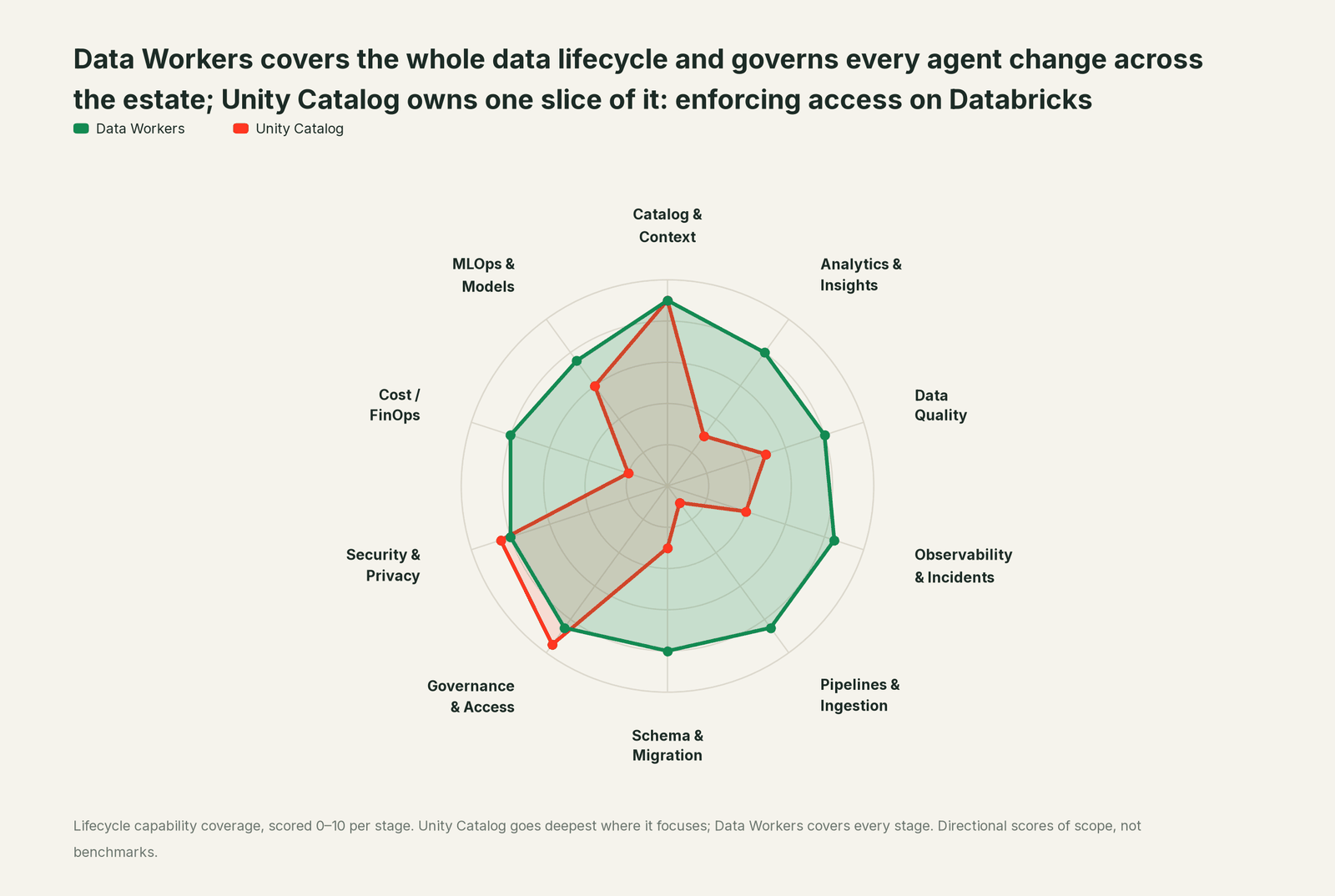
Data Workers covers the whole data lifecycle with one context graph, one approval flow and one audit trail. We score the same ten stages on every comparison page so you can compare tools across pages. Here we score Unity Catalog itself, not all of Databricks. It leads on governance and access and on security and privacy, its home ground. On catalog and context we're level: Unity Catalog goes deep on Databricks, and Data Workers covers every platform.
| Stage | Data Workers | Unity Catalog | Why we scored it this way |
|---|---|---|---|
| Catalog & Context | 9 | 9 | Level, on different ground. Unity Catalog is the inventory and lineage graph for Databricks data and AI assets. Data Workers keeps one context graph across every platform and brings Unity Catalog grants and metric views into it. |
| Analytics & Insights | 8 | 3 | Analytics runs in Genie, not in the catalog. Unity Catalog holds the metric views Genie answers from. Data Workers answers business questions over the whole governed graph. |
| Data Quality | 8 | 5 | Anomaly detection checks freshness and completeness and is in Public Preview. It skips views and foreign tables. Data Workers runs checks on Snowflake, BigQuery and Postgres, holds Databricks tables to baselines the team records and drafts the fix. |
| Observability & Incidents | 8.5 | 4 | Anomaly detection names a likely root cause and does not modify any tables it monitors. Data Workers traces the cause, fixes it at the source and verifies the result. |
| Pipelines & Ingestion | 8.5 | 1 | Pipelines are Lakeflow's job, not the catalog's. Data Workers proposes pipeline changes and reruns behind approval. |
| Schema & Migration | 8 | 3 | Catalog federation reads Hive metastore and Glue, which helps a move into Unity Catalog. Renames break lineage. Data Workers plans schema changes and migrations in approved waves. |
| Governance & Access | 8.5 | 9.5 | Unity Catalog's home stage: grants, roles, ABAC row filters and column masks, GRANT policies (GA) and access requests (Public Preview). Data Workers runs the request queue and applies approved grants through Unity Catalog. |
| Security & Privacy | 8 | 8.5 | Unity Catalog leads on Databricks: data classification (GA) tags sensitive columns automatically, and ABAC masks them. Data Workers' pull request review flags sensitive column names on every other connected platform and proposes the masking policy for each owner. |
| Cost / FinOps | 8 | 2 | Query tags and system tables show where compute goes. Data Workers attributes Snowflake credits per query to the dbt model behind them and drafts the fix for its owner. |
| MLOps & Models | 7.5 | 6 | Models, model services, MCP services and skills are governed as securables. Data Workers keeps the data under models healthy and connects to MLflow and W&B. |
Unity Catalog vs Data Workers on the outcomes you buy
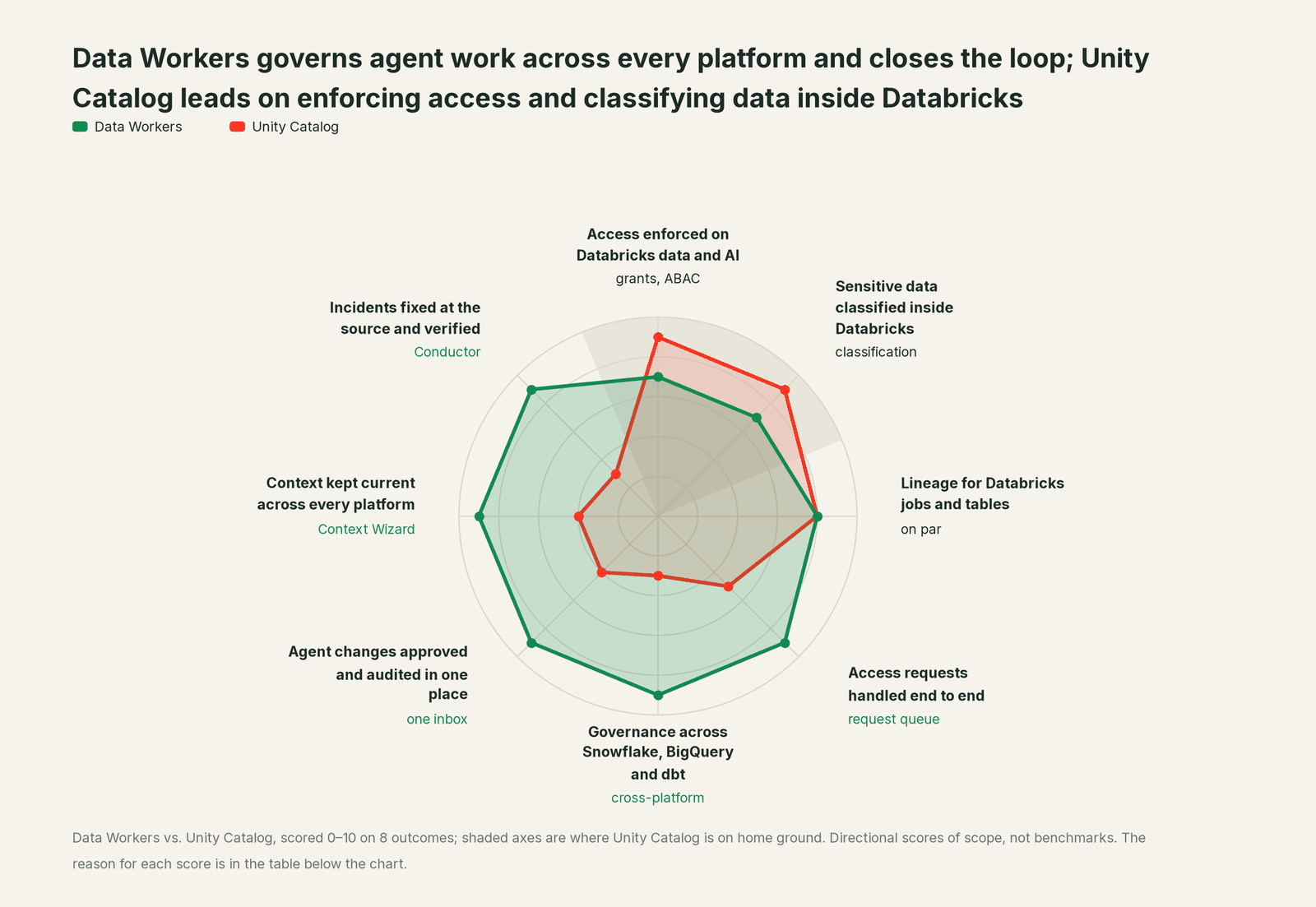
This view narrows to eight outcomes a data leader buys from a catalog and governance layer. Unity Catalog leads on two, both inside Databricks: enforcing access and classifying sensitive data. We're even on lineage for Databricks jobs, because we read the same lineage. Data Workers leads on every outcome that crosses the workspace edge or involves agents changing things.
| Outcome | Data Workers | Unity Catalog | Why we scored it this way |
|---|---|---|---|
| Access enforced on Databricks data and AI | 7 | 9 | Unity Catalog leads on its own surface: privileges, roles (GA), ABAC row filters and column masks, and GRANT policies (GA). Data Workers applies approved grants through Unity Catalog, so enforcement stays there. |
| Sensitive data classified inside Databricks | 7 | 9 | Data classification (GA) is an agentic system that tags sensitive columns automatically once enabled. Data Workers' pull request review flags sensitive column names on every connected platform. |
| Lineage for Databricks jobs and tables | 8 | 8 | Even. Unity Catalog captures table and column lineage automatically; Data Workers builds lineage from the dbt manifest and the team's context-graph notes and joins it to the rest of the estate. |
| Access requests handled end to end | 9 | 5 | Access requests are Public Preview. They route to email, Slack, Teams or a webhook, and the approver grants by hand; expiring grants aren't documented. Data Workers drafts a least-privilege, time-boxed grant, applies it after approval and keeps a receipt. |
| Governance across Snowflake, BigQuery and dbt | 9 | 3 | Lakehouse Federation gives governed, read-only access to external systems. Data Workers reads each platform and drafts its grants and masking policies, with a dry run and a receipt, for each owner to apply. |
| Agent changes approved and audited in one place | 9 | 4 | Contextual Service Policies (Beta) can require approval for an agent's tool call inside Databricks, and AI comments wait for Accept per object. Spellbook puts every agent's proposed change, on every platform, in one inbox with a receipt and rollback. |
| Context kept current across every platform | 9 | 4 | Unity Catalog describes Databricks assets and registered external ones. Data Context Wizard keeps one graph current across 50+ connectors, with Unity Catalog as a first-class source. |
| Incidents fixed at the source and verified | 9 | 3 | Anomaly detection (Public Preview) names a likely root cause and doesn't modify tables; Genie ZeroOps is in private preview. The Conductor fixes the cause and checks the result. |
The scores measure scope, not answer quality. They're directional judgments, not benchmarks, and the reasoning is on every line so you can argue with any of it.
Where Unity Catalog stops
Each limit below comes from Databricks' own documentation. None is a flaw. Databricks built Unity Catalog as the enforcement layer inside its platform, and an enforcement layer should be strict about what it touches.
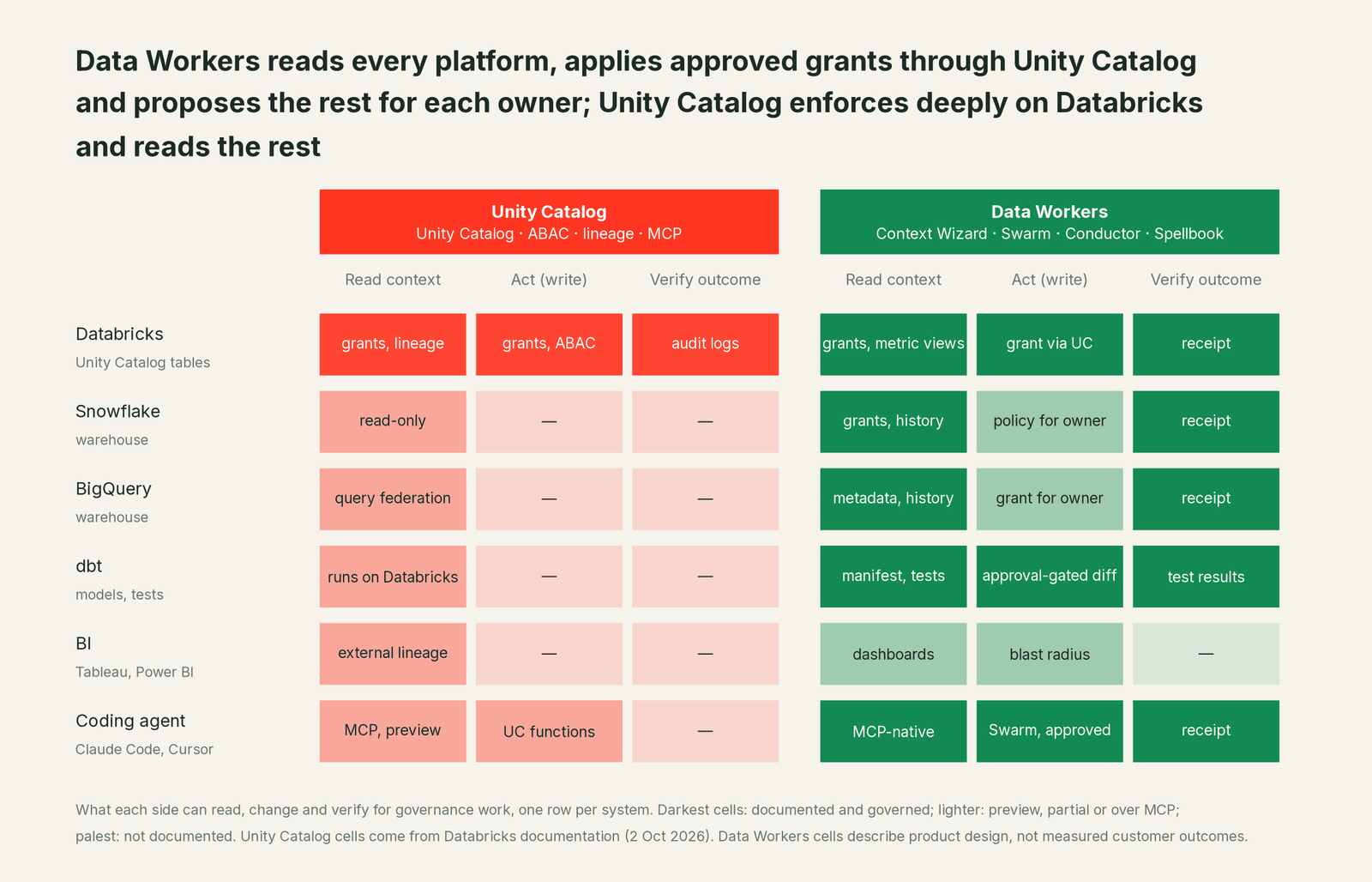
Other platforms are read-only. Lakehouse Federation is documented as "governed, read-only access to external data", with write support "Not supported (read-only)" for both query and catalog federation. Unity Catalog can show you a Snowflake table. It won't change a Snowflake grant or masking policy.
Access requests route; people grant. Request for access is in Public Preview. Destinations are email, Slack, Teams, a webhook or one redirect URL to an outside system. The approver then grants the privilege or adds the requester to a group by hand. The documentation doesn't describe automatic grants or expiry.
Approval works one surface at a time. AI-generated comments wait for a person to accept or edit them, one object at a time, with no bulk mode. Contextual Service Policies (Beta) can require approval for an agent's tool call inside Databricks. Each check is a good one, and there's no single queue where all agent changes across platforms wait together.
Signals stop before the fix. Anomaly detection (Public Preview) checks freshness and completeness, names a likely root cause, and "does not modify any tables it monitors". It doesn't cover views or foreign tables.
Lineage breaks on renames. Renamed catalogs, schemas, tables, views or columns don't keep their lineage, and system tables hold a rolling year.
Why doesn't Unity Catalog just do this itself?
Because it's the lock, and a lock shouldn't also be the locksmith for every other building. Unity Catalog's value is that Databricks enforces its decisions on every query, on every compute type, the same way every time. Keeping federation read-only is a sensible choice for a product with that job: Databricks doesn't take responsibility for grants in Snowflake or masking policies in BigQuery.
Running agent changes across platforms is a different product. It needs blast-radius scoping across systems, an approval flow per domain, rollback, receipts, context about every other platform, and accountability for changes in tools Databricks doesn't own. That's the product Data Workers is. It doesn't compete with the lock. It decides, with your approval, what the lock should say, and records why.
Where the two overlap
"Both" means Data Workers builds on the Unity Catalog capability.
| Job to be done | Unity Catalog | Data Workers | What we recommend |
|---|---|---|---|
| Enforcing access on Databricks | Grants, roles, ABAC | Applies approved grants through Unity Catalog | Unity Catalog enforces; both for the request queue |
| Classifying sensitive data on Databricks | Data classification (GA) | Pull request review flags sensitive column names on every connected platform | Unity Catalog on Databricks; Data Workers elsewhere |
| Access requests | Routing to Slack, Teams or email (Public Preview) | Least-privilege, time-boxed grant with receipt | Data Workers, applied through Unity Catalog |
| Lineage | Automatic on Databricks | Reads it and joins dbt, Snowflake, BigQuery and BI | Data Workers for anything that crosses platforms |
| Descriptions and comments | AI comments, accepted per object | Proposals with source and confidence; approved facts land in the Context Wizard graph, and the steward applies the comment in Unity Catalog | Both |
| Governance on Snowflake and BigQuery | Read-only federation | Drafts grants and masking policies for each owner to apply | Data Workers |
| Agent changes | Contextual Service Policies (Beta) inside Databricks | One inbox for every agent on every platform | Data Workers |
| Audit | Audit logs and system tables for Databricks | Receipt on every change, every platform | Both |
Unity Catalog alternative or add-on: why Data Workers is the better choice for agent governance
Keep Unity Catalog for what it does best: enforcing grants and policies on Databricks, classifying data, and drawing lineage. It's included with your Databricks plan and it's getting better every month.
Choose Data Workers to govern the work. It reads Unity Catalog grants and imports metric views, joins them with every other platform, turns requests and findings into scoped proposals, applies approved grants through Unity Catalog, and hands every other platform's grant or policy to its owner to apply. If you came looking for a Unity Catalog alternative because your estate is bigger than Databricks, this is the answer: keep the lock, and add the control plane.
What it costs
Unity Catalog is included with Databricks Premium and Enterprise, with no separate license. Some features bill compute: anomaly detection runs on serverless and is billed under the DATA_QUALITY_MONITORING product, and data classification scans use compute.
Data Workers is a flat platform fee. The Apache 2.0 core is free. A pilot is $7,500 one-time. Scale starts at $1,000 a month and Enterprise at $3,000 a month (billed annually). Seats are unlimited, there's no usage meter, and there's no markup on model spend because you bring your own model. See pricing.
The fastest first win: access requests on one catalog
Start with the queue that already exists. Keep Unity Catalog's access request destination for one catalog where it is today, and have requesters' asks reach Data Workers through your coding agent or over MCP today. Run the Access & Governance agent in propose mode. Each request arrives in Spellbook as a least-privilege, time-boxed grant with its dry run: effective privileges, the sensitive columns it reaches and any policy conflict. A steward approves it, and Data Workers applies it through Unity Catalog with a receipt.
In the same first weeks, bring Snowflake or BigQuery requests for the same data into the queue. Each gets the same dry run and the same steward, and the grants Data Workers drafts for the owner there carry the same expiry. When your stewards have approved the access proposals as-is for a few weeks, move that domain up to reversible actions.
What Spellbook and Data Context Wizard add
Spellbook Data Catalog. The control plane for agent work, and the idea behind our whitepaper From the Traditional Data Catalog to the Agentic Data Catalog. A traditional catalog records what exists, what it means and who can use it. Once agents do the work, the catalog also has to be where that work is proposed, approved, rolled back and audited.
- •One inbox for all agent work: approve, steer, send back or roll back.
- •Asset pages that cover the whole estate, across Databricks, Snowflake, BigQuery, dbt and BI.
- •An authority guard enforced in code. No agent can approve or promote its own work.
- •Provenance and blast radius on every proposed change.
- •Approval requests reach stewards in Slack or email, and the decision is made in Spellbook with the diff in view.
Data Context Wizard. The cross-platform context graph Spellbook reads from, with 50+ connectors. It reads Unity Catalog grants and imports Unity Catalog metric views as first-class definitions. For the step-by-step version of that, read our guide to Unity Catalog metric views and lineage in Data Context Wizard.
The rest of the platform, the Data-Agents Swarm and the Autonomous Data-Conductor, is covered in Data Workers on Databricks. If you're still moving tables off the Hive metastore or Glue, the Data Migration agent plans that move in approved waves.
Guardrails
Unity Catalog decides who can do what on Databricks. Data Workers decides, with your approval, which changes get made, and leaves Unity Catalog to enforce them.
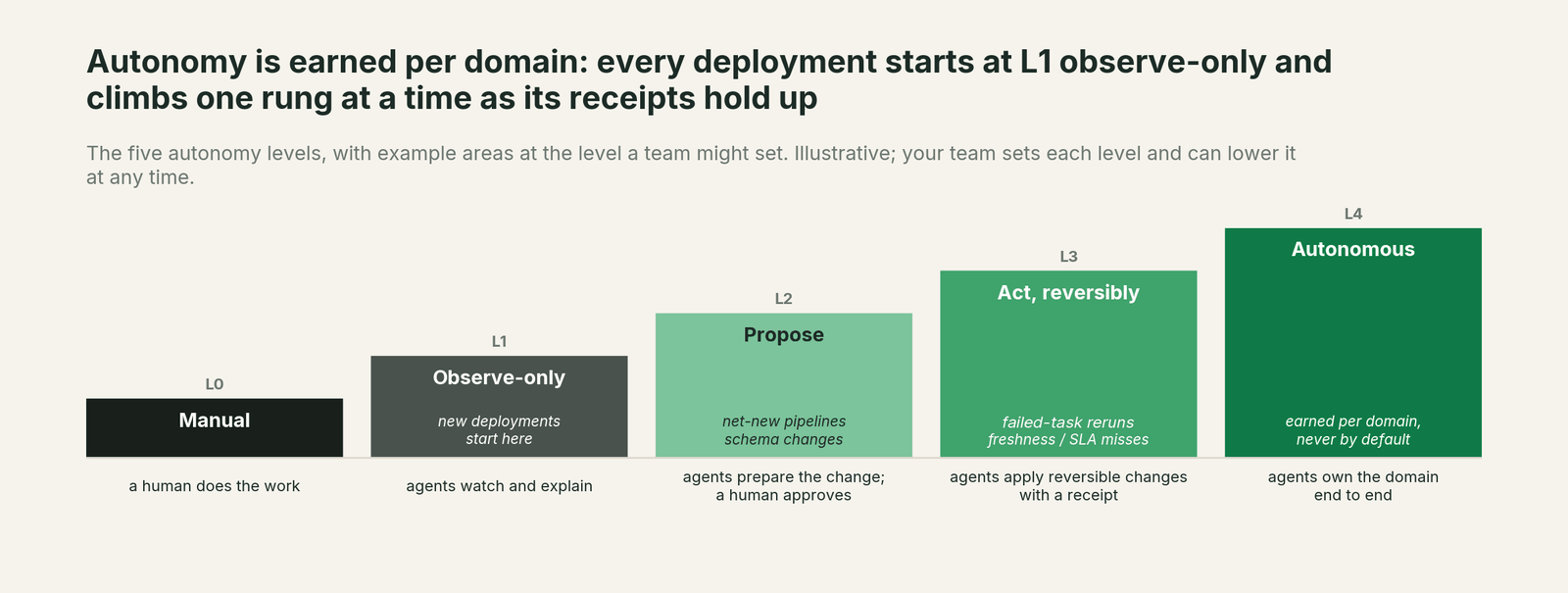
- •New deployments start observe-only, and you extend autonomy one domain at a time.
- •Autonomy is set per domain. Access requests on a sandbox catalog can run at L3 (act, reversibly) while finance grants stay at L2 (propose).
- •Anything irreversible needs a named human to approve it.
- •Every write is scoped before it runs, with blast radius computed across platforms.
- •Every action is approved or reversible, with a tamper-evident receipt covering the diff, approver, timestamp and rollback path.
- •No agent can approve or promote its own work, enforced in code in the write path.
- •Least privilege. Data Workers acts with the Unity Catalog privileges you grant it, so Unity Catalog's enforcement applies to everything it touches on Databricks.
"Databricks has Contextual Service Policies and managed MCP. Isn't that enough for agents?"
For agents running inside Databricks, it's a strong start. Unity Gateway puts spend caps and guardrails on models and MCP services, and Contextual Service Policies (Beta) can allow, deny or require approval for an agent's action, by user, agent, model, MCP service or tool. Managed MCP servers (Public Preview, with the Genie One MCP server GA) give any agent governed access to Genie, SQL and Unity Catalog functions.
Those controls sit at the tool call, inside Databricks. An approval there answers "may this agent call this tool now?". The questions a governance team gets are wider. What else does this change touch, on Snowflake and in Tableau? Who approved it, and how do we undo it? What did every agent change this quarter, on every platform? Spellbook answers those. Every Data Workers agent is itself an MCP server, and each one runs behind the approval flow, the authority guard and the receipts.
How it fits together
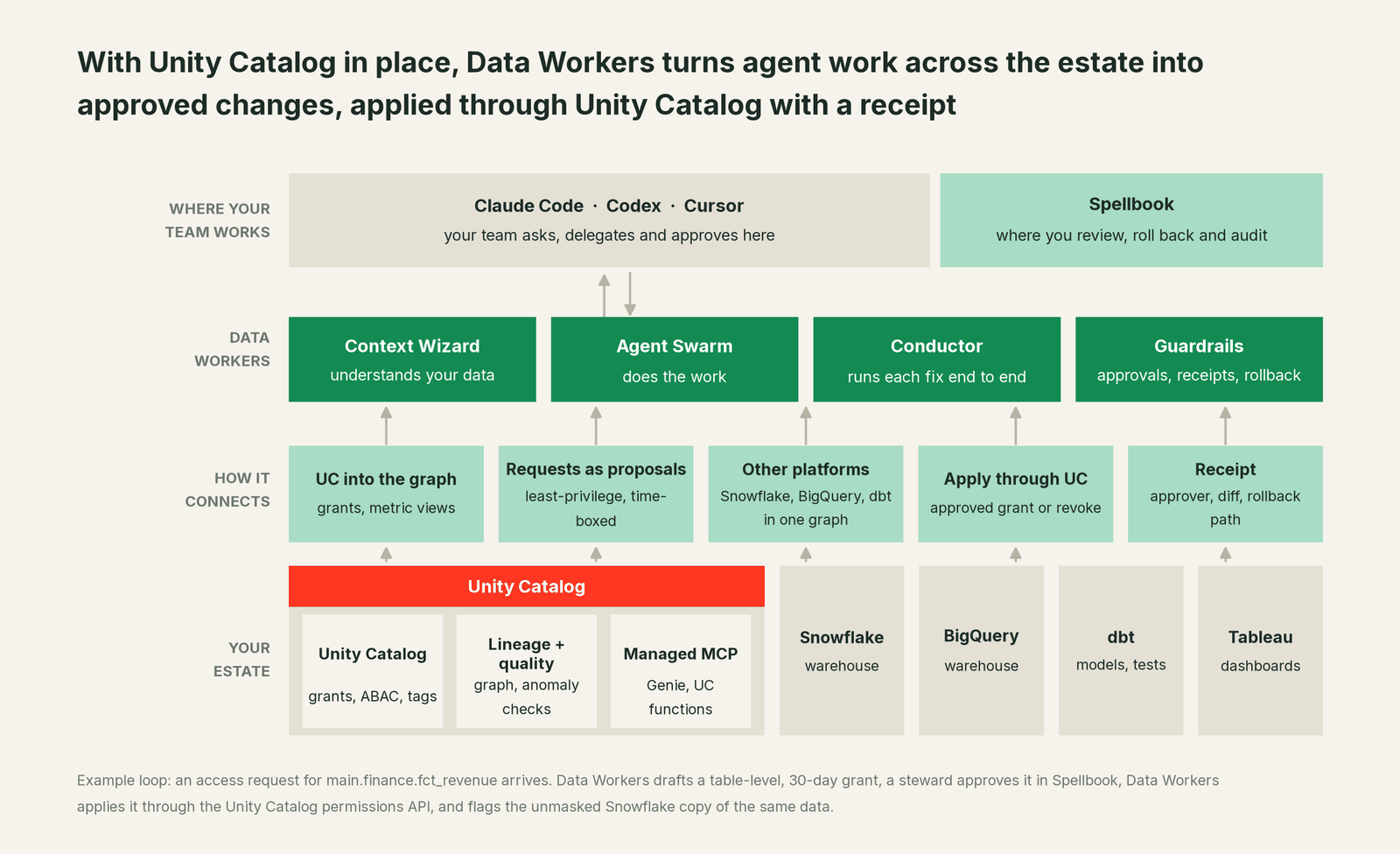
Getting started takes no migration. Give Data Workers a service principal with the Unity Catalog privileges you choose, add your other warehouses, your dbt project and your BI tools, and let the Context Wizard build the graph. Every agent starts observe-only. The first things you see are your access map across platforms and a queue of proposals: access requests scoped down to least privilege, and sensitive columns that lost their mask on the way out of Databricks.
When Unity Catalog alone is enough
Unity Catalog can be enough if Databricks is your whole estate and people, not agents, make the changes. Grants, ABAC, classification and lineage cover that world well. Everyone else, which is most teams with Snowflake, BigQuery or dbt next to Databricks and agents starting to write, chooses Data Workers, because they need one place to approve agent work across platforms and one trail that proves what happened.
The case for your CFO
The outcome in business terms: access requests close the day they're asked instead of sitting in a platform team's queue, grants match what people need instead of whole schemas, and sensitive data stays protected when it leaves Databricks. Every one of those changes is approved once, applied where enforcement already lives, and recorded across every platform, so audit evidence comes out of the work instead of a quarterly scramble.
The risk story is plain. Agents start observe-only and move up one domain at a time. Anything irreversible needs a named person to approve it, no agent can approve its own work, and every change leaves a receipt with a rollback path. Data Workers acts only with the privileges you grant it.
Why now: agents are getting write paths on Databricks and on every platform around it, and the record of their changes is the next thing auditors and security teams will ask for. It's cheaper to put the approval flow in place before that queue grows.
The first win is access requests on one catalog, plus the same dry run for requests on Snowflake or BigQuery. What stays the same: Unity Catalog keeps enforcing exactly as it does today, your grants, ABAC policies and Databricks workflows don't change, and nothing migrates.
The path is a pilot on that one catalog. The pilot is credited in full against the first year; see pricing.
The sentence to repeat upstairs: "Unity Catalog stays the lock on Databricks; Spellbook is where every agent change across all our platforms gets approved, applied and recorded."
FAQ
What is the best Unity Catalog alternative? For most teams the best Unity Catalog alternative is an add-on. Keep Unity Catalog as the enforcement layer on Databricks and add Data Workers to govern agent work across the whole estate. Spellbook puts every proposed change in one inbox and applies approved access changes through Unity Catalog.
Unity Catalog vs Data Workers: which should I choose? Use both, for different jobs. Unity Catalog enforces grants and policies on Databricks. Data Workers decides, with your approval, which changes get made across Databricks, Snowflake, BigQuery and dbt, and keeps the record.
Does Data Workers replace Unity Catalog? No. Data Workers doesn't run a second permission system. On Databricks, approved grant and revoke changes are applied through the Unity Catalog permissions API, so Unity Catalog stays authoritative.
Can Unity Catalog govern Snowflake and BigQuery? It can read them. Lakehouse Federation gives governed, read-only access to external systems, including Snowflake and BigQuery. Changing grants or policies there is outside it. Data Workers drafts those grants and policies, with a dry run, for each platform's owner to apply.
How does Data Workers handle Unity Catalog access requests? Requests still start where your users ask. Data Workers turns each one into a least-privilege, optionally time-boxed grant, sends it to Spellbook for approval, applies it through Unity Catalog and keeps a receipt.
What privileges does Data Workers need on Unity Catalog? The ones you give its service principal. Start read-only for observe mode. Add the privilege to manage grants on the catalogs where you want access requests handled.
Is Spellbook generally available? Spellbook Data Catalog is in preview. The Data Workers core is Apache 2.0 and free to run, and the paid plans add governed writes, hosted components and support.
How much does Data Workers cost? The core is free. A pilot is $7,500 one-time, Scale starts at $1,000 a month and Enterprise at $3,000 a month, billed annually, with unlimited seats and no usage meter. See pricing.
Sources
Sources for Unity Catalog capabilities and statuses: Databricks documentation, release notes and blog posts current as of October 2, 2026, including the Unity Catalog overview, the Unity Catalog product page, the September 2026 release notes, the August 2026 release notes, ABAC, data classification, AI-generated comments, access requests, data lineage, anomaly detection, Lakehouse Federation, managed MCP servers and the Unity Gateway announcement (June 16, 2026). Product names and statuses change quickly; if we've got something wrong, tell us and we'll fix it.