Data Workers for finance and accounting data teams
Close, FP&A and reporting run on data that has to tie out to the ledger every time. This is how finance data teams put that back office on autopilot.
What going fully agentic and autonomous means for this team
- •Close without the scramble. Subledgers tie to the GL every day, not in the last week of the month.
- •One definition of revenue. Finance, sales and the board deck report the same number.
- •Variance explained, not investigated. Every unexpected move is traced to its cause.
- •Audit evidence on demand. Lineage and approvals are recorded as the work happens.
The shift
Finance runs on reconciliations: subledgers to the GL, billing to revenue, budgets to actuals. Every source system change, late feed or restatement becomes a late night at close.
Data Workers reconciles continuously, traces every variance to its source and holds anything that changes a reported number for a named approver.
Use-case guides
- •Month-end close data: The close starts reconciled.
- •Real-time financial reporting data: Leadership sees reconciled numbers mid-month.
- •Audit and controls data: Audit requests are answered in hours.
- •Agentic controllership: The controller reviews exceptions instead of chasing the checklist.
- •Data reconciliation: Breaks are cleared the day they appear.
- •SAP and ERP reporting data: ERP reports survive upgrades.
- •Flux and variance analysis: Flux is explained as it happens.
- •Intercompany and consolidation data: Consolidation starts balanced.
- •Accruals and prepaids data: No missed accruals at review.
- •FP&A and forecasting data: Forecasts start from current actuals.
- •Board and executive reporting data: The board pack is ready and agreed before the week of the meeting.
- •Spend and vendor analytics data: Spend by vendor is accurate and current.
Use cases, in depth
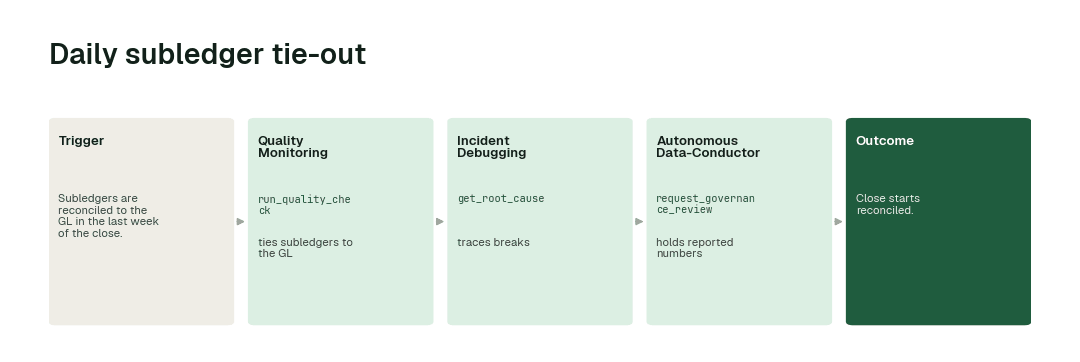
Daily subledger tie-out
Today. Subledgers are reconciled to the GL in the last week of the close.
With Data Workers. Quality Monitoring ties every subledger daily and Incident Debugging traces breaks the day they appear.
What changes. Close starts reconciled.
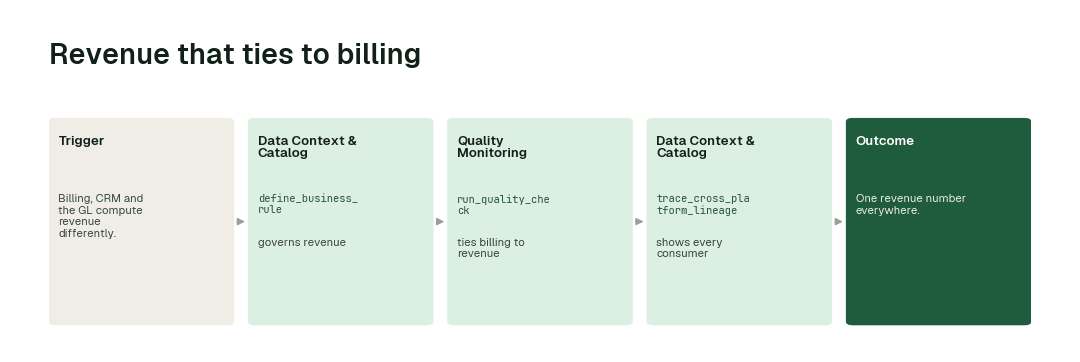
Revenue that ties to billing
Today. Billing, CRM and the GL compute revenue differently.
With Data Workers. Data Context Wizard governs revenue definitions and Quality Monitoring ties billing to revenue daily.
What changes. One revenue number everywhere.
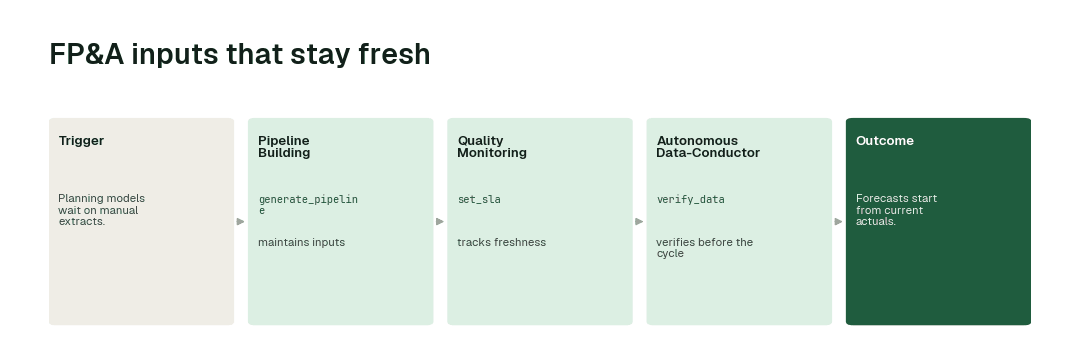
FP&A inputs that stay fresh
Today. Planning models wait on manual extracts.
With Data Workers. Pipeline Building maintains planning inputs and Conductor verifies them before each cycle.
What changes. Forecasts start from current actuals.
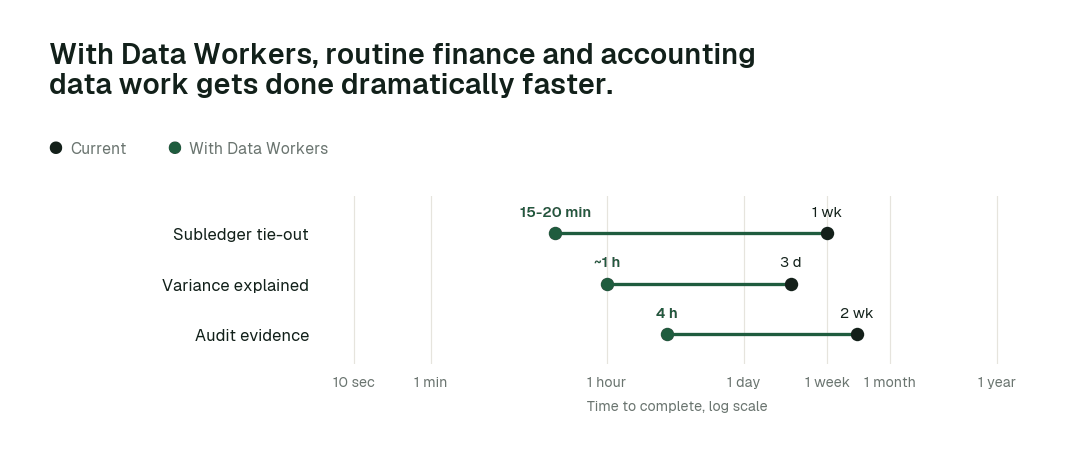
The impact metrics we move
- •Subledger tie-out: from about a week to 15-20 min
- •Variance explained: from about 3 days to ~1 h
- •Audit evidence: from about 2 weeks to 4 h
The pilot
- •Scope. Daily subledger tie-out for one entity at L2.
- •First week. Agents run at L1, observing only, and show the fixes they would have made, with receipts.
- •By week two. The routine work above runs on its own; anything sensitive stays with a named approver.
- •At day 30. We review the impact metrics against your baseline:
- •Subledger tie-out: from about a week to 15-20 min
- •Variance explained: from about 3 days to ~1 h
- •Audit evidence: from about 2 weeks to 4 h
- •Cost. Start with a pilot ($7,500 one-time, credited in full against the first year). Scale is from $1,000 a month and Enterprise from $3,000 a month, billed annually, with unlimited seats, no usage meter and no markup on model spend. See pricing.