Data Workers for AI and automation teams
Copilots and agents are only as good as the data and definitions under them. This is how AI and automation teams give every agent governed context and a safe way to act on data.
What going fully agentic and autonomous means for this team
- •Agents that answer from governed data. Every answer cites governed definitions and lineage.
- •Agents that can act safely. Changes are proposed, approved and receipted.
- •Training and eval data you can defend. Rights, lineage and contamination are enforced.
- •Automation that scales. Missions run long-horizon work across systems.
The shift
Companies have rolled out copilots and built agents, and adoption stalls when answers disagree with reports or when an agent can't safely change data. The bottleneck is not the model; it is governed context and controlled action.
Data Workers gives every AI tool a governed context layer and a controlled way to change data: proposals with diffs, named approvers and receipts.
Use-case guides
- •Enterprise AI context: Every AI tool answers from the same governed context.
- •Agent governance and audit: Every AI action is approved where it matters and auditable everywhere.
- •AI cost management: AI spend is visible per outcome.
- •Model-agnostic deployment: Switch models without rebuilding anything.
Use cases, in depth
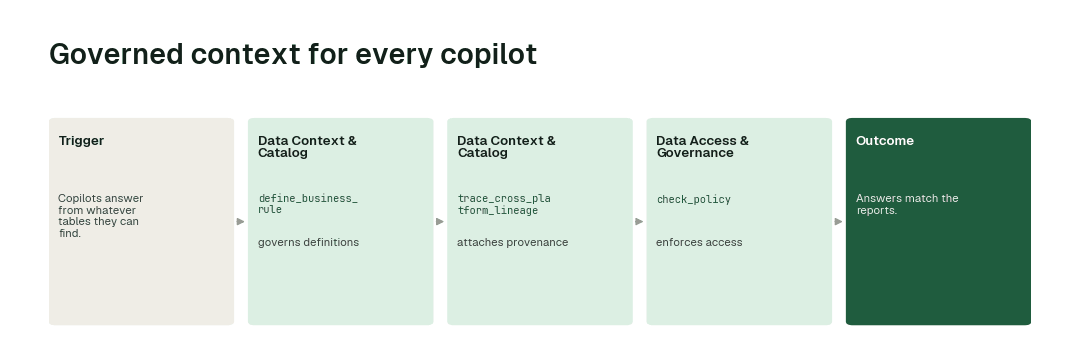
Governed context for every copilot
Today. Copilots answer from whatever tables they can find.
With Data Workers. Data Context Wizard serves governed definitions with provenance over MCP to every AI tool.
What changes. Answers match the reports.
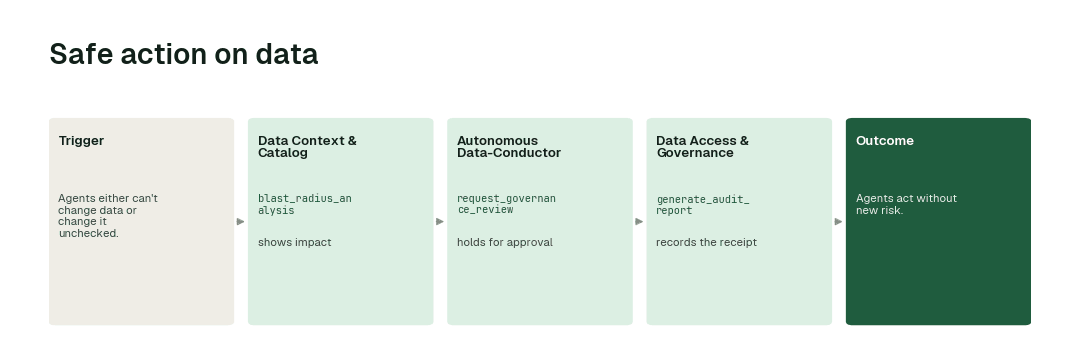
Safe action on data
Today. Agents either can't change data or change it unchecked.
With Data Workers. Changes go through the gate: diff, blast radius, named approver, receipt.
What changes. Agents act without new risk.
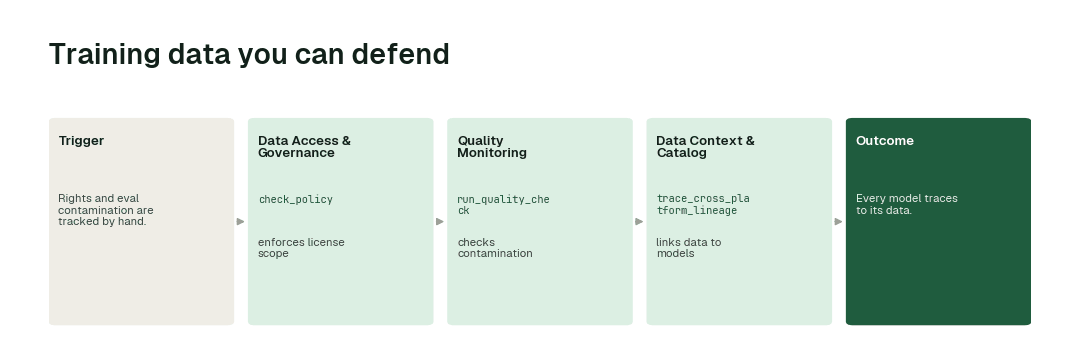
Training data you can defend
Today. Rights and eval contamination are tracked by hand.
With Data Workers. Access & Governance enforces license scope and Conductor checks contamination before every run.
What changes. Every model traces to its data.
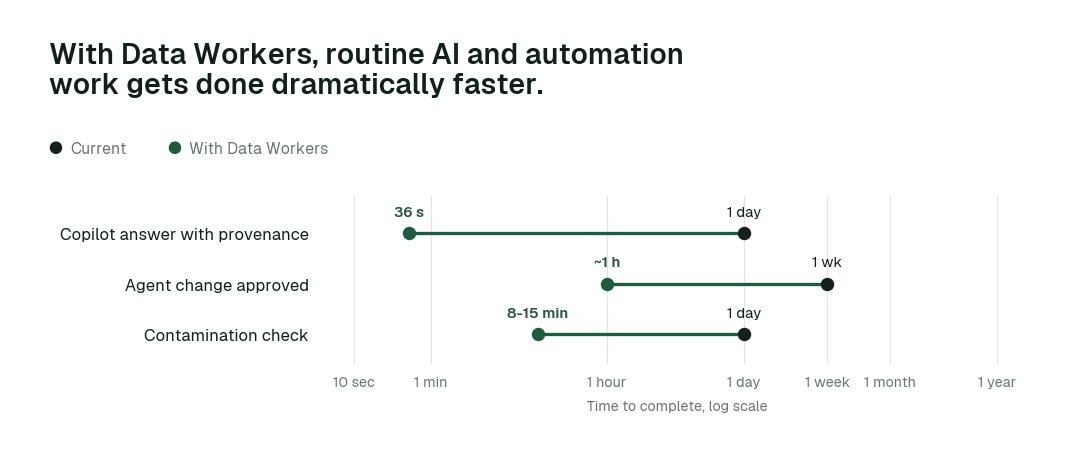
The impact metrics we move
- •Copilot answer with provenance: from about a day to seconds
- •Agent change approved: from about a week to ~1 h
- •Contamination check: from about a day to 8-15 min
The pilot
- •Scope. Governed context for one copilot and one approval workflow.
- •First week. Agents run at L1, observing only, and show the fixes they would have made, with receipts.
- •By week two. The routine work above runs on its own; anything sensitive stays with a named approver.
- •At day 30. We review the impact metrics against your baseline:
- •Copilot answer with provenance: from about a day to seconds
- •Agent change approved: from about a week to ~1 h
- •Contamination check: from about a day to 8-15 min
- •Cost. Start with a pilot ($7,500 one-time, credited in full against the first year). Scale is from $1,000 a month and Enterprise from $3,000 a month, billed annually, with unlimited seats, no usage meter and no markup on model spend. See pricing.