Cost intelligence data, run by agents
Cost-per-case models combine GL, supply, labor and encounter data in spreadsheets that take weeks to refresh. Here is how Data Workers runs it instead.
Key takeaways
- •The problem today. Cost-per-case models combine GL, supply, labor and encounter data in spreadsheets that take weeks to refresh.
- •What changes. Agents keep the cost model's inputs joined and tied to the GL, so service-line margins refresh with every close.
- •What stays with your people. Published service-line margins: leadership decides on them.
- •The result. Service-line margins refresh with every close.
The problem today
Cost-per-case models combine GL, supply, labor and encounter data in spreadsheets that take weeks to refresh.
What changes with Data Workers
Agents keep the cost model's inputs joined and tied to the GL, so service-line margins refresh with every close.
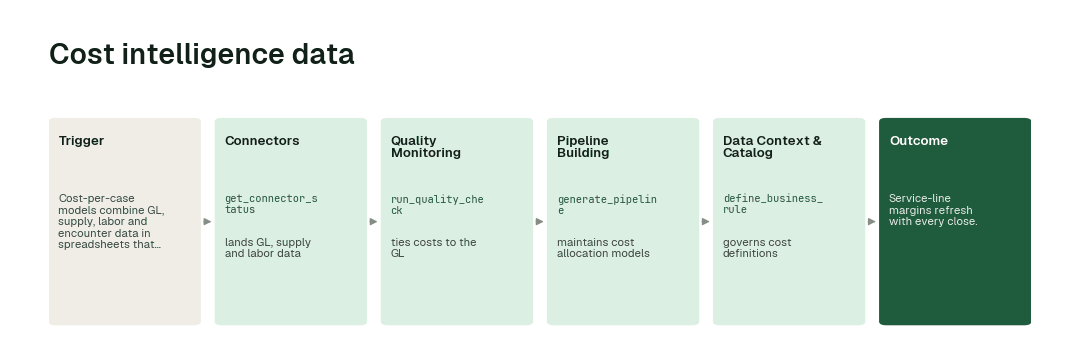
The workflow, step by step
- 1.The Connectors agent calls
get_connector_statusand lands GL, supply and labor data. - 2.The Quality Monitoring agent calls
run_quality_checkand ties costs to the GL. - 3.The Pipeline Building agent calls
generate_pipelineand maintains cost allocation models. - 4.The Data Context & Catalog agent calls
define_business_ruleand governs cost definitions.
The impact metrics we move
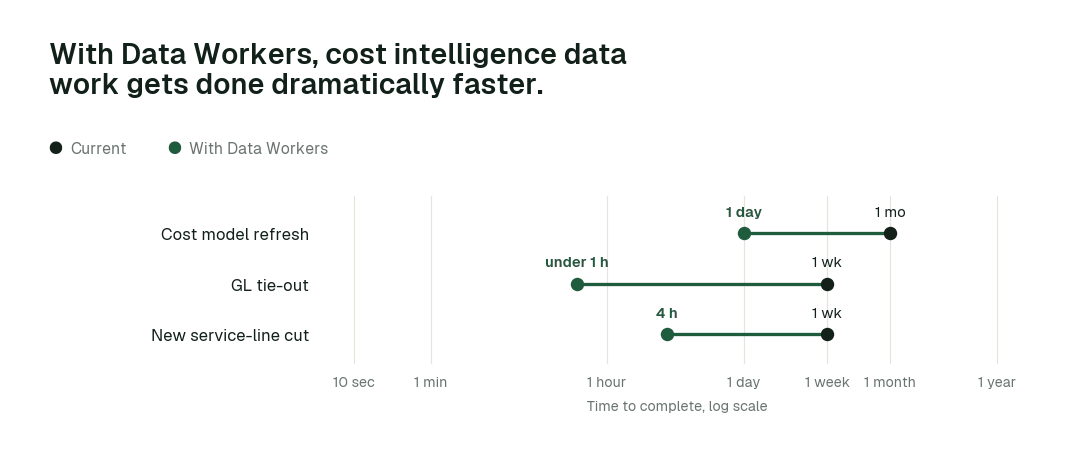
- •Cost model refresh: from about a month to 1 day
- •GL tie-out: from about a week to under 1 h
- •New service-line cut: from about a week to 4 h
What goes on autopilot
- •Cost inputs tie to the GL every close, so margins are trusted.
- •Allocation logic is versioned, so comparisons survive changes.
Where your people stay in charge
Published service-line margins always go to a named approver, because leadership decides on them. Everything starts at L1, observing only, and autonomy rises only on evidence.
The pilot
- •Scope. GL tie-out and one service line.
- •First week. Agents run at L1, observing only, and show the fixes they would have made, with receipts.
- •By week two. The routine work above runs on its own; anything sensitive stays with a named approver.
- •At day 30. We review the impact metrics against your baseline:
- •Cost model refresh: from about a month to 1 day
- •GL tie-out: from about a week to under 1 h
- •New service-line cut: from about a week to 4 h
- •Cost. Start with a pilot ($7,500 one-time, credited in full against the first year). Scale is from $1,000 a month and Enterprise from $3,000 a month, billed annually, with unlimited seats, no usage meter and no markup on model spend. See pricing.