You're on Validio: It Finds the Segment That Broke. Data Workers Fixes the Cause
Validio detects anomalies deep in segments and streams. Data Workers diagnoses the cause across Kafka, Snowflake and dbt, fixes it behind approvals and verifies.
Your team pointed Validio at Snowflake tables, Kafka topics, maybe a Kinesis stream. Each source has validators for volume, freshness, distribution, duplicates and custom SQL, and the important ones are segmented by country, payment method or merchant tier, so a drop in one corner of the data is caught even when the table total looks normal. Thresholds learn seasonality, related incidents form one incident group, and the Root cause tab traces it through lineage. The debug query agent drafts investigation SQL, and Validio's MCP server lets Claude configure validators and analyze incidents in plain language. Validio is the smoke alarm, and few alarms are wired as finely. Data Workers is the crew: it diagnoses, fixes and verifies behind approvals across the producer, the stream, the connector, the warehouse, the orchestrator and the dashboard, with a receipt for every change.
Key takeaways
- •Validio keeps its job. Validators, segmentations, thresholds, incident groups and Validio's agents stay where your team built them.
- •Validio tells you which segment broke and where in the lineage. Data Workers finds out why in the systems around it, such as a schema change a Kafka Connect sink cannot load, and carries the fix through each owner.
- •Both sides draw the same safety line. Validio's debug agent drafts SQL and never runs it, and its MCP server refuses destructive operations. Data Workers adds what a cross-system fix needs: a blast radius, a named approver, an undo and a receipt.
- •Streaming is where this pays off. Data Workers reads Kafka Connect connector status natively and registers approved Schema Registry versions, so a Validio segment alert arrives with the connector's state next to the producer's change.
- •Autonomy per domain. Each domain climbs from L0 manual to L4 autonomous at your team's pace.
Validio is the smoke alarm. Data Workers is the crew.
A Monday night at a European payments company. A payments service produces transaction events to Kafka with Avro schemas in Confluent Schema Registry, a Kafka Connect sink streams them into Snowflake, dbt models run in Prefect flows, and a Tableau workbook tells treasury at 08:30 how much to pre-fund for the day's SEPA payouts. Data Workers connects to all of these natively (Tableau read-only); Validio connects over its API or MCP server, used by your team's assistant side by side with Data Workers. Times CEST. This is an illustrative example.
| Time | System | What happens |
|---|---|---|
| Mon 21:40 | Payments service | A canary of the SEPA collector ships to Germany first and registers schema version 7 on payments.transactions-value, where amount changes from minor units (long) to an Avro decimal; the subject's compatibility check was switched off during a March migration, so the registry accepts it |
| 21:41 | Kafka Connect | The Snowflake sink cannot convert the new amount into the AMOUNT_MINOR column; with errors.tolerance=all it routes those records to payments.transactions.dlq, and the connector and its tasks stay RUNNING |
| 22:00 | Snowflake | RAW.PAYMENTS.TRANSACTIONS keeps loading every other market; table volume is down 4%, inside every table-level threshold |
| 23:12 | Validio | The segmented volume validator (country x payment method, one-hour window) flags DE x SEPA_DD 97% below its lower bound and DE overall 38% low; the incidents group, the Root cause tab shows the upstream Kafka source healthy, and the alert lands in #payments-data |
| 23:14 | Data Workers | Reads the incident group over Validio's MCP server and checks the gap Validio's lineage points at: the sink's connector and task status in Kafka Connect (all RUNNING) and the subject's versions in Schema Registry, where version 7 turned amount into a decimal the sink's AMOUNT_MINOR column cannot take |
| 23:20 | Data Workers | Maps the blast radius: stg_transactions, fct_settlements, the intraday Prefect flow and the treasury workbook; get_incident_history finds a March incident on the same subject |
| 23:28 | Data Workers | Proposes the repair in Spellbook: roll the canary back (payments service owner), turn the subject's backward compatibility check back on, confirm the German records in the sink's dead letter topic and replay them with a drafted converter to minor units and a dedupe on transaction_id (platform owner), and rebuild the affected hours |
| 23:41 | Spellbook | The payments platform on-call reviews the evidence and approves; the payments service owner rolls the canary back at 23:50 |
| Tue 00:30 | Kafka Connect | The platform engineer runs the replay with the drafted converter; 41,612 records land in the raw table |
| 00:45 | Data Workers | Verifies in Snowflake: DE x SEPA_DD hourly counts back within last Tuesday's band, no duplicate transaction_id, amounts on the minor-unit scale |
| 01:05 | Prefect | Data Workers queues the intraday flow run for 21:00 to 01:00; the dbt models rebuild and every test passes |
| 02:00 | Validio | The next windows are back in band; the on-call posts the receipt link in the Slack thread, which lands as a comment on the incident group, and resolves it |
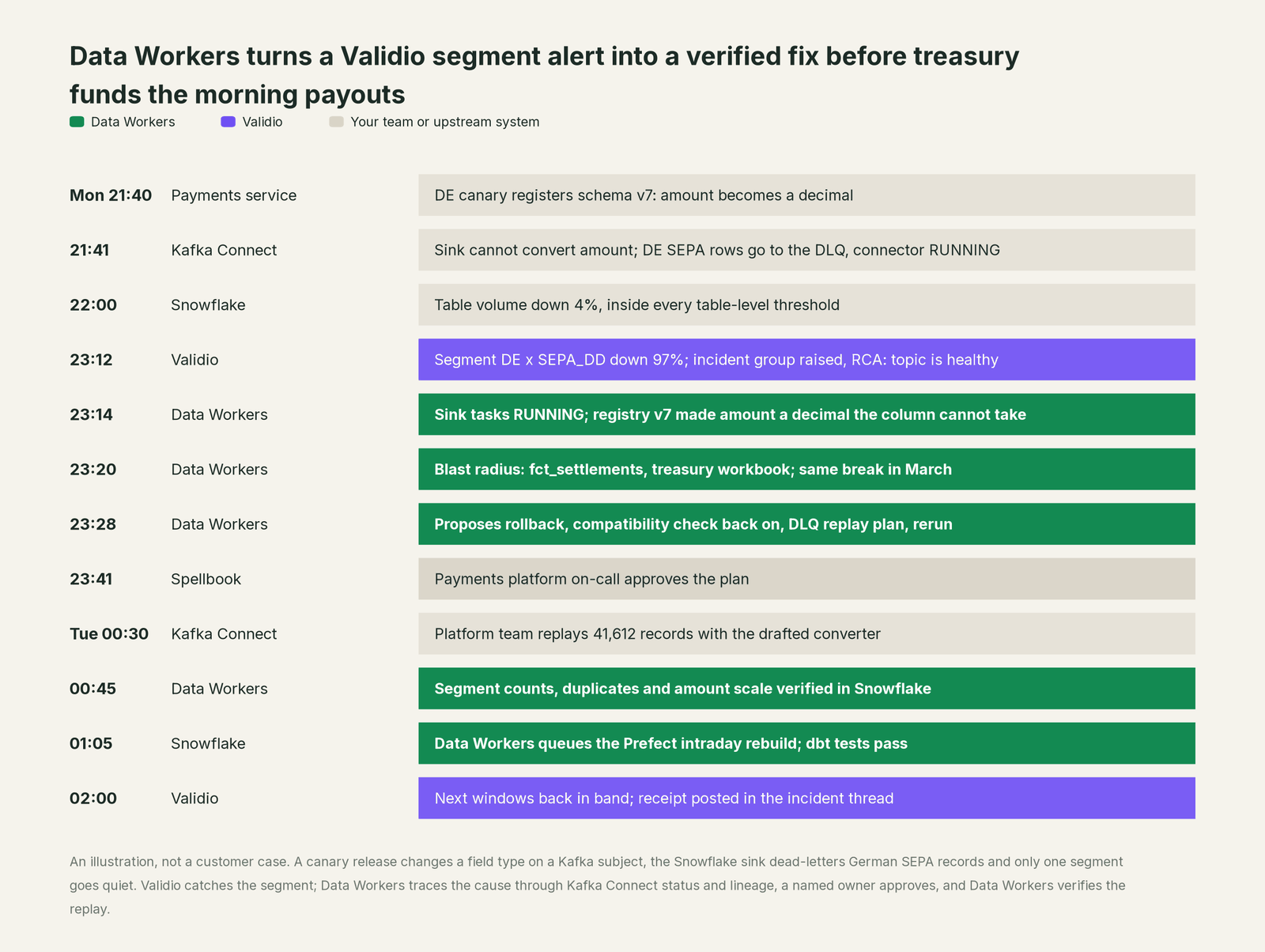
Validio did the hard part of detection. A table-level monitor would have seen a 4% dip and stayed quiet; Validio's segmentation found the one country and payment method that had gone dark, and its lineage put the loss between Kafka and Snowflake. The cause sat behind a connector that reported RUNNING and a schema version the registry should have refused. Data Workers matched version 7 to the column the sink writes, put one plan in front of one approver, checked the replay before the rebuild, and treasury pre-funded German payouts at 08:30 on complete numbers.
| Job | What Validio does | What Data Workers does |
|---|---|---|
| Detection | Segmented validators on tables and streams, with self-learning thresholds and seasonality | Watches freshness and volume, reads schema versions in Schema Registry, and reads the producer and connector side of a stream |
| Grouping and routing | Groups related incidents, filters out false alarms, routes by notification rule to Slack, Teams, Jira or ServiceNow | Joins the incident to history with get_incident_history, so a repeat break arrives with the last fix attached |
| Root cause | RCA on the lineage graph; the debug query agent drafts investigation SQL for the source | Traces past the warehouse into Kafka Connect and Schema Registry, and names the change that caused it |
| The fix | Your team decides and acts | Proposes the complete repair with blast radius: the rollback, the setting, the replay plan and the rebuild, each routed to its owner |
| Running it | Circuit breakers stop downstream steps while incidents are open | A named owner approves in Spellbook; owners run their changes and Data Workers queues the Prefect rebuild |
| Verification | The next windows come back in band | Checks segment counts, duplicates and value scale on every table the fix touched, with load lag against its baseline and the owner's test results |
| The record | The incident group, its comments and the activity log | A receipt: the cause, the change, who approved it, what it touched, how it was verified and how to undo it |
Why doesn't Validio just do this itself?
Because Validio has drawn a clear line around what its agents do, and it is the right line for a product you point at every critical table and stream. The debug query documentation says the agent "only writes SQL" and "never runs it"; running a suggestion still takes the sqlExecution:WRITE permission, and the agent never sees result rows. The MCP server "refuses destructive operations": deletes, removals and resets are rejected before they run, whatever the connecting account could do. With approval workflows on, "there is no way around review." Validio stores no data after processing, and its AI features send schema, configuration and summary statistics, never rows. That design lets a bank or a payments company connect Validio to production with confidence.
The Monday fix needed a producer rollback, a registry setting, a replay out of a dead letter topic, a dbt rebuild and a check against a treasury workbook, each owned by a different team. Acting across them takes blast-radius scoping, an owner's approval, an undo written before anything runs, and a record an auditor can read: responsibility for systems Validio watches but does not run. Data Workers is built for that job, and builds on the signal Validio already produces.
Every tool owns a slice. Data Workers covers the whole lifecycle
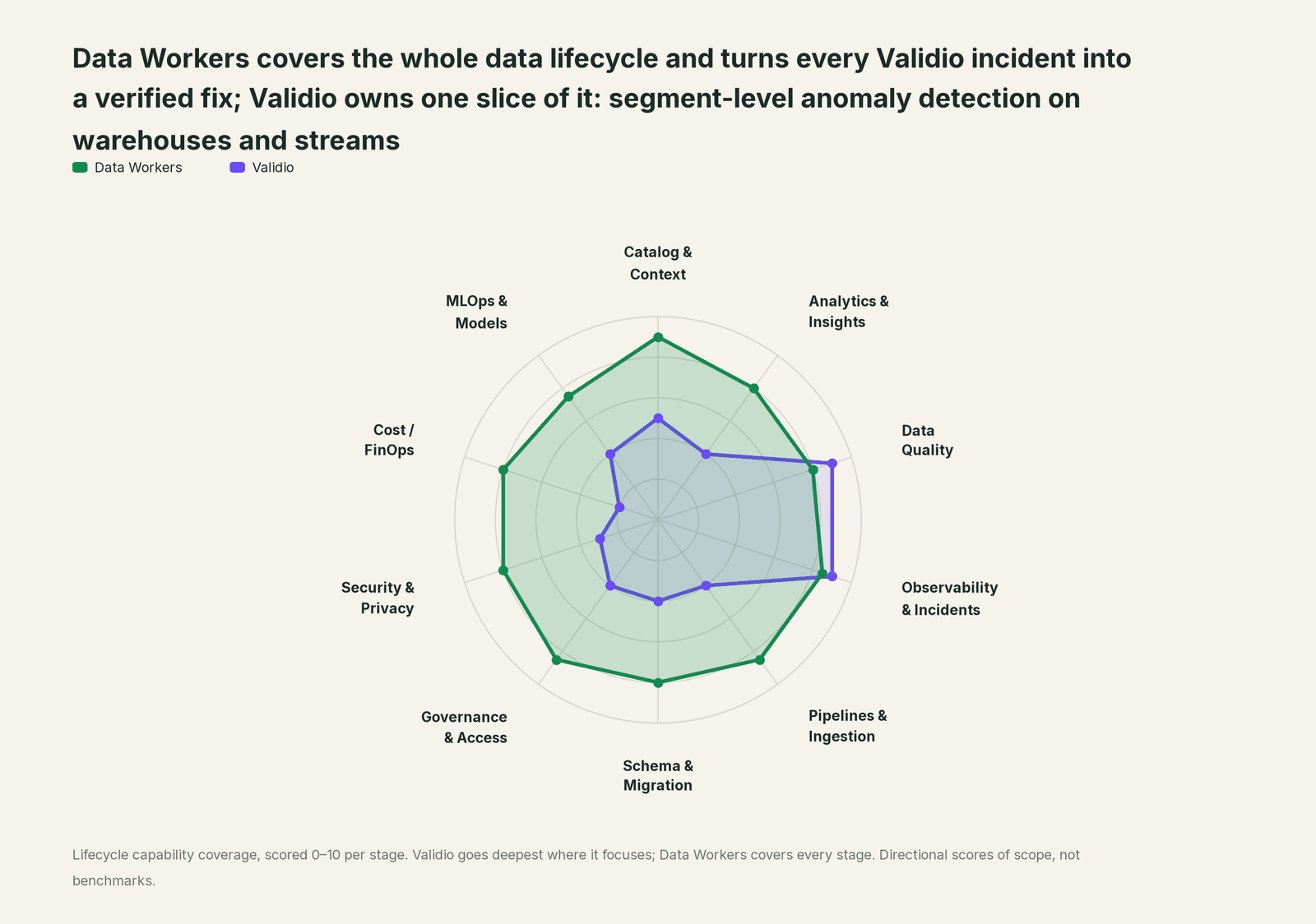
Validio owns segment-level detection on warehouses and streams. Each point tool adds another console, contract and handoff. Data Workers covers the whole lifecycle with one context, one approval flow and one audit trail.
| Stage | Data Workers | Validio | Why we scored it this way |
|---|---|---|---|
| Catalog & Context | 9 | 5 | A catalog with glossary terms, ownership and AI-generated descriptions sits beside the validators. Data Workers keeps one governed context graph of definitions, owners, lineage, quality and usage across every platform. |
| Analytics & Insights | 8 | 4 | Business metrics monitoring watches KPIs per segment. Data Workers answers data questions from governed definitions with lineage behind every number. |
| Data Quality | 8 | 9 | Validio's home stage: validators for volume, freshness, distribution, duplicates and custom SQL, run per segment, with AI-recommended validators and text-to-SQL. Data Workers also writes, runs and repairs checks across every platform. |
| Observability & Incidents | 8.5 | 9 | Validio's home stage: self-learning thresholds on segments, streams validated in real time, grouped incidents and lineage-based root cause analysis. Data Workers fixes the data across systems with approval and verifies it. |
| Pipelines & Ingestion | 8.5 | 4 | Validio validates Kafka, Kinesis and Pub/Sub streams and gates pipelines with circuit breakers. Data Workers queues reruns through your orchestrator and proposes the ingestion or producer change for its owner, with approvals. |
| Schema & Migration | 8 | 4 | Schema checks on sources and suggested lineage edges. Data Workers catches schema changes upstream, scores their blast radius and plans migrations in waves. |
| Governance & Access | 8.5 | 4 | Namespaces, roles and four-eyes approval workflows govern Validio's own configuration. Data Workers runs the warehouse access request queue with time-bound, approved grants. |
| Security & Privacy | 8 | 3 | VPC deployment and metadata-only AI features protect Validio's footprint. Data Workers' pull request review flags new columns whose names or annotations look sensitive, and leaves a receipt on every data change. |
| Cost / FinOps | 8 | 2 | Validio's pricing reflects data assets and segments; it is not a cost tool. Data Workers attributes Snowflake spend query by query and drafts the fix for its owner. |
| MLOps & Models | 7.5 | 4 | Data quality for AI and ML watches training and feature data. Data Workers keeps the data under your models fresh and correct. |
Validio leads on its two home stages: real-time validation on streams and segment depth earn it the 9 on Observability. For the category view, read how Data Workers differs from data observability, beyond data observability: autonomous resolution and the data observability tools comparison.
How Validio and Data Workers work together
Validio stays on top. Spellbook Data Catalog (in preview) is where the data team looks: each proposed change, who approved it and how to roll it back. Between them, Data Context Wizard keeps one governed context graph across Kafka, Snowflake, dbt, Prefect and Tableau, the Data-Agents Swarm does the work with 20+ specialist agents, and the Autonomous Data-Conductor runs each fix end to end: detect, diagnose, fix, review, verify, remember.
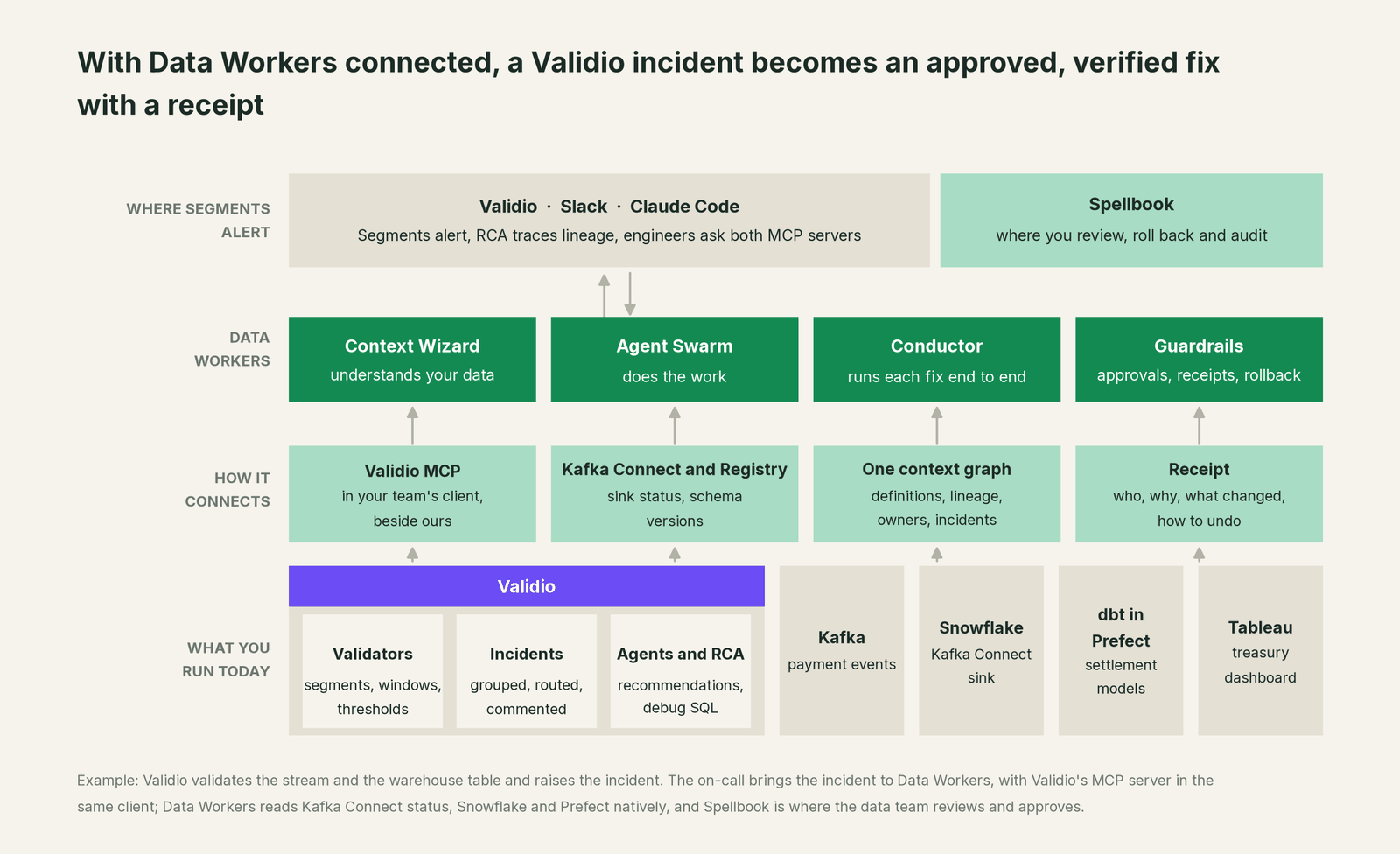
Validio to Data Workers. Validio connects over its API or MCP server today: your team's assistant reads incident groups, validators, segments and lineage side by side with Data Workers, whose own checks rest on Kafka Connect, Snowflake and Prefect. When the team hands over a new incident group, it starts diagnose_incident and get_root_cause. For a stream, get_connector_status reads the Kafka Connect sink's connector and task state, and the producer's owner confirms the subject's new schema version. assess_impact sizes the change, trace_cross_platform_lineage follows it from the topic to the dashboard, blast_radius_analysis maps everything downstream, and get_incident_history checks for a precedent. The repair runs through remediate: producer, registry and replay changes go to their owners as a proposal with the evidence, dbt changes are proposed as a diff for the owner to merge, and rebuilds are queued as Prefect flow runs. Verification uses monitor_metrics and run_quality_check, and every step lands in get_audit_trail.
Data Workers and Validio's agents. Validio's agents make detection better, and Data Workers uses their work as evidence; when a fix shows a coverage gap, it suggests the validator for the Validio owner to add. Validio keeps the incident; the receipt lives in Spellbook and the audit trail, and the on-call can post its link in the incident's Slack thread, which Validio records as a comment.
Side by side in one client. Validio's MCP server runs in your Validio environment over Streamable HTTP with OAuth sign-in and inherits the permissions of the account you connect. Every Data Workers agent is an MCP server; the client setup guide documents the path: clone the open-source repo and add one start-agent.sh entry per agent. Example for Claude Code's .mcp.json, with Validio's documented endpoint format:
{
  "mcpServers": {
    "validio": { "type": "http", "url": "https://YOUR-INSTALLATION.validio.io/mcp" },
    "dw-connectors": { "command": "/path/to/dataworkers-claw-community/start-agent.sh", "args": ["dw-connectors"] },
    "dw-context-catalog": { "command": "/path/to/dataworkers-claw-community/start-agent.sh", "args": ["dw-context-catalog"] },
    "dw-incidents": { "command": "/path/to/dataworkers-claw-community/start-agent.sh", "args": ["dw-incidents"] },
    "dw-schema": { "command": "/path/to/dataworkers-claw-community/start-agent.sh", "args": ["dw-schema"] }
  }
}
Ask "why did the DE SEPA segment go quiet, and what does the fix touch?" and the client calls both: Validio returns the incident group and the RCA path; Data Workers returns the connector state, the schema change and a proposed repair with its blast radius. To keep the Validio side read-only, disable graphql-execute and the creation tools, as Validio's best practices describe. For a shared endpoint, the Data Workers remote server serves /mcp with an API key (bearer) or OAuth tokens from your identity provider, verified through JWKS.
One Validio incident, L0 to L4, set per domain.
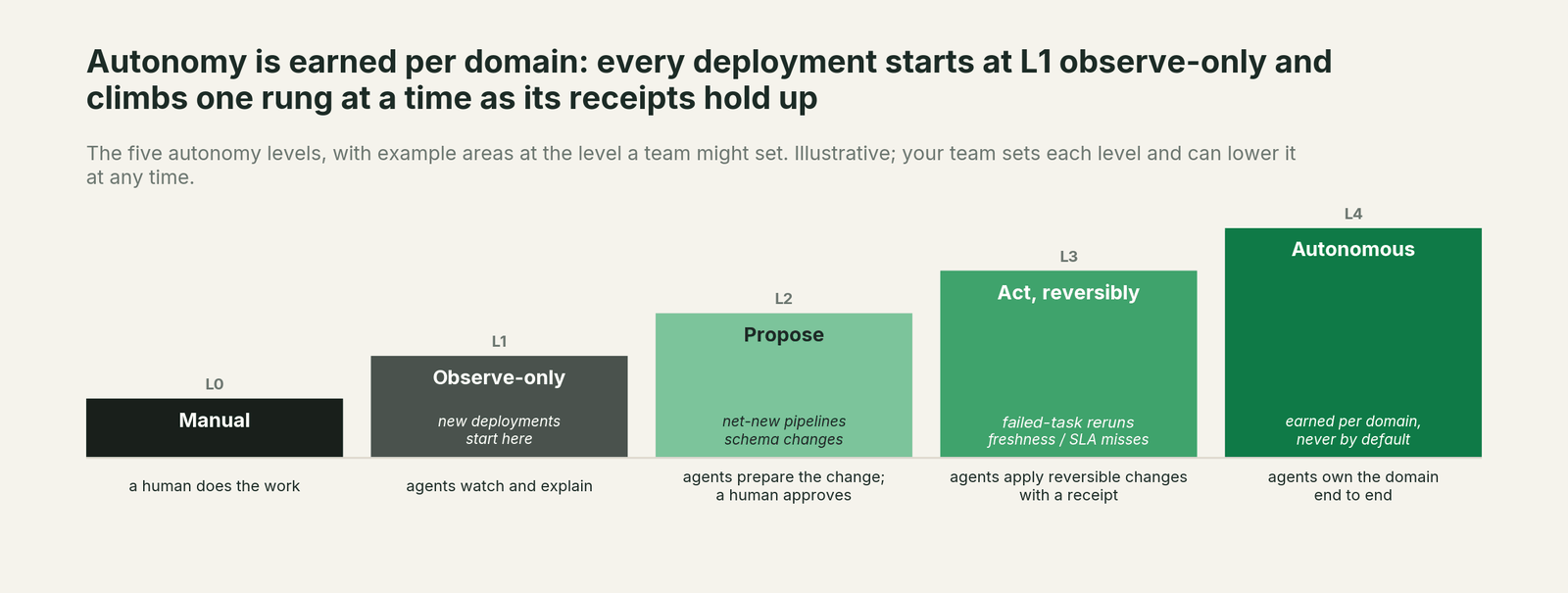
- •L0 manual. The on-call runs a debug query, then reads connector logs.
- •L1 observe. Data Workers posts the diagnosis, the March precedent and everything downstream. Nothing changes.
- •L2 propose. Data Workers proposes the full repair. Nothing runs until the platform owner approves in Spellbook.
- •L3 act reversibly. For proven change classes, such as rebuilding hours after a verified replay, Data Workers queues the Prefect flow run, verifies it and records the receipt.
- •L4 autonomous. In a scoped domain with a long clean record, Data Workers runs the repeatable steps end to end; producer and registry changes still go to their owners.
Read is it safe to let AI agents change production data and how approvals work. On where data lives: the agents run in your infrastructure, your data stays in your systems, and the hosted Conductor sees workflow metadata only.
What changes for your team
Validio makes sure no segment goes quiet unnoticed. Data Workers makes sure the fix is already in motion.
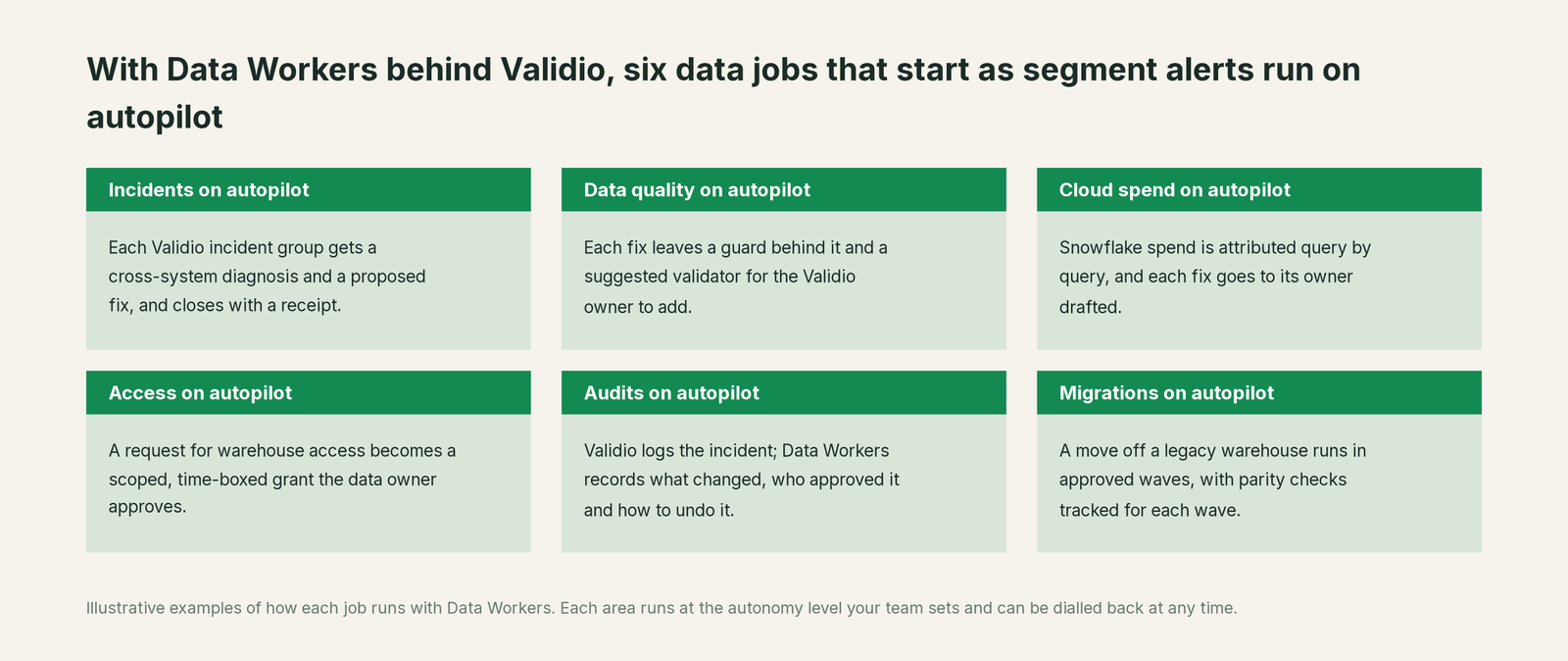
- •Incidents. Each Validio incident group gets a cross-system diagnosis and a proposed fix, and closes with a receipt.
- •Data quality. Each fix leaves a guard behind it and a suggested validator for the Validio owner to add.
- •Cloud spend. Snowflake spend is attributed query by query, and each fix goes to its owner drafted.
- •Access. A request for warehouse access becomes a scoped, time-boxed grant the data owner approves.
- •Audits. Validio logs the incident; Data Workers records what changed, who approved it and how to undo it.
- •Migrations. A move off a legacy warehouse runs in approved waves, with parity checks tracked for each wave.
The streaming on-call changes most: one plan to approve instead of a night in the Connect REST API. See the data incident response playbook and who owns the agents.
Keep Validio, or consolidate?
Keep Validio if you love it; Data Workers works with it from day one. Many teams consolidate once Data Workers runs that slice too.
Most Validio teams keep it. Segment-level detection at hundreds of millions of records a minute is hard to build, and your validators are already tuned. What teams consolidate is the work around it: a second monitor on the same table, hand-written replay scripts and the Slack thread that is the only record of the March fix. Weighing a do-it-yourself fix layer on Validio's MCP server and a coding agent? Read build it ourselves with Claude Code and MCP servers: the MCP calls are the easy part; the context graph, approvals and rollback are the work. The same pattern holds for Anomalo, Monte Carlo and Soda. For this stack, read you're on Confluent, you're on Prefect, Data Workers on Snowflake and Data Workers integrations.
The case for your CFO
The outcome: settlement, payout funding and regulatory reporting depend on streamed transaction data, and Validio already flags the moment one segment goes wrong. Data Workers turns each incident from a night of tracing into a diagnosis on arrival and a complete fix with one approval, so the numbers treasury acts on are whole before anyone opens the dashboard.
The risk story is plain. At L1 Data Workers only reads; at L2 it changes nothing until a named person approves; at L3 it applies changes it can undo. Producer, registry and replay changes go to their owners. An unanswered approval expires and escalates, never auto-grants, and no agent can promote its own work. Every change carries a receipt: cause, change, approver, what it touched, how it was verified and how to undo it. An org-wide stop halts all autonomous dispatch. Zero migration: every system in the stack stays where it is.
Why now: Validio has made detection fast and precise, so the slow part of an incident is tracing the cause through systems Validio watches but does not run, and fixing it safely. The first win is read-only: every incident group on one critical source gets a cross-system diagnosis and a blast radius. What stays the same: your validators, approval workflows, Kafka ownership and Snowflake permissions. For the numbers, see the ROI of agentic data operations.
The sentence to repeat upstairs: "Validio tells us which slice of our data broke; Data Workers finds why, fixes it with an owner's approval across the stack, and proves the numbers are whole."
Getting started
Start with a pilot. Pick one critical source whose incidents already live in Validio, such as payment transactions, connect Data Workers to it and the systems around it, and run at L1 so every incident group gets a diagnosis and a blast radius. Then turn on the first write class at L2, such as rebuilding affected hours after a verified replay, with owner approval. The pilot path and plans are on the pricing page, and the pilot is credited in full against the first year.
FAQ
How does Data Workers connect to Validio? Over Validio's API or MCP server today, reading incident groups, validators, segments and lineage, with Kafka, Kafka Connect, Schema Registry, Snowflake, dbt and Prefect read natively.
Validio already has AI agents. Why add Data Workers? Validio's agents profile data, recommend validators, group incidents, trace root cause and draft debug SQL, all inside Validio by design. Data Workers takes it from there: cause, fix under one approval, rebuild and verification across the systems around Validio.
Does Data Workers need write access to Validio? No. Read access covers the diagnosis. Validio's best practices describe how to keep an MCP connection read-only, and validator changes stay with the people who manage Validio, through its approval workflows where they are on.
Does Data Workers change our Kafka producers or Schema Registry settings? No. Producer rollbacks, compatibility settings and replays out of a dead letter topic go to their owners as a proposal with the evidence attached. Data Workers reads the connector status, drafts the replay plan, verifies the result in Snowflake and queues the downstream rebuild.
Does it work with Validio's circuit breakers? Yes. A circuit breaker stops downstream steps while incidents are open. Data Workers works on the cause behind the open incident, so the pipeline resumes on a verified fix instead of waiting on a manual investigation.
Sources
- •Validio homepage ("Agentic data quality, observability & lineage"), https://validio.io/ (checked Oct 3, 2026)
- •Validio, AI agents page ("Agentic data management, from setup to resolution"), https://validio.io/ai (checked Oct 3, 2026)
- •Validio, Data Quality & Observability page (segmented anomaly detection, Debug feature), https://validio.io/platform/observability (checked Oct 3, 2026)
- •Validio Docs, About Validio (updated Mar 4, 2026), https://docs.validio.io/docs/what-is-validio.md (checked Oct 3, 2026)
- •Validio Docs, About Validio AI Features (updated Sep 4, 2026), https://docs.validio.io/docs/validio-ai-features.md (checked Oct 3, 2026)
- •Validio Docs, Debug Query Suggestions (updated Sep 7, 2026), https://docs.validio.io/docs/debug-query-suggestions.md (checked Oct 3, 2026)
- •Validio Docs, AI Data Transparency (updated Sep 4, 2026), https://docs.validio.io/docs/llm-data-transparency.md (checked Oct 3, 2026)
- •Validio Docs, Validio MCP Server (updated Sep 25, 2026), https://docs.validio.io/docs/validio-mcp-server.md (checked Oct 3, 2026)
- •Validio Docs, MCP Server Setup Instructions (updated Sep 25, 2026), https://docs.validio.io/docs/mcp-server-setup.md (checked Oct 3, 2026)
- •Validio Docs, MCP Server Best Practices (updated Sep 10, 2026), https://docs.validio.io/docs/mcp-server-best-practices.md (checked Oct 3, 2026)
- •Validio Docs, Approval Workflows (updated Sep 23, 2026), https://docs.validio.io/docs/approval-workflows.md (checked Oct 3, 2026)
- •Validio Docs, About Segmentation (updated Apr 7, 2026), https://docs.validio.io/docs/segmentation.md (checked Oct 3, 2026)
- •Validio Docs, Kafka (updated Jul 1, 2026), https://docs.validio.io/docs/kafka.md (checked Oct 3, 2026)
- •Validio Docs, Circuit Breakers (updated Jul 14, 2026), https://docs.validio.io/docs/circuit-breakers.md (checked Oct 3, 2026)
- •Validio Docs, Root Cause Analysis (updated Sep 2, 2026), https://docs.validio.io/docs/root-cause-analysis.md (checked Oct 3, 2026)
- •Validio Docs, Commenting on Incidents (updated Mar 27, 2026), https://docs.validio.io/docs/incident-comments.md (checked Oct 3, 2026)
- •Data Workers open-source repository, https://github.com/DataWorkersProject/dataworkers-claw-community (checked Oct 3, 2026)
- •Data Workers client setup guide, https://dataworkers.io/opensource-docs/client-setup/ (checked Oct 3, 2026)