Data observability tools comparison: Bigeye, Anomalo, Sifflet and Soda vs Data Workers
Bigeye, Anomalo, Sifflet and Soda detect and explain data incidents. Data Workers fixes them at the source, verifies downstream and leaves a receipt. Keep yours or consolidate.
Bigeye, Anomalo, Sifflet and Soda are smoke alarms for your data. Data Workers is the crew that puts the fire out, checks it's out and writes the report. All four alarms are good, and each one is good at something different. This page compares them side by side, then shows what happens after any of them goes off.
Here is the estate most data observability buyers run. Fivetran or Airbyte lands data from Salesforce, Postgres and a dozen SaaS tools into Snowflake, Databricks or BigQuery. dbt builds the models. Airflow schedules the DAG runs. Tableau, Looker or Power BI sits on top. Then one observability tool watches the tables. In Bigeye that's Autometrics and issues. In Anomalo it's unsupervised checks on every table. In Sifflet it's monitors, incidents and Sage. In Soda it's data contracts, metric monitors and failed checks.
Every one of those tools now ships AI agents and an MCP server. Each agent explains the problem better than last year's version did. And in every one, the documentation draws the same line: the agent suggests, proposes or routes, and a person makes the change. Bigeye's docs say its suggested preventions "cannot be applied by Bigeye automatically." Soda's root cause agent "only proposes fixes."
Data Workers is the agentic data platform that does the work after the alert. It traces the cause, fixes it at the source, verifies the result downstream and leaves a receipt on every change. It also runs the jobs observability doesn't cover: access, cost, schema changes, migrations and audit evidence. You don't give anything up to get there. Keep the tool you have and let Data Workers act on its alerts, or consolidate later once Data Workers runs that slice well enough for you.
Key takeaways
- •Detection vs resolution. Bigeye, Anomalo, Sifflet and Soda detect and explain data issues. Data Workers resolves them: fix at the source, verify downstream, record a receipt.
- •Each tool has a different home. Bigeye: lineage across modern and legacy stacks, plus monitoring of AI agents' data access. Anomalo: unsupervised ML checks and unstructured data. Sifflet: catalog, lineage and incidents in one control plane. Soda: data contracts kept in git.
- •All four stop at a suggestion. Their agents suggest fixes (Bigeye), will start ServiceNow or Jira workflows (Anomalo, coming soon), guide and route (Sifflet) or propose a diff (Soda). The change in dbt, Airflow or the warehouse stays with your engineers.
- •Keep yours, or consolidate. Data Workers connects to each over its API or MCP server today and treats its alerts as the start of the loop.
- •One platform for the rest of the lifecycle. Access, cost, schema changes, migrations and audit evidence, with one context, one approval flow and one audit trail.
If you run Monte Carlo, read Monte Carlo vs Data Workers, which makes the same detection vs resolution comparison for one tool in depth. For single-tool views, see our earlier pages on Data Workers vs Bigeye, Data Workers vs Anomalo and Soda alternatives.
The four tools at a glance
| Bigeye | Anomalo | Sifflet | Soda | |
|---|---|---|---|---|
| What it calls itself | Data Observability and AI Trust Platform | Self-Driving Data, an agentic data quality platform | The Control Plane for Data and AI | The AI-native, fully automated data quality platform |
| Home ground | Enterprise lineage and monitoring across modern and legacy systems | Unsupervised ML checks on tables, plus unstructured documents | Catalog, lineage, monitors and incidents in one place | Data contracts, checks in git and in Soda Cloud |
| AI agents | bigAI (public preview): suggested resolutions and preventions; Agent Trust Hub | Table Observability, Data Quality and AIDA GA; First Responder coming soon | Sentinel (beta), Sage, Forge | Soda AI chat, Contract Autopilot (preview), RCA agent (private preview) |
| MCP server | Hosted gateway; issues, lineage, root cause, monitors | Gemini CLI extension; status and investigation | Assets, monitors as code, incidents, impact | Soda Cloud API v4: contracts, monitors, incidents, users |
| Where it stops | Suggests fixes; ETL changes happen in your process | Investigates; will route to ServiceNow or Jira | Guides and routes the incident | Proposes a diff; won't push without being asked |
| Role | Smoke alarm with the best wiring diagram | Smoke alarm that learns the room | Smoke alarm with the floor plan | Smoke alarm wired into the building code |
Every row ends at a signal, an explanation or a suggestion. That's the right design for an observability product, and it's where Data Workers picks up.
Bigeye: monitoring and lineage for large, mixed estates
What it is. Bigeye describes itself as the "Data Observability and AI Trust Platform." You connect a source, and Bigeye profiles it and generates Autometrics, suggested metrics for every new dataset, with Autothresholds that learn what normal looks like. Its lineage reaches unusually far. The docs list lineage connectors for Snowflake, Databricks, Oracle, SQL Server, Db2 for z/OS, Netezza, SSIS, Azure Data Factory, Matillion, SnapLogic, Tableau, Power BI, Looker, Qlik, Cognos and SAP BusinessObjects.
Where it's strong. Two places. First, estates that mix a modern warehouse with decades of legacy systems, where lineage is the hard part and Bigeye's connectors cover the older tools. Second, AI agents. Since June 2026 Bigeye's Agent Trust Hub records how agents use your data: Snowflake Cortex agents, Databricks Genie Spaces, Claude Code and, as of September 29, Cursor sessions, each linked to the tables and columns it touched. September's Evidence Reports rank the agents and data resources that carry the most risk. Its MCP server is broad too. Through a hosted gateway that works with Claude Code, Snowflake Cortex Code (CoCo) and GitHub Copilot CLI, an assistant can list and update issues, merge issues into an incident, walk lineage, find upstream root causes and downstream impact, and create metrics.
Where it stops. bigAI, the AI layer, is in public preview. Its Suggested Resolutions run "1-2 queries (no more than this)" against the data, read the upstream ETL code and produce a list of potential fixes that a person marks "Worked" or "Didn't Work." Its Suggested Preventions read dbt models and recommend changes, and the docs are direct: "Suggestions cannot be applied by Bigeye automatically. You will need to modify your ETL job using your existing software development process." The MCP server's write tools change Bigeye objects: issues, incidents, metrics, tags and glossary terms. The dbt PR, the rerun and the backfill are still your team's job.
The role swap. Bigeye is the smoke alarm with the best wiring diagram in the building. Data Workers is the crew that follows the wiring to the fault and fixes it.
Anomalo: unsupervised checks and unstructured data
What it is. Anomalo monitors tables with unsupervised machine learning. It learns each table's normal shape and flags what changed without anyone writing rules first. In April 2026 it relaunched as an agentic platform under the banner "Self-Driving Data." The Table Observability, Data Quality and Conversational Analytics (AIDA) agents are generally available. Data Insights and Data Documentation are in preview.
Where it's strong. Coverage without rules. A team can put Anomalo on hundreds of tables and get useful alerts before anyone writes a check. And unstructured data, which is Anomalo's own ground in this group. Its unstructured monitoring scores documents such as support transcripts and regulatory reports on 15 out-of-the-box issues, including PII, duplicates, abusive language, tone and sentiment, plus custom issues you define. It's available as a Snowflake Native App and processes documents with Snowflake Cortex. AIDA, the conversational analyst, also gives Anomalo some reach into analytics that the other three don't have. Since December 2025, Anomalo has offered a Gemini CLI extension whose MCP server lets an assistant check data quality status and investigate failures. "Gemini can only access metadata and data quality summaries for which the authenticated user already has permissions."
Where it stops. The agent that would act, the Data Issue First Responder, is listed as coming soon. When it ships, Anomalo says it will "follow any established runbooks or policies to take appropriate action, including initiating workflows in tools like ServiceNow and JIRA." That's a routing step. The fix to the dbt model, the Fivetran connector or the warehouse table still lands with an engineer, and so does the check that the fix held.
The role swap. Anomalo is the smoke alarm that learns the room, so it notices smoke nobody told it to look for. Data Workers is the crew that answers it.
Sifflet: the control plane for detection
What it is. Sifflet calls itself "The Control Plane for Data and AI." It combines a data catalog, field-level lineage, monitors, data products and incident management in one product. Three AI agents sit on top. Sentinel (Auto-Monitoring, in beta) reads metadata and lineage and suggests monitors. Sage writes a summary of an incident, highlights likely root causes and impacted assets, and proposes "next steps or remediation ideas," using lineage, incident history and dbt run logs. Forge, per Sifflet's agents page, turns diagnosis into resolution "by recommending next steps, routing incidents to the right owner, and guiding teams through resolution."
Where it's strong. Teams that want catalog, lineage and observability in one tool get that in Sifflet, and it scores highest of the four on our Catalog & Context stage. Its AI works on metadata by default: Sentinel and Sage don't read raw rows, which keeps security reviews simple. Smarter Incident Grouping is generally available. Sifflet's MCP server (MIT-licensed) lets Cursor or Claude list incidents, explore assets, generate Monitor-as-Code YAML from a plain-English request and trace the downstream impact of a change before it ships.
Where it stops. Sifflet's own words describe the line: Sage proposes, Forge recommends, routes and guides. The MCP server reads incidents and generates monitor configuration for you to commit. None of the three agents changes your dbt project, reruns your DAG or backfills a table, and nothing in the docs records whether the fix held downstream.
The role swap. Sifflet is the smoke alarm with the floor plan. It knows every room and who owns it. Data Workers is the crew that walks into the room and fixes it.
Soda: data contracts and checks in code
What it is. Soda is a data quality platform built around data contracts. You define expectations for a dataset in YAML, keep them in git or in Soda Cloud, and verify them in your pipelines. Soda Cloud adds metric monitoring with dynamic thresholds, Record-level Anomaly Detection, failed-row samples and incidents. One note on licensing: with the Soda Core v4 release in January 2026, the Soda Core repository moved to the Elastic License 2.0, so it's source-available, and the license terms are worth reading before you embed it.
Where it's strong. Engineering teams that want quality expectations reviewed like code. Contracts sit next to the dbt project, run in CI and fail a build before bad data ships. Soda's AI is careful by design. Contract Autopilot (preview) drafts contracts from your data's profile, Contract Copilot edits them in plain English, and Soda's docs promise that "every proposed action is shown and approved by a person before it is applied." Soda MCP is the broadest MCP surface in this group: it wraps Soda Cloud's public API v4, so an agent can create and edit contracts and monitors, trigger verification and manage roles. And Soda's root cause analysis agent (private preview) runs inside your own Claude Code. It triages failing checks, reads orchestrator logs, queries the warehouse, reads the dbt project and git history, and writes an evidence-backed report onto a Soda Cloud incident.
Where it stops. The RCA agent's documentation is clear: "The agent only proposes fixes. It does not commit to a remote, push, or open a pull request unless you explicitly ask it to." It also tells you to "register warehouse MCP servers read-only," because "an investigation must not be able to" write. So the fix runs in one engineer's session, with that engineer's credentials, and the approval, rollback and record are left to the team.
The role swap. Soda is the smoke alarm wired into the building code. Data Workers is the crew that brings the building back up to code.
One incident, seven systems
Here is a scenario any of the four tools could raise. It's an illustration, not a customer case.
- •23:10. A Salesforce admin renames the opportunity stage "Closed Won" to "Won."
- •23:40. Fivetran syncs the new picklist value into Snowflake.
- •01:00. Airflow runs dbt. The run succeeds, but
fct_bookingsfilters on the old value, so every new deal drops out. - •02:15. Your observability tool fires a volume anomaly on
fct_bookings. - •08:30. Sales leadership opens the Tableau bookings dashboard for the Monday forecast call.
| Step | What your observability tool sees | What Data Workers does |
|---|---|---|
| Picklist rename in Salesforce, via Fivetran | A changed value distribution on the landed column, if it's monitored | Sees the new value, maps every dbt model that filters on the old one |
| dbt drops new deals in Snowflake | Bigeye opens an issue with suggested resolutions; Anomalo flags the table; Sifflet's Sage summarizes the incident; Soda's contract check fails and the RCA agent can trace it | Reads the alert over the tool's API or MCP server, confirms the cause and proposes an approval-gated dbt diff that accepts both values and adds an accepted-values test, with its blast radius to Tableau attached |
| Backfill after the fix | Lineage shows the affected downstream tables | After the on-call engineer approves, triggers the Airflow backfill for the three affected days |
| Verify the result | The monitor or check passes on its next run | Diffs row counts and bookings totals against the source, confirms the dbt tests pass and records a tamper-evident receipt |
| Tableau dashboard | Lineage to the dashboard | The number is right before sales opens it, and the pattern is remembered so the next picklist change is caught before the dbt run |
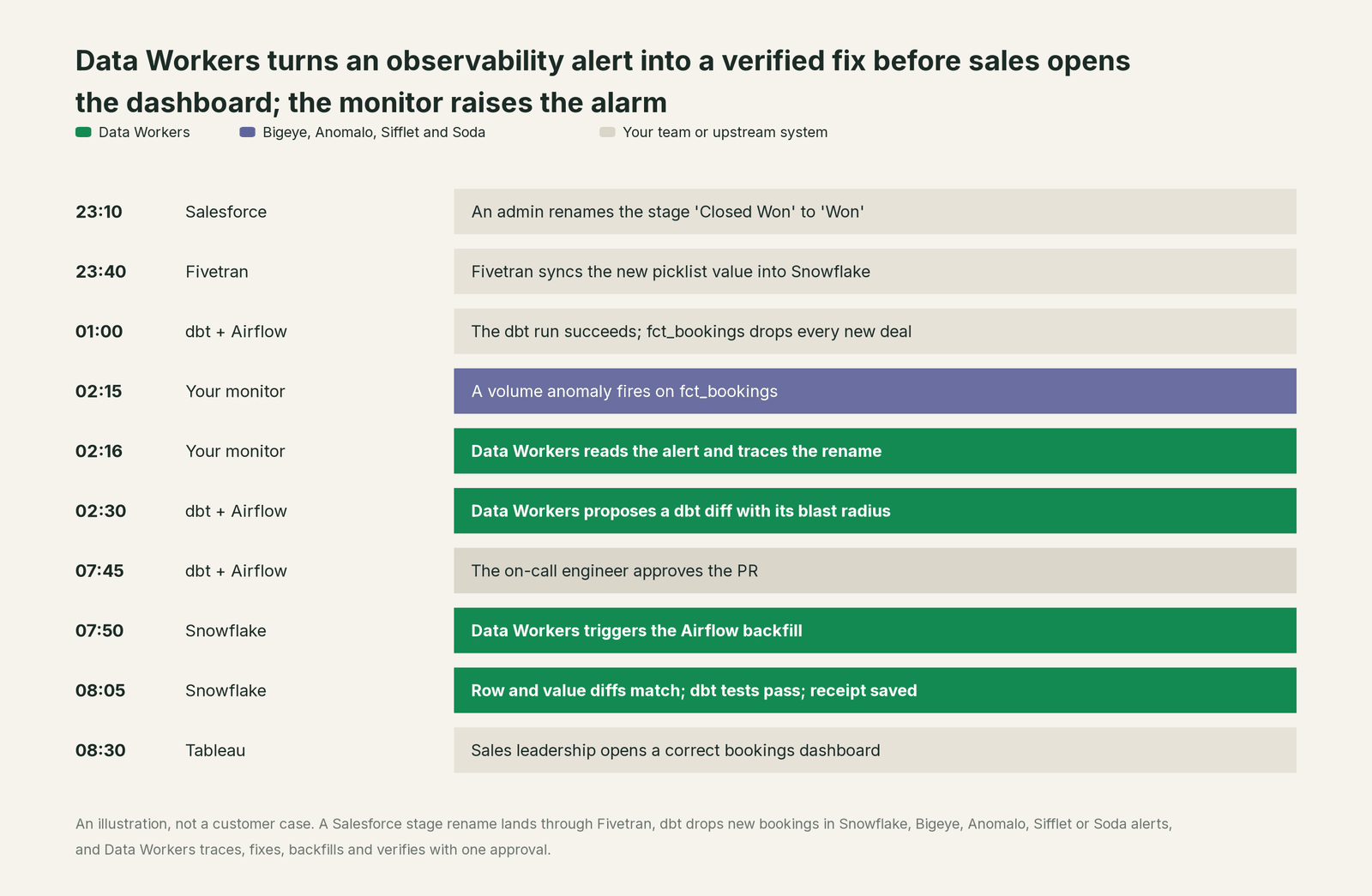
Any of the four tools would have caught this at 02:15, and that catch is valuable. The difference is what happens between 02:15 and 08:30. With the observability tool alone, an engineer spends the morning in Salesforce, dbt and Airflow. With Data Workers, one engineer spends it on one approval.
Why doesn't Bigeye, Anomalo, Sifflet or Soda just do this itself?
Because each built a great product for one job, and each made a sensible call about risk.
An observability tool holds read access to almost everything you run. It's easy to approve because its blast radius is close to zero. All four keep their writes inside their own objects. Bigeye's MCP server updates issues and creates metrics. Sifflet's generates monitor YAML for you to commit. Soda MCP edits contracts and monitors inside Soda Cloud. Anomalo's First Responder, when it ships, opens workflows in ServiceNow or Jira.
Writing to production data across systems is a different product category. It needs blast-radius scoping before every change, approvals that vary by domain, rollback, a receipt an auditor can read, context about every other system in the estate, and liability for changes inside tools the vendor doesn't own: your dbt repo, your Airflow deployment, your warehouse grants, your Fivetran connectors. Taking that on would change each vendor's security review, buyer and sales motion.
The most capable answer in this group is Soda's RCA agent, which runs inside the customer's own Claude Code and can draft the exact diff. Soda deliberately stops there: proposals only, warehouse access read-only. Bigeye's Suggested Preventions stop at a checklist. These are good choices for a quality vendor. They leave the fix, the rollback and the record to the customer, and those are the parts Data Workers is built around.
One platform across the data lifecycle
Detection is one stage of a data team's lifecycle. The same team keeps context current, answers business questions, writes quality checks, changes pipelines, migrates schemas, handles access, protects sensitive data, cuts spend and keeps models fed with healthy data. Each point tool adds another console, another contract and another handoff. Data Workers covers the whole lifecycle with one context, one approval flow and one audit trail.
We score the same ten stages on every comparison page so you can compare across pages. Each of the four tools leads or ties Data Workers on its home stages, Data Quality and Observability & Incidents. Data Workers covers all ten.
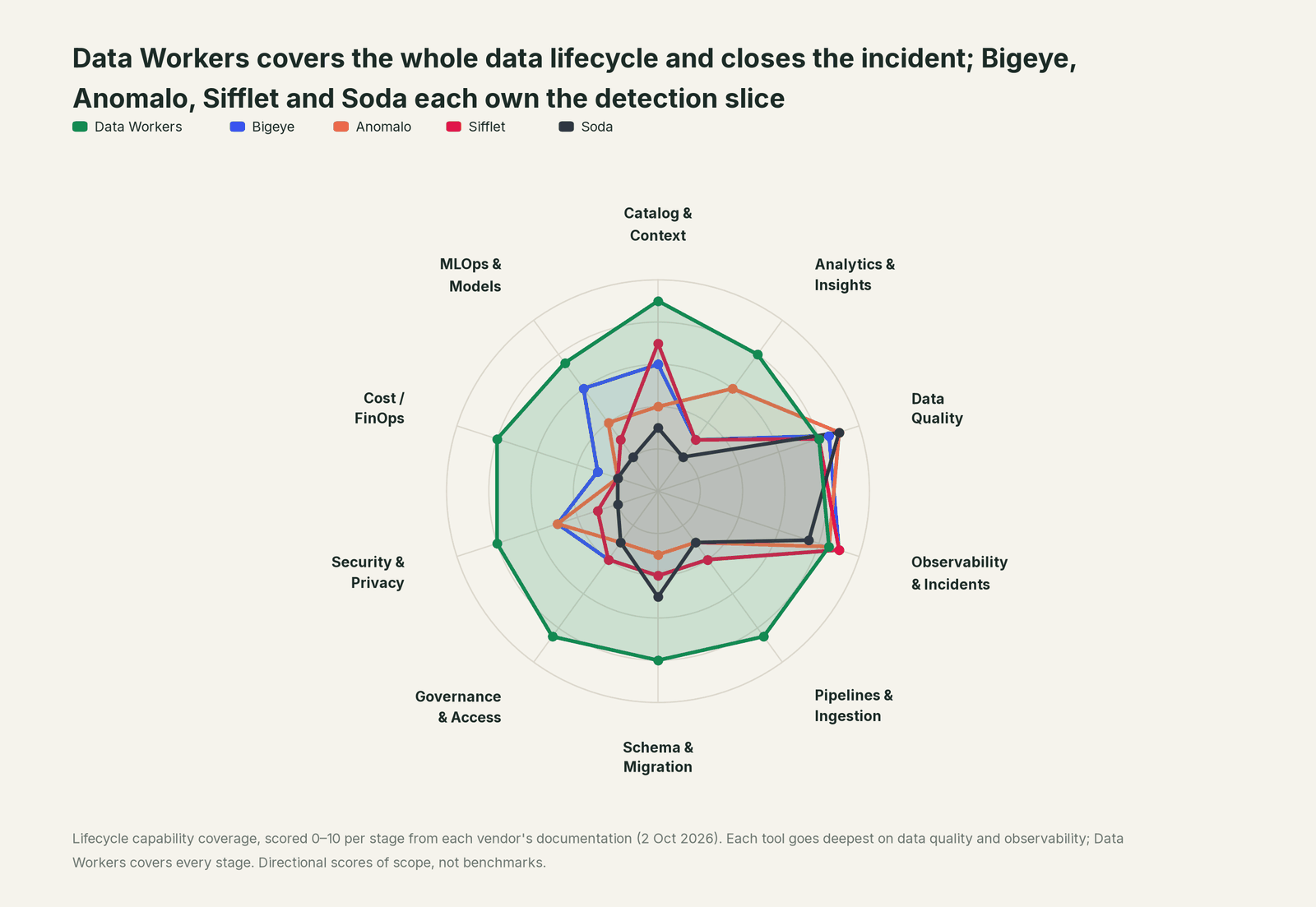
| Stage | Data Workers | Bigeye | Anomalo | Sifflet | Soda | Why we scored it this way |
|---|---|---|---|---|---|---|
| Catalog & Context | 9 | 6 | 4 | 7 | 3 | Sifflet ships a full catalog and Bigeye catalogs what its lineage reaches. Data Workers keeps one context graph across warehouses, dbt, orchestration and BI. |
| Analytics & Insights | 8 | 3 | 6 | 3 | 2 | Anomalo's AIDA answers questions in natural language. Data Workers answers business questions over the same governed graph its agents use. |
| Data Quality | 8 | 8.5 | 9 | 8 | 9 | Home ground for all four: Autometrics, unsupervised checks, Sentinel-suggested monitors and data contracts. Data Workers writes, runs and repairs checks and dbt tests. |
| Observability & Incidents | 8.5 | 9 | 8.5 | 9 | 7.5 | Bigeye and Sifflet lead on lineage-backed incidents and grouping. Data Workers owns the loop after the alert: diagnose, fix, verify, record. |
| Pipelines & Ingestion | 8.5 | 4 | 3 | 4 | 3 | The four watch pipeline output, and bigAI and Sage read dbt code and logs. Data Workers writes the pipeline change and triggers the rerun behind approval. |
| Schema & Migration | 8 | 4 | 3 | 4 | 5 | Soda contracts and Sifflet impact analysis catch some breaking changes in CI. Data Workers assesses schema changes, drafts each migration with rollback SQL for the owner to apply and plans platform moves. |
| Governance & Access | 8.5 | 4 | 3 | 4 | 3 | Each governs access to its own product and Bigeye shows which agents touched which columns. Data Workers proposes least-privilege grants on your data platforms behind approvals. |
| Security & Privacy | 8 | 5 | 5 | 3 | 2 | Bigeye scans for sensitive data and Anomalo flags PII in documents. Data Workers flags new sensitive column names in pull request review and leaves a tamper-evident receipt on every change. |
| Cost / FinOps | 8 | 3 | 2 | 2 | 2 | Bigeye reports AI agent conversation cost; none of the four manages warehouse spend. Data Workers traces Snowflake credits to the dbt model behind them and drafts the fix for its owner. |
| MLOps & Models | 7.5 | 6 | 4 | 3 | 2 | Bigeye's Agent Trust Hub watches how AI agents use data. Data Workers keeps the data under models healthy and connects to MLflow and W&B. |
The scores measure scope, what each product covers, not answer quality. They're directional scores of scope, not benchmarks, and the reasoning is shown so you can check every line.
Detection vs resolution, outcome by outcome
The lifecycle view shows breadth. This view shows the eight outcomes a data leader pays for when an incident lands, and which product delivers each one.
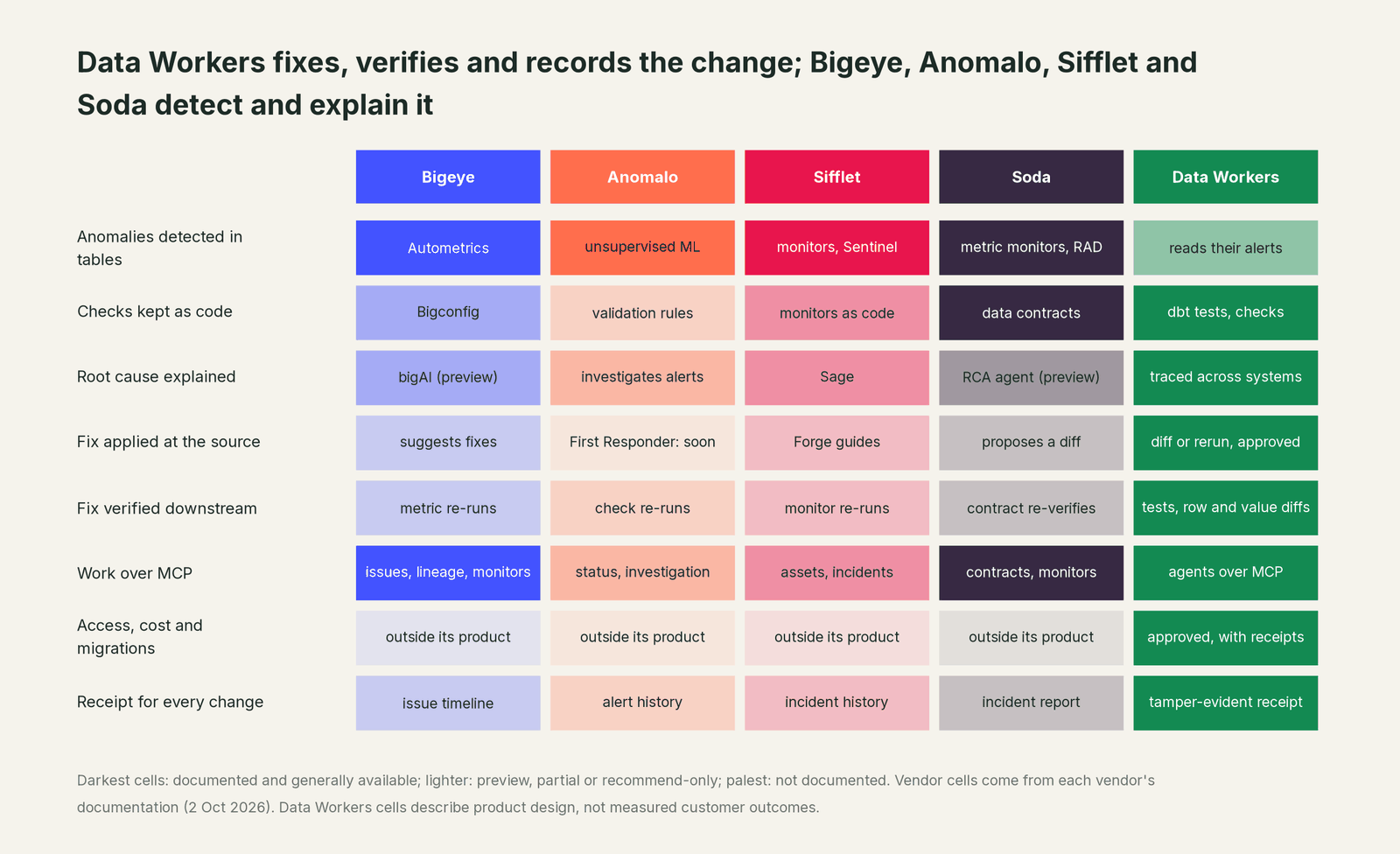
Two rows are worth a closer look. On "Work over MCP," Bigeye and Soda have the deepest servers in the group, and Data Workers can call either of them. On "Fix applied at the source," all four stop at a suggestion, a diff or a ticket, by design. That row is the whole reason to add Data Workers.
Keep your tool, or consolidate
Keep it and add Data Workers. This is the natural starting point. Your monitors are tuned, your contracts are in git and your on-call routing works. Data Workers connects to Bigeye, Anomalo and Soda over their APIs or MCP servers today, and to Sifflet over its MCP server or API today. An alert starts the loop. Data Workers traces the cause, fixes it at the source behind your approval, verifies the result downstream and records a receipt. Your tool keeps watching; Data Workers does the work.
Some reasons to keep each one for the long run:
- •Bigeye if you depend on its legacy lineage connectors or its Agent Trust Hub to watch how AI agents use your data.
- •Anomalo if unstructured data quality matters to your AI programs, or your team values rule-free coverage on hundreds of tables.
- •Sifflet if your business users live in its catalog and data products.
- •Soda if your engineers like contracts reviewed in pull requests.
Consolidate once Data Workers runs that slice too. Some teams want one platform, one approval flow and one audit trail for detection, fixes and the rest of the lifecycle. Data Workers writes and runs checks and dbt tests, and its Schema Evolution and Data Change Review agents stop many breaks before they alert. Every recurring incident becomes a test upstream. When that covers what you need, consolidation is an option.
Either way, nothing moves. Data Workers stores metadata and scrubbed facts about your data, not copies of your tables.
The case for your CFO
The outcome. Today your observability tool turns data problems into alerts, and engineers turn alerts into fixes. Data Workers closes the second step for the incident classes you allow. Alerts become closed incidents with a receipt, and the numbers in the forecast call and the board deck are right before anyone opens them.
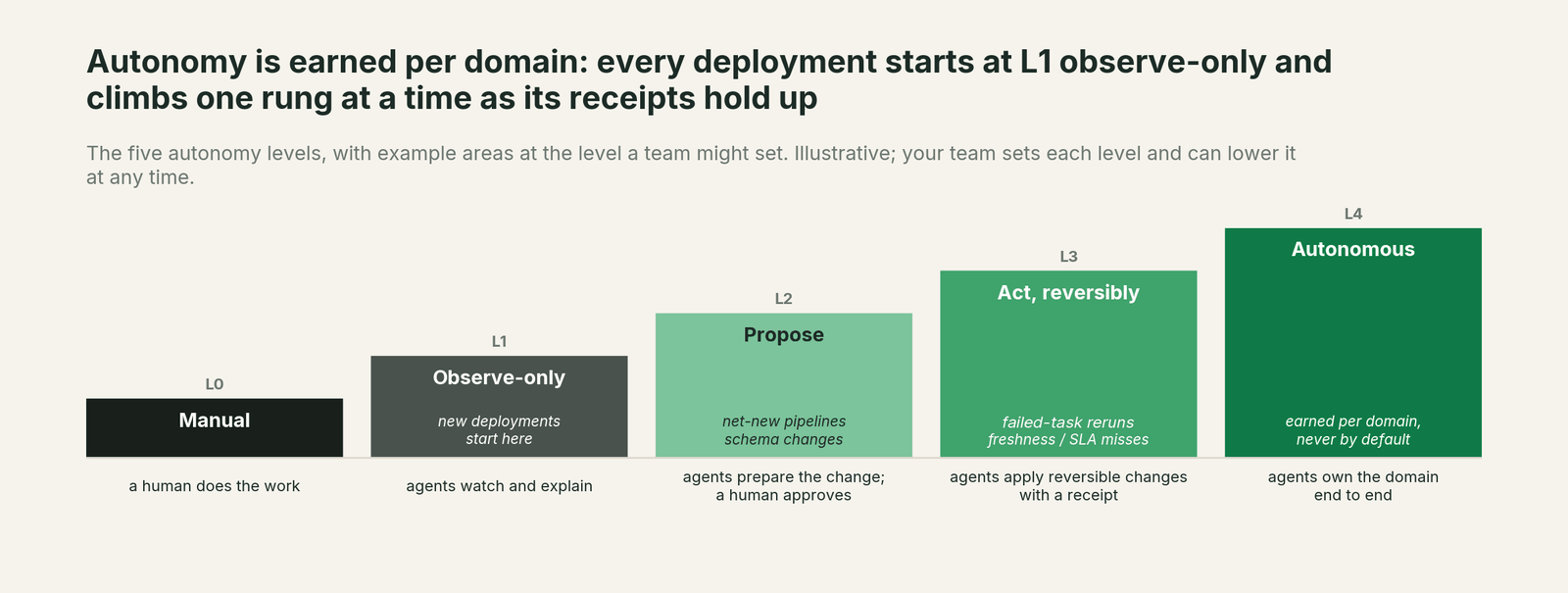
The risk story. Data Workers starts observe-only (L1): it reads and reports. At propose (L2) every fix is a draft a person approves. At act reversibly (L3) it runs only changes it can undo, and only in the domains you've moved up. Autonomous (L4) is a per-domain choice, never a default. Every write is scoped before it runs, no agent approves its own work, and every receipt records who or what acted, why, what it touched and how to undo it. Zero migration: your data stays where it is.
Why now. All four vendors shipped AI agents and MCP servers this year, and all four hand the fix to a person or to one engineer's coding agent. Execution is moving to agents either way. The choice is between ungoverned sessions and one governed loop across the estate.
The first win. Freshness and pipeline-failure alerts in one domain, handled in propose mode.
What stays the same. Your observability tool and its monitors, contracts and routing; dbt, Airflow and your warehouse; and the coding agent your engineers already use as the way in.
The path. Start with a pilot. See pricing; the pilot is credited in full against the first year.
The sentence to repeat upstairs: "We keep the monitor that tells us what broke; Data Workers fixes it at the source, proves the fix held and leaves a receipt, so alerts turn into closed incidents instead of tickets."
The fastest first win: freshness and pipeline-failure alerts
Start with the alerts that end the same way every time. A late or failed load usually needs a rerun and a check. Point Data Workers at those alerts from Bigeye, Anomalo, Sifflet or Soda, with that domain in propose mode. Each one arrives in the Spellbook inbox with the root cause, the proposed rerun or diff and its blast radius. When your team has approved those proposals as-is for a few weeks, move the domain up to reversible actions. Your observability tool keeps detecting throughout.
What each Data Workers product does here
Autonomous Data-Conductor. The Autonomous Data-Conductor owns an outcome rather than a step. It runs detect, diagnose, fix, review, verify and remember across the estate, directs the right agents and scopes the blast radius before acting. Your observability tool's alerts are one input to the detect step.
Data-Agents Swarm. The Data-Agents Swarm is 20+ specialist agents that do the work the observability agents suggest. Here the Incident Debugging agent, the Schema Evolution agent, the Data Change Review agent and the Quality Monitoring agent matter most. The last one turns a recurring alert into a dbt test, so the same break is caught earlier.
Data Context Wizard. Data Context Wizard builds one governed graph from your warehouses, dbt manifest, Airflow, BI metadata, through 50+ connectors. Every fact carries its source, author, confidence and the time it was observed, so the agent fixing a model knows what else depends on it.
Spellbook Data Catalog. Spellbook Data Catalog (in preview) is the control plane for agent work. Every proposed change lands in one inbox to approve, steer, send back or roll back, and an authority guard enforced in code stops any agent from approving its own work.
Autonomy guardrails and security
The four observability tools manage agent risk by keeping writes inside their own products. Data Workers lets agents act on your estate, under graded and reversible control, because that's how incidents get closed.
- •Autonomy is set per domain. Freshness fixes can run at L3 (act, reversibly) while schema changes stay at L2 (propose).
- •New deployments start observe-only. You extend autonomy one domain at a time as the receipts earn trust.
- •Every write is scoped before it runs, with blast radius computed across platforms. Incidents it hasn't seen before route to a person.
- •Every action is approved or reversible, and leaves a tamper-evident receipt.
- •No agent can approve or promote its own work. This is enforced in code, not left to a prompt.
- •Least privilege. Data Workers acts with the grants you give it, through each platform's own permission system.
"They all have MCP servers and root cause agents now. Doesn't that close the gap?"
It closes part of it, and the progress is real. With Bigeye's or Soda's MCP server in Claude Code, an engineer can pull an issue, walk lineage to the upstream cause and ask the coding agent to draft the fix. Soda's RCA agent does most of an investigation on its own.
It's still one engineer, one session and one fix at a time, on that engineer's credentials. Nobody gates the change by domain, rolls it back cleanly, verifies the result across downstream systems or records the outcome where the next incident can use it. MCP gives an agent one more tool. Data Workers gives you an operating model for incidents across the estate, and every Data Workers agent is itself an MCP server your coding agent can call, next to Bigeye's, Sifflet's or Soda's.
FAQ
Which data observability tool is best: Bigeye, Anomalo, Sifflet or Soda? It depends on your estate. Bigeye suits large estates with legacy systems and teams that want to watch AI agents' data access. Anomalo suits teams that want rule-free coverage and unstructured data checks. Sifflet suits teams that want catalog and observability together. Soda suits engineering teams that manage quality as contracts in code. All four detect and explain; none fixes the cause at the source.
Do I have to replace my observability tool to use Data Workers? No. Keep it for detection and add Data Workers for resolution. Data Workers connects to each over its API or MCP server today. Consolidation is an option later, once Data Workers runs detection for you too.
Will Data Workers double our alerts? No. Data Workers reads your tool's alerts and adds a resolution path. It doesn't need to re-monitor what Bigeye, Anomalo, Sifflet or Soda already covers.
What license is Soda Core under? Soda Core's repository has been under the Elastic License 2.0 since the v4 release in January 2026. That's a source-available license with limits on offering the software as a managed service, so check its terms before you build on it. The Data Workers core is Apache 2.0.
Isn't Soda's RCA agent or Bigeye's Suggested Resolutions enough? They end at a diagnosis and a proposed fix. Soda's agent "only proposes fixes" and works with read-only warehouse access; Bigeye's suggestions "cannot be applied by Bigeye automatically." Data Workers takes that diagnosis as input and does the fix, the backfill and the verification behind your approval.
What happens if a Data Workers agent gets a fix wrong? Every write is scoped before it runs and goes to review at the autonomy level you set for that domain. Every action is approved or reversible and leaves a tamper-evident receipt. No agent can approve its own work.
How is Data Workers priced? The Apache 2.0 core is free. The pilot is $7,500 one-time, credited in full against your first year. Scale starts at $1,000 a month and Enterprise at $3,000 a month, billed annually, with unlimited seats, no usage meter and no markup on model spend. See pricing.
Sources
Vendor capabilities and statuses are current as of October 2, 2026, from each vendor's own documentation and pages.
Bigeye: MCP Server (updated Aug 11, 2026), MCP server repository and tool list, bigAI overview, Suggested Resolutions and Suggested Preventions (updated Jul 31, 2026), Getting Started, platform release notes (through 2.96.0, Sep 29, 2026).
Anomalo: Self-Driving Data and the agentic platform (Apr 2, 2026), unstructured data monitoring, unstructured monitoring with Snowflake Cortex (Jun 2, 2025), Gemini CLI extension and MCP server (Dec 9, 2025).
Sifflet: AI agents, Auto-Monitoring (Sentinel), Root Cause Analysis (Sage), AI Features Overview and MCP Server (all updated Oct 1, 2026), MCP server repository.
Soda: Soda Core license (Elastic License 2.0, v4 release Jan 28, 2026), Soda AI, Soda MCP and MCP tools, Root cause analysis agent, Contract Autopilot.
Product names and statuses change quickly. If we've got something wrong, tell us and we'll fix it.