You're on Pinecone: Keep Every Index True to Its Source, From the Warehouse Table to the RAG Answer
Already on Pinecone? Data Workers traces each index back to its warehouse tables, catches stale or mis-permissioned vectors, and fixes them with approvals and receipts.
Your team runs retrieval on Pinecone. Serverless indexes hold the chunks behind your support assistant, your sales copilot and the agents engineers built last quarter. More and more of that text comes from warehouse tables: knowledge articles, product specs and account notes, modeled in dbt, chunked in a kb_chunks table and embedded by an Airflow DAG that upserts into a namespace per audience or tenant. Integrated embedding turns text into vectors at write time, metadata filters keep each app to its slice, rerank sharpens the top results, Pinecone Assistant answers over uploaded files, and Pinecone Nexus (generally available since August 6, 2026) compiles sources into contexts that return cited answers to agents. Pinecone is where your agents retrieve. Data Context Wizard traces every index back to its source, next to lineage, quality, usage and permissions, with a named owner on every fact, and Data Workers carries the re-embed or fix with approvals and a receipt when the source changes.
An index is a copy. When a source row is edited, reclassified, deleted or re-permissioned upstream, its vectors stay as they were until something rewrites them. That seam, between the warehouse table and the namespace your app reads, is the job this guide covers.
Key takeaways
- •Pinecone keeps its job. Indexes, namespaces, rerank, Assistant and Nexus stay as they are; Data Workers works next to them from day one.
- •Every index gets a lineage. Data Context Wizard records which tables and embedding jobs feed each index and namespace, with an owner and freshness on each.
- •Stale and mis-permissioned vectors are caught at the source. An upstream edit or revoked permission is traced to the chunks it left behind before an agent retrieves them.
- •Writes stay gated. Your team's assistant reads Pinecone on a viewer-role API key, side by side with Data Workers; approved purges and re-embeds run in your own pipeline, with a blast radius, an approver and a rollback path.
- •Start with a pilot. One index, read-only; then one fix class in one domain, on the ladder from L0 manual to L4 autonomous.
Pinecone is the retrieval layer. Data Workers keeps what it retrieves true.
Pinecone is a superb place to store and search embeddings. Its developer MCP server gives Claude Code, Cursor, Claude Desktop and Antigravity nine tools: search-docs, list-indexes, describe-index, describe-index-stats, create-index-for-model, upsert-records, search-records with metadata filtering and reranking, cascading-search across indexes, and rerank-documents. It works with indexes that use integrated embedding. Every Pinecone Assistant also has its own MCP server, remote or self-hosted, and Nexus serves its contexts over an MCP server with three read-only tools. Since September 29, 2026, namespace aliases let a team rebuild data in a fresh namespace and atomically repoint readers to it.
Outside the index sits everything that decides whether it is right: the CRM, ingestion, the dbt models, the warehouse policies and the DAG that embeds it. Data Workers covers that side with one context, one approval flow and one audit trail.
Here is an afternoon with Data Workers next to a support index. This is an illustration, not a customer case; the article and chunk counts are illustrative.
| Time | System | What happens |
|---|---|---|
| 15:20 | Salesforce Knowledge | Support ops reclassifies 380 articles about a delayed product line as internal-only |
| 16:00 | Fivetran | The sync lands the visibility change in Snowflake |
| 16:30 | dbt | kb_chunks builds; its incremental filter keys on the publish date, which didn't change, so the 380 articles are skipped and their chunks are never rewritten |
| 16:35 | Data Workers | It detects the visibility change on 380 source rows and sees that none reached the embedding feed |
| 16:40 | Pinecone | The on-call's assistant reads the index over the Pinecone MCP server and hands it to Data Workers: a filtered search-records and describe-index-stats show 2,140 chunks from those articles still in the public namespace, tagged audience: public |
| 16:50 | Airflow | Data Workers opens an incident on the embed_support_kb DAG with the cause, the 2,140 chunks and the customer-facing assistant named |
| 17:05 | dbt | Data Workers proposes a diff that adds the visibility timestamp to the incremental filter, and a DAG change that purges those article IDs, re-embeds into a fresh namespace and swaps the alias, with its blast radius: one dbt model, one DAG, one index, two apps |
| 17:40 | Spellbook | The index owner reviews the diff and the impact and approves; dbt CI passes |
| 18:00 | Airflow | The DAG re-embeds the public articles into public-v2 and repoints the public alias in one call |
| 18:20 | Pinecone | The on-call's assistant re-reads the index over the Pinecone MCP server; Data Workers checks its record counts against the warehouse, confirms zero internal-only chunks behind the alias and writes the receipt |
| 08:30 | Support assistant | A customer asks about the product line; the answer cites public articles only |
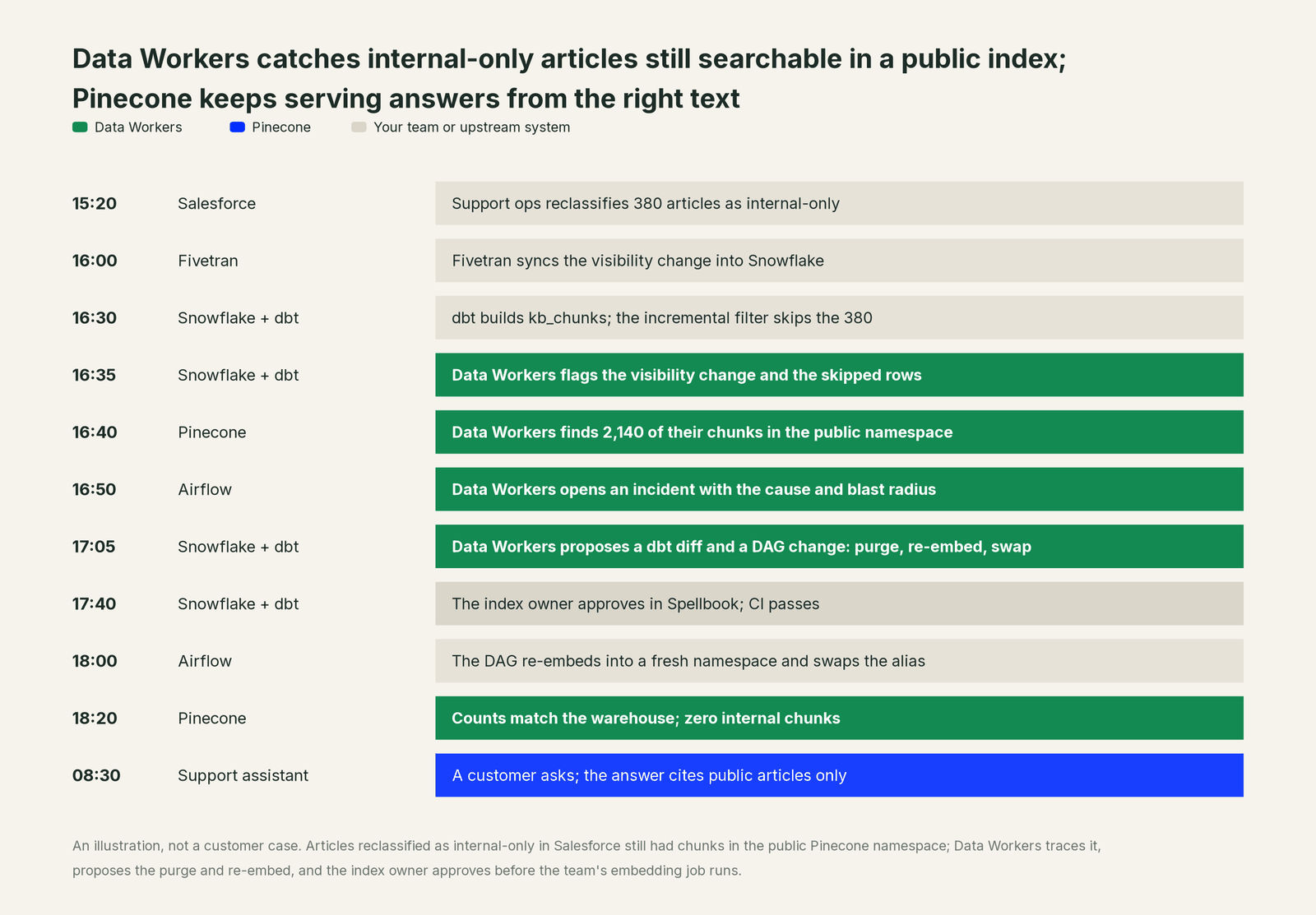
From the index alone, nothing looked wrong: the vectors, the metadata and the filter were all valid, and Pinecone did exactly its job. The cause and the fix were upstream, in systems the index doesn't run, and the change went through an owner's approval first.
| Job | What Pinecone does | What Data Workers does |
|---|---|---|
| The index | Stores vectors, text and metadata in namespaces, with integrated embedding at write time | Records which tables, columns and jobs feed each index and namespace, with an owner on each |
| The answer | Searches, filters and reranks; Assistant and Nexus return grounded, cited answers | Makes sure the text behind those answers is current, correct and permitted |
| The feed | Accepts upserts and bulk imports from object storage | Checks the chunk tables before the embedding job runs and catches skipped or broken rows |
| The break | Serves what it was last given | Detects the upstream edit, reclassification or schema change and traces it to the chunks it left behind |
| Permissions | Enforces project roles and the metadata filters your app sends | Keeps source permissions and the metadata your app filters on in step, with conflicts routed to an owner |
| The fix | Runs the purge, upsert and alias swap your pipeline sends | Proposes the change with its blast radius, routes it to a named owner, lands it in dbt and the embedding DAG |
| The proof | Reports record counts per namespace | Verifies counts and content against the warehouse after the run and writes a receipt with cause, diff, approver and rollback |
Why doesn't Pinecone just do this itself?
Because Pinecone built a database for the hardest part of its job: fast, accurate retrieval at scale, for any domain and any customer. Deciding whether a chunk is still true means knowing the CRM, ingestion, dbt, warehouse policies and your embedding code. Those belong to other vendors and your team, and changing them is a different product with a different liability.
Pinecone's own design draws that line sensibly. Its developer MCP server is "intended for use with coding assistants", to "test queries and evaluate results within your dev environment". Its RBAC separates viewer roles from editor roles for users, service accounts and API keys alike. Reads can go through a namespace alias, while every write addresses a namespace by name, so ingest and the live read path stay separate. That is the right design for a database that serves many teams and many apps.
Data Workers is the product on the other side of that line. It knows what an upstream change touches, routes the fix to the owner, applies it reversibly through your pipelines, checks the result against the warehouse and keeps the record.
Every tool owns a slice. Data Workers covers the whole lifecycle
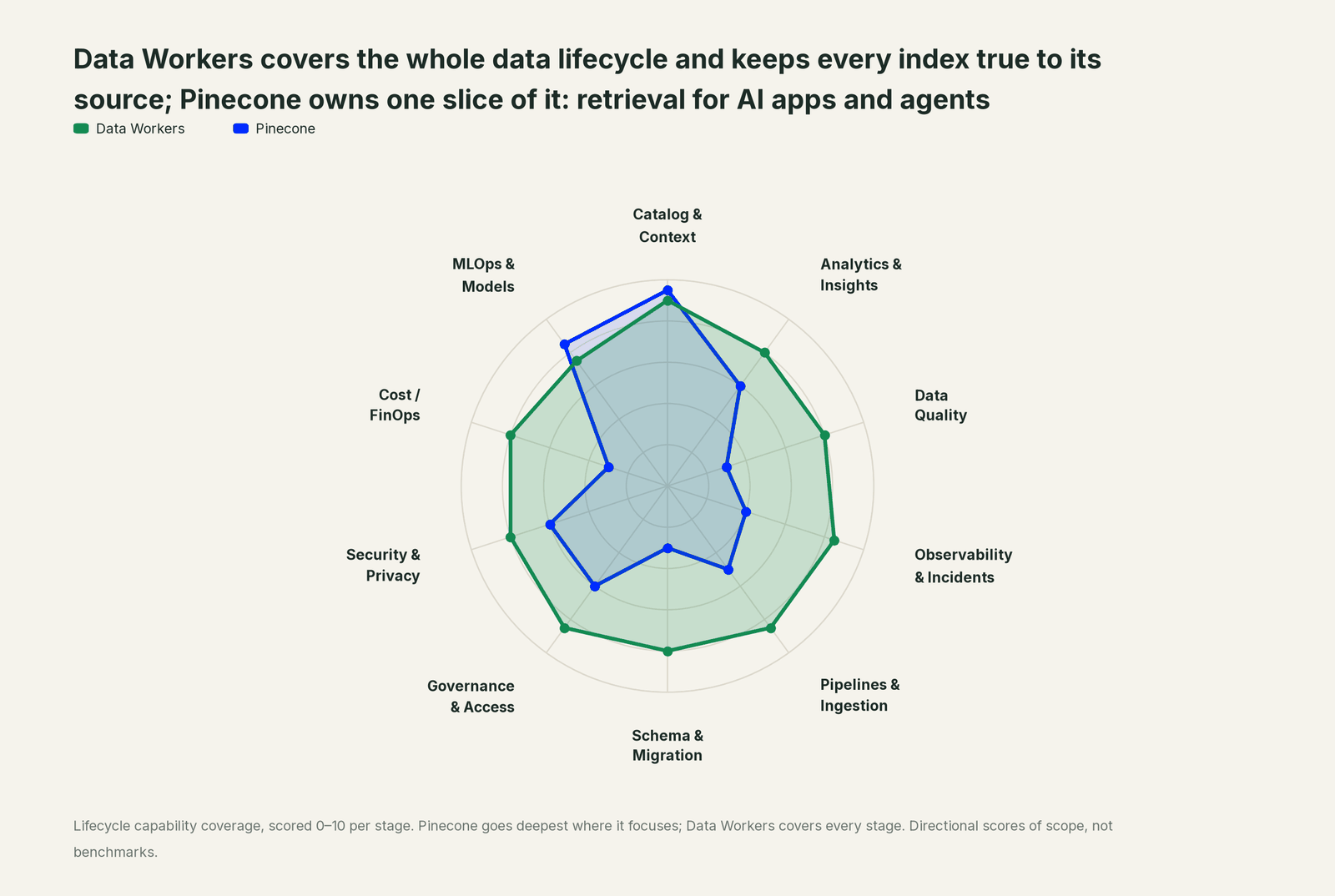
Pinecone owns one slice of the data lifecycle outright: retrieval for AI apps and agents, and the models behind it. Each point tool adds another console, contract and handoff. Data Workers covers the whole lifecycle with one context, one approval flow and one audit trail.
| Stage | Data Workers | Pinecone | Why we scored it this way |
|---|---|---|---|
| Catalog & Context | 9 | 9.5 | Pinecone's home stage: serverless indexes, namespaces, metadata filters and Nexus contexts serve the right chunks and cited answers to agents. Data Workers brings the index's sources, owners and freshness in as context, next to lineage and quality. |
| Analytics & Insights | 8 | 6 | Search and rerank return the passages behind an answer, and Assistant chats over uploaded files. Data Workers' Insights agent answers numeric questions through governed metric definitions. |
| Data Quality | 8 | 3 | Pinecone stores what it is given and reports record counts per namespace. Data Workers checks the warehouse tables and chunks that feed the index before the embedding job runs. |
| Observability & Incidents | 8.5 | 4 | Index metrics flow to the console, Prometheus or Datadog, and index fullness metrics cover dedicated read nodes. Data Workers detects a stale or wrong index, traces it to the upstream change, fixes it and verifies the index after the run. |
| Pipelines & Ingestion | 8.5 | 5 | Upsert, bulk import from S3, GCS or Azure Blob, and integrated embedding at write time. Data Workers builds, reruns and backfills the embedding pipelines behind those writes with approvals. |
| Schema & Migration | 8 | 3 | Schema-based document indexes declare their fields. Data Workers detects upstream schema changes in the source tables and shows which embedding jobs and indexes they reach. |
| Governance & Access | 8.5 | 6 | Strong over its own project: RBAC with data plane and control plane viewer roles, SAML and SCIM role sync, namespaces per tenant. Data Workers keeps source permissions and index metadata in step across systems. |
| Security & Privacy | 8 | 6 | Strong for its own estate: BYOC (GA Aug 25, 2026), private endpoints and CMEK. Data Workers' pull request review flags sensitive column names before a new source is embedded, and the owner decides what reaches a public namespace. |
| Cost / FinOps | 8 | 3 | Pinecone meters its own reads, writes, storage and egress. Data Workers traces Snowflake credits to the dbt model behind them and drafts the fix for its owner. |
| MLOps & Models | 7.5 | 8.5 | Pinecone's other home stage: hosted embedding and rerank models and integrated inference at write and query time. Data Workers keeps the data under every model healthy and connects to MLflow and W&B. |
How Pinecone and Data Workers work together
Engineers stay in Claude Code or Cursor, and people keep asking questions in your RAG app or Assistant. Spellbook Data Catalog (in preview) is where the data team looks: each proposed change, its blast radius, its approver and its rollback. Between them, Data Context Wizard keeps one governed context graph, the Data-Agents Swarm does the work with 20+ specialist agents, the Autonomous Data-Conductor runs each fix (detect, diagnose, fix, review, verify, remember), and per-domain guardrails hold approvals, receipts and rollback.
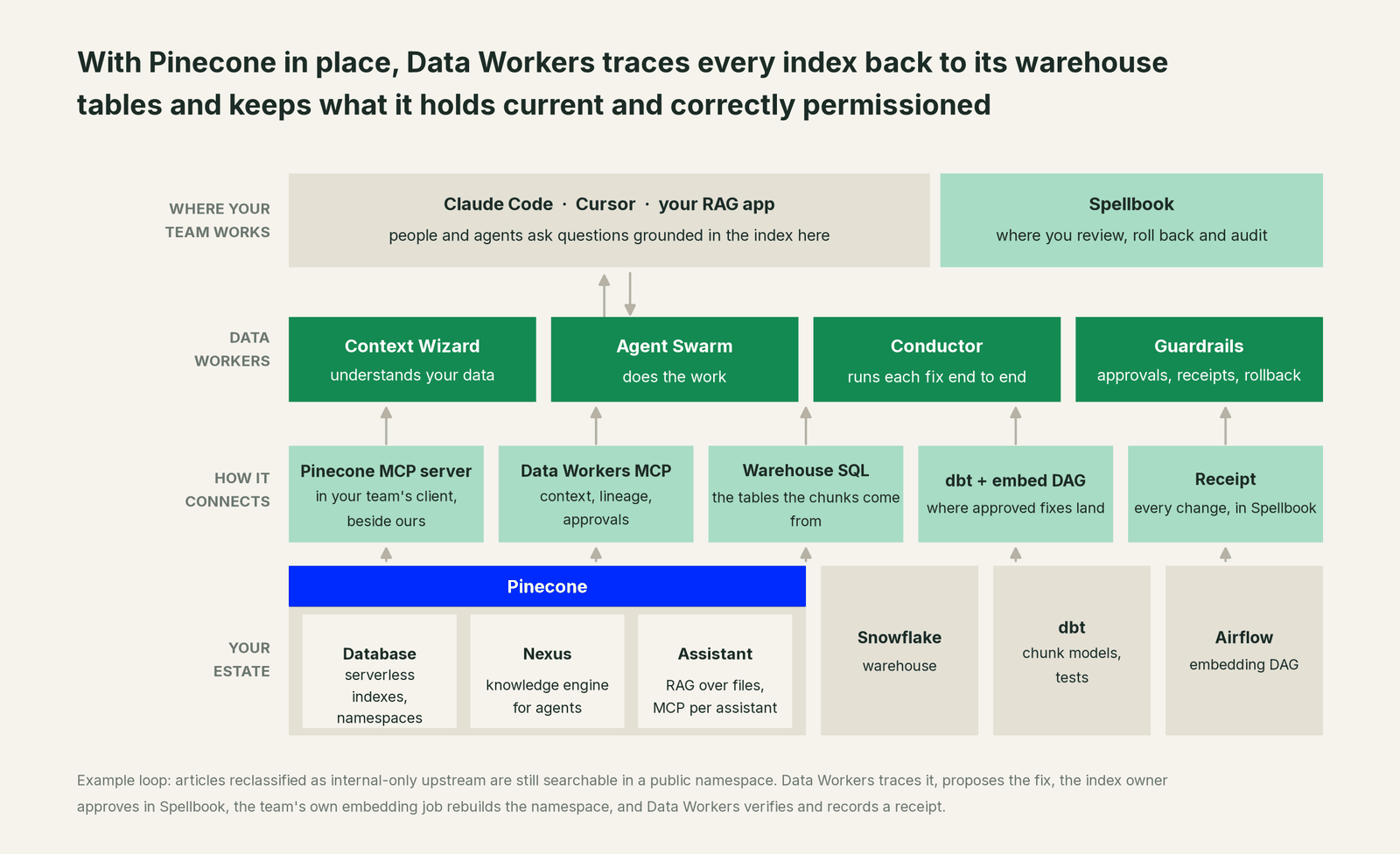
What Context Wizard does with your indexes. It records each index and namespace as a governed asset: the source tables and columns, the dbt model that chunks them, the DAG that embeds them, the metadata fields your apps filter on, and the owner. It joins that to lineage, so a public namespace traces back through kb_chunks and Fivetran to the Salesforce field that sets visibility, scores trust with quality, freshness, usage and ownership, and serves one governed view to every agent through tools like explain_table (definition, lineage, trust score), and trace_cross_platform_lineage, while get_quality_score on dw-quality returns the quality score. When the index and the source disagree about an article's audience, the conflict goes to a named owner.
Setup over MCP today. Pinecone connects over its MCP server today, in your team's client alongside Data Workers' agents, which never call it. Data Workers' agents are MCP servers from the open-source repository: clone it and add start-agent.sh entries to your client config, as the client setup docs show. Pinecone API keys take project roles, so give this one ControlPlaneViewer and DataPlaneViewer: agents can describe, query and rerank, and nothing can upsert or create an index from the chat. For indexes built with external embedding models, which the MCP server doesn't cover, your team reads index stats and metadata over Pinecone's API with the same key.
// Example: .mcp.json for Claude Code (Cursor uses the same mcpServers shape)
{
  "mcpServers": {
    "pinecone": {
      "command": "npx",
      "args": ["-y", "@pinecone-database/mcp"],
      "env": {
        "PINECONE_API_KEY": "<viewer-role key from your secret store>"
      }
    },
    "dw-context-catalog": {
      "command": "/path/to/dataworkers-claw-community/start-agent.sh",
      "args": ["dw-context-catalog"]
    },
    "dw-schema": {
      "command": "/path/to/dataworkers-claw-community/start-agent.sh",
      "args": ["dw-schema"]
    },
    "dw-quality": {
      "command": "/path/to/dataworkers-claw-community/start-agent.sh",
      "args": ["dw-quality"]
    },
    "dw-governance": {
      "command": "/path/to/dataworkers-claw-community/start-agent.sh",
      "args": ["dw-governance"]
    }
  }
}
List the tools with your client's own command (for example /mcp in Claude Code). An engineer can then ask "what feeds the support-kb index, and is any of it stale or restricted?" and get index stats from Pinecone, lineage from trace_cross_platform_lineage, run_quality_check results on kb_chunks, open incidents from get_incident_history and check_policy, in one answer. Before a re-embed, blast_radius_analysis names every app and agent that reads the namespace.
Where writes go. Fixes land where your team already reviews change: a dbt diff for the owner to merge, a change to the embedding DAG, a new metadata field in the upsert code. After the owner approves, your pipeline runs the purge, the upsert and the alias swap with its own editor-role key. Re-embeds go into a fresh namespace and cut over by repointing the alias, so rollback is repointing it back. Alias changes aren't part of Pinecone's audit log export, so the Data Workers receipt records each swap: which namespace, when, who approved it and how to undo it.
One request, L0 to L4. The autonomy ladder is set per domain.
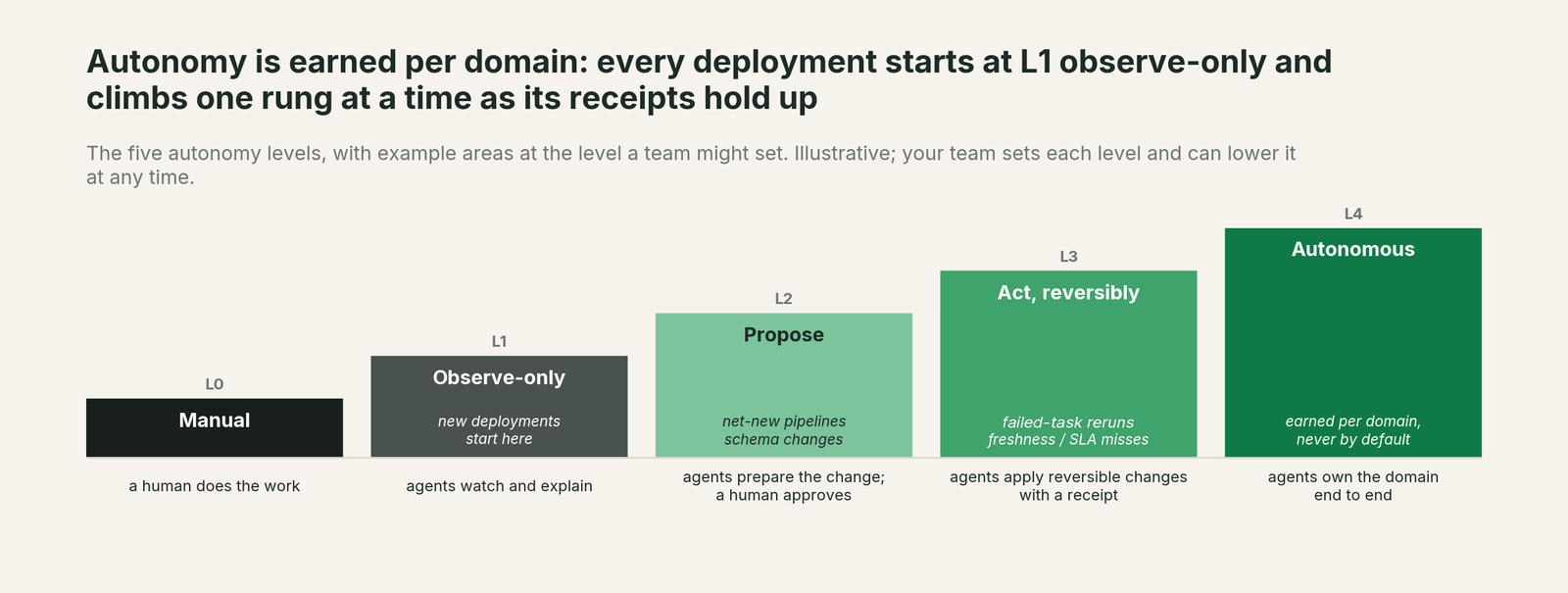
- •L0 manual. Data Workers is connected but not acting. Your engineer traces a stale answer by hand.
- •L1 observe. Data Workers watches the tables, permissions and jobs that feed each index and flags drift before the next embed, with cause and owner. Nothing changes.
- •L2 propose. Data Workers drafts the dbt diff or DAG change with its blast radius; the index owner approves in Spellbook.
- •L3 act reversibly. For proven change classes, such as re-embedding edited articles into a fresh namespace behind an alias, Data Workers triggers the run, verifies it and can swap back.
- •L4 autonomous. For a scoped class like daily freshness re-embeds on one internal index, Data Workers fixes and verifies on its own and posts the receipt.
The safety model is in is it safe to let AI agents change production data; where data and credentials live is in where does our data go.
The same pattern holds for every store your agents read: see the hub, bring your own context, and the guides on Weaviate, Qdrant and Glean. For background, read our explainers on vector databases for data engineers, agentic RAG for data engineering and what a context graph is.
What changes for your team
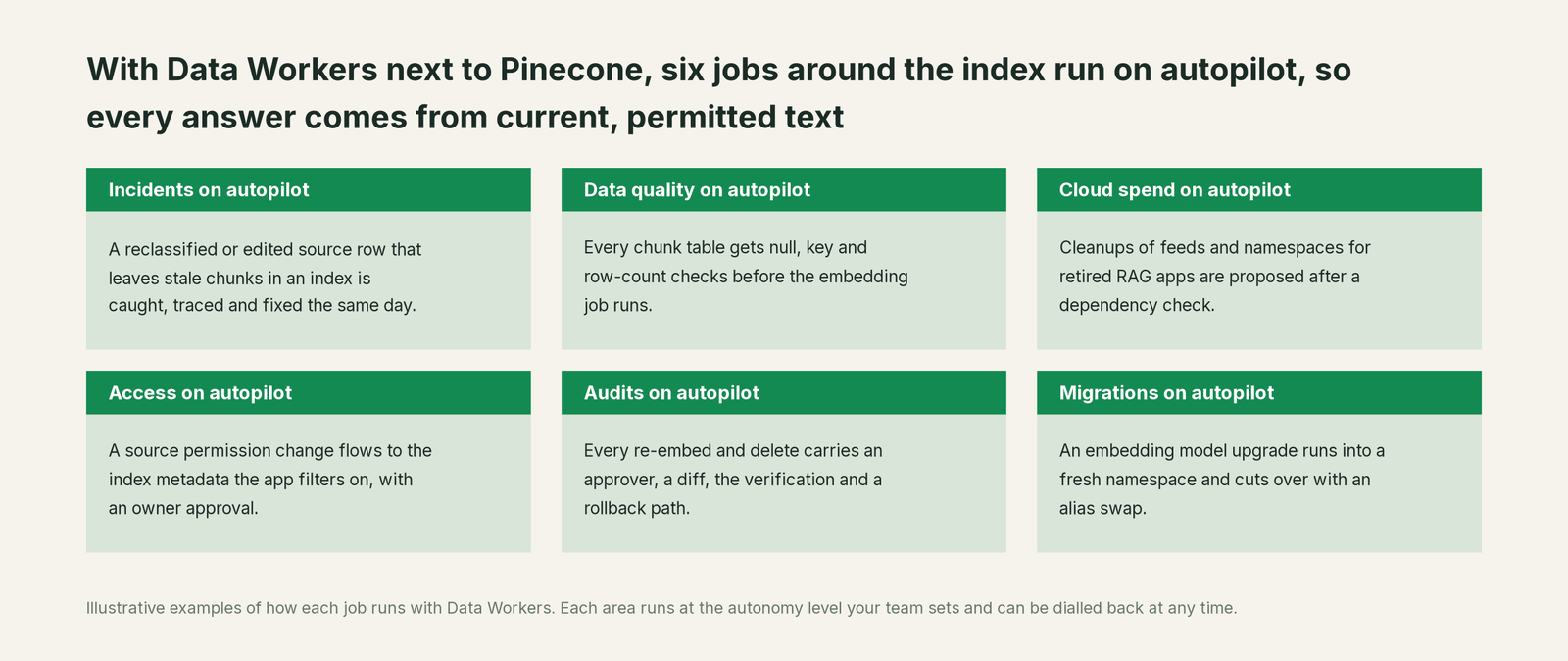
AI platform teams spend much of the week chasing an answer that quoted last quarter's policy, working out which job wrote a chunk, or re-embedding by hand after a source table changed. With Data Workers next to Pinecone, those jobs run on autopilot at the level you set.
- •Incidents. A source row edited, reclassified or deleted upstream is traced to the chunks it left behind and fixed the same day.
- •Data quality. Every chunk table gets freshness, null, duplicate and row-count checks before the embedding job runs.
- •Cloud spend. Cleanups of feeds, staging tables and namespaces built for retired RAG apps are proposed to the owner after a dependency check.
- •Access. A source permission or classification change reaches the metadata your app filters on through an owner-approved re-embed.
- •Audits. Every purge, re-embed and alias swap carries an approver, a diff, the verification and a rollback path.
- •Migrations. An embedding model upgrade or a pod-to-serverless move runs into a fresh namespace, is checked against the warehouse, and cuts over with an alias swap.
The AI platform team gets its week back for chunking, evaluation and retrieval work.
Keep Pinecone, or consolidate?
Keep Pinecone if you love it; Data Workers works with it from day one. Many teams consolidate once Data Workers runs that slice too.
For most teams on Pinecone, the indexes, integrated embedding, rerank, Assistant and Nexus stay where they are. What teams consolidate is the tooling around the index: a separate quality tool for the chunk tables, a homegrown script that diffs record counts against the warehouse, a spreadsheet mapping namespaces to sources and owners, and a one-off re-embed job. Data Workers runs those jobs with one context, one approval flow and one audit trail. If you are weighing building this layer yourself on the Pinecone MCP server, read build it ourselves with Claude Code and MCP servers: the connection is the easy part; cross-system lineage, approvals and rollback are where the work is.
The case for your CFO
The outcome: the AI assistants the company paid to build answer from current, permitted text, because Data Workers keeps every index in step with the systems of record.
The risk story is plain. Your team's assistant reads Pinecone on a viewer-role key, so nothing writes to an index from a chat, and Data Workers' agents never call it. Every change Data Workers proposes shows its blast radius, goes to a named approver, lands through the embedding pipeline your team already runs, is verified against the warehouse and leaves a receipt: who approved it, what it touched and how to undo it. Re-embeds go into a fresh namespace behind an alias, so undoing one is a single repoint. Autonomy is set per domain from L0 manual to L4 autonomous and can be dialled back at any time. Zero migration: Pinecone, the warehouse, dbt and your embedding jobs stay put.
Why now: agents answer customers and act on what they retrieve, so a stale or restricted chunk reaches people outside the company. The first win is one index with its sources watched, read-only, so the next upstream change is caught before the next answer. What stays the same: your indexes, models, Pinecone plan, warehouse permissions and review process. For the numbers, see the ROI of agentic data operations.
The sentence to repeat upstairs: "Our AI is only as good as what's in the index; Data Workers keeps the index in step with the source, and fixes it with an approval and a receipt."
Getting started
Start with a pilot. Pick one index people already rely on, such as the support knowledge base, connect the Pinecone MCP server on a viewer-role key next to Data Workers, and let Data Workers map and watch its sources before enabling the first fix class. The pilot path and plans are on the pricing page, and the pilot is credited in full against the first year.
FAQ
Does Data Workers write to our Pinecone indexes? No. Your team's assistant reads Pinecone through its MCP server on a key with the project's viewer roles; Data Workers' agents never call it. Purges, re-embeds and alias swaps run in your own embedding pipeline with its own key, after the index owner approves in Spellbook.
How does Data Workers know which warehouse table a vector came from? Context Wizard records the lineage from source table to chunk model, embedding job, index and namespace. trace_cross_platform_lineage follows a namespace back to the field that produced its text. Our recommendation: have your embedding job write a source ID and a content hash into each chunk's metadata, so every vector maps to a row in the chunk table Data Workers checks, and changed text shows by its hash.
Our indexes use our own embedding model. Does the MCP setup still work? The Pinecone MCP server covers indexes with integrated embedding. For indexes built with external models, your team reads index stats and metadata over Pinecone's API on the same viewer-role key, and the embedding job stays yours.
What about permissions? Pinecone doesn't know our warehouse policies. It doesn't need to. Data Workers reads the source classification and access policies, checks them against the metadata your app filters on, and proposes a re-embed or purge when they drift. Pinecone keeps enforcing project roles and your filters.
Does this replace Pinecone Assistant or Nexus? No. Data Workers keeps the data under them correct and current.
Sources
- •Pinecone, Use the Pinecone MCP server, https://docs.pinecone.io/guides/operations/mcp-server (checked Oct 2, 2026)
- •Pinecone, Developer MCP server README (npm @pinecone-database/mcp 0.3.0, Aug 7, 2026), https://github.com/pinecone-io/pinecone-mcp (checked Oct 2, 2026)
- •Pinecone, Use an Assistant MCP server, https://docs.pinecone.io/guides/assistant/mcp-server (checked Oct 2, 2026)
- •Pinecone, Pinecone Nexus overview, https://docs.pinecone.io/guides/nexus/overview (checked Oct 2, 2026)
- •Pinecone, Nexus MCP server, https://docs.pinecone.io/guides/nexus/mcp-server (checked Oct 2, 2026)
- •Pinecone, 2026 changelog (namespace aliases Sep 29; Documents API GA Sep 2; pod-to-serverless migration Sep 15; index fullness metrics Aug 21; BYOC GA Aug 25; Nexus GA Aug 6; RBAC Jul 13; SAML and SCIM roles Jul 20), https://docs.pinecone.io/release-notes/2026 (checked Oct 2, 2026)
- •Pinecone, Namespace aliases overview, https://docs.pinecone.io/guides/manage-data/namespace-aliases/overview (checked Oct 2, 2026)
- •Pinecone, Delete data, https://docs.pinecone.io/guides/manage-data/delete-data (checked Oct 2, 2026)
- •Pinecone, Manage roles and access, https://docs.pinecone.io/guides/production/manage-rbac (checked Oct 2, 2026)
- •Pinecone, Understanding projects (project roles; API keys take ControlPlaneViewer and DataPlaneViewer), https://docs.pinecone.io/guides/projects/understanding-projects (checked Oct 2, 2026)
- •Pinecone, Monitoring (console, Prometheus, Datadog), https://docs.pinecone.io/guides/production/monitoring (checked Oct 2, 2026)
- •Pinecone, Security overview (audit logs, CMEK, Private Endpoints), https://docs.pinecone.io/guides/production/security-overview (checked Oct 2, 2026)
- •Pinecone, Indexing overview (namespaces, integrated embedding, metadata), https://docs.pinecone.io/guides/index-data/indexing-overview (checked Oct 2, 2026)
- •Pinecone, Import records, https://docs.pinecone.io/guides/index-data/import-data (checked Oct 2, 2026)
- •Pinecone, Bring your own cloud, https://docs.pinecone.io/guides/production/bring-your-own-cloud (checked Oct 2, 2026)
- •Data Workers, Client setup (open-source docs), https://dataworkers.io/opensource-docs/client-setup/ (checked Oct 2, 2026)
- •Data Workers open-source repository, agent tools and start-agent.sh, https://github.com/DataWorkersProject/dataworkers-claw-community (checked Oct 2, 2026)