You're on Jira: Keep Planning the Data Team's Work There, Let Data Workers Do the Data Work and Close It With Proof
Jira is where the data team plans and tracks its work. Data Workers does the data operations work those work items describe, and your team's assistant posts each diagnosis and receipt over Atlassian's MCP server.
Your data team plans in Jira. There is a DATA space with a backlog, a sprint board, epics for the lakehouse migration and the new revenue model, and a steady stream of work items nobody planned: "need read access to invoices", "fct_renewals failing since Friday", "Board KPIs dashboard shows old numbers". Atlassian keeps making that backlog smarter: Rovo creates and breaks down work items from chat, Rovo and third-party agents can be assigned work like a teammate, and Atlassian's MCP server lets AI tools read and write your work items. Jira is where the data team plans and tracks its work. Data Workers does the data operations work those work items describe, and each one gets its diagnosis and its receipt.
The pattern every data lead knows: the plan is clean, and a third of the sprint goes to unplanned tickets. Each starts with archaeology across the warehouse, dbt, the orchestrator and the BI tool, and many end with "should be fixed now" and a move to Done. Data Workers takes the archaeology and the fix, and hands the work item back with proof.
Key takeaways
- •Jira stays the plan. Spaces, backlogs, sprints, epics, workflows, automation rules and Jira Plans stay exactly as your team runs them.
- •Unplanned data work arrives diagnosed. Broken models, stale dashboards and schema breaks get a cause and a blast radius on the work item before standup.
- •Access requests get a real decision. Data Workers dry-runs the grant, flags sensitive columns and proposes least-privilege, time-bound access for the data owner to approve.
- •Done means verified. The receipt says what changed, who approved it, how it was checked and how to undo it.
- •Connected today over Atlassian's MCP server or the Jira REST API from your team's MCP client, with a native connector for Jira Service Management, and autonomy per domain from L0 manual to L4 autonomous.
Jira tracks the work. Data Workers does the data work.
Jira makes work visible: who owns it, what sprint it sits in, what blocks it. The work itself happens in the systems the data team runs. Here is one Monday morning with both in place: three work items in the DATA backlog, one root cause. This is an illustrative example.
| Time | System | What happens |
|---|---|---|
| Fri 15:10 | Jira | An FP&A lead files DATA-2214: "Read access to main.finance.invoices for the FP&A analysts group" |
| Fri 16:30 | Confluent Schema Registry | The billing team registers a new billing-events schema version that renames plan_code to plan_sku |
| Fri 16:41 | Kafka Connect | The Databricks sink lands the new field in main.bronze.billing_events |
| Sat 02:14 | dbt Core on Airflow | In the dbt_nightly run, stg_billing_events fails: plan_code cannot be resolved. fct_renewals and mart_board_kpis are skipped; an engineer files DATA-2219 |
| Mon 08:40 | Jira | The CFO's chief of staff files DATA-2221: "Board KPIs dashboard shows Friday's numbers" |
| 08:46 | Claude + Data Workers | The on-call engineer asks Claude, with Data Workers and the Atlassian MCP server connected, to work the open DATA bugs. Data Workers traces DATA-2219 upstream to billing-events with trace_cross_platform_lineage, where the producer team's new schema version renamed the field, and maps the blast radius (two marts, the Tableau "Board KPIs" workbook); the cause goes onto DATA-2219 and DATA-2221 as a comment: same root cause |
| 08:52 | Spellbook | Data Workers proposes the dbt change as a diff for the model's owner: map plan_sku in stg_billing_events, add a test on the column |
| 09:05 | Databricks + Unity Catalog | For DATA-2214, Data Workers dry-runs the grant: effective privileges for the group, two PII columns (customer_email, billing_address), and a recommendation of read-only access with a 90-day expiry |
| 09:20 | GitHub | The analytics engineer reviews the diff and merges it |
| 09:31 | Spellbook | The finance data owner approves the access proposal; Data Workers applies the grant in Unity Catalog and records it with its expiry |
| 09:33 | Airflow | Data Workers queues a rerun of dbt_nightly |
| 10:05 | Databricks + dbt | The build completes and the analytics engineer reports every dbt test passing on fct_renewals, with Sunday's rows in place |
| 10:10 | Tableau | "Board KPIs", on a live connection to Databricks, shows Sunday's numbers |
| 10:12 | Jira | Through the Atlassian MCP server, the receipts go onto DATA-2214, DATA-2219 and DATA-2221, and DATA-2230 is filed in the billing team's space: set the billing-events subject to backward compatibility. The assignees move the three work items to Done |
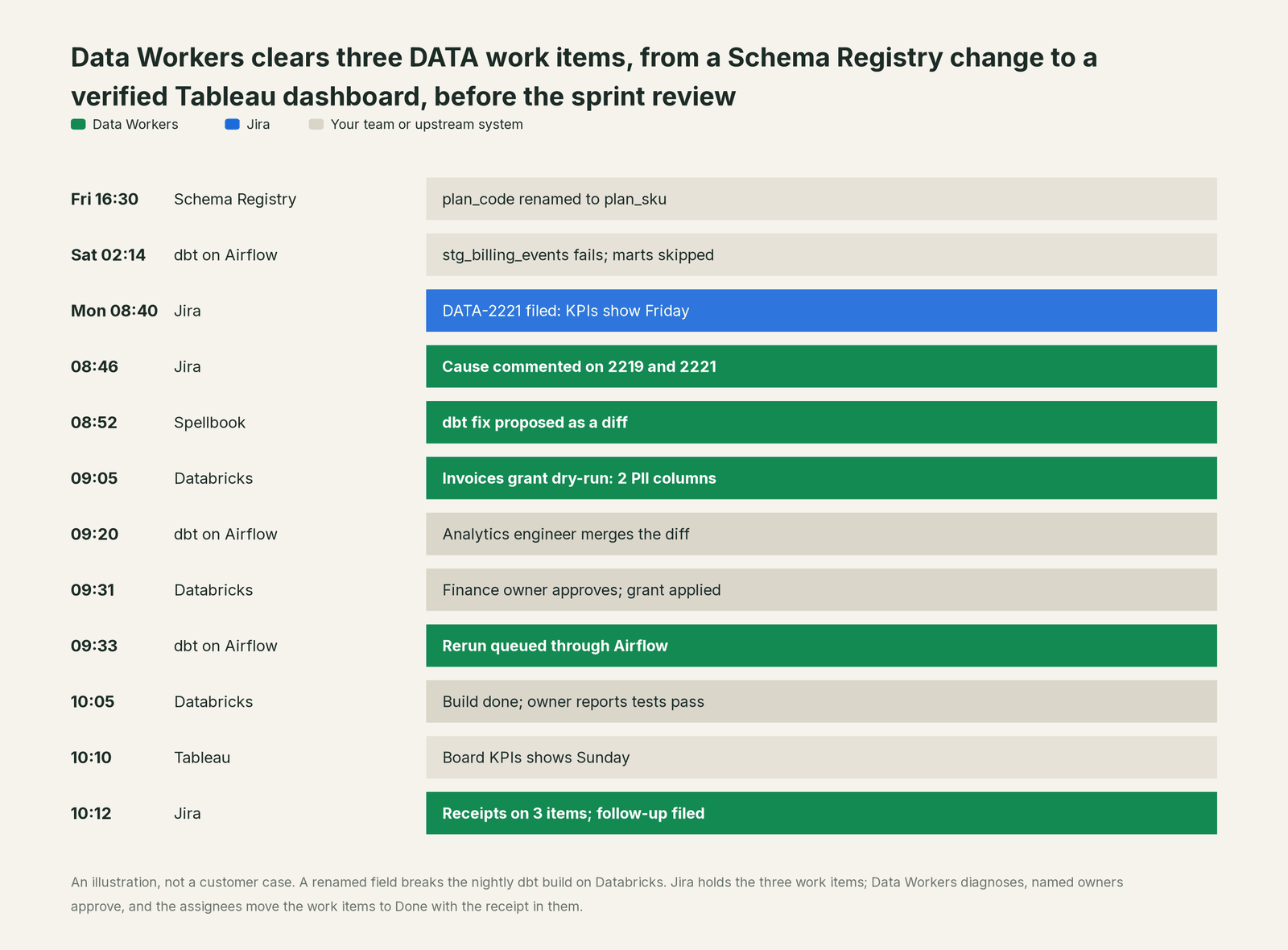
Every system did its job. The gap was between them: one renamed field became two work items that looked unrelated, with an access request queued behind them. With Data Workers, the cause was on the work items before standup, the fix waited only on the two people who own the change, and each work item closed with proof. The follow-up went to the team that owns it, not to a Slack thread.
| Job | What Jira does | What Data Workers does |
|---|---|---|
| The intake | Work items from people, forms, automation rules and Rovo, in one backlog | Diagnoses the open data work items and links the ones that share a cause |
| The context | Links work items to pages, code and people through the Teamwork Graph | Keeps one governed context graph of tables, models, DAGs, owners, lineage and past incidents |
| The plan | Sprints, epics, priorities, Jira Plans and the board | Gives each unplanned work item a cause, a blast radius and a proposed fix, so triage is a decision |
| The approval | Workflow transitions and permissions on the work item | Routes the data change to the named data owner in Spellbook, with blast radius and rollback |
| The fix | Records who did what; Rovo Dev turns work items into code for review | Proposes dbt changes as a diff, applies an approved Unity Catalog grant, queues the rerun and verifies the result |
| The close | The assignee moves the work item to Done | Writes the receipt for the work item and names the follow-up work for the team that owns it |
Why doesn't Jira just do this itself?
Because Jira is built to plan and track work for every team in the company, and that focus is right. Rovo and third-party agents in Jira "reference context in the Teamwork Graph to figure out what needs to be done". Rovo chat creates and updates work items and drafts status updates. Since late September, Atlassian is rolling out Rovo-first work item creation in list view and an automation builder that turns a plain-language request into a rule. Rovo Dev "turns work items into code" in the CLI, VS Code, Bitbucket and GitHub; Atlassian says it is reaching end of life as a standalone product while its capabilities move into eligible Jira subscriptions.
Those features work from the work graph: work items, pages, code. The cause of a data work item sits elsewhere: in a Schema Registry subject, a lakehouse table, a dbt model, a DAG run and a dashboard. Doing that work means changing systems Atlassian does not run, under the approval of the person who owns the data, with blast-radius scoping across lineage, rollback and a receipt an auditor can read. That is a different product with a different liability. It is the product Data Workers is, and it reports back into the work item.
Every tool owns a slice. Data Workers covers the whole lifecycle
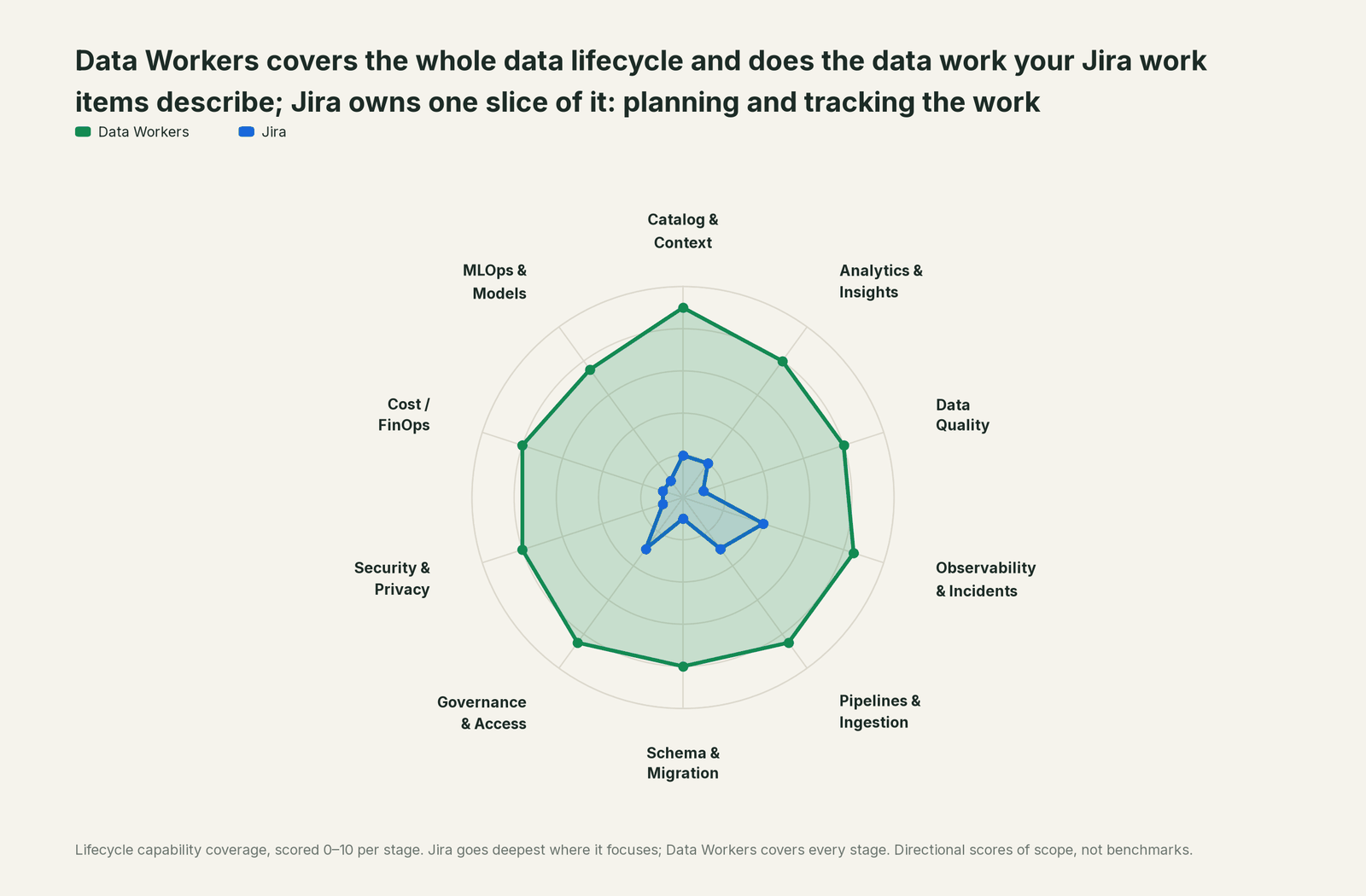
Jira's job, planning and tracking the work, sits outside the data lifecycle: it is where Data Workers reports, not a stage it competes on, so we scored it from its docs and gave it no home stage. Each point tool adds another console, contract and handoff. Data Workers covers the whole lifecycle with one context, one approval flow and one audit trail, and builds on Jira where your team plans.
| Stage | Data Workers | Jira | Why we scored it this way |
|---|---|---|---|
| Catalog & Context | 9 | 2 | Jira's job, tracking the work, sits outside the data lifecycle; work items link to pages and code, not tables. Data Workers keeps one governed context graph of tables, models, owners and lineage. |
| Analytics & Insights | 8 | 2 | Dashboards and Jira Plans report on sprints, epics and throughput. Data Workers answers data questions from governed definitions with lineage behind every number. |
| Data Quality | 8 | 1 | A failed check arrives in Jira as a work item someone files. Data Workers holds key tables to baselines the team records and drafts a test after every incident. |
| Observability & Incidents | 8.5 | 4 | Jira's closest stage: bugs and incidents are tracked, prioritized and assigned, and automation routes them. It records the work; it does not see the data. Data Workers diagnoses, fixes and verifies. |
| Pipelines & Ingestion | 8.5 | 3 | Work items describe pipeline changes and Rovo Dev turns work items into code for review. Data Workers queues reruns and approved backfills through the orchestrator. |
| Schema & Migration | 8 | 1 | Schema changes show up as work items after something breaks. Data Workers catches them in Schema Registry, the dbt manifest and review, and plans migrations with rollback. |
| Governance & Access | 8.5 | 3 | Workflows, permissions and approvals on transitions govern the work items. Data Workers adds data-level policy checks and least-privilege access proposals. |
| Security & Privacy | 8 | 1 | Atlassian's data security policies protect the work items and govern MCP access. Data Workers leaves a receipt on every data change and proposes masking for the owner. |
| Cost / FinOps | 8 | 1 | Not a work tracking job. Data Workers attributes warehouse spend to the dbt model and drafts warehouse settings for the owner. |
| MLOps & Models | 7.5 | 1 | Not a work tracking job. Data Workers keeps the data under your models healthy. |
How Jira and Data Workers work together
Jira stays on top, where the data team plans and tracks its work. Spellbook Data Catalog (in preview) is where the data team and the data owners look: each proposed change, who approved it, what it touched and how to roll it back. Between them, Data Context Wizard keeps one governed context graph across Schema Registry, Databricks, dbt, Airflow and Tableau, the Data-Agents Swarm does the work with more than 20 specialist agents, and the Autonomous Data-Conductor runs each job end to end: detect, diagnose, fix, review, verify, remember.
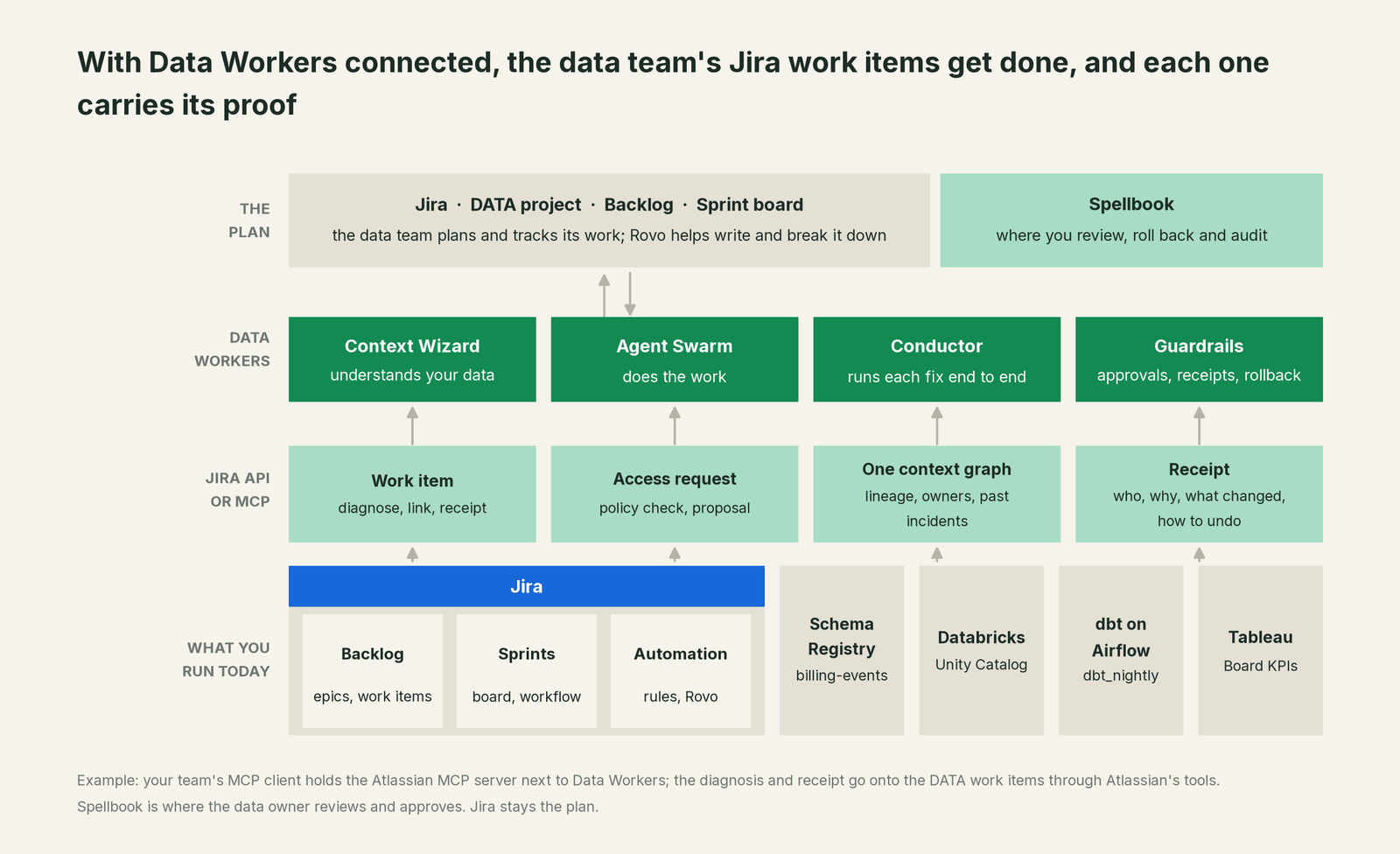
Connected over the Atlassian MCP server or the Jira REST API, today. Your team's MCP client (Claude, Cursor or another) holds Atlassian's tools next to Data Workers' agents. It reads the open work items in the spaces you choose; Data Workers does the diagnosis, the proposals and the verification; the comment, the receipt and any follow-up work item go back to Jira through Atlassian's tools. Status transitions stay with the assignee and your workflow, so the board, sprint reports and automation rules behave exactly as they do now. For a service desk, Data Workers connects natively to Jira Service Management: create_jira_sm_ticket opens a service request with the cause in its description, and the Jira Service Management guide covers that side.
The Atlassian MCP server. Atlassian hosts it at https://mcp.atlassian.com/v2/mcp for Jira, Jira Service Management, Confluence, Bitbucket, Projects, Goals and Loom. It can "create and update work items or pages using natural language commands", uses OAuth 2.1 (an API token is optional) and respects each user's existing permissions. Rovo credits are used per call. A Rovo MCP server control in the data security policy, rolling out since late September, lets admins govern how external AI tools read and write Jira and Confluence data. Existing v1 use moves to v2 tools automatically on March 1, 2027.
Setup. Every Data Workers agent is an MCP server; the client setup guide documents the path (clone the repo, one start-agent.sh entry per agent). In Cursor, a data engineer can put Jira and Data Workers in one .cursor/mcp.json:
// Example: Atlassian's MCP server plus Data Workers agents in Cursor (.cursor/mcp.json)
{
  "mcpServers": {
    "atlassian": { "url": "https://mcp.atlassian.com/v2/mcp" },
    "dw-incidents": { "command": "/path/to/dataworkers-claw-community/start-agent.sh", "args": ["dw-incidents"] },
    "dw-context-catalog": { "command": "/path/to/dataworkers-claw-community/start-agent.sh", "args": ["dw-context-catalog"] },
    "dw-schema": { "command": "/path/to/dataworkers-claw-community/start-agent.sh", "args": ["dw-schema"] },
    "dw-quality": { "command": "/path/to/dataworkers-claw-community/start-agent.sh", "args": ["dw-quality"] },
    "dw-governance": { "command": "/path/to/dataworkers-claw-community/start-agent.sh", "args": ["dw-governance"] }
  }
}
Then ask: "Work the open bugs in the DATA backlog: find the cause of each, comment it on the work item and link the ones that share a cause." In production the Data Workers remote endpoint serves /mcp and takes an API key (bearer) or OAuth tokens from your identity provider, verified through JWKS. The agents run in your infrastructure and hold the lakehouse credentials; your data stays in your systems, and the hosted Conductor sees workflow metadata only.
In the loop: trace_cross_platform_lineage, Schema Registry and the dbt manifest find where a break started, diagnose_incident and get_root_cause name the cause, blast_radius_analysis maps what it touches, provision_access evaluates an access request and grants nothing when the verdict is review (request_governance_review then opens a trackable review), the monitor_metrics baseline verifies the fix, and get_incident_history means the next schema break starts from this one. dbt changes go to the owner as a diff to merge (Data Workers opens the pull request when your team turns on the GitHub pull-request target), and Data Workers reviews pull requests for their blast radius.
One work item, L0 to L4, set per domain. The work item: "Board KPIs dashboard shows Friday's numbers."
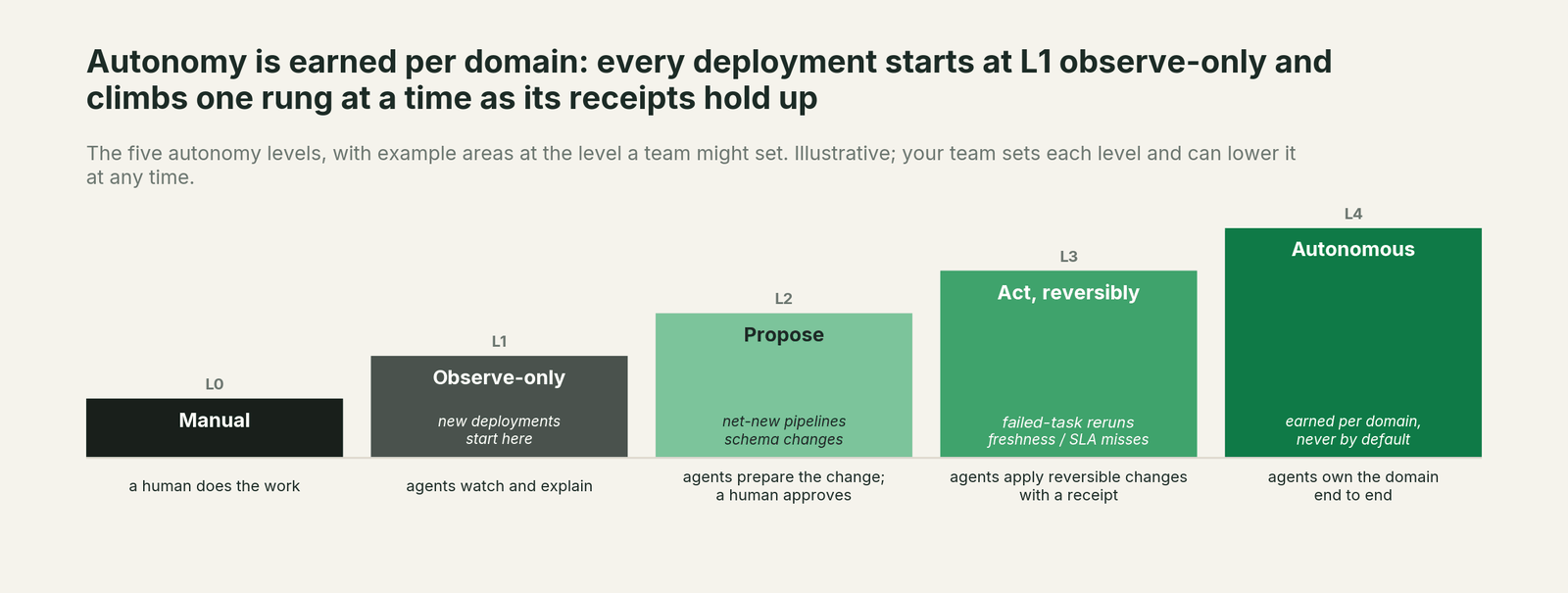
- •L0 manual. An engineer opens Airflow, reads the dbt log, checks Schema Registry and finds the rename an hour later.
- •L1 observe. The cause, the blast radius and the linked work items land on the work item. Nothing changes; the engineer starts from the answer.
- •L2 propose. Data Workers proposes the dbt diff and the rerun. Nothing changes until the owner merges and approves; a request nobody answers expires and escalates, and never grants itself.
- •L3 act reversibly. For change classes with a clean record, such as rerunning a failed DAG after an approved fix, Data Workers queues the rerun, verifies it and writes the receipt, with rollback ready.
- •L4 autonomous. For a scoped domain such as the finance marts, Data Workers runs that change class end to end, and the team reviews the receipts after the fact. Code changes still go to the model owner.
More on the guardrails: who owns the agents, how approvals work, is it safe to let AI agents change production data and where does our data go. Teams that plan in Linear can read you're on Linear; teams paged through PagerDuty can read you're on PagerDuty.
What changes for your team
Unplanned data work stops eating the sprint.
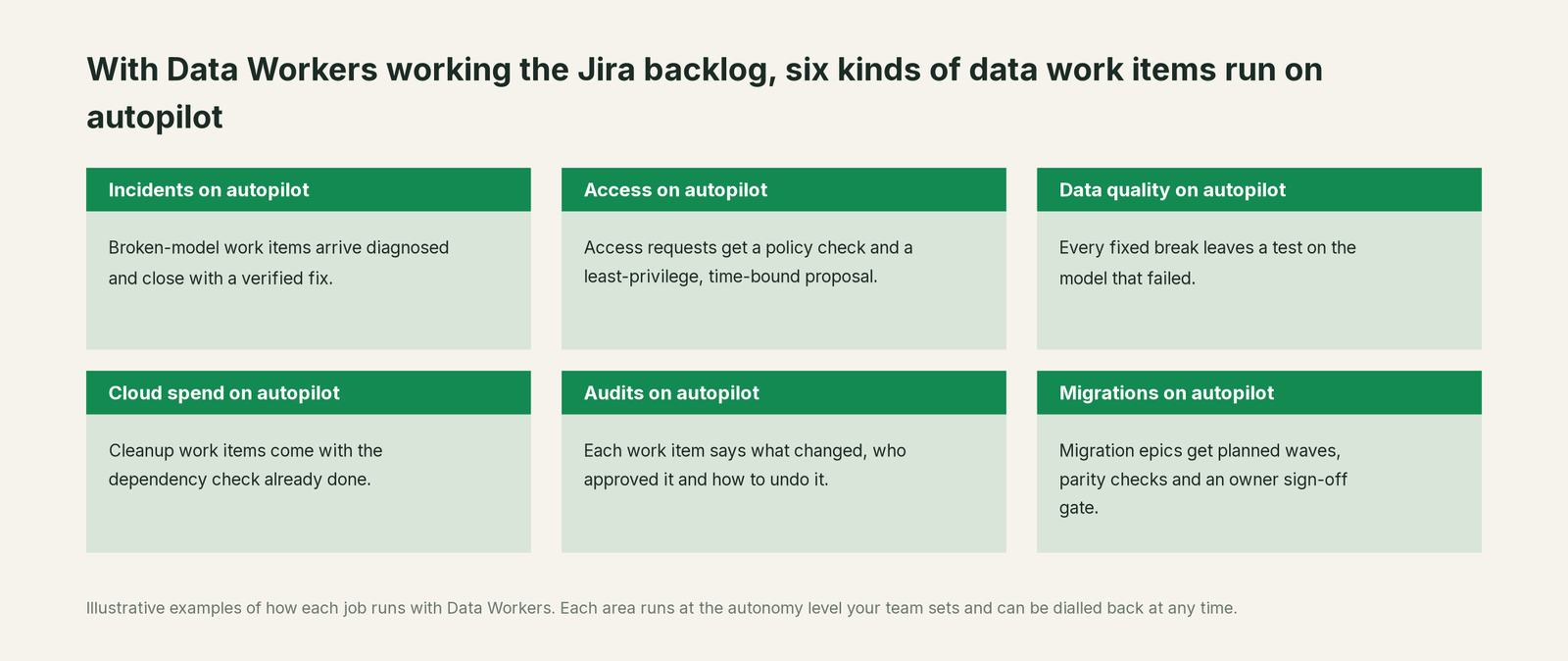
The data lead keeps the board and the sprint ritual. Engineers stop starting every bug from zero and review proposals instead. Data owners approve access with the sensitive columns in front of them. Every Done work item says what changed, who approved it and how to undo it. For the runbook side, see the data engineering runbook template and the data incident response playbook.
Keep Jira, or consolidate?
Keep Jira if you love it; Data Workers works with it from day one. Many teams consolidate once Data Workers runs that slice too.
For almost every team the answer is keep it: it is where the company plans, and the data team's work belongs next to the product work it serves. What teams consolidate is the stack around the lakehouse: a separate observability tool, a quality tool, a stale catalog and homegrown watchers that each file their own tickets. See Data Workers vs data observability. Tempted to build this with Rovo automation rules and an assistant on the Atlassian MCP server? Read build it ourselves with Claude Code and MCP servers first: creating the work item is the easy part; the context graph, approvals, rollback and receipts are the work.
The case for your CFO
The outcome: the data team's sprint goes to the roadmap again. Broken models, stale dashboards and access requests are diagnosed before standup and closed the same morning, under approvals from the people who own the data, with a record of why.
The risk story is plain. Jira keeps governing the work: priorities, sprints, workflows. Data Workers governs changes to the data: autonomy per domain from L0 manual to L4 autonomous, every change routed to a named approver, applied reversibly, verified and recorded in a receipt with who approved it, what it touched and how to undo it. No agent can promote its own work. Your data stays in your systems; the hosted Conductor sees workflow metadata only. Zero migration: Jira, Schema Registry, Databricks, dbt, Airflow and Tableau stay where they are.
Why now: Atlassian is putting agents into Jira and opening it to AI tools over MCP, with admin controls over what those tools read and write. The open question for a data leader is which agent may change production data, under whose approval, with what receipt. The first win is L1 on the DATA space: every bug and incident work item gets a diagnosis before standup. For the numbers, see the ROI of agentic data operations.
The sentence to repeat upstairs: "Jira keeps our plan; Data Workers does the data work in it, with an approval and a receipt on every work item."
Getting started
Start with a pilot. Pick one space, such as DATA, connect your team's MCP client to Jira through the Atlassian MCP server and to Data Workers, and let every bug and incident work item get a diagnosis at L1. Then move one domain, such as the finance marts, to L2 propose, and add your access request work type. Plans are on the pricing page, and the pilot is credited in full against the first year.
FAQ
How does Data Workers connect to Jira? Over the Atlassian MCP server or the Jira REST API, from your team's MCP client, today. The client reads the work items in the spaces you choose and writes back Data Workers' diagnosis, receipt and follow-up work items. For a Jira Service Management service desk, Data Workers has a native connector: create_jira_sm_ticket opens a service request and update_jira_sm_ticket keeps its summary current.
Does Data Workers move work items across the board? No. Status transitions stay with the assignee and your workflow, so sprint reports, automation rules and cycle-time numbers stay true. The assignee moves the work item to Done with the proof in front of them.
We have Rovo agents in Jira. Why add Data Workers? Rovo agents work from the Teamwork Graph: they plan, write, break down and update work, and do it well. Data Workers works in the data systems: cause through lineage, fix with its blast radius, approval from the data owner, verification and receipt.
What about Rovo Dev? Rovo Dev turns work items into code and reviews pull requests against acceptance criteria; Atlassian is moving its capabilities into eligible Jira subscriptions. A data work item usually needs more than code: an access grant, a rerun, a verification and a record for the auditor. Data Workers reviews pull requests on data models for their blast radius, so the two fit together.
Can we give an assistant the Atlassian MCP server and let it close data tickets? It lets an assistant read and update work items. Closing a data work item with proof needs context across every other system, a named data approver, rollback and a receipt. Pair the assistant with Data Workers over MCP, and use Atlassian's data security policy control to keep its write scope narrow.
Does Data Workers grant access when someone files an access request? It dry-runs the grant, shows the effective privileges and the sensitive columns it would reach, and proposes least-privilege, time-bound access. The data owner approves. In Unity Catalog, Data Workers applies the approved grant and records it with its expiry; on other platforms it proposes the grant for the owner to apply.
Sources
- •Atlassian, Rovo in Jira (Rovo and third-party agents assigned work, Teamwork Graph, Rovo chat skills, plans), https://www.atlassian.com/software/jira/ai (checked Oct 2, 2026)
- •Atlassian, Rovo Dev (CLI, VS Code, Bitbucket and GitHub; turn work items into code; end of life as a standalone product, capabilities moving into eligible Jira subscriptions), https://www.atlassian.com/software/rovo-dev (checked Oct 2, 2026)
- •Atlassian Support, Get started with the Atlassian MCP server (v2 endpoint, OAuth 2.1 or API token, create and update work items, Rovo credits per call, v1 to v2 on March 1, 2027), https://support.atlassian.com/atlassian-rovo-mcp-server/docs/getting-started-with-the-atlassian-remote-mcp-server/ (checked Oct 2, 2026)
- •Atlassian, Atlassian Cloud changes Sep 21 to Sep 28, 2026 (create work items with Rovo, build automation rules with Rovo, Rovo MCP server control in data security policy, MCP v2, Rovo Dev self-service signup removed; all rolling out), https://confluence.atlassian.com/cloud/blog/2026/09/atlassian-cloud-changes-sep-21-to-sep-28-2026 (checked Oct 2, 2026)
- •Data Workers open-source repository (incident, context, schema, quality, governance and Jira Service Management tools), https://github.com/DataWorkersProject/dataworkers-claw-community (checked Oct 2, 2026)
- •Data Workers client setup guide (Cursor
.cursor/mcp.json,start-agent.sh), https://dataworkers.io/opensource-docs/client-setup/ (checked Oct 2, 2026)