Why now? Three changes that make agentic data operations practical in 2026
Every major data platform and assistant now speaks MCP and ships agents, models can fix code and SQL, and estates have outgrown teams. What's left is one governed layer across all of it.
Agentic data operations became practical in 2025 and 2026 because three things changed at once: every major data platform and assistant now speaks MCP and ships its own agents, so an agent can reach the whole estate; models got good enough at code and SQL to fix problems as well as flag them; and data estates grew faster than the teams that run them. What that picture still needs is one governed layer across all of it, with one context, one approval flow and one audit trail, and that layer is Data Workers.
Two years ago an agent that wanted to fix a broken dbt model needed custom glue for every warehouse, catalog and BI tool, and the models behind it failed more often than they succeeded. Today the doors are open on every major platform, the models solve most tasks on the public coding and SQL benchmarks, and the backlog is bigger than ever. This page lays out the evidence for each change, shows how Data Workers turns it into governed work, and gives your CFO the cost of waiting.
Key takeaways
- •The reach is here. Snowflake, Databricks, Google Cloud, Microsoft Fabric, Claude, ChatGPT and Gemini Enterprise all shipped MCP support or data agents between November 2024 and September 2026.
- •The capability is here. On SWE-bench Verified, the best published resolve rate rose from 45.2% in August 2024 to 79.2% in December 2025. On Spider 2.0-Snow, 547 enterprise text-to-SQL tasks on Snowflake, the o1-preview baseline agent scored 23.6% and the top agent submissions now score above 90%.
- •The pressure is here. In dbt Labs' 2026 survey, 57% of respondents report higher warehouse and compute spend while 36% report higher team budgets.
- •Each platform governs its own slice. Snowflake, Databricks, Google Cloud and Microsoft scope their agents to their own platforms, and the assistants read across sources to answer questions. Both are the right design for them. Changing data across platforms needs a layer above them.
- •Data Workers is that layer. One context graph, one approval flow and one hash-chained audit trail across every platform, with autonomy set per domain from L0 manual to L4 autonomous.
Change one: every platform now speaks MCP and ships agents
Anthropic open-sourced the Model Context Protocol on November 25, 2024, as "a new standard for connecting AI assistants to the systems where data lives". In the 22 months since, every platform a data team runs on has opened a door for agents.
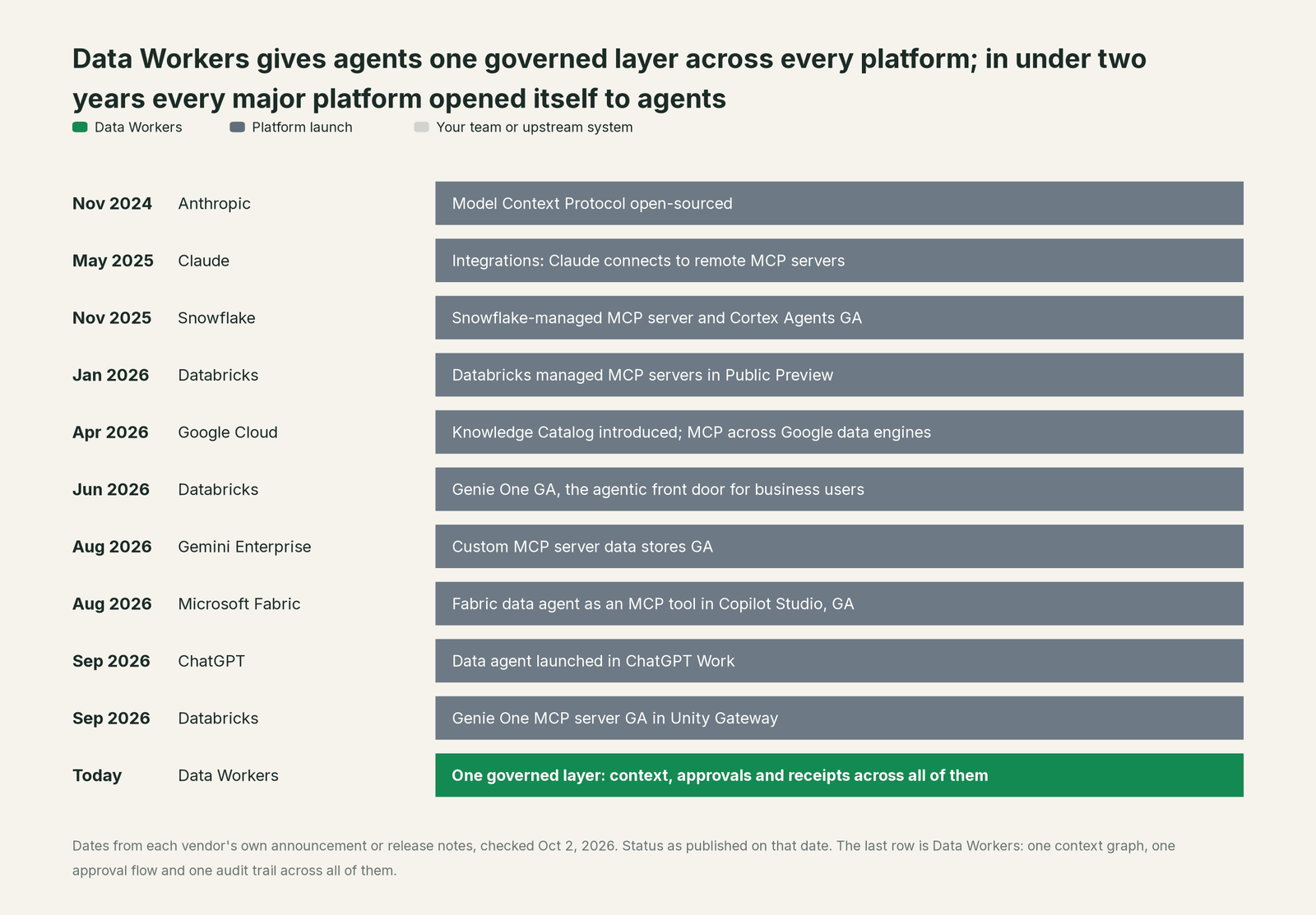
Snowflake made its managed MCP server generally available on November 4, 2025, alongside Cortex Agents and what is now CoWork (formerly Snowflake Intelligence). Databricks put managed MCP servers into Public Preview on January 27, 2026, made Genie One generally available on June 16, and on September 25 made the Genie One MCP server GA in Unity Gateway (formerly AI Gateway), so "any MCP client or agent, such as Claude, ChatGPT, or Cursor" can ground questions in Genie with Unity Catalog permissions on every request. Google Cloud introduced Knowledge Catalog (evolved from Dataplex Universal Catalog) on April 22, 2026 and said it has "fully embraced Model Context Protocol" across its core engines, with MCP for Cloud SQL GA and for Spanner and Looker in Preview. Microsoft made the Fabric data agent integration with Copilot Studio generally available in August 2026, adding a data agent to a Copilot Studio agent as an MCP tool that keeps source permissions. On the assistant side, Claude has connected to remote MCP servers since May 1, 2025, Gemini Enterprise made custom MCP server data stores GA on August 7, 2026, and OpenAI launched the Data agent in ChatGPT Work on September 10, 2026, connecting to Snowflake, Databricks, BigQuery, Redshift and more.
The practical result: an agent can now read lineage, run SQL and call tools on every major platform through one protocol. The vendors now carry most of the integration tax that stopped teams in 2024. The guide to what to do after your company rolled out AI assistants covers the assistant side of this shift.
Change two: models can fix, not only flag
The second change is quality. SWE-bench Verified is a public set of 500 real GitHub issues that a model must resolve with a patch that passes the project's tests. On the official published results, the top resolve rate was 45.2% at the end of August 2024, 62.2% by December 21, 2024, and 79.2% by December 2025, the highest entry as of October 2, 2026. Spider 2.0, published at ICLR 2025, tests text-to-SQL on 632 real enterprise workflows in BigQuery, Snowflake and other engines, often with over 1,000 columns per database. At release, the strongest model solved 17.1% of it. On the official Spider 2.0-Snow results (547 Snowflake tasks), the baseline Spider-Agent with o1-preview scored 23.6%; checked October 2, 2026, five agent submissions score above 90%, the highest 96.7%.
Benchmarks are not your estate, and we treat them as signals. They show that a correct code fix or a correct backfill query is now within reach of a model with the right context. The open question has moved from "can the model do it?" to "can we let it, safely, with our context?" That is a governance question, and it has an engineering answer.
Change three: estates outgrew teams
dbt Labs' 2026 State of Analytics Engineering report (published April 10, 2026; 363 responses; third-party survey) found that 57% of respondents saw warehouse and compute spend rise, and only 13% saw it fall. Team budgets rose for 36%. Poor data quality is still the most frequently reported obstacle, and 41% cite ambiguous data ownership. The 2025 edition found that 57% of respondents spend most of their workdays maintaining or organizing data sets. More tables, more pipelines and more consumers land on roughly the same number of people, and data engineering toil fills the gap.
What's still missing: one governed layer across all of it
Each platform vendor built its agents for its own platform, and that is the right call for them. The Fabric data agent "strictly enforces read-only access" and generates only read queries (Microsoft Learn, updated September 29, 2026). Genie One's MCP server enforces Unity Catalog permissions. Snowflake's managed MCP server works through Snowflake role-based privileges, and its SQL tool is read-only by default. The assistants, such as the Data agent in ChatGPT Work, read across sources to answer questions and run the actions a user approves. Each one is excellent at its job. A real incident crosses platforms: a source field renames in Salesforce, Fivetran lands it in Snowflake, a dbt model breaks, a Databricks job reads the result and a Genie Agent gives a wrong answer. Among the platform agents and assistants named on this page, none is built to trace that chain end to end and write a scoped, approved, reversible fix into systems its vendor doesn't own.
Data Workers is the agentic data platform built for that layer. The Data Context Wizard keeps one governed context graph across every platform, joined to lineage, quality and usage. The Data-Agents Swarm brings 20+ specialist agents for schema, quality, incidents, pipelines, cost, governance and migrations. The Autonomous Data-Conductor runs the loop: detect, diagnose, fix, review, verify, remember. Spellbook Data Catalog (in preview) is where people review, approve and roll back. It connects to the platform MCP servers above and to your warehouses directly, with zero migration. If you already hold context in a semantic layer or ontology, bring your own context shows how it plugs in. The category is defined in what is an agentic data platform.
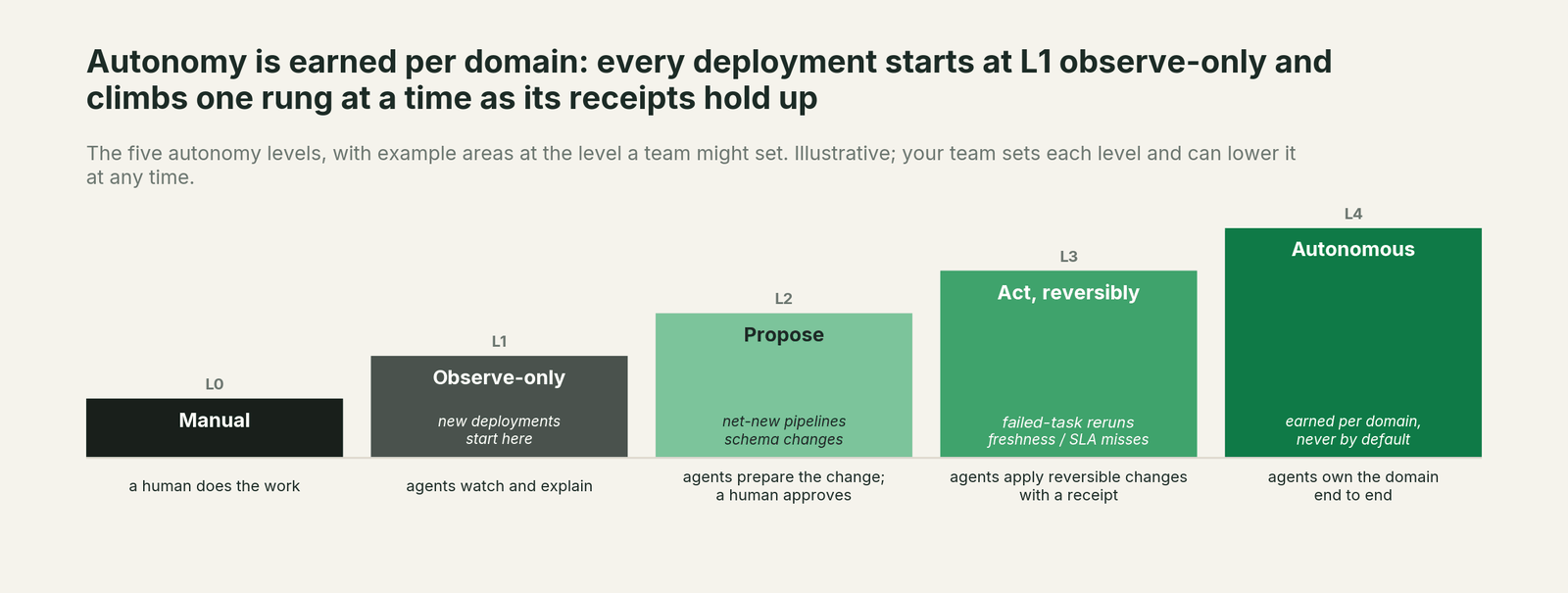
Autonomy is set per domain on one ladder: L0 manual, L1 observe, L2 propose, L3 act reversibly, L4 autonomous. Every change carries a blast radius from blast_radius_analysis, a rollback path recorded before it runs, verification after it runs and a receipt in a SHA-256 hash-chained audit log you read with get_audit_trail. No agent can approve its own work. Is it safe to let AI agents change production data? covers each guardrail.
A worked example across five systems
This is an illustration, not a customer event. A sales operations admin renames Region__c to Sales_Region__c in Salesforce on Monday at 18:10. Fivetran syncs the change into Snowflake at 18:40, and the nightly dbt run builds fct_pipeline with null regions. A Databricks job reads that table through Lakehouse Federation, and by 08:00 a Genie Agent tells the CRO that EMEA pipeline fell 40%.
| Time | System | What happens |
|---|---|---|
| 18:40 | Fivetran, Snowflake | The renamed column lands; run_quality_check fails on the table: region is null in new rows |
| 18:42 | Data Workers | trace_cross_platform_lineage follows the column from Snowflake through dbt into the Databricks job and the Genie Agent |
| 18:45 | Data Workers | blast_radius_analysis lists one dbt model, one Databricks job, one Genie Agent and the weekly forecast export |
| 18:50 | Spellbook | The sales domain runs at L2 propose, so a dbt change with the blast radius, dry-run counts and rollback plan waits for a named approver |
| 19:05 | dbt, Snowflake | The analytics engineer approves; the model rebuilds and the quality checks pass |
| 19:20 | Databricks | The job reruns on correct data; the Genie Agent answers from the fixed table |
The CRO's question the next morning gets the right number, and the receipt shows who approved what, why, and how to undo it. Here Data Workers worked with Fivetran, Snowflake, dbt and Databricks as they are, and each kept its own job.
The alternatives buyers weigh
Build it yourself. With vendor MCP servers and a coding agent, a strong team can wire a lot. What remains is the product around it: cross-platform lineage, approvals, rollback, receipts and connectors maintained as APIs change. Can't we just build this ourselves with Claude Code and a few MCP servers? maps that work, and the Data Workers core is Apache 2.0 if you want to start there.
Catalogs. Knowledge Catalog added a data lineage remote MCP server in preview on May 27, 2026, and catalogs are the right inventory. Data Workers reads them and writes approved facts back; the catalog stays the system of record.
Observability. Monte Carlo's Triage Agent runs on every new alert by default, and its Cost agent page says "The agent recommends; it does not act on your behalf" (Monte Carlo docs, checked October 2, 2026). Its alerts are excellent signals, and Data Workers acts on them with a fix and a receipt.
Platform-native agents. Genie, CoWork, Cortex Agents and Fabric data agents are the best way to ask questions inside each platform. Data Workers works alongside them and governs changes across them.
Coding agents. Claude Code, Cursor and Codex write code well. Connected to Data Workers over MCP, they get governed context and an approval path. How does it work with the coding agents we already use? shows the setup.
The case for your CFO
The outcome: engineers spend their time on new work while agents work tickets, incidents and cleanups across the estate, behind approvals, with a receipt for each one.
The cost of waiting is concrete. Every quarter without this layer, maintenance keeps filling most workdays (57% of respondents in dbt Labs' 2025 survey), warehouse spend keeps rising for the majority of teams, and every platform agent your company turns on builds context inside its own walls. Unifying that context later costs more than starting from one governed graph now. Meanwhile the assistants already rolled out keep answering from whatever context they can reach.
The risk story: Data Workers runs in your infrastructure on your own model account, reads through grants you issue, and writes only at the autonomy level each domain has earned, with blast radius, rollback and a hash-chained audit trail. Nothing migrates, and your warehouse, catalog, BI and identity provider stay the same.
The first win is one domain at L2 propose, with incidents fixed through an approval and verified. Design targets on top: 25 to 40% lower warehouse spend from the Cost Savings agent, and migrations in 4 to 8 weeks instead of 6 to 12 months. Your pilot measures the real numbers.
Start with a pilot at $7,500 one time, and the pilot is credited in full against the first year. Scale starts from $1,000 a month and Enterprise from $3,000 a month, billed annually, with unlimited seats, no usage meter, no markup on model spend, bring your own model and an Apache 2.0 core. See /pricing/, run the ROI calculator, and read the ROI of agentic data operations.
The sentence to repeat upstairs: "Every platform we run opened itself to agents in the last two years; Data Workers is how we let them do real work under our rules."
FAQ
Isn't it smarter to wait a year for the platforms to mature? The parts that matter are already generally available: Snowflake's managed MCP server, the Genie One MCP server, Fabric data agents in Copilot Studio and Gemini Enterprise custom MCP data stores. What a year of waiting adds is more context scattered across platform agents. Starting at L1 observe costs no write risk and builds the context graph now.
Won't Snowflake or Databricks just do this themselves? They govern their own platforms superbly, and their agents are scoped to them by design. A change that crosses Fivetran, Snowflake, dbt and Databricks needs a layer that sees all four and takes responsibility for the change. That is the product Data Workers is.
Are models really reliable enough to change production data? Benchmarks show models write correct code and SQL far more often than two years ago, and Data Workers doesn't rely on that alone. Every change has a blast radius, an approval at the level the domain has earned, a rollback path and post-change verification.
Where does our data go? Data Workers runs in your infrastructure, and you bring your own model. Remote access authenticates through your identity provider, such as Okta or Entra, with Data Workers verifying tokens via JWKS. Details are in where does our data go.
What does the first quarter look like? Observe first, then propose, then act reversibly in the domains that earn it. What happens in the first 90 days? walks through it, and will Data Workers replace my data team? covers what changes for the people.
Do we have to pick one assistant first? No. Data Workers serves Claude, ChatGPT, Gemini Enterprise, Copilot and your coding agents over MCP, all from the same governed context.
Sources
- •Anthropic, Introducing the Model Context Protocol (Nov 25, 2024), checked Oct 2, 2026: https://www.anthropic.com/news/model-context-protocol
- •Anthropic, Integrations (May 1, 2025), checked Oct 2, 2026: https://claude.com/blog/integrations
- •Snowflake, Snowflake-managed MCP server GA release note (Nov 4, 2025), checked Oct 2, 2026: https://docs.snowflake.com/en/release-notes/2025/other/2025-11-04-cortex-agents-mcp
- •Snowflake, Snowflake Intelligence (now CoWork) GA release note (Nov 4, 2025), checked Oct 2, 2026: https://docs.snowflake.com/en/release-notes/2025/other/2025-11-04-snowflake-intelligence
- •Snowflake, Snowflake-managed MCP server docs (access control, read-only SQL tool), checked Oct 2, 2026: https://docs.snowflake.com/en/user-guide/snowflake-cortex/cortex-agents-mcp
- •Databricks, release notes January 2026 (managed MCP servers Public Preview, Jan 27, 2026), checked Oct 2, 2026: https://docs.databricks.com/aws/en/release-notes/product/2026/january
- •Databricks, Genie One launch press release (Jun 16, 2026), checked Oct 2, 2026: https://www.databricks.com/company/newsroom/press-releases/databricks-launches-genie-one-all-new-agentic-coworker-every-team
- •Databricks, release notes September 2026 (Genie One MCP server GA, Sep 25, 2026), checked Oct 2, 2026: https://docs.databricks.com/aws/en/release-notes/product/2026/september
- •Google Cloud, What's new in the Agentic Data Cloud (Apr 22, 2026), checked Oct 2, 2026: https://cloud.google.com/blog/products/data-analytics/whats-new-in-the-agentic-data-cloud
- •Google Cloud, Knowledge Catalog release notes (lineage MCP server preview, May 27, 2026), checked Oct 2, 2026: https://docs.cloud.google.com/dataplex/docs/release-notes
- •Google Cloud, Gemini Enterprise release notes (custom MCP server data stores GA, Aug 7, 2026), checked Oct 2, 2026: https://docs.cloud.google.com/gemini/enterprise/docs/release-notes
- •Microsoft, What's new in Microsoft Fabric (Copilot Studio integration GA, August 2026), checked Oct 2, 2026: https://learn.microsoft.com/en-us/fabric/fundamentals/whats-new
- •Microsoft, Fabric data agent concepts (updated Sep 29, 2026), checked Oct 2, 2026: https://learn.microsoft.com/en-us/fabric/data-science/concept-data-agent
- •OpenAI, Now everyone can put data to work (Data agent in ChatGPT Work, Sep 10, 2026), checked Oct 2, 2026: https://openai.com/index/put-data-to-work/
- •SWE-bench, official results (Verified, 500 instances), checked Oct 2, 2026: https://www.swebench.com/
- •Spider 2.0 (ICLR 2025), benchmark and Spider 2.0-Snow results, checked Oct 2, 2026: https://spider2-sql.github.io/
- •dbt Labs, 2026 State of Analytics Engineering (Apr 10, 2026), checked Oct 2, 2026: https://www.getdbt.com/resources/state-of-analytics-engineering-2026
- •dbt Labs, 2025 State of Analytics Engineering (Apr 29, 2025), checked Oct 2, 2026: https://www.getdbt.com/resources/state-of-analytics-engineering-2025
- •Monte Carlo, Cost agent docs, checked Oct 2, 2026: https://docs.getmontecarlo.com/docs/cost-agent
- •Monte Carlo, Triage Agent docs, checked Oct 2, 2026: https://docs.getmontecarlo.com/docs/triage-agent
- •Data Workers open-source repo (tool registrations for
detect_schema_change,trace_cross_platform_lineage,blast_radius_analysis,get_audit_trail), checked Oct 2, 2026: https://github.com/DataWorkersProject/dataworkers-claw-community - •Data Workers, Pricing, checked Oct 2, 2026: https://dataworkers.io/pricing/