AI data engineering agents compared: nao, Datus, definity and Mica AI vs Data Workers
nao and Datus answer data questions, definity tunes the Spark run and Mica AI governs AI skills. Data Workers runs the data lifecycle and fixes the data at the source, with receipts.
nao and Datus answer the question. definity watches and tunes the Spark run. Mica AI keeps the AI skills your employees build in one governed marketplace. Data Workers runs the data lifecycle underneath all of them: it fixes the data at the source, proves the fix held and leaves a receipt on every change.
These four land on the same shortlist because they all sell some version of "agents for data." The estate under them is usually the same: Fivetran or Airbyte lands Postgres, Salesforce and SaaS data in Databricks, Snowflake or BigQuery; dbt and Spark build the models; Airflow schedules the DAG runs; Looker or Tableau sits on top, and now an analytics agent answers the CFO in Slack. When a source changes overnight, every layer can be green while the number is wrong.
Data Workers is the agentic data platform that owns that whole loop. It traces the cause across systems, fixes it at the source behind your approval, verifies the result downstream and records a receipt. It also runs schema changes, access requests, cost, migrations and audit evidence, with one context, one approval flow and one audit trail. Nothing moves.
Key takeaways
- •Four jobs, one shortlist. nao and Datus answer business questions from curated context, definity monitors and tunes Spark from inside the driver, and Mica AI governs the AI skills employees build.
- •Where each stops. nao writes to its own context repo and reports. Datus writes tables and jobs inside one agent session. definity acts on the Spark run and cluster it sits in. Mica changes AI skills, not data.
- •Data Workers acts across systems. A fix in Spark, dbt or the warehouse, a rerun in Airflow, checks on the changed tables against recorded baselines, and a tamper-evident receipt, at the autonomy level you set per domain.
- •Keep yours, or consolidate. Data Workers connects to each over its MCP server or API today, and its own agents are MCP servers that nao and Datus can call.
If you're comparing AI analysts specifically, read MinusX, PromptQL and TextQL vs Data Workers. For detection tools, see the data observability tools comparison. For single-vendor views of other agents, see Alkera vs Data Workers, Altimate vs Data Workers and our Datus comparison.
The four tools at a glance
| nao | Datus | definity | Mica AI | |
|---|---|---|---|---|
| What it calls itself | The Analytics Agent built for context engineering | Enterprise data context layer | Agentic Data Engineering for the Lakehouse and Spark | Turn employee-built AI into company infrastructure |
| Home ground | Context repo, analytics chat in Slack, Teams and MCP | Generated semantic models, metric Q&A, data-engineering subagents | In-run monitoring and auto-tuning for Spark and dbt | Internal marketplace for AI skills, with owner approval and evals |
| Where it runs | Self-hosted or nao Cloud | Open-source CLI, Datus Studio, MCP server | Agent in the Spark driver and dbt run; SaaS or self-hosted | Inside the AI tools employees already use |
| MCP story | nao MCP (May 2026): ask_nao, context tools, execute_sql, stories | MCP server and client: schema, read_query, metrics, knowledge | MCP server: pipeline metadata, quality metrics, lineage, task status | Distributes skills to AI tools |
| What it writes | Its context repo (PRs), stories, files | Tables and ETL jobs, behind SQL policies | Cluster size and run decisions on Spark | AI skills and their overlays |
| Role | The analyst on call | The semantic engineer | The engine mechanic | The skills librarian |
Each is a strong product doing one job well. None owns the change across your sources, pipelines, warehouse and BI. Data Workers does.
nao: context engineering for an analytics agent
What it is. nao is an open-source framework for building and deploying analytics agents. nao init and nao sync pull context from your warehouse, dbt and Looker repos and Notion into a file system you version in git. nao test unit-tests the agent against expected SQL, and nao chat deploys a chat UI. Since May it also runs headless, as an MCP server inside other AI tools. v0.3.19 shipped on September 30, 2026.
Where it's strong. The context workflow and identity. nao treats context as code; since June 22 its context recommendations audit real usage, find the questions the agent gets wrong and open the fix as a pull request to the context repo. nao Enterprise passes each user's identity to the warehouse (documented for Redshift with Microsoft Entra ID) so "queries run as the user asking them," and native row-level security applies. The nao MCP (May 12) lets Claude, Cursor or Codex call ask_nao or drive the context tools directly, and since May 22 renders nao charts inside those clients. Analysts reach it in Slack, Teams and WhatsApp.
Where it stops. nao's writes stay inside its own world by design. The chat agent's write tool saves files under /home, and the docs say "project context is read-only." Recommendations and automations open PRs to the context repo, and an optional YOLO mode opens them "without human review." All of that improves how the agent answers. When a source change or a dropped Spark row makes the number wrong, fixing that data is outside its product.
The role swap. nao is the analyst on call, with a great notebook of context. Data Workers is the crew that makes sure the data the analyst reads is right before anyone asks.
Datus: semantic models and data-engineering subagents
What it is. Datus is an open-source data engineering agent, Apache 2.0, that "connects your warehouse, catalog, semantic layer, and BI." Its site now leads with "Enterprise data context layer": it reads your schema and SQL history and generates OSI semantic models on Apache Ossie, and its Dosi engine compiles them to native SQL for 16 dialects. Engineers work in Datus-CLI, analysts in Datus-Chat (web, Slack, Feishu, VS Code) or the commercial Datus Studio, and other agents call Datus-API over REST and MCP. v0.4.2 shipped on September 24, 2026, with adapters for 21 databases.
Where it's strong. Datus goes further toward data engineering than any other question-answering tool in this group. AskMetrics answers from metric definitions and attributes a metric's movement to the dimension that drove it. Its context engine writes every correction back, so answers improve with use. Built-in subagents create tables (gen_table, with DDL confirmation), generate ETL and cross-database migration jobs (gen_job) with Airflow orchestration, and build reports. Governance is careful: statement-level SQL authorization with AI pre-review, an sql_read_only mode that blocks every non-read statement, row filters that "fail closed," a sandbox for bash and traces you can export over OTLP.
Where it stops. Datus writes inside one agent session, against the datasource that session points at. The gen_job subagent builds a pipeline job. It doesn't trace an overnight break across Fivetran, Spark and Airflow, scope its blast radius to Looker and the CFO's Slack thread, rerun the DAG and diff the result against the source. Its MCP server exposes schema, read_query and context search, which is the right shape for an answering tool. Approvals, audit logs and long-running agents sit in the Enterprise tier, scoped to Datus' own sessions.
The role swap. Datus is the semantic engineer who writes down what every metric means. Data Workers is the crew that keeps the tables under those metrics healthy and fixes them when something upstream moves.
definity: inside the Spark run
What it is. definity sells "Agentic Data Engineering for Lakehouse & Spark," with "AI agents to optimize, fix, and upgrade pipelines." Its agent installs in the Spark driver (PySpark, Databricks, Amazon EMR, Google Dataproc) and alongside dbt and Airflow, with "zero code changes." Four capabilities sit on top: cost optimization, in-motion observability, agentic troubleshooting and code changes validation. Pricing is public: a free Explorer tier for 10 Spark jobs, Pro from $0.003 per vCore-hour and custom Enterprise.
Where it's strong. The insertion point. Everyone else in this space sits beside the pipeline; definity sits inside it. That lets it see a run go wrong while it's running, with "in-motion detection and automated run preemptions," and act on the engine directly. On EMR, Auto-Tune "reads your cluster and resizes it" through a dedicated role you can delete to switch it off. Code changes validation simulates runs in staging before a change ships, and its AI assistant root-causes incidents from runtime context. Its MCP server lets Claude Desktop or Cline query execution history, quality metrics, anomalies, lineage and task status. For a team whose biggest line item is Spark compute, definity goes deeper on the engine than anything else here.
Where it stops. definity's actions are scoped to the run and the cluster it's installed in, which is exactly what keeps it safe to approve. When the cause sits upstream, say a Postgres migration that changed a column's unit, definity can flag and stop the run and point to the cause. Shipping the fix across the source, the job and the DAG, confirming downstream tables and dashboards match the source and recording what changed is cross-system work, and so is the warehouse, BI and access work outside Spark.
The role swap. definity is the engine mechanic riding along in the car. Data Workers is the crew that fixes the road, the route and the delivery, and signs for it.
Mica AI: a marketplace for the AI skills employees build
What it is. If Mica reached your shortlist from an older listing, look again. Mica AI (YC Summer 2024) today describes "a managed, agent-native internal marketplace where employees can publish capabilities, discover them by describing the task they need help with, and install them through the AI tools they already use." Its tagline: "Turn employee-built AI into company infrastructure."
Where it's strong. Governing the sprawl of homemade AI. Mica tracks who owns each capability, what it needs and who can install it. Owners review each improvement's intent, AI summary, security flags and diff, and Verified capabilities must pass evals Mica generates from real traces. Overlays let a team adapt a capability without forking it. For a company where every team has its own prompts and skills, Mica answers a real control problem well.
Where it stops. Mica's object is the AI skill. It doesn't read your warehouse, pipelines or lineage, and it doesn't change data. It sits beside Data Workers comfortably: Mica distributes skills into employees' AI tools, those tools call Data Workers' agents over MCP, and Data Workers does the data work with its own approvals and receipts.
The role swap. Mica is the librarian for your company's AI skills. Data Workers is the crew that keeps the data those skills touch correct.
One incident, six systems
Here is a break any of these tools could be near. It's an illustrative example.
- •21:05. A billing engineer ships a Postgres migration.
invoices.amountnow stores dollars instead of cents. - •21:30. Fivetran syncs the new column type into the raw layer in Databricks.
- •02:00. Airflow starts the Spark job that builds
fct_revenue. It still divides by 100. - •02:12. definity flags a 100x drop in the amount distribution while the job runs.
- •09:00. The CFO asks the analytics agent in Slack, nao or Datus, for last week's revenue.
| Step | What nao, Datus, definity or Mica sees | What Data Workers does |
|---|---|---|
| Postgres migration, via Fivetran | Nothing yet; the change is upstream of all four | Sees the type change land and maps every job and model that reads invoices.amount |
Spark job builds fct_revenue | definity flags the distribution shift in the run and can preempt it | Reads definity's flag over its MCP server, confirms the cause is the migration, and scopes the blast radius: fct_revenue, the Looker revenue Explore and the metric the analytics agent answers from |
| The fix | Datus could write a new job in an engineer's session; nao and Mica don't touch pipelines | Proposes a diff to the Spark job that drops the divide-by-100 for rows after the migration, with tests and the blast radius attached |
| Approval and rerun | Waiting on a person | After the on-call engineer approves at 07:40, triggers the Airflow DAG rerun for the affected days |
| Verify | definity sees a healthy run | Diffs row counts and revenue totals against Postgres, confirms tests pass and records a tamper-evident receipt |
| The CFO's question | nao or Datus answers from fct_revenue | The answer is right at 09:00, and the pattern is remembered so the next unit change is caught before the run |
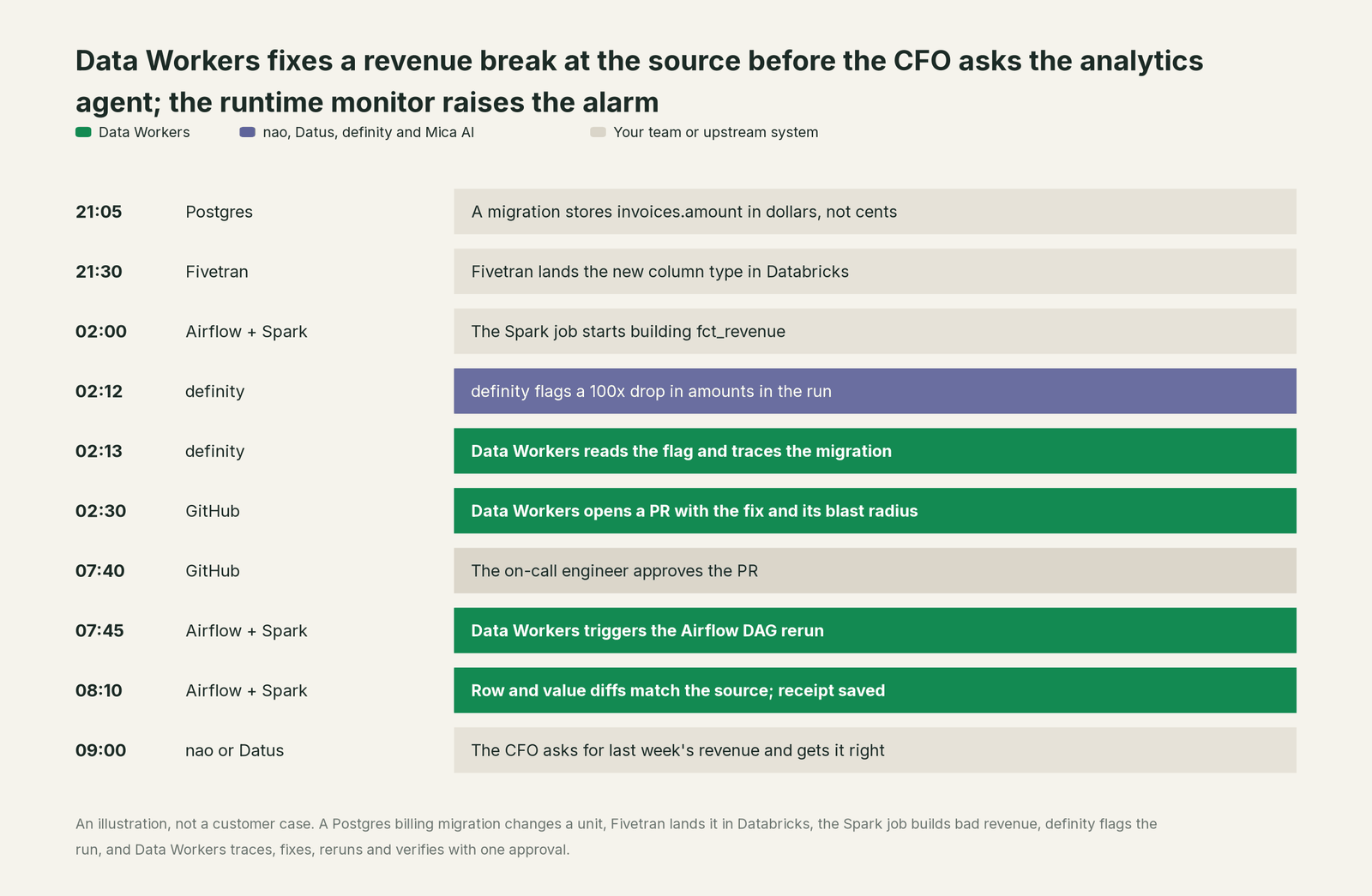
definity's catch at 02:12 is valuable. The gap is between that catch and the 09:00 question. Without Data Workers, an engineer spends the morning across Postgres, Fivetran, Spark and Airflow. With it, that engineer gives one approval, and the analytics agent answers from data checked before anyone asked.
Why doesn't nao, Datus, definity or Mica just do this itself?
Because each built a strong product for one job and made a sensible call about risk. nao and Datus are answering tools whose safety model is read access plus identity: nao runs queries as the asking user, Datus offers a hard read-only switch and statement-level SQL policies. That makes them easy to roll out to hundreds of analysts. definity's writes stay close to the engine on purpose: resizing a cluster or preempting a run is reversible and contained to Spark, which keeps its security review short. Mica's approval loop is for prompts and tools, not tables.
Writing to production data across systems is its own product category. It needs blast-radius scoping across platforms, approvals that vary by domain, rollback, a receipt an auditor can read, context about every other system in the estate, and liability for changes inside tools the vendor doesn't own: your Spark repo, your Airflow deployment, your warehouse grants, your Fivetran connectors. That's the product Data Workers is.
One platform across the data lifecycle
Answering questions is one stage of a data team's work and tuning Spark is another. Each point tool adds another console, another contract and another handoff. Data Workers covers the whole lifecycle with one context, one approval flow and one audit trail. On the ten stages we score on every comparison page, nao and Datus lead on Analytics & Insights, definity on Observability & Incidents and on Cost / FinOps for Spark, and Mica's home sits beside the lifecycle. Data Workers covers all ten.
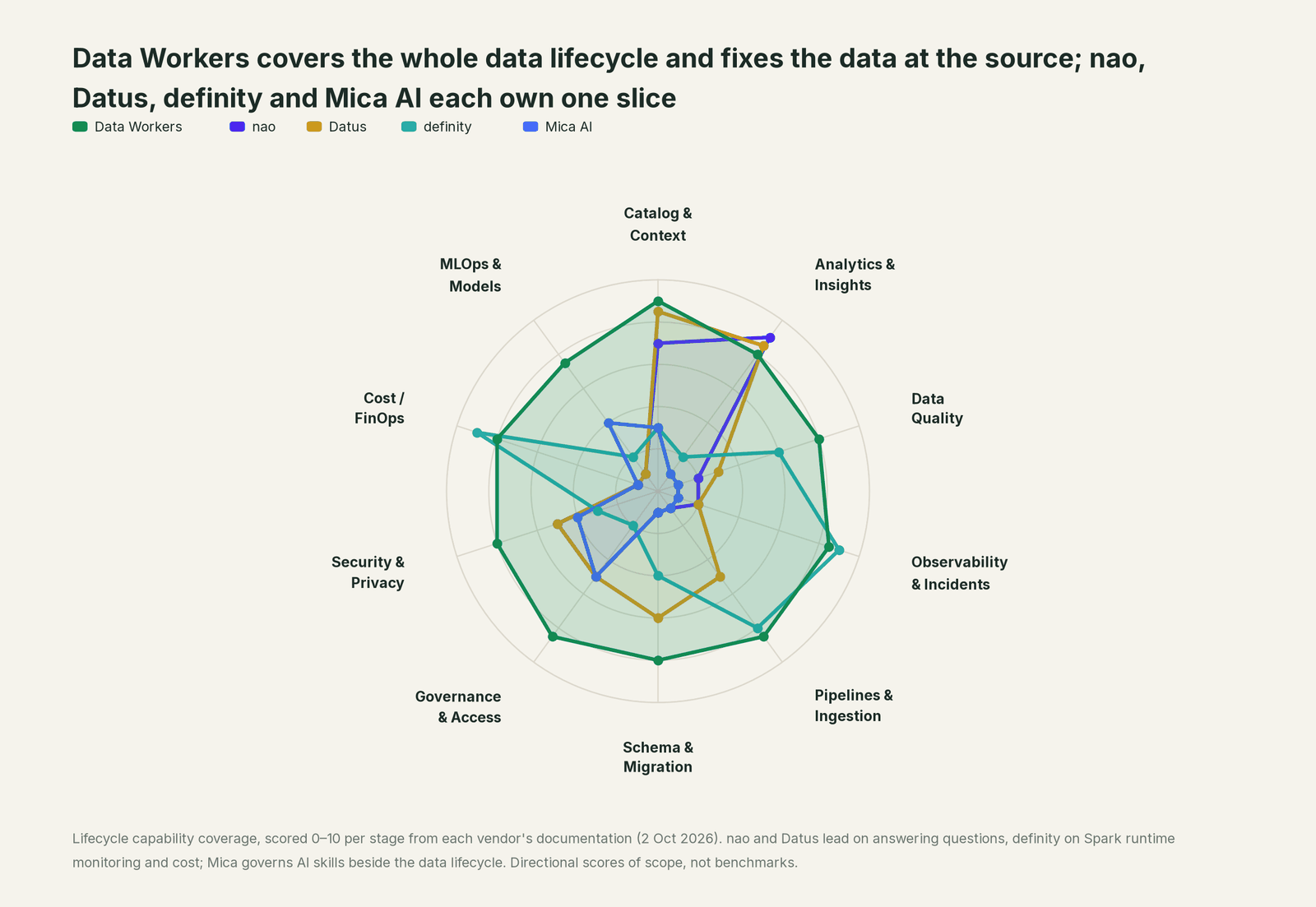
| Stage | Data Workers | nao | Datus | definity | Mica AI | Why we scored it this way |
|---|---|---|---|---|---|---|
| Catalog & Context | 9 | 7 | 8.5 | 3 | 3 | nao builds a context repo with nao sync; Datus generates OSI semantic models and a context engine; definity maps runtime lineage; Mica keeps a registry of AI skills. Data Workers keeps one governed graph across warehouses, dbt, orchestration and BI. |
| Analytics & Insights | 8 | 9 | 8.5 | 2 | 1 | Home stage for nao and Datus: plain-English questions to SQL, charts and reports, with AskMetrics attribution in Datus. Data Workers' Insights agent answers over the same governed graph its agents use. |
| Data Quality | 8 | 2 | 3 | 6 | 1 | definity runs automated data validation tests and contracts in the run. Data Workers writes, runs and repairs checks and dbt tests. |
| Observability & Incidents | 8.5 | 2 | 2 | 9 | 1 | definity's home stage: in-motion detection and automated run preemptions inside Spark. Data Workers owns the loop after the alert: diagnose, fix, verify, record. |
| Pipelines & Ingestion | 8.5 | 1 | 5 | 8 | 1 | definity sits in the Spark driver; Datus' gen_job writes ETL jobs with Airflow orchestration. Data Workers changes the pipeline, triggers the rerun behind approval and checks the result. |
| Schema & Migration | 8 | 1 | 6 | 4 | 1 | Datus' gen_job moves data across databases and definity validates code changes in staging. Data Workers detects schema changes upstream and plans platform moves in approved waves. |
| Governance & Access | 8.5 | 5 | 5 | 2 | 5 | nao Enterprise runs queries as the asking user with warehouse row-level security; Datus has SQL policies and row filters; Mica gates AI skills by owner approval. Data Workers proposes least-privilege grants on your platforms. |
| Security & Privacy | 8 | 5 | 5 | 3 | 4 | nao and Datus self-host with sandboxed code; Mica flags security issues in skill changes. Data Workers flags new sensitive column names in pull request review and leaves a tamper-evident receipt on every change. |
| Cost / FinOps | 8 | 1 | 1 | 9 | 1 | definity's other home stage: auto-tuning that resizes Spark clusters and jobs. Data Workers traces Snowflake credits to the dbt model behind them and drafts the fix for its owner. |
| MLOps & Models | 7.5 | 1 | 1 | 2 | 4 | Mica generates evals for AI skills from real traces. Data Workers keeps the data under models healthy and connects to MLflow and W&B. |
Directional scores of scope, not benchmarks; the reasoning is shown so you can check every line.
Answer, tune or fix: outcome by outcome
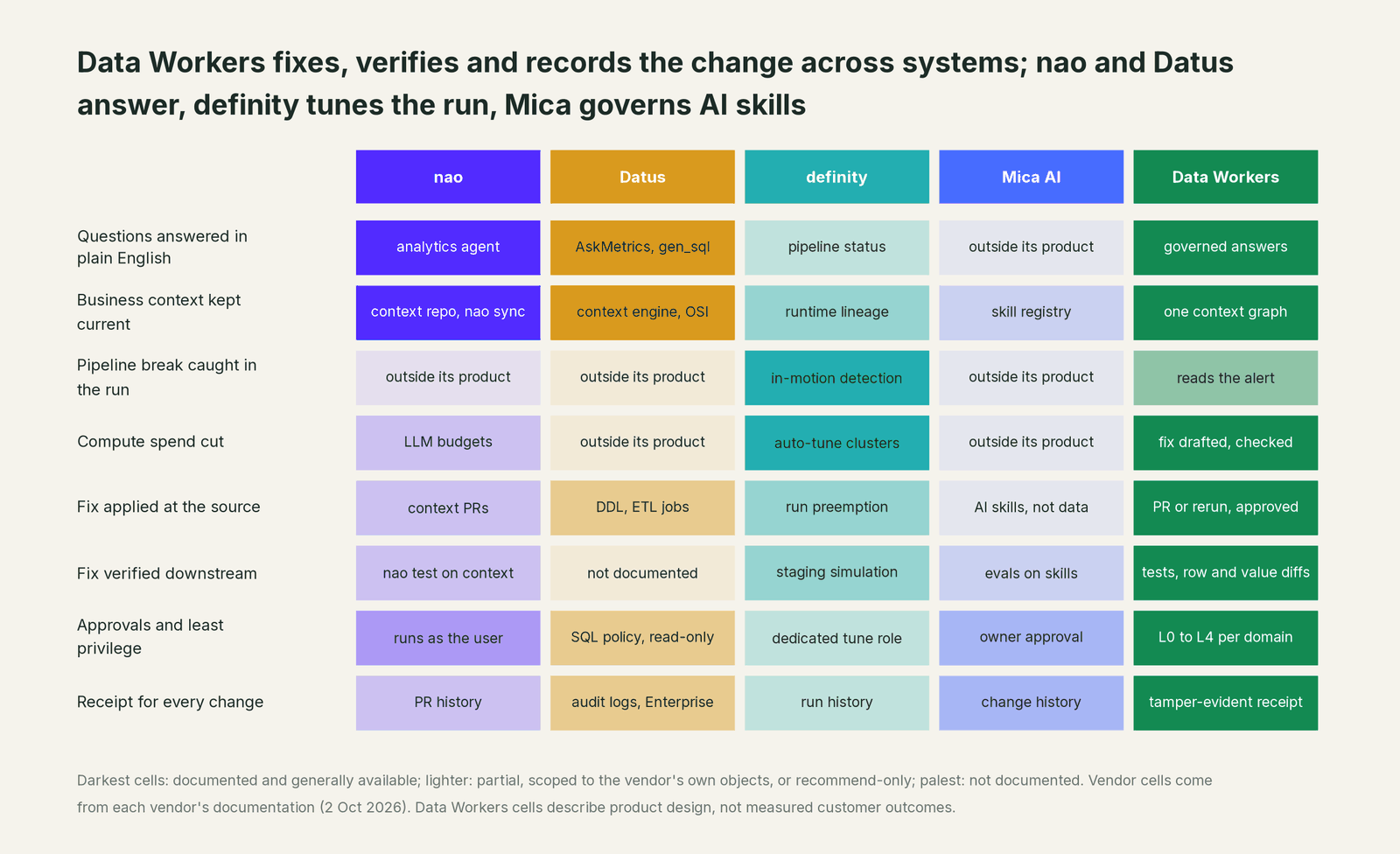
Two rows decide most evaluations. On "Questions answered in plain English," nao and Datus are excellent, and Data Workers is glad to sit under either one. On "Fix applied at the source," Datus writes jobs in a session and definity acts on the run, while Data Workers changes the pipeline across systems behind your approval, then proves it held. That row is the reason to add Data Workers.
Keep your tool, or consolidate
Keep it and add Data Workers. Most teams start here. Data Workers connects to nao, Datus and definity over their MCP servers or APIs today, and its own agents are MCP servers that nao and Datus can add to their agent's tools. definity's flag or a failed DAG run starts the loop. Data Workers traces the cause, fixes it at the source behind your approval, verifies the result downstream and records a receipt.
Reasons to keep each one for the long run:
- •nao if your analysts live in its chat and your context repo is already tuned and tested.
- •Datus if your team wants semantic models generated from SQL history and metric attribution in the CLI.
- •definity if Spark compute is your biggest bill and you want an agent inside the driver.
- •Mica AI if the problem you're solving is governing the AI skills employees build across the company.
Consolidate once Data Workers runs that slice too. Teams that want one approval flow and one audit trail for answers, incidents and cost move those jobs onto Data Workers: its Insights agent answers business questions from the same governed context its other agents use, and its cost agent traces Snowflake credits to the dbt model behind them and drafts each fix after a dependency check.
Either way, nothing moves. Data Workers stores metadata and scrubbed facts about your data, not copies of your tables.
The case for your CFO
The outcome. Your analytics agent is only as good as the tables under it. Data Workers fixes overnight breaks at the source, verifies them against the source system and records them, so the revenue number in Slack, Looker and the board deck is the same number, and it's correct.
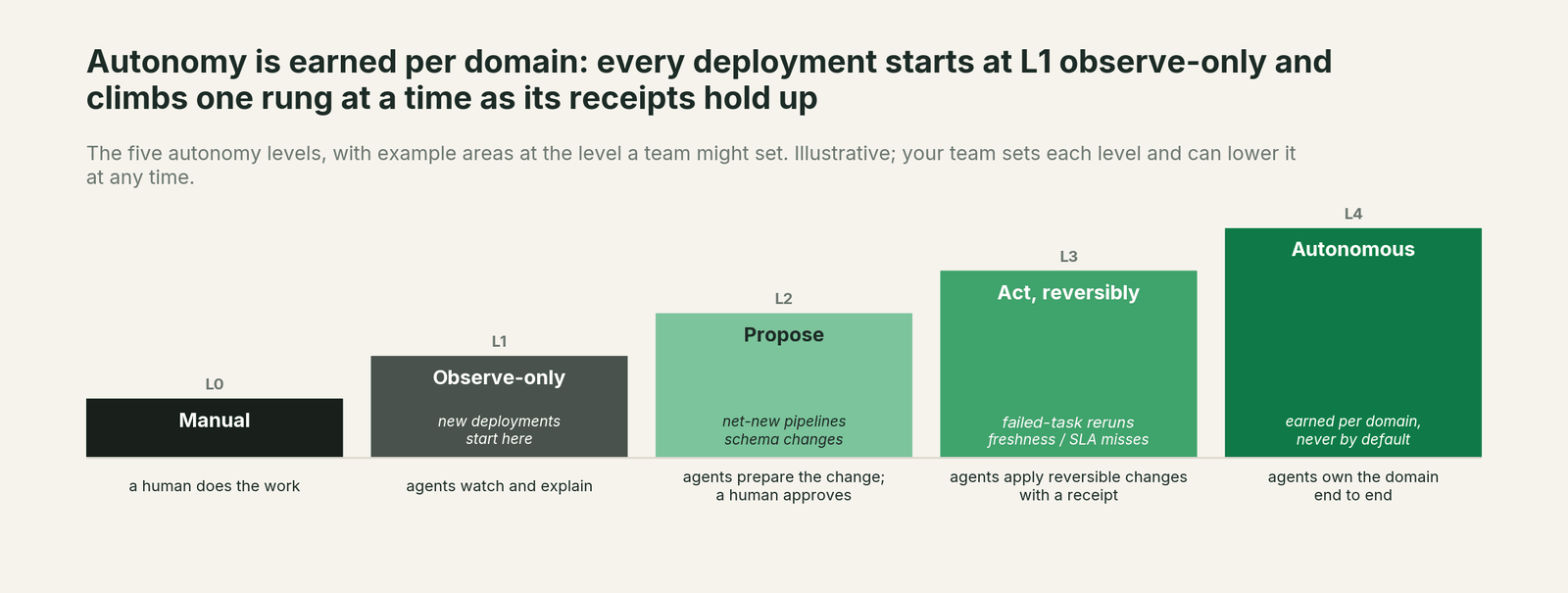
The risk story. New deployments start at L1 (observe): Data Workers reads and reports. At L2 (propose) every fix is a draft a person approves. At L3 (act reversibly) it runs only changes it can undo, and only in the domains you've moved up. L4 (autonomous) is a per-domain choice, never a default. Every write is scoped before it runs, no agent approves its own work, and every receipt records who or what acted, why, what it touched and how to undo it. Zero migration: your data stays where it is.
Why now. Agents are already answering your executives. nao and Datus both put an analytics agent in Slack. When the data under them is wrong, the agent repeats the wrong number with confidence. Governed fixes are what make that rollout safe.
The first win. Overnight pipeline breaks in the revenue domain, handled in propose mode, so the analytics agent's morning answers are checked first.
What stays the same. Your analytics agent, your Spark runtime tooling and your AI skills marketplace; Databricks, Snowflake or BigQuery; dbt, Airflow and Looker.
The path. Start with a pilot. See pricing; the pilot is credited in full against the first year.
The sentence to repeat upstairs: "Our analytics agent answers, our Spark monitor watches the run, and Data Workers makes sure the data under both is right, fixed at the source with a receipt."
The fastest first win: the overnight break behind the morning answer
Pick the metric your executives ask the analytics agent about most, usually revenue. Put that domain in propose mode and point Data Workers at definity's flags, failed Airflow DAG runs and schema changes on the tables behind it. Each break lands in the Spellbook inbox with the root cause, the proposed diff or rerun and its blast radius. Once your team approves those proposals as-is for a few weeks, move the domain up to reversible actions.
What each Data Workers product does here
Autonomous Data-Conductor. The Autonomous Data-Conductor runs detect, diagnose, fix, review, verify and remember across the estate and scopes the blast radius before acting. definity's flags and Airflow failures feed the detect step.
Data-Agents Swarm. The Data-Agents Swarm is 20+ specialist agents for pipeline, schema, quality, cost and access work. Here the Incident Debugging agent, the Schema Evolution agent and the Data Change Review agent matter most.
Data Context Wizard. Data Context Wizard builds one governed graph from your warehouses, dbt manifest, Airflow and BI metadata through 50+ connectors. Every fact carries its source and when it was observed, so the agent fixing a Spark job knows which metrics depend on it.
Spellbook Data Catalog. Spellbook Data Catalog (in preview) is the control plane for agent work. Every proposed change lands in one inbox to approve, steer, send back or roll back, and an authority guard enforced in code stops any agent from approving its own work.
Autonomy guardrails and security
The four tools here manage risk by keeping writes close to home. Data Workers acts across your estate under graded, reversible control, because that's how breaks get fixed. For the full safety model, read is it safe to let AI agents change production data?, and for where your data goes, security, privacy and deployment.
- •Autonomy is set per domain. Freshness reruns can run at L3 (act reversibly) while schema changes stay at L2 (propose).
- •Every write is scoped before it runs, with blast radius computed across platforms. Breaks it hasn't seen before route to a person.
- •Every action is approved or reversible, and leaves a tamper-evident receipt.
- •No agent can approve or promote its own work. This is enforced in code, not left to a prompt.
- •Least privilege. Data Workers acts with the grants you give it, through each platform's own permission system.
"nao and Datus are open source with MCP. Can't we build this ourselves?"
You can get far. Point Claude Code at the nao, Datus and definity MCP servers plus your warehouse and GitHub, and an engineer can investigate a break and draft the fix in one session (trade-offs here). It's still one engineer, one session and one fix at a time, on that engineer's credentials, with nobody gating the change by domain, rolling it back, verifying it downstream or remembering it. MCP gives an agent more tools. Data Workers gives you an operating model across the estate, and every Data Workers agent is itself an MCP server your coding or analytics agent can call. The ROI of agentic data operations page shows how to size that difference for your team.
FAQ
Which is better, nao or Datus? nao has the stronger context-engineering loop (tests, usage-driven recommendations, PRs) and per-user warehouse identity. Datus generates semantic models from SQL history, attributes metric changes and adds table and ETL subagents. Neither fixes the pipeline behind a wrong number; Data Workers sits under either one.
Is definity a data observability tool or a data engineering agent? Both, scoped to the run. It installs in the Spark driver and dbt run, detects problems in motion, preempts runs and auto-tunes clusters. It acts on the engine. Data Workers acts on the code, the DAG, the warehouse and the downstream checks, and can use definity's flags as the start of its loop.
Is Mica AI a data pipeline tool? No. Mica's site and YC listing describe an internal marketplace for employee-built AI capabilities, with owner approval, evals and change history. It doesn't read or change your data. If you need an agent to fix data at the source, that's Data Workers' job, and the two can run side by side.
Can nao or Datus call Data Workers? Yes. Both accept external MCP servers in their agent's context, and every Data Workers agent is an MCP server. An analyst can ask nao or Datus why a number moved and get Data Workers' trace and receipt in the same answer.
What happens if a Data Workers agent gets a fix wrong? Every action is approved or reversible, so you roll it back from the receipt, and no agent can approve its own work.
How is Data Workers priced? The Apache 2.0 core is free. The pilot is $7,500 one-time, credited in full against your first year. Scale starts at $1,000 a month and Enterprise at $3,000 a month, billed annually, with unlimited seats, no usage meter and no markup on model spend. See pricing.
Sources
Vendor capabilities, statuses and prices are current as of October 2, 2026, from each vendor's own pages and documentation.
nao: home page and pricing, blog launch posts (nao MCP May 12, Enterprise May 20, MCP App May 22, context recommendations June 22, 2026), GitHub repository (v0.3.19, Sep 30, 2026), agent tools, MCP endpoint, context recommendations, automations, Enterprise permissions.
Datus: home page and pricing, GitHub repository and README (v0.4.2, Sep 24, 2026; README cites 13+ Dosi dialects, the site 16), built-in subagents, SQL policy, MCP server.
definity: home page, pricing, cost optimization, documentation, MCP server, EMR Auto-Tune role.
Mica AI: home page, Y Combinator company page.
Product names and statuses change quickly. If we've got something wrong, tell us and we'll fix it.